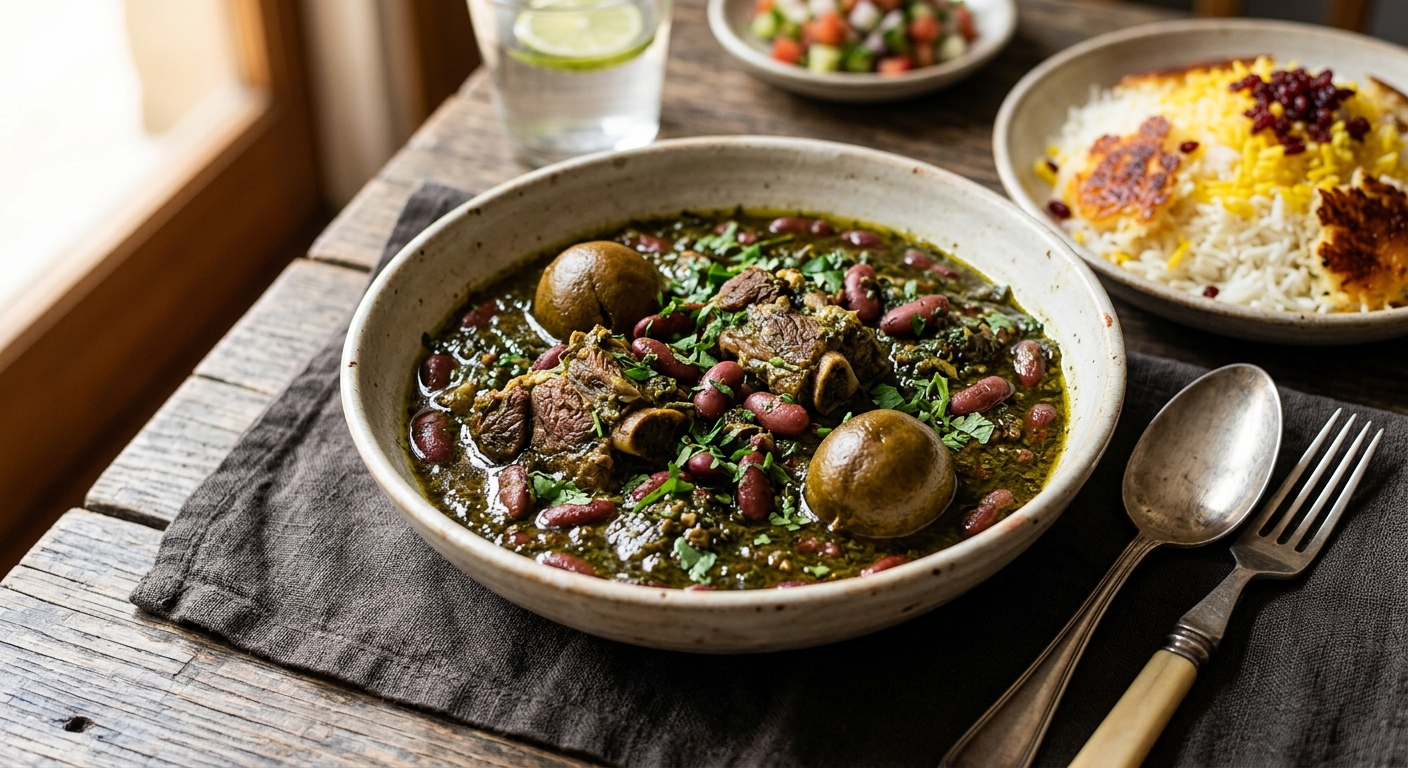
If there is one dish that earns the title of nutritional masterpiece from the world of ancient cuisines, it is Ghormeh Sabzi. Translated literally as ‘cooked greens,’ this Persian stew dates back over two thousand years and remains the most-loved dish in Iranian households today. The genius of the recipe lies in its central technique: a massive quantity of fresh herbs, primarily fenugreek, parsley, coriander, and chives, is dry-fried until deeply concentrated, then slow-cooked with bone-in lamb, dried kidney beans, and the irreplaceable tang of dried Persian limes (limu omani). What emerges from the pot is not a green vegetable side dish but a rich, almost black, intensely savory stew with extraordinary depth of flavor and an equally extraordinary nutritional profile.
From a nutritional standpoint, Ghormeh Sabzi is a near-perfect convergence of iron sources. The lamb shoulder provides abundant heme iron, the most bioavailable form that the body absorbs at rates of 15 to 35 percent, while the kidney beans and the concentrated herbs supply non-heme iron in quantities that dwarf most plant-based meals. Fenugreek leaves alone provide more iron per 100 grams than beef liver, and when you account for the volume of herbs used in this recipe (over 600 grams of fresh herbs reduced to a deeply caramelized paste), the cumulative iron contribution is remarkable. Vitamin K1 from the parsley and coriander and vitamin K2 produced during the long fermentation-adjacent slow-cooking process further distinguish this stew as a bone-health powerhouse.
At Calibrated Cuisine, we have tested this recipe across three cooking methods to honor both the traditional technique and the modern kitchen. The stovetop method, simmered low and slow for three hours, produces the most authentic flavor. The slow cooker delivers a hands-off version with comparably deep results. The pressure cooker brings the entire stew together in under an hour without sacrificing the mineral density. Whichever method you choose, we recommend sourcing dried limu omani from a Middle Eastern grocery, as this ingredient is genuinely irreplaceable and drives the dish’s signature sour-savory complexity.
4
servings
Ingredients
- 600 gbone-in lamb shoulder, cut into 4cm chunks
- 160 gdried kidney beans, soaked overnight and drained
- 250 gflat-leaf parsley, leaves and tender stems
- 180 gfresh fenugreek leaves (or 60g dried fenugreek, kasuri methi)
- 120 gfresh coriander (cilantro), leaves and stems
- 80 gfresh chives or spring onion greens, finely sliced
- 4 wholedried Persian limes (limu omani), pierced twice with a skewer
- 1 largebrown onion, finely diced
- 3 tbspextra-virgin olive oil, divided
- 1 tspground turmeric
- 0.5 tspground black pepper
- 0.5 tspground cinnamon
- 0.25 tspground dried rose petals (optional, adds floral depth)
- 500 mllow-sodium beef or lamb stock
- 250 mlwater
- 1 tbsptomato paste
- —Colima Sea SaltMicroplastic Free Salt and freshly ground black pepper to taste
- —Saffron-infused basmati rice, to serve
Instructions
Click on an item below to shop for the recommended items for this recipe on Amazon.
As an Amazon Associate, we earn from qualifying purchases.
- Finely chop all fresh herbs together (parsley, fenugreek, coriander, and chives) until they resemble a coarse, slightly wet paste. This is best done in two batches in a food processor using the pulse function, avoiding over-processing into a puree. Spread on a clean kitchen towel and pat gently to remove excess moisture.
- Heat 2 tablespoons of olive oil in a large Dutch oven or heavy-based pot over medium heat. Add the chopped herb mixture and spread into an even layer. Cook, stirring every 2 to 3 minutes, for 18 to 22 minutes until the herbs have darkened dramatically to a deep olive-green to near-black color, are completely dry, and smell intensely fragrant and slightly nutty. This critical step concentrates both flavor and nutrients. Transfer to a bowl and set aside.
- In the same pot, heat the remaining 1 tablespoon of oil over medium-high heat. Pat the lamb chunks dry with paper towels and season generously with salt. Sear in a single layer, without crowding, for 3 to 4 minutes per side until deeply browned on all surfaces. Work in batches if needed. Remove the seared lamb and set aside.
- Reduce heat to medium. Add the diced onion to the pot and cook, stirring occasionally, for 8 to 10 minutes until soft and golden. Add the turmeric, black pepper, cinnamon, and rose petals if using. Stir for 60 seconds until fragrant. Add the tomato paste and stir for another 90 seconds until it darkens slightly.
- Return the seared lamb and any accumulated juices to the pot. Add the pre-soaked and drained kidney beans, the fried herb mixture, the pierced dried limes, the stock, and the water. Stir to combine and bring to a vigorous boil over high heat. Skim off any foam that rises to the surface.
- Reduce heat to the lowest possible setting, place the lid on slightly askew to allow some steam to escape, and simmer gently for 2 hours 30 minutes to 2 hours 45 minutes. Stir every 30 minutes, pressing the dried limes gently against the side of the pot to release their sour juice. The stew is ready when the lamb is completely tender and falling from the bone, the beans are soft throughout, and the liquid has reduced to a thick, dark, glossy sauce. Taste and adjust salt. Remove the dried limes before serving. Serve over saffron-infused basmati rice.
- Drain the soaked kidney beans and place them in a small saucepan. Cover with fresh cold water by 5cm and bring to a rolling boil over high heat. Boil hard for 10 minutes, then drain thoroughly and set aside. This step is non-negotiable for safe slow-cooker preparation.
- Finely chop all fresh herbs (parsley, fenugreek, coriander, and chives) using a food processor with the pulse function. Heat 2 tablespoons of olive oil in a large skillet over medium heat and fry the herb mixture, stirring frequently, for 18 to 22 minutes until very dark, dry, and intensely aromatic. Scrape into the slow cooker insert.
- In the same skillet over medium-high heat, add the remaining oil and sear the seasoned lamb chunks in batches for 3 to 4 minutes per side until deeply browned. Add the seared lamb directly to the slow cooker on top of the herbs. Do not discard the skillet.
- Reduce skillet heat to medium. Add the diced onion and cook for 6 to 8 minutes until softened and lightly golden. Add turmeric, black pepper, cinnamon, and rose petals, stirring for 60 seconds. Add the tomato paste and stir for 90 seconds. Pour in the stock and water and bring to a simmer, scraping up all the browned bits from the bottom of the skillet with a wooden spoon. Pour this entire mixture over the lamb in the slow cooker.
- Add the boiled and drained kidney beans and the pierced dried limes to the slow cooker. Stir gently to distribute everything evenly. The liquid should come to just below the level of the solid ingredients since the slow cooker will not reduce the liquid as aggressively as the stovetop.
- Place the lid on and cook on Low for 8 hours or on High for 5 hours. In the final 30 minutes, remove the lid and increase to High if cooking on Low, to allow some excess liquid to evaporate and the sauce to concentrate. Press the dried limes against the side once or twice during cooking to release their sour juice. Remove limes, adjust salt, and serve over saffron rice.
- Finely chop all fresh herbs (parsley, fenugreek, coriander, and chives) using a food processor. Select the Saute function on your Instant Pot (or use a separate skillet for a traditional pressure cooker) and heat 2 tablespoons of olive oil over medium-high heat. Add the herb mixture and fry, stirring frequently, for 15 to 18 minutes until very dark and dry. The Saute function on high heat accelerates this step slightly compared to the stovetop. Remove and set aside.
- With the Saute function still active, add the remaining oil and sear the seasoned lamb chunks in batches for 3 minutes per side until well browned. The Maillard browning here is critical for flavor depth, do not skip it. Remove the lamb and set aside.
- Add the diced onion to the pot and saute for 5 minutes until softened. Add turmeric, black pepper, cinnamon, and rose petals and stir for 45 seconds. Add the tomato paste and stir for 60 seconds. Pour in a small splash of the stock (about 60ml) and scrape up any browned bits from the bottom of the pot, this prevents a burn warning during pressurization.
- Return the lamb to the pot. Add the pre-soaked kidney beans (no need to pre-boil for the pressure cooker since the full pressure temperature of 120 degrees Celsius effectively deactivates lectins), the fried herb mixture, the pierced dried limes, and the remaining stock. Do not add the extra water used in the stovetop version since there is less evaporation under pressure. Stir to combine.
- Secure the lid and set the valve to Sealing. Cook on Manual High Pressure for 35 minutes. Allow a natural pressure release for 15 minutes, then carefully move the valve to Venting to release any remaining steam. Open the lid and check that the lamb is tender and beans are fully cooked.
- Press the dried limes against the side of the pot to extract their juice, then remove and discard them. Select Saute mode and simmer uncovered for 10 to 15 minutes, stirring occasionally, until the sauce reduces to a thick, coating consistency. Taste and adjust salt. Serve immediately over saffron rice.
- Preheat your oven to 160 degrees C (320 degrees F) with a rack positioned in the lower third. Finely chop all fresh herbs together using a food processor. Heat 2 tablespoons of olive oil in a large oven-safe Dutch oven over medium heat on the stovetop. Fry the chopped herb mixture for 18 to 22 minutes, stirring frequently, until very dark, dry, and deeply fragrant. Remove and set aside.
- Increase stovetop heat to medium-high. Add the remaining oil and sear the seasoned lamb chunks in batches, turning to brown all sides deeply, about 3 to 4 minutes per side. Remove and set aside. Add the diced onion and cook over medium heat for 8 minutes until golden. Add turmeric, black pepper, cinnamon, and rose petals and stir for 60 seconds. Add the tomato paste and cook for 90 seconds.
- Return the lamb to the Dutch oven. Add the soaked kidney beans, fried herbs, pierced dried limes, stock, and water. Stir to combine. Bring the mixture to a boil over high heat on the stovetop, skim any foam, then remove from the heat.
- Place the lid tightly on the Dutch oven and transfer to the preheated oven. Braise at 160 degrees C for 2 hours. The oven’s consistent ambient heat cooks the stew from all sides simultaneously, developing a subtly different caramelized note on the surface of the beans and herbs that direct-heat methods cannot replicate.
- After 2 hours, remove the lid and increase oven temperature to 190 degrees C (375 degrees F). Return the uncovered Dutch oven to the oven for a further 25 to 30 minutes. During this time the surface of the stew will caramelize slightly and the sauce will reduce to a thick, glossy consistency. Gently press the dried limes against the side of the pot using tongs to release their juice partway through this stage.
- Remove from the oven, discard the dried limes, and let the stew rest uncovered for 10 minutes before serving. This resting period allows the proteins to relax and the sauce to tighten further as it cools slightly. Adjust seasoning and serve over saffron rice.
Nutrition Breakdown
Per 1 serving (makes 4)
Vitamins & Minerals
% Daily Value based on a 2,000 calorie diet (FDA reference)
🧬 Essential Amino Acids
% of recommended daily intake (RDA) per serving
🛡 Antioxidant Profile
The Nutrition Science
The iron story in Ghormeh Sabzi is a study in dietary synergy. Each serving provides approximately 9.4mg of iron from three distinct sources: heme iron from the lamb shoulder (absorbed at 15 to 35 percent efficiency regardless of dietary context), non-heme iron from the kidney beans (absorbed at 2 to 20 percent depending on meal composition), and non-heme iron from the concentrated herbs, particularly fenugreek, which contains 33mg of iron per 100g dry weight. The vitamin C present in the parsley and coriander (approximately 62mg per serving even after cooking-related losses) actively converts ferric iron (Fe3+) to the more soluble ferrous form (Fe2+) in the acidic environment of the stomach, dramatically improving non-heme absorption. Equally important, the dried limes provide citric acid, which forms soluble iron-citrate complexes that remain absorbable even at the higher pH of the small intestine.
Vitamin K1 content in this dish is exceptional and clinically meaningful. A single serving provides 310mcg, more than twice the adequate intake of 120mcg for adult males and 90mcg for adult females. Vitamin K1, or phylloquinone, is the essential cofactor for the gamma-carboxylation of osteocalcin, the protein that anchors calcium into the bone matrix. Without adequate K1, osteocalcin remains undercarboxylated and unable to bind hydroxyapatite, regardless of calcium intake. Population studies consistently associate higher dietary K1 intake with reduced hip fracture risk, improved bone mineral density, and, emerging evidence suggests, reduced arterial calcification. The concentration of K1 in this dish is largely attributable to the sheer volume of dark leafy herbs used, a single serving of Ghormeh Sabzi contains the K1 equivalent of roughly three large servings of raw spinach.
Fenugreek leaves (methi) deserve special recognition as a functional food ingredient in this context. Beyond their iron content, fenugreek leaves are rich in 4-hydroxyisoleucine, an unusual branched-chain amino acid derivative that has demonstrated insulin-sensitizing effects in clinical studies by directly stimulating glucose-dependent insulin secretion. The soluble fiber content of fenugreek, principally galactomannan, forms a viscous gel in the gut that slows glucose absorption and contributes to the dish’s relatively moderate glycemic load. Combined with the resistant starch in kidney beans (which feeds butyrate-producing bacteria in the colon), Ghormeh Sabzi functions as a genuinely prebiotic meal that supports both iron status and gut microbiome health simultaneously.
Pro Tips
- Do not substitute fresh herbs with fresh spinach or kale. The specific combination of parsley, fenugreek, coriander, and chives is what produces Ghormeh Sabzi’s irreplaceable flavor profile. Dried fenugreek (kasuri methi) is a reasonable substitute for fresh fenugreek only, use one-third the weight.
- Pierce the dried limes deeply all the way through with a skewer before adding them. This allows the sour, intensely citric juice inside to seep into the stew gradually during cooking. If you squeeze them too aggressively early on they release a bitter pith note, so press them gently and only in the final hour.
- For maximum iron absorption, pair each serving with a source of vitamin C (lemon juice, fresh tomato salad, or fresh herbs) and avoid drinking black tea or coffee within 60 minutes of the meal, as the tannins in tea are among the most potent inhibitors of non-heme iron absorption known.
Sandra, thank you for that important note about sulfur sensitivities – that’s exactly the kind of personalized nutrition thinking I’m encouraging my class to develop! I’m actually planning to make ghormeh sabzi next month and will definitely be exploring herb substitutions for students with CBS considerations, maybe swapping some of the traditional parsley or chives for milder options like dill or cilantro while keeping that gorgeous iron and mineral profile intact. Have you found specific herb swaps that work well for you in other stews, or do you tend to lean toward different iron sources altogether?
This is exactly the kind of iron bioavailability analysis I geek out over – the vitamin C from the sun-dried limes should significantly enhance non-heme iron absorption from both the beans and herbs, which a 2015 study in the American Journal of Clinical Nutrition showed can increase uptake by up to 3-4x. Sandra’s point about sulfur sensitivity is super valid though, and I’m curious if anyone’s tracked their CGM response to the traditional herb blend versus a modified version, since sulfur compounds can affect glucose stability in some individuals. Do you happen to have micronutrient data on whether the kidney beans are cooked long enough to reduce phytic acid, or is that accounted
This sounds absolutely delicious and the iron content is impressive! I do want to mention that for anyone with sulfur sensitivities like me (due to a CBS gene variation), the traditional herb blend might be something to approach carefully, since parsley and cilantro can be higher in sulfur compounds. I’ve had good success making a modified version using just one herb like dill instead, which gives me the flavor without the digestive fallout. Of course this is pretty rare, but curious if you’ve come across readers experimenting with single-herb versions or other adaptations?