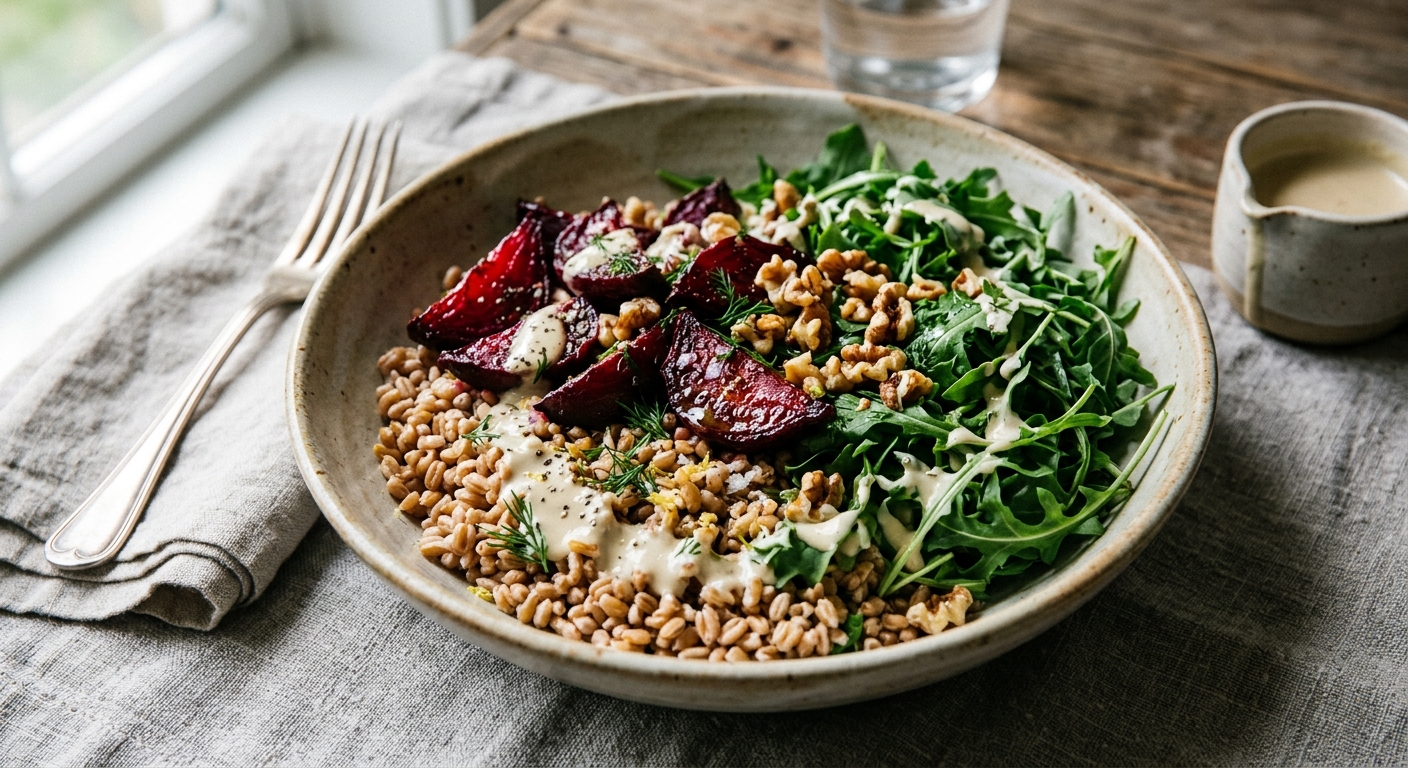
Some meals earn the label ‘healthy’ through sheer restraint. This one earns it through abundance. The Tahini-Dressed Farro Bowl with Roasted Beets and Arugula is built on three ingredients that nutritional scientists genuinely get excited about: farro, an ancient whole grain with an impressive mineral profile that modern wheat varieties have largely lost; beets, whose deep crimson pigments signal a density of betalain antioxidants and folate that few vegetables can match; and tahini, a paste of ground sesame seeds that quietly contributes calcium, copper, and manganese in quantities that would surprise most home cooks. Together, they construct a bowl that covers more nutritional ground than most multi-day meal plans.
Beyond the numbers, this is a bowl designed for real pleasure. Farro has a nutty, almost barley-like chew that holds its texture beautifully under a dressing, making it ideal for meal prep or a composed dinner. The beets are cooked until their natural sugars concentrate into a sweet, almost jammy interior with lightly crisped edges, providing a counterpoint to the bright, peppery bite of fresh arugula. The lemon-tahini dressing, built with raw garlic, lemon zest, and a touch of maple syrup, emulsifies into something that tastes far richer and more complex than its four ingredients suggest. A handful of toasted pumpkin seeds adds crunch and a final push of magnesium and zinc.
We have calibrated this recipe across four cooking methods, because the way you cook farro and beets genuinely changes their texture and flavor. The stovetop version gives you the most control. The oven method is a hands-off approach that produces the most deeply caramelized beets. The slow cooker develops an almost creamy, risotto-adjacent farro texture. And the pressure cooker delivers the full bowl in under 40 minutes from cold start. Choose the method that fits your schedule and equipment, knowing the nutritional outcome is consistent across all four.
4
servings
Ingredients
- 300 gpearled farro, rinsed under cold water
- 600 graw beets (about 4 medium), scrubbed and trimmed
- 120 gtahini (well-stirred, from a fresh jar)
- 80 mlfresh lemon juice (about 2 large lemons)
- 1 tsplemon zest
- 2 clovesgarlic, finely minced or grated
- 1 tbsppure maple syrup
- 60 mlwarm water (to thin dressing)
- 3 tbspextra-virgin olive oil, divided
- 100 gbaby arugula, washed and dried
- 60 gpumpkin seeds (pepitas), raw
- 40 gcrumbled feta cheese (optional, omit for dairy-free)
- 900 mlvegetable stock or water (for cooking farro)
- —Colima Sea SaltMicroplastic Free Salt and freshly cracked black pepper to taste
- —Colima Sea SaltMicroplastic Free Salt for finishing
Instructions
Click on an item below to shop for the recommended items for this recipe on Amazon.
As an Amazon Associate, we earn from qualifying purchases.
- Peel the beets and cut them into 2 cm wedges. Bring a medium saucepan of salted water to a boil over high heat. Add the beet wedges, reduce heat to medium, and simmer uncovered for 20 to 25 minutes until a paring knife slides through with only slight resistance. Drain and set aside. The beets will finish in the pan with olive oil later.
- While the beets simmer, heat 1 tablespoon of olive oil in a large heavy-bottomed saucepan or Dutch oven over medium heat. Add the rinsed farro and toast, stirring frequently, for 3 to 4 minutes until the grains smell nutty and look faintly golden. You will hear a faint popping sound as the outer bran dries against the hot pan.
- Pour in the 900 ml of vegetable stock (it will bubble vigorously), add 1/2 teaspoon of fine sea salt, and bring to a boil. Reduce heat to low, cover with a tight-fitting lid, and cook for 25 to 30 minutes, checking at 25 minutes. Farro is done when it is tender and chewy but not mushy, and most liquid has been absorbed. Drain any excess stock through a sieve.
- While the farro cooks, make the tahini dressing. Combine the tahini, lemon juice, lemon zest, minced garlic, maple syrup, and a pinch of salt in a medium bowl. Whisk vigorously. The mixture will initially seize and thicken dramatically. Continue whisking while adding warm water one tablespoon at a time until it reaches a pourable, creamy consistency. Taste and adjust salt, lemon, and maple syrup as needed.
- Heat the remaining 2 tablespoons of olive oil in a wide skillet over medium-high heat. Add the drained beet wedges in a single layer, season with salt and pepper, and cook undisturbed for 3 to 4 minutes per side until lightly caramelized and sizzling at the edges. Meanwhile, toast the pumpkin seeds in a dry skillet over medium heat for 3 to 4 minutes, stirring often, until they puff slightly and smell toasted.
- To assemble, spread the warm farro across four bowls. Top with arugula, then arrange the caramelized beet wedges over and around the greens. Drizzle generously with tahini dressing, scatter the toasted pumpkin seeds, add crumbled feta if using, and finish with flaky sea salt and cracked black pepper. Serve the remaining dressing on the side.
- Peel the beets and cut them into 2.5 cm chunks (slightly larger than for other methods, as they will cook longer and shrink). Place the beet chunks directly into the slow cooker insert.
- Add the rinsed farro on top of the beets. Pour in 950 ml of vegetable stock, 1 tablespoon of olive oil, and 1/2 teaspoon of fine sea salt. Stir once to distribute. Do not add more liquid than specified; pearled farro absorbs stock slowly and the enclosed environment retains all moisture.
- Place the lid on the slow cooker and cook on Low for 6 to 7 hours. Resist lifting the lid before the 5.5-hour mark, as each lid-lift adds approximately 20 minutes of cook time. At 6 hours, check farro for tenderness. It should be swollen, creamy, and fully cooked through. The beets will be very soft and will have stained the farro a gorgeous rose-purple hue.
- While the slow cooker finishes, prepare the tahini dressing and toast the pumpkin seeds. For the dressing, whisk together tahini, lemon juice, lemon zest, garlic, maple syrup, and warm water as described. For the seeds, place raw pumpkin seeds in a dry skillet over medium heat and stir for 3 to 4 minutes until puffed and golden. Set aside.
- When the farro-beet mixture is done, taste and adjust seasoning generously, as slow-cooked dishes often need more salt than stovetop versions. Drizzle the remaining 2 tablespoons of olive oil over the top and stir once to incorporate. Spoon into bowls, pile arugula on top (the residual heat will gently wilt it slightly, which works beautifully here), drizzle with tahini dressing, scatter pumpkin seeds and feta if using, and finish with flaky salt.
- Peel the beets and cut into 2 cm cubes. Select the Saute function on your Instant Pot (or heat the stovetop pressure cooker over medium heat). Add 1 tablespoon of olive oil and when shimmering, add the farro. Toast, stirring, for 2 to 3 minutes until the grains smell nutty. This step is quick but important for flavor development, even under pressure.
- Add the beet cubes to the pot and stir to combine with the farro. Pour in 750 ml of vegetable stock (less than other methods because the sealed environment loses no steam). Add 1/2 teaspoon of fine sea salt. Stir once, then cancel the Saute function.
- Secure the lid, ensuring the valve is set to Sealing (Instant Pot) or locked (stovetop cooker). Cook on Manual High Pressure for 20 minutes. The pot will take approximately 8 to 10 minutes to come to full pressure before the timer begins.
- When the cycle completes, allow the pressure to release naturally for a minimum of 10 minutes before moving the valve to Venting to release any remaining pressure. Open the lid carefully, tilting it away from you. The farro should be tender and the beets deeply cooked and vibrantly colored.
- While the pressure releases, prepare the tahini dressing and toast pumpkin seeds using the dry skillet method. Taste the farro-beet mixture, adjust salt and pepper, and stir in the remaining 2 tablespoons of olive oil. Assemble bowls immediately: farro base, fresh arugula, beet-farro mixture over the top, tahini dressing drizzled generously, toasted pumpkin seeds, optional feta, and flaky salt to finish.
- Preheat your oven to 200°C (400°F) with a rack in the center. Line a large rimmed baking sheet with parchment paper. Peel the beets and cut them into 2 cm wedges. Arrange in a single layer on the prepared baking sheet, drizzle with 1.5 tablespoons of olive oil, season generously with salt and pepper, and toss to coat evenly. Spread into a single layer with no pieces overlapping.
- Roast the beets for 40 to 50 minutes, flipping once at the 25-minute mark with a thin spatula. The beets are done when the cut surfaces are deeply caramelized and slightly crisped at the edges, and a fork meets no resistance in the centers. In the last 8 minutes of roasting, scatter the pumpkin seeds directly onto a small section of the baking sheet (or a separate small pan) and return to the oven to toast alongside the beets.
- While the beets roast, cook the farro on the stovetop. Bring 900 ml of vegetable stock to a boil in a medium saucepan. Add the rinsed farro and 1/2 teaspoon salt. Reduce heat to medium-low, cover, and simmer for 25 to 30 minutes until tender and chewy. Drain any excess liquid and stir in the remaining 1.5 tablespoons of olive oil while the farro is still hot.
- Prepare the tahini dressing while the farro cooks: whisk together tahini, lemon juice, lemon zest, garlic, maple syrup, and warm water until smooth and pourable. Taste and balance the salt and acidity to your preference. The dressing can be made up to 4 days ahead and stored in a jar in the refrigerator.
- To assemble, divide the warm farro among four wide bowls. Lay a generous handful of arugula over each portion. Arrange the caramelized oven-roasted beet wedges on top, leaning them against each other for height. Drizzle the tahini dressing in a wide arc across each bowl. Scatter the oven-toasted pumpkin seeds, crumble over feta if using, and finish with flaky salt and several grinds of black pepper. Serve immediately while the beets are still warm.
Nutrition Breakdown
Per 1 serving (makes 4)
Vitamins & Minerals
% Daily Value based on a 2,000 calorie diet (FDA reference)
🧬 Essential Amino Acids
% of recommended daily intake (RDA) per serving
🛡 Antioxidant Profile
The Nutrition Science
Farro’s mineral density comes from its intact bran and germ layers, which are retained even in pearled farro (the most common supermarket variety). These layers are where the grain stores phosphorus, magnesium, and manganese for germination energy. Manganese is particularly notable here: a single serving provides 165% of the daily value, almost entirely from farro and tahini combined. Manganese is a cofactor for superoxide dismutase, the body’s primary antioxidant enzyme inside mitochondria, meaning it plays a direct structural role in cellular defense, not merely a supportive one. The zinc from both farro and pumpkin seeds is similarly functional rather than incidental, underpinning over 300 enzymatic reactions including DNA repair and immune signaling.
Beets derive their color from betalains, a class of nitrogen-containing pigments that are structurally distinct from anthocyanins found in berries or purple cabbage. Betanin, the dominant betalain in red beets, has been shown in cell and animal studies to inhibit pro-inflammatory pathways including NF-kB signaling. Dietary nitrates in beets are converted in saliva and the gut to nitric oxide, a vasodilatory molecule that improves blood flow and has been studied for its effects on exercise performance and blood pressure. Cooking reduces nitrate content somewhat, which is why we include the arugula raw: arugula is one of the highest dietary nitrate vegetables by weight, complementing the beets’ contribution meaningfully.
Tahini is arguably the most underestimated ingredient in this bowl from a mineral standpoint. A 30g serving of tahini contributes meaningful copper (a cofactor for iron metabolism, collagen synthesis, and neurotransmitter production), calcium, and the sesame lignans sesamin and sesamolin. These lignans are not simple antioxidants but enzyme modulators: they upregulate certain liver detoxification enzymes and have been shown to influence lipid metabolism in human trials. The fat in tahini and olive oil is also nutritionally strategic here, since beta-carotene, lutein, and vitamin K are all fat-soluble, meaning they require dietary fat present in the same meal for meaningful absorption. This bowl is designed so that every fat-soluble nutrient has its delivery vehicle already built in.
Pro Tips
- Wear gloves when peeling raw beets. The betalain pigments that make them so nutritious also stain hands, cutting boards, and light-colored clothing with impressive tenacity. A squeeze of lemon on your hands immediately after contact will neutralize most staining.
- The tahini dressing will thicken considerably as it sits or when refrigerated. This is normal emulsion behavior. Whisk in warm water, one teaspoon at a time, to restore it to a pourable consistency. Stored in a sealed jar in the fridge it keeps well for up to 5 days and works as a dip or sandwich spread.
- For maximum mineral absorption from the iron in this dish, avoid brewing tea or coffee within 45 minutes before or after eating. Tannins in both beverages form insoluble complexes with non-heme iron in the gut, significantly reducing absorption. A glass of water with lemon is a better companion to this meal.


This looks absolutely delicious and I love the mineral focus! I’d just mention that for anyone with sulfur sensitivities (like me with my CBS issue), arugula can be pretty high in sulfur compounds, so I’ve had better luck swapping it for something like spinach or lettuce in similar bowls. The beets and tahini are mineral superstars though, so keeping those is key. Just wanted to flag that as a small tweak for folks who might need it, since most people do great with arugula.
What a wonderful mineral-focused bowl, and Sandra, I’m glad you brought up that sulfur consideration because it’s exactly the kind of personalized nutrition detail my class participants ask about! I’ve been making similar grain bowls for years, but I have to say, the scientific approach to pairing these specific ingredients for bioavailable minerals is something I wish I’d understood back in my teaching days. I’m definitely making this for next week’s class on functional whole grains, though I’ll have some substitution options on hand like you mentioned so everyone can adapt it to their own needs. The tahini dressing is such a smart move for that mineral bioavailability too.
What a beautiful thread here, and Sue, I love that you’re already thinking about adaptations for your class. I’m curious if anyone’s experimented with adding a pinch of black pepper to this tahini dressing, since it can really enhance mineral absorption alongside the sesame’s copper and magnesium. In Ayurveda, we’d view this bowl through the lens of building ojas, that nourishing essence, and the earthiness of beets with tahini’s grounding quality makes so much sense for that. For sulfur sensitivities, swapping arugula for something like gentle spinach or even microgreens could maintain that mineral density Sandra mentioned while being gentler on the system.