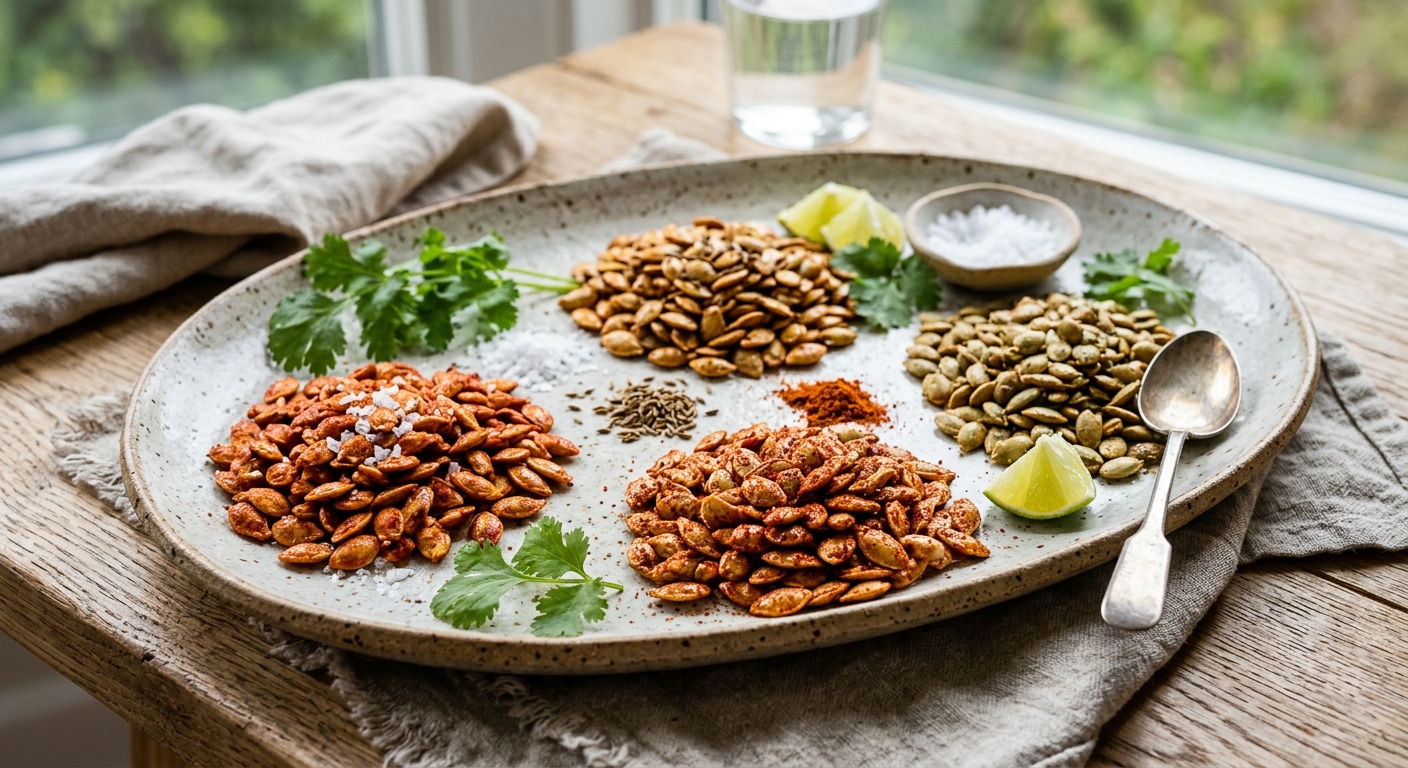
If you had to design a snack from scratch that targeted two of the most commonly deficient minerals in the modern diet, you would land on exactly this: a small bowl of golden, spiced pumpkin seeds. Zinc and magnesium are foundational minerals involved in over 600 enzymatic reactions between them, yet surveys consistently show that a large portion of adults fall short of recommended intakes. Pumpkin seeds, also known as pepitas, are one of the rare whole foods that deliver a meaningful dose of both in a single serving, without any supplementation required.
This recipe keeps the ingredient list deliberately minimal so nothing dilutes the nutritional punch of the seeds themselves. A base of smoked paprika, cumin, and cayenne builds complexity while a touch of olive oil helps fat-soluble compounds absorb efficiently. The result is a snack that works equally well tossed over a salad, stirred into yogurt, or eaten straight from the bowl. We have developed four genuine cooking methods so that whether you have a sheet pan, a skillet, a slow cooker, or a pressure cooker on hand, you can achieve perfectly toasted seeds with the right technique for each piece of equipment.
The four methods are not interchangeable shortcuts. Each one uses a different heat mechanism, produces a slightly different texture profile, and demands its own timing. The stovetop version gives you the fastest, most controllable result with direct contact heat. The oven method delivers the most even, hands-off roast. The slow cooker produces a uniquely dry-roasted, almost dehydrated crunch that develops over hours of gentle heat. The pressure cooker uses a dry-saute function to toast quickly under pressure, creating a distinctive toasted interior. Choose the method that fits your kitchen and your schedule.
4
servings
Ingredients
- 240 graw hulled pumpkin seeds (pepitas), rinsed and thoroughly dried
- 1.5 tbspextra-virgin olive oil
- 1 tspsmoked paprika
- 0.75 tspground cumin
- 0.5 tspgarlic powder
- 0.25 tspcayenne pepper
- 0.5 tspground coriander
- 1 tspColima Sea SaltMicroplastic Free Salt
- 1 tsplight brown sugar or coconut sugar
- —Colima Sea SaltMicroplastic Free Salt and black pepper to taste
Instructions
Click on an item below to shop for the recommended items for this recipe on Amazon.
As an Amazon Associate, we earn from qualifying purchases.
- Ensure your pumpkin seeds are thoroughly dry by spreading them on a clean kitchen towel and pressing gently. Any surface moisture will cause steaming instead of toasting and lead to a chewy rather than crunchy result.
- In a medium bowl, combine the olive oil, smoked paprika, cumin, garlic powder, cayenne, ground coriander, brown sugar, and flaky sea salt. Whisk together until a uniform spice paste forms. Add the dried pumpkin seeds and toss thoroughly so every seed is coated.
- Place a large heavy-bottomed skillet, preferably cast iron or stainless steel, over medium heat. Allow the pan to preheat for 90 seconds until it is genuinely hot before adding anything.
- Add the coated pumpkin seeds in a single layer to the dry preheated skillet. Do not add extra oil. Spread them as evenly as possible and let them sit undisturbed for 60 to 90 seconds so the spice coating can set and begin to caramelize against the hot surface.
- Begin stirring and tossing the seeds continuously with a wooden spoon or heatproof spatula. You will hear a series of light popping sounds as internal moisture escapes, which is a good sign. Continue tossing over medium heat for a total of 8 to 10 minutes until the seeds are uniformly golden-green, fragrant, and showing light browning on the spice coating.
- Immediately transfer to a parchment-lined baking sheet or large plate in a single layer. Do not leave them in the hot pan as residual heat will continue cooking them and can lead to burning. Season with an extra pinch of fine sea salt if desired. Allow to cool completely for at least 10 minutes before eating, as they crisp up significantly as they cool.
- Position a rack in the center of your oven and preheat to 175 degrees Celsius (350 degrees Fahrenheit). Line a large rimmed baking sheet with parchment paper.
- Pat the pumpkin seeds dry with a clean kitchen towel or paper towels, pressing firmly to remove all surface moisture. Spread them on the parchment-lined sheet in a single layer and place in the preheating oven for 5 minutes to warm and dry further while the oven comes to temperature.
- While the seeds warm, whisk together the olive oil, smoked paprika, cumin, garlic powder, cayenne, ground coriander, and brown sugar in a large bowl to create a smooth spice slurry.
- Remove the pre-warmed seeds from the oven and tip them into the spice bowl. Toss vigorously until every seed is evenly coated. Return them to the parchment-lined baking sheet and spread back into a single, even layer with as little overlap as possible.
- Roast in the center of the oven for 10 minutes, then remove and use a flat spatula to stir and redistribute the seeds, flipping any clumps. Return to the oven for a further 8 to 12 minutes, watching closely in the final few minutes. The seeds are done when they are golden-green, the spice coating appears dry and slightly darkened at the edges, and the kitchen smells deeply toasted and nutty.
- Remove from the oven and immediately sprinkle with flaky sea salt. Allow to cool completely on the baking sheet for at least 15 minutes before eating or storing. The seeds will harden noticeably as they cool. Store in an airtight container at room temperature for up to two weeks.
- Do not grease the slow cooker insert. Combine the olive oil, smoked paprika, cumin, garlic powder, cayenne, ground coriander, and brown sugar directly in the slow cooker insert. Stir with a spatula to form an even spice paste across the bottom of the insert.
- Add the thoroughly dried pumpkin seeds and toss directly in the insert until all seeds are well coated with the spice mixture. Spread into a reasonably even layer.
- Set the slow cooker to High. Cook with the lid fully on for the first 90 minutes, stirring every 30 minutes to prevent the seeds on the bottom from over-toasting and to redistribute the spice coating evenly.
- After 90 minutes, prop the slow cooker lid open by about 2 to 3 centimeters using a wooden spoon or a chopstick laid across the rim. This allows moisture to escape. Continue cooking on High for another 60 to 90 minutes, stirring every 20 to 30 minutes, until the seeds are noticeably drier, the spice coating has set firmly to the surface, and the seeds have turned a deeper golden-green color.
- Carefully transfer the finished seeds onto a parchment-lined tray or large plate in a single layer. Sprinkle with flaky sea salt immediately. Allow to cool uncovered for at least 20 minutes. The slow cooker method produces a slightly denser, chewier crunch that firms up fully as the seeds reach room temperature.
- Select the Saute function on your Instant Pot or electric pressure cooker and set it to the Medium or Normal heat level. Allow the insert to preheat for 2 minutes with nothing in it. Do not add oil to the insert at this stage.
- While the insert preheats, combine the olive oil, smoked paprika, cumin, garlic powder, cayenne, ground coriander, and brown sugar in a medium bowl and whisk into a smooth paste. Add the thoroughly dried pumpkin seeds and toss until every seed is fully coated.
- Add the coated seeds to the preheated insert in an even layer. They will sizzle immediately on contact. Using a wooden spoon or high-heat silicone spatula, begin stirring the seeds continuously. Unlike a stovetop skillet, the curved walls of the insert mean seeds can escape if tossed, so use a folding and stirring motion rather than a toss.
- Continue stirring on Medium Saute for 10 to 12 minutes. The insert retains heat well, so if the seeds begin to darken too quickly or the spice coating starts to scorch, press Cancel briefly to drop the temperature, then resume on the Low Saute setting. You are looking for a consistent golden-green color with a dry, fragrant spice crust.
- Once done, press Cancel to stop all cooking immediately. Lift the entire insert out of the base using oven mitts if your model allows, or quickly transfer the seeds to a parchment-lined plate. Spread into a single layer, sprinkle with flaky sea salt, and allow to cool for 10 to 15 minutes before serving. The insert retains heat aggressively, so do not leave the seeds sitting in it after cooking is complete.
Nutrition Breakdown
Per 1 serving (makes 4)
Vitamins & Minerals
% Daily Value based on a 2,000 calorie diet (FDA reference)
🧬 Essential Amino Acids
% of recommended daily intake (RDA) per serving
🛡 Antioxidant Profile
The Nutrition Science
Pumpkin seeds earn their reputation as a mineral-dense food primarily through their extraordinary zinc and magnesium concentrations. A 60g serving of hulled pepitas delivers approximately 4mg of zinc, representing around 38% of the daily value, and 168mg of magnesium, around 40% of the daily value. Zinc is required for the activity of more than 300 enzymes and plays a critical structural role in immune cell signaling, wound healing, and DNA synthesis. Magnesium participates in over 300 enzymatic processes, including ATP production, muscle contraction, protein synthesis, and the regulation of blood glucose via insulin receptor function. Crucially, both minerals are provided in a whole-food matrix alongside co-factors including phosphorus, copper, and manganese that support their absorption and utilization in ways that isolated supplements cannot fully replicate.
The fat profile of pumpkin seeds is particularly favorable for cardiovascular health. Approximately 45% of total fat is linoleic acid, an omega-6 polyunsaturated fatty acid, and around 32% is oleic acid, the same monounsaturated fat found in olive oil. The olive oil used in the spice coating adds further oleic acid and enhances the bioavailability of fat-soluble compounds including gamma-tocopherol (vitamin E) and the carotenoids beta-carotene, lutein, and zeaxanthin. Cooking with fat is not merely a culinary choice here; it is a nutritionally deliberate one. Studies show that pairing carotenoid-rich foods with a source of dietary fat increases carotenoid absorption from the digestive tract by three to eight times compared to fat-free preparations.
The toasting process itself has measurable nutritional implications. Dry heat applied to pumpkin seeds causes a Maillard reaction between the seed’s amino acids and trace reducing sugars, producing hundreds of flavor compounds that make roasted seeds distinctly more palatable than raw ones. Importantly, the mineral content of zinc and magnesium is essentially unchanged by roasting at the temperatures used here (up to 175 degrees Celsius), and the fat-soluble antioxidants are largely preserved. However, very high-heat roasting above 200 degrees Celsius for extended periods can degrade vitamin E and some phenolic antioxidants, which is why the oven method in this recipe deliberately uses a moderate temperature and shorter time rather than a high-heat blast.
Pro Tips
- Buy raw hulled pepitas rather than pre-roasted or salted seeds. Pre-roasted seeds are often cooked at very high heat, which can degrade vitamin E and the delicate polyunsaturated fats before you even start cooking.
- For maximum crunch in every method, seeds must be bone-dry before the spice coating goes on. Even a small amount of surface moisture will steam the seeds rather than toast them, resulting in a chewy texture that never fully crisps up.
- Store finished seeds in a glass jar or airtight container away from direct sunlight. The high polyunsaturated fat content means they can go rancid faster than nuts roasted in more saturated fats. They keep well at room temperature for up to two weeks, or in the freezer for up to three months without losing their crunch.
This is fantastic timing, I just had my magnesium levels checked last month and my practitioner flagged that I’m sitting at 6.8 mg/dL, which is on the lower end of optimal. I’ve been leaning heavily on supplementation, but I’d much rather get more from whole foods when possible, so I’m really curious about your roasting methods here, specifically whether you’re keeping the seeds raw before roasting or doing any soaking first. I’ve read that sprouting or brief soaking can enhance bioavailability of those minerals, but I’m wondering if that might interfere with achieving that golden crunch you mentioned?
yeah the four roasting methods thing is perfect because i’m always wondering if heat affects the bioavailability of those minerals, like does roasting at higher temps denature any of the magnesium or is that mostly a protein thing? also curious if youre pairing these with anything that boosts absorption – ive noticed when i eat pumpkin seeds with a bit of vitamin c rich food my sleep tracker actually shows better sleep onset, which makes me think the zinc absorbtion + tryptophan synergy might be a real thing, though that could totally be placebo and my desperate need to believe roasted seeds = better zzz’s
ooh this is such a smart post because pumpkin seeds are seriously underrated! i’m always thinking about zinc since it works with iron absorption and my anemia brain is constantly in “how does this nutrient play with others” mode, but honestly ive been sleeping on how much magnesium is in these. fred makes a great point about wanting to lean more on food than supplements – have you noticed any difference in how you feel since shifting toward getting more from actual seeds and foods? im curious if the spice blends here add any additional benefits or if theyre mostly for flavor, because warming spices can have their own micronutrient profiles sometimes