Teff has been the nutritional backbone of the Ethiopian highlands for thousands of years, and modern nutrition science is finally catching up to what Ethiopian farmers and runners have always known. This ancient grain contains more iron per gram than almost any other whole grain, delivering roughly 3.7mg of iron per 100g dry weight, along with a remarkable calcium profile and a complete suite of B vitamins. Unlike refined grains that shed their minerals during processing, teff is always eaten whole because the grain is too small to mill away its bran and germ. Every bite is the entire seed.
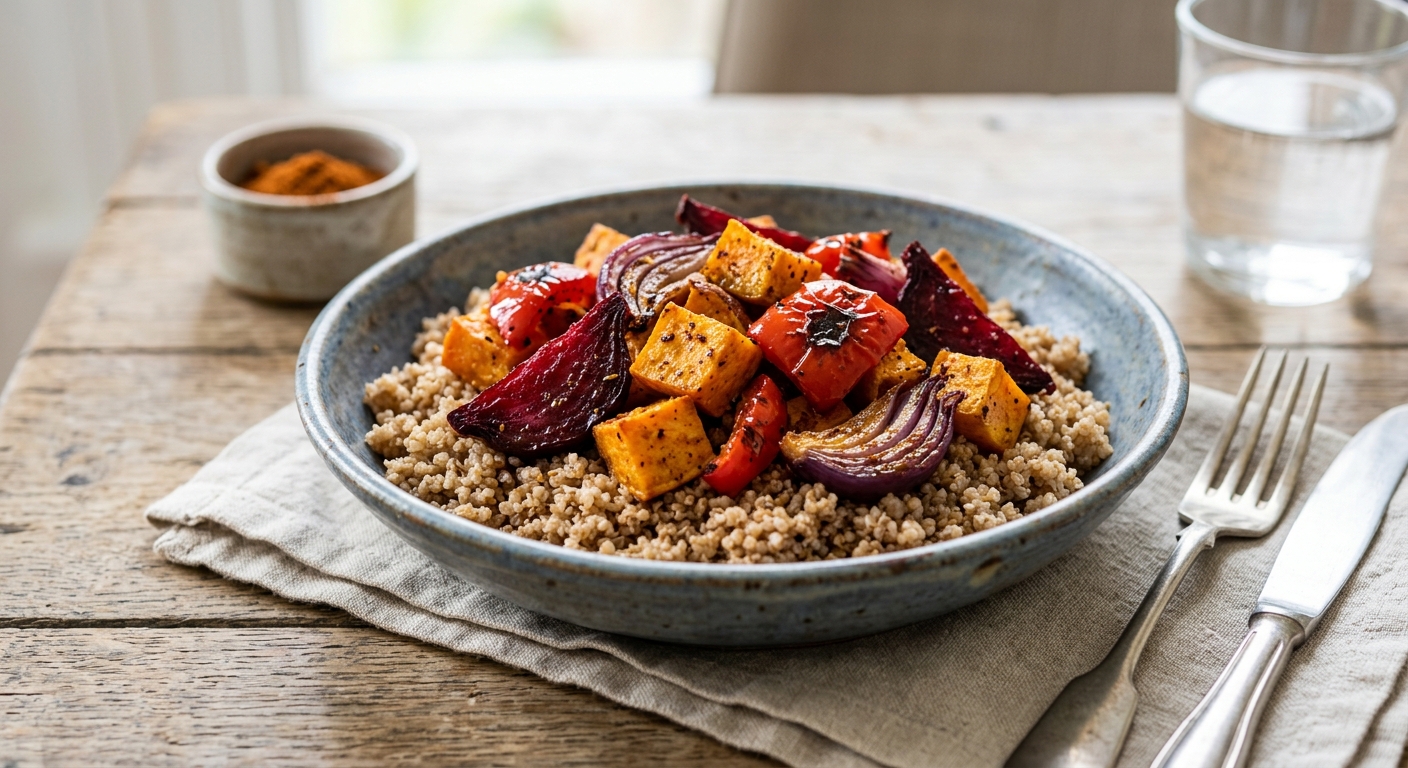
This bowl builds on that nutritional foundation by pairing teff with roasted beetroot, red capsicum, sweet potato, and red onion, all of which contribute beta-carotene, vitamin C, and folate. The vitamin C from the capsicum and the acidity in the lemon-tahini dressing are not merely flavour decisions; they are deliberate nutritional engineering. Ascorbic acid actively converts ferric iron (Fe3+) to the more bioavailable ferrous form (Fe2+), significantly boosting absorption of teff’s non-heme iron. A sprinkle of pumpkin seeds adds a zinc and magnesium bonus that rounds out the mineral profile beautifully.
The flavour story is equally compelling. Teff cooked low and slow develops a deep, almost chocolatey, slightly earthy flavour that anchors the natural sweetness of roasted vegetables. A warm berbere-spiced oil ties the dish to its Ethiopian roots, adding complexity without overpowering the grain’s character. Whether you cook the teff on the stovetop, surrender it to a slow cooker, or use a pressure cooker for speed, each method produces a bowl that is genuinely satisfying and precisely calibrated to move the nutritional needle.
4
servings
Ingredients
- 280 gwhole teff grain, rinsed under cold water and drained
- 900 mllow-sodium vegetable stock
- 300 gsweet potato, peeled and cut into 2cm cubes
- 250 graw beetroot, peeled and cut into 2cm wedges
- 2 mediumred capsicum (bell pepper), deseeded and cut into 3cm pieces
- 1 largered onion, cut into 8 wedges
- 3 tbspextra-virgin olive oil, divided
- 2 tspberbere spice blend
- 1 tspground cumin
- 1 tspsmoked paprika
- 3 tbsptahini (hulled sesame paste)
- 2 tbspfresh lemon juice (about 1 large lemon)
- 1 tspraw honey or maple syrup
- 1 clovegarlic, finely grated
- 3 tbspwarm water, to thin the dressing
- 40 graw pumpkin seeds (pepitas)
- 15 gfresh flat-leaf parsley, roughly chopped
- 10 gfresh mint leaves, torn
- —Colima Sea SaltMicroplastic Free Salt and freshly cracked black pepper to taste
Instructions
Click on an item below to shop for the recommended items for this recipe on Amazon.
As an Amazon Associate, we earn from qualifying purchases.
- Preheat your oven to 220C (200C fan, 425F). Toss the sweet potato, beetroot, capsicum, and red onion with 2 tablespoons of olive oil, the berbere spice, cumin, smoked paprika, a generous pinch of salt, and several grinds of black pepper. Spread in a single layer across two large baking sheets, keeping the beetroot on its own sheet to prevent its colour bleeding onto the other vegetables. Roast for 30 to 35 minutes, turning once halfway, until the edges are caramelised and tender.
- While the vegetables roast, place a medium heavy-based saucepan over medium heat. Add the remaining 1 tablespoon of olive oil and the rinsed, well-drained teff. Stir constantly with a wooden spoon for 3 to 4 minutes until the grains smell nutty and toasty and begin to pop faintly, like very small popcorn. This dry-toast step drives off surface moisture and creates deeper, nuttier flavour compounds through the Maillard reaction.
- Pour the vegetable stock carefully into the hot pan (it will steam vigorously). Add a half teaspoon of salt and stir to combine. Bring to a full boil over medium-high heat, then immediately reduce the heat to the lowest setting. Cover tightly with a lid and simmer for 12 to 15 minutes, stirring every 4 minutes to prevent sticking, until the teff has absorbed all the liquid and has a thick, creamy, polenta-like consistency.
- Remove the teff from the heat and let it rest covered for 5 minutes. Meanwhile, whisk together the tahini, lemon juice, honey, grated garlic, and warm water in a small bowl until smooth and pourable. Season with salt to taste. In a dry skillet over medium heat, toast the pumpkin seeds for 2 to 3 minutes, shaking the pan constantly, until they begin to pop and turn golden.
- To serve, spoon the creamy teff into four wide bowls. Arrange the roasted vegetables on top in sections. Drizzle generously with the lemon-tahini dressing, scatter with toasted pumpkin seeds, fresh parsley, and torn mint. Serve immediately while the teff is hot and the vegetables are still warm.
- Preheat your oven to 220C (200C fan, 425F). Toss the sweet potato, beetroot, capsicum, and red onion with 2 tablespoons of olive oil, the berbere spice, cumin, smoked paprika, salt, and pepper. Spread across two baking sheets, keeping the beetroot separate, and roast for 30 to 35 minutes until caramelised. The vegetables can be roasted before or during the slow cooker cycle and reheated briefly before serving.
- Lightly grease the inside of your slow cooker insert with the remaining 1 tablespoon of olive oil using a pastry brush or paper towel. This prevents the teff from sticking and scorching on the edges during the long cook.
- Add the rinsed, drained teff directly to the greased slow cooker insert. Pour over the cold vegetable stock and add half a teaspoon of salt. Stir once to distribute the grain evenly across the base. Place a clean folded tea towel under the lid (draping it over the rim) to absorb condensation and prevent water droplets from dripping back onto the surface and making the porridge watery.
- Cook on Low for 3 to 4 hours, stirring once at the 2-hour mark to check consistency and prevent the edges from drying out. The teff is ready when it has swelled completely, the liquid is fully absorbed, and the porridge holds a soft, spoonable shape. If it looks too thick, stir in 2 to 3 tablespoons of warm water. If it looks loose at the 4-hour mark, remove the lid for the final 20 minutes.
- While the teff finishes, whisk together the tahini, lemon juice, honey, grated garlic, and warm water to make the dressing. Toast the pumpkin seeds in a dry pan for 2 to 3 minutes. Reheat the roasted vegetables in the oven for 5 minutes at 180C if needed. Spoon the slow cooker teff into bowls, top with vegetables, drizzle with dressing, and finish with seeds, parsley, and mint.
- Set your pressure cooker or Instant Pot to the Saute function on medium heat. Add 1 tablespoon of olive oil, then add the rinsed, well-drained teff. Stir continuously for 2 to 3 minutes until the grains smell nutty. This brief toast even inside the pressure cooker adds meaningful flavour depth. Press Cancel to stop the saute function.
- Pour in 950ml of vegetable stock (slightly more than the stovetop method to account for reduced evaporation under pressure). Add half a teaspoon of salt and stir well, scraping any toasted grains from the bottom of the insert to prevent a burn notice on electronic models.
- Secure the lid and set the pressure valve to Sealing. Cook on Manual High Pressure for 10 minutes. While the teff cooks, roast the vegetables: toss sweet potato, beetroot, capsicum, and onion with the remaining 2 tablespoons of olive oil and all the spices, spread across baking sheets, and roast in a preheated 220C oven for 30 to 35 minutes. The oven cycle times almost perfectly with the pressure cooker cycle.
- Once the pressure cooker finishes, allow a natural pressure release for 10 minutes (do not touch the valve). After 10 minutes, carefully switch the valve to Venting to release any remaining steam. Open the lid and stir the teff vigorously with a wooden spoon or silicone spatula. The texture should be thick, creamy, and uniform. If it appears loose, switch back to the Saute function and stir for 2 minutes without the lid.
- Whisk the tahini dressing in a small bowl and toast the pumpkin seeds in a dry skillet. Spoon the pressure-cooked teff into four bowls and top with the roasted vegetables straight from the oven. Drizzle with dressing, scatter seeds, parsley, and mint, and serve at once.
- Preheat the oven to 200C (180C fan, 400F). On one large and one medium baking sheet, toss the sweet potato, beetroot, capsicum, and red onion with 2 tablespoons of olive oil, the berbere spice, cumin, smoked paprika, salt, and pepper. Keep the beetroot on its own tray. Place both trays in the oven on the upper and middle racks.
- In a medium saucepan on the stovetop, bring the vegetable stock to a simmer over medium heat. Meanwhile, in a 3-litre oven-safe Dutch oven or deep lidded casserole dish, heat the remaining 1 tablespoon of olive oil over medium heat on the stovetop. Add the rinsed, drained teff and stir for 2 minutes until it smells faintly toasty.
- Pour the hot simmering stock over the teff in the Dutch oven (starting with hot stock is critical for the oven method, as it ensures the grain begins absorbing liquid immediately rather than sitting cold during the oven preheat). Add half a teaspoon of salt, stir once, and cover tightly with the lid or a double layer of foil crimped firmly around the rim.
- Transfer the covered Dutch oven to the lower rack of the oven. Bake for 35 minutes without lifting the lid. Rotate the vegetable trays at the 20-minute mark. After 35 minutes, remove the Dutch oven lid and bake uncovered for a further 8 to 10 minutes until the surface sets slightly and the edges pull away from the sides.
- Remove everything from the oven. Let the teff stand uncovered for 5 minutes, then stir from the bottom to recombine the crust into the creamy centre. Whisk the tahini dressing and toast the pumpkin seeds in a dry pan for 2 minutes. Serve the baked teff in bowls topped with the simultaneously roasted vegetables, dressing, seeds, fresh parsley, and mint.
Nutrition Breakdown
Per 1 serving (makes 4)
Vitamins & Minerals
% Daily Value based on a 2,000 calorie diet (FDA reference)
🧬 Essential Amino Acids
% of recommended daily intake (RDA) per serving
🛡 Antioxidant Profile
The Nutrition Science
The iron in teff is entirely non-heme iron, the form found in all plant foods. Non-heme iron is absorbed at a baseline rate of roughly 2 to 20 percent depending on the body’s iron stores and the dietary environment it encounters. The key insight behind this recipe’s design is that vitamin C (ascorbic acid) consumed in the same meal can increase non-heme iron absorption by up to threefold by chemically reducing ferric iron (Fe3+) to the more soluble ferrous form (Fe2+) before it reaches the intestinal mucosal cells. A single medium red capsicum contributes approximately 150mg of vitamin C, and the lemon juice in the dressing adds further ascorbic acid, creating an optimal absorption environment at the moment of consumption.
Teff’s mineral density goes well beyond iron. It is one of the richest grain sources of manganese, a cofactor for superoxide dismutase, the body’s primary intracellular antioxidant enzyme. It also supplies meaningful amounts of magnesium, critical for over 300 enzymatic reactions including ATP synthesis, and calcium at levels comparable to some dairy products on a per-calorie basis. Unlike wheat, which concentrates its minerals in the bran layer that is removed during milling, teff’s tiny grain size (approximately 1mm diameter) makes bran removal impractical, meaning commercially sold teff retains its full mineral complement regardless of the brand you purchase.
The pumpkin seeds deserve specific mention for their zinc content (approximately 2.2mg per 28g serving), which complements teff’s own zinc contribution. Zinc and iron share intestinal absorption transporters (DMT-1), so very high supplemental doses of one can compete with the other. However, the moderate, food-based zinc levels here fall well within the range that supports rather than competes with iron absorption. The tahini provides healthy unsaturated fats that enhance the absorption of the fat-soluble beta-carotene from sweet potato and capsicum, completing a nutritional synergy that was engineered into every component of this bowl.
Pro Tips
- Rinse teff in a very fine-mesh strainer only. The grains are so small (about 1mm) that a standard colander will allow most of them to pass straight through into the drain.
- Roast the beetroot on a separate baking sheet in all methods. Beetroot’s high betalain pigment content will stain every other vegetable a deep magenta if they share a tray, which affects presentation without affecting flavour.
- Make the lemon-tahini dressing in a small jar with a lid and shake vigorously. Tahini seizes and clumps when lemon juice hits it directly; adding the warm water first and shaking, then adding the lemon, produces a smoother emulsion with less whisking effort.
- Leftover teff porridge firms up in the refrigerator into a sliceable cake. Cut cold teff into 1cm slices the next day and pan-fry in olive oil for 3 to 4 minutes per side to make crispy teff cakes, which make an excellent base for poached eggs the following morning.
- If berbere spice is unavailable, combine 1 teaspoon of sweet paprika with a quarter teaspoon each of cayenne, ground ginger, ground coriander, and a pinch of ground cardamom and fenugreek as a workable substitute.





Oh this is fantastic! I’ve been recommending teff to clients for years but I love that you’re pairing it strategically with the vitamin C from roasted veggies and the lemon drizzle, because non-heme iron absorption can be such a game changer when you nail those combos. The tahini is a nice bonus too, adding both fat for nutrient absorption and more minerals. Do you have a preferred roasting temperature that brings out the best caramelization without compromising the vitamin C content?
This is such a smart methylation-focused approach! I’ve been experimenting with teff in my own kitchen and noticed something interesting, the roasting actually seems to concentrate the folate content while the vitamin C from those veggies acts as a cofactor for iron absorption, but here’s what really got me thinking, teff’s nutrient density might be supporting methylation cycles more effectively than some other grains because of its B12 and folate combo. I started adding teff porridge with roasted beets and lemon to my breakfast rotation specifically to support my MTHFR pathway, and I’m curious whether you’ve noticed any metabolic shifts in clients who’ve incorporated teff regularly, or is that
This is such a smart pairing, and I love seeing someone highlight the vitamin C strategy for non-heme iron! I’ve found teff to be a game changer in my own diet, especially once I realized how the roasting method actually works in our favor here – the caramelization concentrates the veggie nutrients without destroying the heat-sensitive vitamin C like prolonged cooking would. One thing I always mention to folks in my thyroid group though: teff is a tiny grain with a decent amount of phytates, so if anyone has absorption issues, soaking or sprouting can really help unlock more of that iron while also reducing compounds that compete with mineral uptake. The lemon tahini drizzle