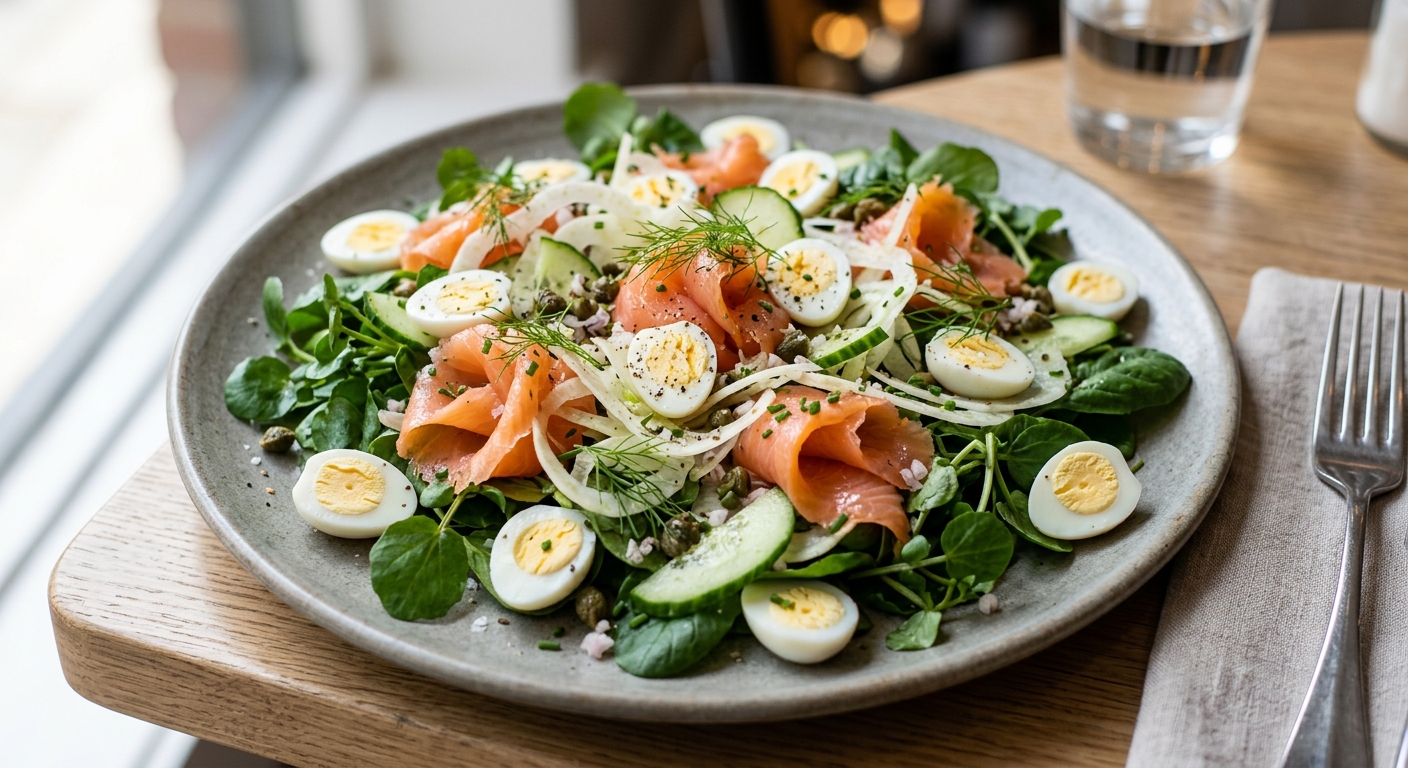
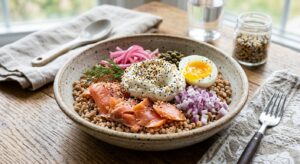
Protein density, the ratio of protein grams to total calories, is one of the most useful lenses through which to evaluate a meal. Most high-protein foods come loaded with saturated fat or refined carbohydrates that dilute their nutritional efficiency. This quail egg and smoked salmon salad breaks that pattern entirely. At roughly 0.36g of protein per calorie, it sits comfortably among the most protein-efficient meals in the culinary world, rivalling skinless chicken breast while delivering a far more complex and satisfying eating experience.
Quail eggs are a quiet powerhouse. Gram for gram they contain more protein, more riboflavin (B2), more iron, and more vitamin B12 than hen eggs, wrapped in a shell small enough to feel like a chef’s secret. Their yolks, when cooked to a jammy, slightly yielding centre, provide choline and a concentrated hit of fat-soluble vitamins A, D, and E. Paired with cold-smoked Atlantic salmon, which contributes long-chain omega-3 fatty acids (EPA and DHA), selenium, and additional B12, the protein profile of this salad becomes genuinely complete, covering every essential amino acid at or above the RDA for a 70kg adult.
The base of watercress, baby spinach, and thinly shaved fennel is not decorative filler. Watercress is one of the most nutrient-dense vegetables on the planet by calorie, contributing vitamin K, vitamin C, and the glucosinolate compounds associated with cellular protection. Fennel adds prebiotic fibre and potassium. A dressing of good extra-virgin olive oil, lemon juice, and a whisper of Dijon brings the whole composition together with healthy monounsaturated fats that aid absorption of the fat-soluble vitamins present throughout the salad. This is a dish that works as hard as you do.
4
servings
Ingredients
- 24 quail eggs
- 320 gcold-smoked Atlantic salmon, thinly sliced
- 120 gwatercress, thick stems removed
- 80 gbaby spinach leaves
- 1 mediumfennel bulb, very thinly shaved on a mandoline, fronds reserved
- 120 gseedless cucumber, halved lengthways and thinly sliced
- 2 tbspcapers, drained and roughly chopped
- 30 gshallots, finely minced
- 3 tbspextra-virgin olive oil
- 2 tbspfresh lemon juice
- 1 tspDijon mustard
- 1 tspraw honey
- 1 tbspfresh dill, finely chopped
- 20 gtoasted pumpkin seeds
- —Colima Sea SaltMicroplastic Free Salt and cracked black pepper to taste
- —Lemon wedges, to serve
Instructions
Click on an item below to shop for the recommended items for this recipe on Amazon.
As an Amazon Associate, we earn from qualifying purchases.
- Bring a medium saucepan of water to a rolling boil over high heat. While the water heats, prepare an ice bath by filling a large bowl with cold water and a generous handful of ice cubes. Set it directly beside the stove.
- Once boiling, use a slotted spoon to gently lower the quail eggs one at a time into the water. Immediately set a timer for exactly 2 minutes and 30 seconds. Maintain a gentle boil and do not cover the pan. The brief cook time gives a set white with a soft, creamy yolk.
- When the timer sounds, transfer the eggs immediately to the ice bath using the slotted spoon. Leave them undisturbed for at least 5 minutes. This halts cooking instantly and makes the shells far easier to peel. Do not skip this step.
- While the eggs chill, whisk together the olive oil, lemon juice, Dijon mustard, honey, minced shallots, and chopped dill in a small bowl. Season with a pinch of fine sea salt and cracked black pepper. Taste and adjust the acid-to-oil balance to your preference.
- Gently peel each quail egg under a thin stream of cold running water, starting from the wider end where the air pocket sits. Pat dry on a clean kitchen towel. Halve each egg lengthways with a sharp paring knife just before plating to keep the yolk intact and vivid.
- In a large mixing bowl, combine the watercress, baby spinach, shaved fennel, and cucumber slices. Drizzle two thirds of the dressing over the greens and toss gently with your hands or tongs so every leaf is lightly coated without bruising.
- Divide the dressed greens among four chilled plates. Lay the smoked salmon ribbons loosely over the top in natural folds rather than flat sheets to create height and texture. Arrange 6 quail egg halves per plate, yolk-side up. Scatter capers, toasted pumpkin seeds, and reserved fennel fronds over each plate. Drizzle the remaining dressing over the salmon and eggs, then finish with a crack of black pepper and lemon wedges alongside.
- Place the quail eggs in a single layer in the insert of your slow cooker. Do not stack them. Pour in enough warm tap water to submerge the eggs completely by at least 2cm. Put the lid on and set the cooker to Low. There is no need to preheat.
- Cook on Low for exactly 1 hour. The slow cooker will bring the water to approximately 75 to 80 degrees Celsius, a temperature that gently firms the whites all the way through while keeping the yolk at a luscious, soft-set consistency that no stovetop boil can reliably replicate. Do not open the lid during cooking.
- While the eggs cook, prepare the dressing by whisking together the olive oil, lemon juice, Dijon mustard, honey, minced shallots, and chopped dill in a small bowl. Season with fine sea salt and cracked black pepper. Set aside at room temperature to allow the shallots to mellow in the acid.
- Also during this time, prepare all vegetables: trim and wash the watercress and baby spinach, shave the fennel on a mandoline and keep the fronds, slice the cucumber, and drain and chop the capers. Store everything separately in the refrigerator until assembly so the greens stay crisp.
- When the hour is up, use a slotted spoon to transfer the eggs directly into an ice bath for 5 minutes. Peel gently under cold running water, pat dry, and halve lengthways with a sharp paring knife just before plating.
- Toss the watercress, baby spinach, fennel, and cucumber with two thirds of the dressing in a large bowl. Plate as described: dressed greens first, smoked salmon ribbons arranged loosely on top, then 6 quail egg halves per plate yolk-side up. Finish with capers, pumpkin seeds, fennel fronds, the remaining dressing, cracked pepper, and lemon wedges.
- Pour 240ml of cold water into the pressure cooker insert and place the trivet or steam rack inside. Arrange the quail eggs in a single layer on the trivet. If you do not have a trivet, a folded piece of foil shaped into a ring works well to keep the eggs off the direct heat of the base.
- Secure the lid and set the pressure release valve to Sealing. Set the cooker to Low Pressure (also labelled Egg or Steam on some models) for 1 minute. The pot will take approximately 5 to 8 minutes to come to pressure before the 1-minute cook time begins.
- As soon as the 1-minute cook cycle ends, perform an immediate quick release by carefully turning the pressure valve to Venting. Do not use natural release, as residual heat will overcook the yolks. Transfer the eggs at once to a prepared ice bath and leave for a minimum of 5 minutes.
- While the eggs are chilling, whisk the dressing: olive oil, lemon juice, Dijon mustard, honey, minced shallots, and dill. Season well. The quick release and ice bath window is the perfect time to prep vegetables if you have not already done so.
- Peel the chilled eggs under cold running water, pat dry, and halve lengthways just before serving. Toss the greens, fennel, and cucumber with two thirds of the dressing. Assemble the plates: greens as the base, smoked salmon loosely folded on top, 6 egg halves per plate yolk-side up, then capers, pumpkin seeds, fennel fronds, remaining dressing, cracked black pepper, and lemon wedges.
Nutrition Breakdown
Per 1 serving (makes 4)
Vitamins & Minerals
% Daily Value based on a 2,000 calorie diet (FDA reference)
🧬 Essential Amino Acids
% of recommended daily intake (RDA) per serving
🛡 Antioxidant Profile
The Nutrition Science
The protein density of this salad is driven by the complementary profiles of two animal proteins: quail eggs and cold-smoked salmon. Quail eggs contain approximately 13g of protein per 100g of edible portion, slightly higher than hen eggs, with an exceptionally high biological value (BV) of around 97, meaning nearly all of the protein consumed is retained and utilised by the body. Cold-smoked salmon contributes roughly 25g of protein per 100g and, critically, provides large quantities of the sulphur-containing amino acid methionine, which complements the lysine-rich profile of the eggs to create a complete essential amino acid matrix across the full serving.
The omega-3 fatty acids in smoked salmon (EPA and DHA) do more than support cardiovascular health. Emerging research shows that EPA and DHA directly enhance muscle protein synthesis when consumed alongside high-quality protein, acting as a sensitiser to the mTOR signalling pathway. This means the protein in this salad may be used more efficiently for muscle repair and maintenance than the same quantity of protein consumed without accompanying omega-3 lipids. The olive oil dressing simultaneously ensures that fat-soluble vitamins A, D, E, and K present across the dish are absorbed efficiently, since dietary fat is required for their uptake in the small intestine.
Selenium, provided at 69% of the daily value primarily by the salmon, functions as the essential cofactor for glutathione peroxidase, the body’s primary endogenous antioxidant enzyme. Selenium and vitamin E work in a tightly coupled system: vitamin E donates hydrogen to neutralise lipid peroxyl radicals, producing a vitamin E radical that selenium-dependent enzymes then regenerate back to active vitamin E. The simultaneous presence of both nutrients in this dish means the antioxidant protection is multiplicative rather than simply additive. This synergy is one reason why whole-food sources of these nutrients consistently outperform isolated supplementation in clinical outcomes.
Pro Tips
- Source the freshest quail eggs you can find. Fresh eggs peel significantly more easily after ice bathing than eggs that are close to their use-by date, because the pH of the white changes with age and causes it to adhere more stubbornly to the membrane.
- Buy cold-smoked rather than hot-smoked salmon for this salad. Cold-smoked salmon retains its silky, translucent texture and delicate flavour at room temperature, while hot-smoked salmon is cooked through and will flake into the greens rather than draping gracefully over them.
- To make the dressing ahead, prepare it up to 24 hours in advance and store it covered in the refrigerator. Remove it 20 minutes before serving so the olive oil re-liquefies and the shallots have had time to fully mellow in the lemon juice, which removes their raw bite without cooking them.
This is exactly the kind of nutrient density optimization I track obsessively on my CGM. 28g protein at 310 calories gives you a protein-to-calorie ratio of 0.09, which is genuinely elite territory, and I’m curious whether you’ve measured the glycemic response from this specifically. The quail eggs vs chicken eggs comparison fascinates me since quail eggs have a slightly different amino acid profile, and the smoked salmon’s omega-3 content should theoretically flatten any glucose curve. Do you happen to have macrobreakdown data for the greens/dressing, or is the 28g protein figure just from the eggs and salmon? Thinking about testing this
Oh, I’m absolutely making this for next week’s class! I taught home ec for thirty years and we always did egg salads, but never with quail eggs and never with this kind of intentional nutrient architecture you describe. The protein density here is exactly what I’ve been wanting to demonstrate to my students, especially the ones managing blood sugar or trying to feel satisfied on fewer calories. I’m curious about the smoked salmon you’re using, though, since sodium can add up quickly there, especially for folks watching their intake, so I’d love to know if you have thoughts on choosing lower-sodium varieties without losing that beautiful depth of flavor.
This ratio is exactly what I coach my athletes toward, and the quail egg choice here is brilliant from a leucine perspective – you’re hitting roughly 3.1g per serving, which is right at that sweet spot for triggering protein synthesis without needing massive portions. The smoked salmon adds the omega-3s that improve nutrient partitioning, so you’re not just getting protein density, you’re getting functional density. Ben, to your point on glycemic response: the greens and that fat content from the salmon will blunt any blood sugar spike, plus the egg yolk’s choline actually improves insulin sensitivity, so this isn’t just macro optimization, it’s metabolic optimization.