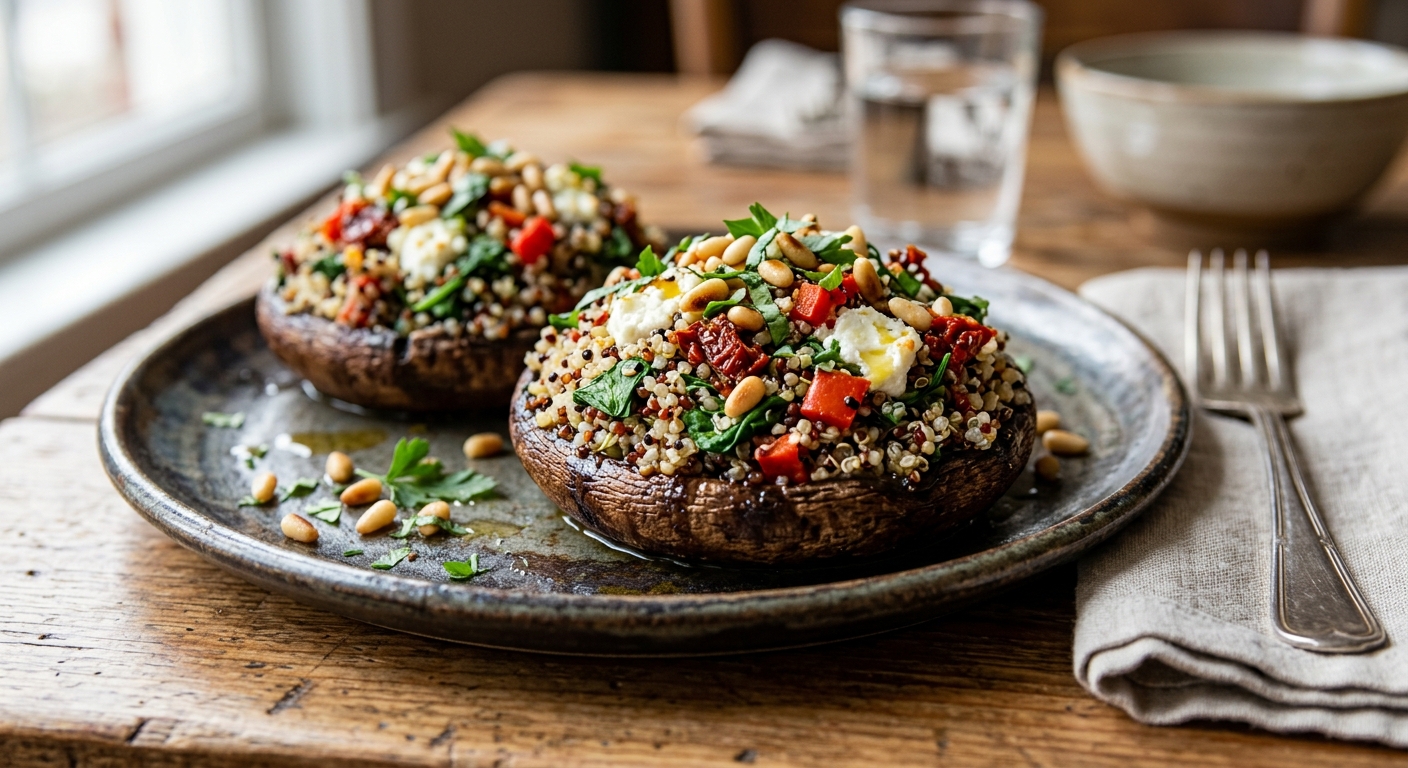
Few vegetarian dishes earn the word ‘satisfying’ as genuinely as a well-stuffed portobello mushroom. The cap itself is a culinary gift: wide enough to hold a generous filling, meaty enough to stand up to high heat, and loaded with umami compounds that make every bite feel substantial. Paired with tri-color quinoa, one of the very few plant foods that supplies all nine essential amino acids in meaningful quantities, and finished with tangy goat cheese, this dish punches well above its weight in the protein department, delivering roughly 28 grams per serving.
What makes this recipe a Calibrated Cuisine standout is how intelligently each ingredient earns its place. Baby spinach contributes iron and folate that the body absorbs more readily when paired with the vitamin C from roasted red peppers. Sun-dried tomatoes bring concentrated lycopene, a carotenoid antioxidant linked to cardiovascular protection. Goat cheese, beyond its creaminess, provides calcium and phosphorus in a form that is easier on many lactose-sensitive digestive systems than cow’s-milk cheese. And quinoa’s saponin-free, rinsed grain delivers a low glycemic carbohydrate base that keeps blood sugar stable for hours.
We have calibrated four cooking methods, each genuinely suited to the dish’s structure. The oven method produces the deepest caramelization on the mushroom caps. The stovetop method keeps everything in one pan for quick weeknights. The pressure cooker method dramatically shortens active time while preserving moisture. And the slow cooker method develops the most integrated, braised flavor profile. Choose your method, trust the process, and expect a plate that looks stunning and fuels you completely.
4
servings
Ingredients
- 4 largeportobello mushroom caps (about 120g each), stems removed and gills scraped
- 185 gtri-color quinoa, rinsed thoroughly under cold water
- 420 mllow-sodium vegetable broth
- 120 gsoft goat cheese (chevre), crumbled
- 90 gbaby spinach, roughly chopped
- 60 gsun-dried tomatoes (oil-packed), drained and finely chopped
- 80 groasted red peppers (jarred, drained), finely diced
- 40 gpine nuts, lightly toasted
- 3 clovesgarlic, minced
- 1 smallyellow onion, finely diced
- 3 tbspextra-virgin olive oil, divided
- 2 tbspfresh lemon juice
- 2 tspfresh thyme leaves (or 3/4 tsp dried)
- 1 tspsmoked paprika
- 2 tbspfresh flat-leaf parsley, chopped, for garnish
- —Colima Sea SaltMicroplastic Free Salt and freshly cracked black pepper to taste
Instructions
Click on an item below to shop for the recommended items for this recipe on Amazon.
As an Amazon Associate, we earn from qualifying purchases.
- Cook the quinoa: combine rinsed quinoa and vegetable broth in a medium saucepan over medium-high heat. Bring to a boil, then reduce heat to low, cover tightly, and simmer for 14 to 16 minutes until all liquid is absorbed and the germ rings have separated. Remove from heat, fluff with a fork, and let stand uncovered for 5 minutes to dry slightly.
- While the quinoa cooks, prepare the filling: heat 2 tablespoons of olive oil in a large, deep skillet (at least 30cm) over medium heat. Add the diced onion and cook, stirring occasionally, for 4 to 5 minutes until softened and translucent. Add the garlic and smoked paprika and cook for 60 seconds, stirring constantly, until fragrant.
- Add the sun-dried tomatoes and roasted red peppers to the skillet and stir to combine. Add the baby spinach in two handfuls, tossing with tongs until just wilted, about 2 minutes. Season generously with salt and pepper. Remove the filling mixture from the heat and fold it into the cooked quinoa. Stir in the lemon juice, thyme, and half the crumbled goat cheese. Taste and adjust seasoning.
- Wipe the skillet clean and return it to medium-high heat. Brush the portobello caps on both sides with the remaining 1 tablespoon of olive oil and season with salt and pepper. Place caps gill-side down in the hot skillet and sear for 3 minutes without moving them, until they develop a golden-brown color on the underside.
- Flip the caps so they are gill-side up. Divide the quinoa filling evenly among the four caps, mounding it generously. Scatter the remaining goat cheese over the top of each cap. Reduce heat to medium-low, cover the skillet with a tight-fitting lid, and cook for 8 to 10 minutes until the mushrooms are tender when pierced with a knife and the cheese is warm and slightly melted.
- Remove the lid, increase heat to medium-high for 60 seconds to evaporate any excess moisture, then transfer to serving plates. Scatter toasted pine nuts and fresh parsley over each cap and serve immediately.
- Cook the quinoa on the stovetop or rice cooker as a first step: combine rinsed quinoa and vegetable broth in a saucepan, bring to a boil, then reduce to a low simmer, cover, and cook for 14 minutes. Fluff and set aside to cool for 10 minutes. This step is done before anything goes into the slow cooker because the long, moist environment of the slow cooker would turn loose quinoa mushy.
- Build the filling directly in a large mixing bowl. Combine the cooked quinoa, baby spinach (it will wilt from the residual heat), sun-dried tomatoes, roasted red peppers, garlic, onion, thyme, smoked paprika, lemon juice, and 2 tablespoons of olive oil. Season well with salt and pepper and mix until fully combined. Do not add any goat cheese at this stage.
- Pour 60ml of vegetable broth or water into the bottom of the slow cooker insert to create a steaming environment. Brush the portobello caps lightly on both sides with the remaining olive oil and season with salt and pepper. Arrange the caps gill-side up in the slow cooker, overlapping slightly if necessary depending on the size of your insert.
- Spoon the quinoa filling generously into each mushroom cap, pressing it in lightly so it holds its shape. Place the lid on the slow cooker and cook on Low for 2 hours 30 minutes to 3 hours, until the mushrooms are completely tender and deeply flavorful. Avoid lifting the lid during cooking, as each peek adds approximately 20 minutes to the cooking time.
- In the final 10 minutes of cooking, scatter the crumbled goat cheese over the tops of the filled caps, replace the lid, and allow the cheese to warm through without fully melting. Carefully lift each cap out using a wide spatula (they will be delicate), transfer to serving plates, then top with toasted pine nuts and fresh parsley. Drizzle any accumulated juices from the insert over each cap for extra flavor.
- Cook the quinoa using the pressure cooker first: add rinsed quinoa and 360ml of vegetable broth to the inner pot. Secure the lid, set the valve to Sealing, and cook on Manual High Pressure for 1 minute. Allow a natural pressure release for 10 minutes, then switch the valve to Venting for a quick release. Open the lid, fluff the quinoa with a fork, transfer it to a large mixing bowl, and let it cool for 5 minutes. Rinse the inner pot and return it to the base.
- While the quinoa rests, build the filling: heat 2 tablespoons of olive oil in the inner pot using the Saute function (Normal heat). Add the onion and cook for 3 minutes until softened. Add the garlic and smoked paprika and cook for 45 seconds, stirring constantly. Press Cancel to stop the Saute function. Add the sun-dried tomatoes, roasted red peppers, spinach, lemon juice, and thyme, stirring until the spinach just wilts from the residual heat. Pour this mixture over the cooked quinoa, season well, and fold together. Set aside half the goat cheese for topping and fold the rest into the filling.
- Pour 240ml of water (the minimum required for pressure cooking) into the now-empty inner pot. Place the steamer rack or trivet inside. Brush the portobello caps on both sides with the remaining 1 tablespoon of olive oil, season with salt and pepper, and arrange them gill-side up on the steamer rack, nesting them as needed.
- Mound the quinoa filling into each cap, packing it gently. Secure the lid and set the valve to Sealing. Cook on Manual High Pressure for 5 minutes. Perform a quick pressure release immediately by carefully switching the valve to Venting.
- Open the lid and immediately scatter the reserved crumbled goat cheese over each stuffed cap. Replace the lid (without locking it) and allow to rest for 3 minutes: the residual steam will gently warm the cheese to a creamy, spreadable consistency without overcooking the mushrooms. Lift the caps carefully onto serving plates, top with toasted pine nuts and parsley, and serve at once.
- Preheat the oven to 200 degrees Celsius (400F / Gas Mark 6). Cook the quinoa on the stovetop: combine rinsed quinoa and vegetable broth in a saucepan, bring to a boil, reduce heat, cover, and simmer for 14 to 16 minutes until liquid is absorbed. Fluff and set aside.
- Prepare the mushroom caps for roasting: brush both sides generously with 2 tablespoons of olive oil and season well with salt and pepper. Arrange gill-side down on a parchment-lined rimmed baking sheet. Roast in the preheated oven for 10 minutes to pre-cook the caps and draw out excess moisture. Remove from the oven and carefully tip any accumulated liquid off the baking sheet. Flip the caps so they are now gill-side up.
- While the caps pre-roast, make the filling: heat the remaining 1 tablespoon of olive oil in a skillet over medium heat and saute the onion for 4 minutes until soft. Add garlic and smoked paprika and cook for 60 seconds. Remove from heat and combine with the cooked quinoa, baby spinach, sun-dried tomatoes, roasted red peppers, lemon juice, and thyme in a large bowl. Season well with salt and pepper. Fold in half of the crumbled goat cheese.
- Divide the quinoa filling evenly among the four pre-roasted caps, pressing it in firmly and mounding it above the rim of each cap. Scatter the remaining goat cheese generously over the top of each mound, then press the toasted pine nuts lightly into the surface of the filling so they don’t roll off during baking.
- Return the baking sheet to the oven and roast at 200 degrees Celsius for 14 to 16 minutes, until the mushrooms are fully tender, the filling is heated through, and the goat cheese is lightly golden and bubbling at the edges. For deeper browning on top, switch the oven to the Broil/Grill setting for the final 2 minutes, watching closely. Remove from the oven, rest for 2 minutes on the baking sheet, then transfer to plates using a wide spatula. Garnish with fresh parsley and serve.
Nutrition Breakdown
Per 1 serving (makes 4)
Vitamins & Minerals
% Daily Value based on a 2,000 calorie diet (FDA reference)
🧬 Essential Amino Acids
% of recommended daily intake (RDA) per serving
🛡 Antioxidant Profile
The Nutrition Science
The nutritional architecture of this dish is built around a concept called protein complementarity, and quinoa is the cornerstone. Unlike most plant proteins, quinoa contains all nine essential amino acids at levels sufficient to meet adult RDA requirements, a profile technically comparable to casein, the protein in dairy. Goat cheese amplifies this further by adding concentrated lysine and tryptophan, two amino acids that are often limiting in grain-based meals. The combined effect is a dish where every gram of protein is highly bioavailable and metabolically complete, which is relatively rare in vegetarian cooking.
The iron story here is equally deliberate. Portobello mushrooms, quinoa, and spinach collectively contribute approximately 5.8mg of non-heme iron per serving. Non-heme iron has lower baseline absorption than the heme iron found in red meat, absorbing at roughly 5 to 12% under normal conditions. However, the roasted red peppers and lemon juice in this recipe provide approximately 28mg of vitamin C per serving, and research consistently shows that vitamin C consumed simultaneously with non-heme iron can increase its absorption by 2 to 3 fold by reducing ferric iron to the more soluble ferrous form. This is food synergy operating in a clinically meaningful way.
The mushroom caps themselves deserve special mention beyond their role as a vessel. Portobellos are one of the only non-animal food sources of ergothioneine, a sulfur-containing amino acid derivative that humans cannot synthesize endogenously but actively transport into tissues via a dedicated transporter protein (OCTN1). Research published in journals including Oxidative Medicine and Cellular Longevity suggests ergothioneine accumulates in high-oxidative-stress tissues, particularly mitochondria and red blood cells, where it acts as a long-lasting antioxidant buffer. Cooking does not substantially degrade ergothioneine, which is why this nutrient is retained across all four cooking methods in this recipe.
Pro Tips
- Scrape the dark gills from the portobello caps with a spoon before cooking: the gills are edible but release a dark, slightly bitter liquid during cooking that can muddy the filling’s appearance and flavor.
- Toast the pine nuts in a dry skillet over medium heat for 2 to 3 minutes, shaking constantly, until golden. They go from perfectly golden to burned in under 30 seconds, so do not walk away.
- Rinse quinoa very thoroughly in a fine-mesh strainer under cold running water for at least 60 seconds to remove the natural saponin coating, which otherwise imparts a bitter, soapy aftertaste that no amount of seasoning can fully mask.
- If making ahead, store the quinoa filling and roasted mushroom caps separately in airtight containers in the refrigerator for up to 2 days. Assemble and finish with goat cheese just before the final cook or reheat to prevent the caps from becoming waterlogged.
- For a richer umami depth in the filling, add 1 teaspoon of white miso paste stirred into the quinoa mixture before stuffing. Miso is fermented, not raw soy, and contributes probiotic compounds alongside glutamates that amplify savoriness without tasting ‘Asian’.
Love that you’re thinking about the carb angle, Kurt! One thing I’d gently offer though: those portobellos are actually adaptogens in their own right, packed with ergothioneine and beta-glucans that can help modulate stress response and blood sugar stability. I’ve found that when I pair quinoa with mushroom-heavy meals like this, the whole dish becomes more metabolically “complete” than if I subbed in cauliflower rice alone. That said, if lower carb is your goal, you could totally do a hybrid approach with half quinoa, half cauliflower rice and really lean into the portobello’s functional benefits. Were these caps sourced specifically for their
This hybrid approach is genius, Alex! I’ve noticed something similar with my own meals – when I keep the quinoa but amp up the protein and fiber ratio (like with that goat cheese here), I get way flatter glucose curves than I’d expect. The portobello caps adding those beta-glucans is such a smart observation too because it genuinely seems to slow down carb absorption. If Kurt wants to test this, doing the 50/50 split would let him dial in what his body actually responds to instead of just assuming all carbs behave the same way – that’s where the real personalization magic happens!
yo this is actually really solid thinking – youre right that not all carbs hit the same way and i appreciate you pointing out the beta-glucans thing, ive never dug into that with mushrooms specifically. honestly my thing is more about finding what keeps me stable and energized, and for my body quinoa just tends to spike me even with the fiber and protein, but that 50/50 split idea with cauliflower rice is actually genius for testing – gives you the micronutrient density you’re after while dialing in the glucose response. might try this approach instead of just going all or nothing, thanks for the thoughtful take!
this looks amazing and im totally making it, but just curious – whats the net carb count on the quinoa per serving? ive found that swapping it for cauliflower rice keeps all that protein and iron from the spinach and goat cheese without spiking blood sugar, which has been huge for keeping my metabolism stable. the rest of it sounds perfect though, love the micronutrient focus here.
I totally get wanting to dial in carbs, Kurt! Just want to gently mention that quinoa itself actually has a pretty moderate glycemic impact, especially when paired with protein and fiber like you have here, so it shouldn’t spike blood sugar the way simple carbs do. That said, if cauliflower rice works better for your individual response, that’s valid – everyone’s metabolism is different. One thing I’d point out though: you’d lose that complete amino acid profile quinoa gives you, so you’d want to make sure the goat cheese and spinach combo is hitting all your amino acids (spoiler: they do, but it’s a closer call). The iron from spinach is still there with cauli
Love this recipe! I’m actually saving it for my clients who want to boost their iron intake, since the quinoa-spinach combo is such a smart pairing for absorption (the vitamin C from the sun-dried tomatoes really helps with that iron bioavailability). Kurt, just wanted to mention that quinoa brings those complete amino acids to the table too, so you’re getting all 9 essentials in one dish – cauliflower rice would give you the carb savings but you’d lose that amino acid completeness, so it really depends on your priorities! The goat cheese adds a nice touch of bioavailable B12 as well, which pairs perfectly with the plant sources here.