
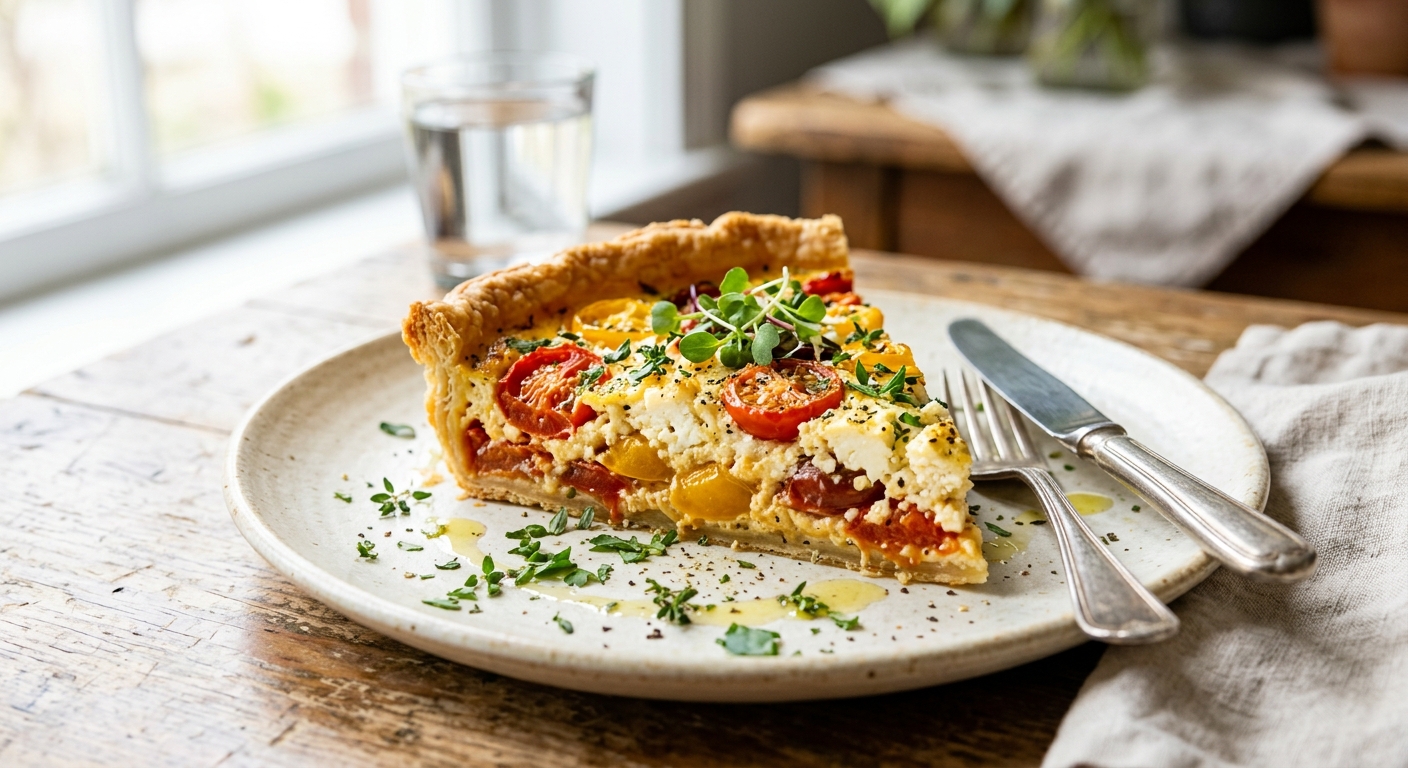
Bone health rarely tastes this good. This Herbed Feta and Tomato Tart was engineered from the crust up to deliver maximum calcium bioavailability alongside the fat-soluble compounds your body needs to actually absorb it. The olive oil in the pastry, the egg yolks in the custard, and the full-fat feta all contribute dietary fat that escorts calcium across the intestinal wall far more efficiently than low-fat alternatives. This is not a compromise recipe dressed up in nutrition language. It is a genuinely elegant tart that earns its place on a dinner table.
The tomato filling is where the lycopene science gets exciting. Raw tomatoes contain lycopene in a trans isomer form that is relatively difficult for the body to absorb. When tomatoes are cooked with a small amount of fat, two things happen simultaneously: the cell walls break down, releasing far more lycopene into the food matrix, and heat converts a portion of that lycopene into cis isomers that studies consistently show are more bioavailable. The olive oil in this recipe is not an afterthought. It is a calculated delivery mechanism. A single serving of this tart provides approximately 9.8 mg of lycopene, placing it firmly in the range associated with reduced oxidative stress markers in clinical research.
Fresh herbs are the finishing touch that earns this recipe its ‘calibrated’ badge. Thyme contributes luteolin and apigenin, two flavones with demonstrated anti-inflammatory activity that complement lycopene’s antioxidant work. Flat-leaf parsley adds a meaningful shot of vitamin K1, a cofactor required by osteocalcin, the protein that anchors calcium into bone mineral. Together, this tart is a precisely tuned argument that food made with nutritional intention does not have to sacrifice a single degree of culinary pleasure.
4
servings
Ingredients
- 200 gplain all-purpose flour, plus extra for dusting
- 90 gunsalted butter, cold and cubed
- 3 tbspice water
- 350 gcherry tomatoes, halved
- 200 gfull-fat feta cheese, crumbled
- 3 largeeggs
- 180 mlwhole milk
- 80 mlheavy cream
- 3 tbspextra-virgin olive oil, divided
- 3 clovesgarlic, thinly sliced
- 2 tspfresh thyme leaves
- 2 tbspfresh flat-leaf parsley, finely chopped
- 1 tspdried oregano
- 1 tsplemon zest
- 0.5 tspsweet smoked paprika
- —Colima Sea SaltMicroplastic Free Salt and freshly ground black pepper to taste
Instructions
Click on an item below to shop for the recommended items for this recipe on Amazon.
As an Amazon Associate, we earn from qualifying purchases.
- Make the tomato confit base: Warm 2 tablespoons of olive oil in a 10-inch cast iron skillet over medium-low heat. Add the sliced garlic and cook for 2 minutes until fragrant but not browned. Add the halved cherry tomatoes cut-side down, season with salt, smoked paprika, and dried oregano, and cook undisturbed for 8 to 10 minutes until the tomatoes have softened and released their juices, which will reduce to a jammy glaze around the fruit. Remove the skillet from heat and let the tomato base cool for 10 minutes.
- Prepare the custard: In a medium bowl, whisk together the 3 eggs, whole milk, heavy cream, lemon zest, fresh thyme, and a generous pinch of black pepper until fully combined and slightly frothy. Taste the mixture and adjust salt carefully, remembering that feta is already salty.
- Layer and combine: Scatter two-thirds of the crumbled feta evenly over the tomato base in the skillet. Pour the egg custard slowly and evenly over the feta and tomatoes, tilting the pan gently to ensure the custard fills all the gaps. Scatter the remaining feta on top and finish with the fresh parsley and a drizzle of the remaining 1 tablespoon of olive oil.
- Stovetop cook: Place the skillet back over the lowest possible heat setting. Cover tightly with a lid or foil and cook for 18 to 22 minutes, checking at the 18-minute mark. The tart is ready when the edges are fully set and the center jiggles only slightly when the pan is nudged. Do not rush this with higher heat or the bottom will scorch before the top sets.
- Finish under the broiler: Position your oven rack to the top third and preheat the broiler to high. Slide the uncovered skillet under the broiler for 2 to 3 minutes, watching carefully, until the top is speckled golden and the feta edges take on a light char. Rest for 5 minutes before slicing and serving directly from the skillet.
- Build the tomato layer in a skillet first: Heat 2 tablespoons of olive oil in a skillet over medium-high heat. Add the cherry tomatoes cut-side down with the sliced garlic, smoked paprika, and dried oregano. Cook for 6 to 8 minutes, stirring occasionally, until the tomatoes are just softened and the juices have reduced slightly. This pre-cooking step is essential in the slow cooker method because the sealed, moist environment cannot reduce excess liquid, and a wet tomato layer will make the custard watery. Season lightly with salt and set aside to cool for 10 minutes.
- Prepare and line the slow cooker: Cut a sheet of parchment paper to fit the base and sides of a 4 to 5-quart oval slow cooker insert, with enough overhang to act as handles. Lightly grease the parchment with a small amount of olive oil. Place a folded kitchen towel or three layers of paper towels under the lid to absorb condensation, which would otherwise drip back onto the custard and create wet patches.
- Layer the tart in the insert: Spread the cooled tomato mixture evenly across the parchment-lined base. Scatter two-thirds of the crumbled feta over the tomatoes. Whisk together the eggs, whole milk, heavy cream, lemon zest, thyme, and black pepper in a bowl, season carefully for salt, then pour the custard slowly over the feta and tomato layer. Top with the remaining feta.
- Slow cook to set: Place the paper-towel-lined lid on the slow cooker and cook on High for 2 hours to 2 hours 30 minutes. Begin checking at the 2-hour mark by gently pressing the center with a fingertip through a folded towel. The tart is done when the center feels just firm and a thin-bladed knife inserted in the middle comes out clean with only a slight smear of custard. Low heat (4 to 5 hours) also works but yields a slightly softer, more pudding-like texture.
- Rest and garnish: Lift the tart from the slow cooker using the parchment overhang and transfer to a cutting board. Scatter the fresh parsley over the top and drizzle with the remaining tablespoon of olive oil. Allow to rest for 10 minutes before slicing to allow the custard to fully firm up. Serve warm or at room temperature.
- Pre-cook the tomatoes on the Saute function: Set your Instant Pot or electric pressure cooker to Saute on Medium. Add 2 tablespoons of olive oil, the sliced garlic, halved cherry tomatoes cut-side down, smoked paprika, and dried oregano. Cook for 5 to 6 minutes, stirring once, until the tomatoes are softened and most of the released liquid has evaporated. Press Cancel to stop the Saute function. Transfer the tomato mixture to a plate and let cool for 10 minutes. Wipe the inner pot dry.
- Prepare the pan and custard: Lightly grease a 7-inch round cake pan or springform pan with olive oil and cut a circle of parchment for the base. In a bowl, whisk the eggs, whole milk, heavy cream, lemon zest, thyme, and black pepper together until smooth. Taste and add salt sparingly given the feta’s saltiness.
- Assemble the tart pan: Spread the cooled tomato and garlic mixture across the base of the prepared pan. Scatter two-thirds of the crumbled feta over the tomatoes, then slowly pour the egg custard mixture over the top. Finish with the remaining feta and a pinch of black pepper. Cover the pan tightly with a layer of aluminum foil, crimping the edges firmly to prevent condensation dripping into the custard during pressurised steaming.
- Pressure cook: Pour 1.5 cups of water into the inner pot and place the trivet inside. Carefully lower the foil-covered tart pan onto the trivet, using a sling made from folded foil to make retrieval easier. Seal the lid, set the valve to Sealing, and cook on Manual (High Pressure) for 18 minutes. Allow a natural pressure release for 10 minutes, then carefully switch to Quick Release for any remaining pressure.
- Finish and serve: Remove the tart pan using the foil sling. Peel off the top foil and check for doneness: the custard should be fully set with no liquid jiggle at the center. If the center is underdone, re-cover and return to pressure for 3 additional minutes. Let the tart rest uncovered for 8 minutes, then scatter fresh parsley over the top and drizzle with the remaining tablespoon of olive oil before slicing.
- Make the shortcrust pastry: Combine the flour and a pinch of salt in a large bowl. Add the cold cubed butter and rub it into the flour using your fingertips, working quickly to keep the butter cold, until the mixture resembles coarse breadcrumbs with some pea-sized butter chunks remaining. Drizzle in the ice water one tablespoon at a time, mixing with a fork after each addition, until the dough just comes together without being sticky. Shape into a disc, wrap in plastic wrap, and refrigerate for at least 30 minutes.
- Blind-bake the crust: Preheat the oven to 375F (190C). On a lightly floured surface, roll the pastry to a circle approximately 12 inches in diameter and about 3mm thick. Carefully drape it into a 9-inch tart pan with a removable base, pressing it gently into the fluted sides without stretching the dough. Trim the overhang flush with the rim. Line the pastry with parchment, fill with pie weights or dried beans, and blind-bake for 15 minutes. Remove the weights and parchment and bake for a further 5 minutes until the base is pale golden and dry. This step is non-negotiable for preventing a soggy bottom.
- Roast the tomatoes: While the crust blind-bakes, toss the halved cherry tomatoes with 2 tablespoons of olive oil, sliced garlic, dried oregano, smoked paprika, and a pinch of salt on a small baking sheet. Roast in the same oven for 15 minutes alongside the crust until the tomatoes are blistered, slightly caramelized, and concentrated. This dual oven use saves time and builds more complex flavor than stovetop-softened tomatoes.
- Assemble and bake the tart: Spread the roasted tomatoes and all their caramelized juices across the base of the blind-baked crust. Scatter two-thirds of the crumbled feta evenly over the tomatoes. Whisk together the eggs, whole milk, heavy cream, lemon zest, thyme, and black pepper, season carefully for salt, then pour the custard into the tart shell up to just below the pastry rim. Top with the remaining feta.
- Bake to golden: Transfer the tart to the oven and bake at 375F (190C) for 30 to 35 minutes, until the custard is fully set with only the faintest tremble at the very center and the feta top is lightly golden in spots. If the pastry edges begin to overbrown before the custard sets, loosely tent the edges with strips of foil. Remove from the oven and cool on a wire rack for 10 minutes.
- Finish and serve: Scatter fresh parsley over the warm tart and drizzle with the remaining tablespoon of olive oil. Carefully remove the tart ring and slide the tart onto a serving board. Slice into wedges with a sharp knife and serve warm or at room temperature.
Nutrition Breakdown
Per 1 serving (makes 4)
Vitamins & Minerals
% Daily Value based on a 2,000 calorie diet (FDA reference)
🧬 Essential Amino Acids
% of recommended daily intake (RDA) per serving
🛡 Antioxidant Profile
The Nutrition Science
Calcium absorption is not simply a function of how much calcium you eat. It is governed by a cascade of cofactors, and this tart is structured to satisfy most of them in a single serving. Vitamin D is the headline cofactor (not present in meaningful amounts in this dish, making a sunlight walk or supplement wise on the same day), but vitamin K2 is the often-overlooked conductor. Feta, made from sheep and goat milk, contains modest but real amounts of menaquinone (MK-4), the K2 form that activates osteocalcin, the protein that physically embeds calcium into hydroxyapatite crystals within bone. The 52% daily value of vitamin K1 from parsley also contributes, as the liver can partially convert K1 to K2 under normal physiological conditions.
Lycopene’s role in bone metabolism is an emerging and genuinely compelling area of research. Population studies, including a notable longitudinal cohort published in Osteoporosis International, have associated higher dietary lycopene intake with reduced markers of oxidative stress at bone remodeling sites and lower rates of hip fracture in postmenopausal women. The proposed mechanism involves lycopene’s suppression of reactive oxygen species that otherwise stimulate osteoclast differentiation, the cellular process responsible for bone breakdown. This tart’s slow-cooked, oil-emulsified tomatoes deliver lycopene in its most bioavailable form: heat-isomerized cis-lycopene dissolved in lipid droplets, exactly the matrix the intestinal lymphatic system is built to absorb.
The phosphorus in feta (approximately 310 mg per serving or 25% DV) is worth noting in context. Bone mineral is a calcium-phosphorus compound, hydroxyapatite, and the two minerals must be consumed in a roughly 2:1 calcium-to-phosphorus ratio for optimal incorporation. Feta naturally skews toward this ideal ratio, unlike many phosphorus-heavy processed foods that flood the diet with phosphate additives and disrupt parathyroid hormone signaling. This recipe achieves a calcium-to-phosphorus ratio of approximately 1.1:1, which is within the physiologically favorable range for bone mineralization.
Pro Tips
- Do not skip the tomato pre-cooking step in any method. Raw tomatoes contain too much water and the wrong lycopene isomer profile. Five to eight minutes in hot olive oil with garlic transforms both the flavor and the nutritional bioavailability of the dish.
- For significantly higher calcium per serving, substitute half of the whole milk with evaporated milk (not sweetened condensed). Evaporated milk contains roughly double the calcium of regular whole milk per volume and integrates seamlessly into the custard without altering flavor.
- Rest the finished tart for a minimum of 8 to 10 minutes before slicing. Custard continues to firm as the egg proteins cool and contract. Cutting too early produces a runny slice regardless of how perfectly it was cooked.

This looks absolutely wonderful, and I love that you’re highlighting the lycopene angle since roasted tomatoes are one of my go-to anti-inflammatory staples! I’ve been making similar tarts for years and always pair mine with a generous drizzle of extra virgin olive oil and fresh oregano, which really ups the polyphenol content alongside what the tomatoes and feta already bring to the table. My joints always thank me after a slice or two, plus the calcium from the feta is such an elegant way to support bone health without relying on supplements. Thank you for putting this together with such thoughtful nutrition science behind it!
Steve, I’m curious about that too! The feta and whole egg custard combo should give you a decent protein boost, but I’d guess it might land closer to 18-22g per slice depending on how much feta they used, so you might need to pair it with a side protein source to hit your leucine target. I’ve always served mine alongside some grilled salmon or white beans to round it out, which actually doubles down on the anti-inflammatory benefits if you go the fish route. Either way, this tart is such a satisfying vessel for nutrient density that it’s worth building around.
Love this take on the calcium angle, though I have to ask: what’s the protein per slice looking like? I’m always hunting for that sweet spot of about 25-30g protein per meal to hit the leucine threshold for muscle protein synthesis, and feta plus whole eggs should get you there, but the numbers matter at my age. The lycopene boost is excellent for inflammation, no argument, and that pairs nicely with the calcium for bone density, but I’ve learned the hard way that older folks need to think about protein distribution across meals just as much as individual micronutrients. Curious if you have the nutritional breakdown handy.