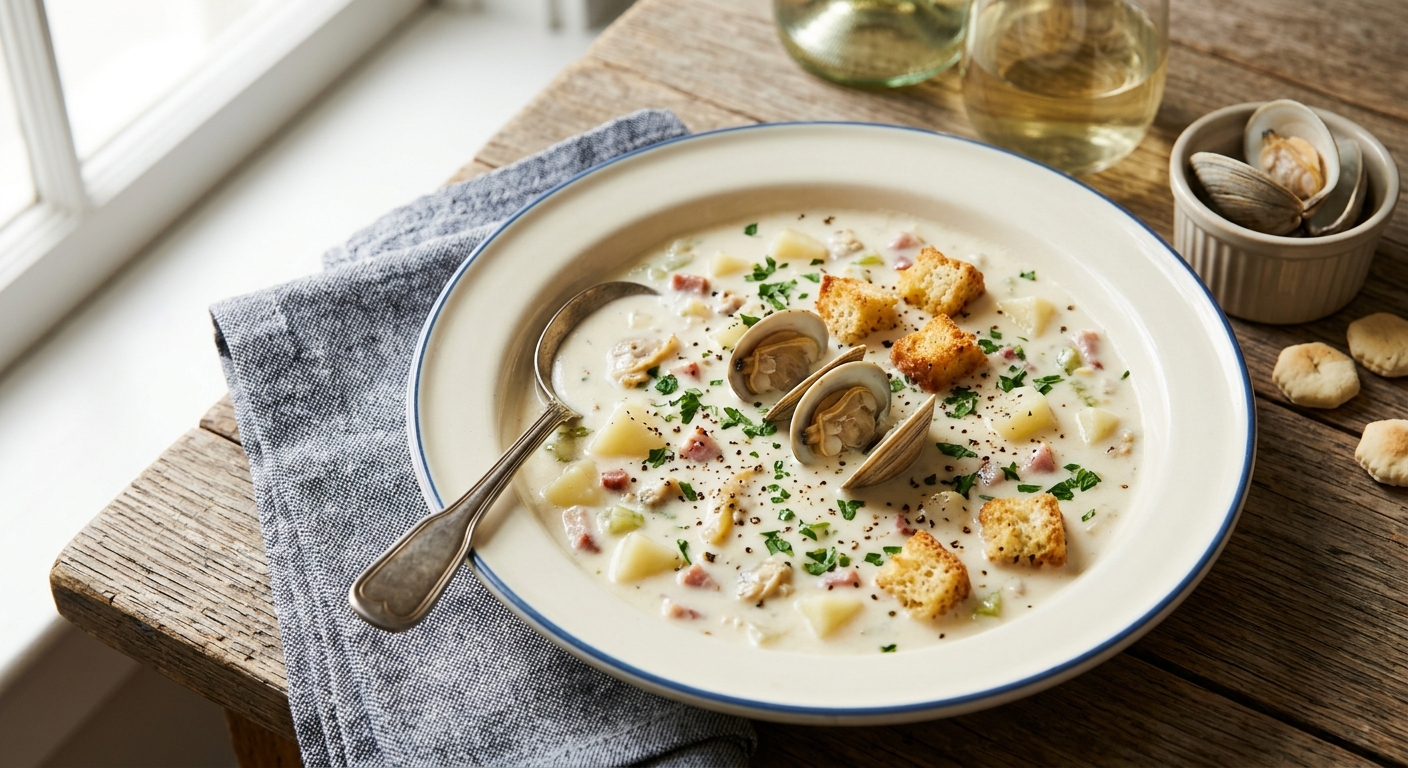
Few dishes in the American culinary canon carry the nutritional authority of a properly made New England clam chowder. Behind that ivory, cream-kissed broth lies one of the most mineral-dense meals you can put in a bowl: littleneck and chopped surf clams that deliver staggering quantities of vitamin B12, iron, zinc, and selenium in a single serving. We have engineered this recipe to maximize those benefits without sacrificing even a degree of the soul-warming comfort that makes chowder a lifelong obsession.
The science here starts with the clam itself. Gram for gram, clams rank among the highest food sources of vitamin B12 on the planet, outpacing beef liver in B12 density and providing non-heme iron that, when paired with this recipe’s potato-derived vitamin C and the acidity from a small addition of dry white wine, becomes meaningfully more bioavailable. The smokiness comes from a modest amount of thick-cut bacon, which contributes not just flavor but also a lipid matrix that helps fat-soluble nutrients absorb more efficiently. Every ingredient here has a reason to exist, both on the palate and on the periodic table.
What separates a Calibrated Cuisine chowder from a diner version is restraint and technique. We use a roux built on rendered bacon fat and a whisper of butter to create body without drowning the clam liquor, then finish with half-and-half rather than heavy cream to keep saturated fat in a sensible range while preserving that signature silkiness. The result is a chowder that is genuinely restaurant-worthy, precisely calibrated, and nutritionally transformative. Choose your cooking method below: stovetop for the most control, slow cooker for a hands-off afternoon, or pressure cooker when dinner needs to arrive in under 30 minutes.
4
servings
Ingredients
- 1200 gfresh littleneck clams, scrubbed (or 3 x 280g cans of chopped clams in clam juice, drained with juice reserved)
- 120 gthick-cut bacon, cut into 1cm lardons
- 1 tbspunsalted butter
- 180 gyellow onion, finely diced (about 1 large onion)
- 120 gcelery, finely diced (about 3 stalks)
- 3 clovesgarlic, minced
- 3 tbspall-purpose flour
- 120 mldry white wine (such as Pinot Grigio or Muscadet)
- 600 mlclam juice (from reserved canned liquor, bottled, or steaming fresh clams)
- 240 mllow-sodium chicken stock
- 600 gYukon Gold potatoes, peeled and cut into 1.5cm cubes
- 2 sprigsfresh thyme
- 2 wholebay leaves
- 360 mlhalf-and-half (10% fat)
- 2 tbspfresh flat-leaf parsley, finely chopped
- 1 tspsmoked paprika
- —Colima Sea SaltMicroplastic Free Salt and white pepper to taste
- —Oyster crackers or crusty sourdough, to serve
Instructions
Click on an item below to shop for the recommended items for this recipe on Amazon.
As an Amazon Associate, we earn from qualifying purchases.
- If using fresh clams, place them in a large pot with 240ml of water, cover tightly, and bring to a high heat. Steam for 5 to 7 minutes, shaking the pot once, until shells open. Remove clams with a slotted spoon, discard any that remain closed, and strain the steaming liquid through a fine-mesh sieve lined with a paper towel to remove grit. Reserve this liquid as your clam juice. When cool enough to handle, remove clam meat from shells and roughly chop. Set aside.
- Wipe out the pot and set it over medium heat. Add the bacon lardons and cook, stirring occasionally, for 6 to 8 minutes until the fat is fully rendered and the bacon is golden and crisp. Use a slotted spoon to transfer the bacon to a paper-towel-lined plate, leaving all the rendered fat in the pot.
- Add the butter to the bacon fat. Once foaming subsides, add the diced onion and celery with a pinch of salt. Cook over medium heat, stirring frequently, for 6 to 8 minutes until the vegetables are completely softened and translucent but not browned. Add the minced garlic and smoked paprika, stir for 60 seconds until fragrant.
- Sprinkle the flour over the vegetables and stir constantly for 2 minutes to cook out the raw flour taste and build a pale roux. Pour in the white wine and stir vigorously, scraping up any bits from the pot bottom. Let the wine bubble and reduce for 90 seconds.
- Pour in the clam juice and chicken stock in a steady stream, whisking to prevent lumps. Add the cubed potatoes, thyme sprigs, and bay leaves. Bring to a gentle boil, then reduce heat to a steady simmer. Cook uncovered for 15 to 18 minutes, stirring occasionally, until the potatoes are completely tender when pierced with a knife.
- Remove and discard the thyme sprigs and bay leaves. Reduce heat to low. Pour in the half-and-half and stir gently to combine. Add the chopped clam meat and the reserved crispy bacon. Warm through for 3 to 4 minutes over low heat, but do not boil, as boiling will toughen the clams and may cause the dairy to break.
- Taste and adjust seasoning with fine sea salt and white pepper. Ladle into warm bowls, garnish with fresh parsley, and serve immediately with oyster crackers or crusty sourdough.
- In a skillet over medium heat, cook the bacon lardons for 6 to 8 minutes until crisp and the fat is rendered. Transfer bacon to a plate and pour all rendered fat into your slow cooker insert. Add the butter to the same skillet over medium heat. Cook the onion and celery for 5 minutes until softened. Add garlic and smoked paprika, stir for 60 seconds, then sprinkle in the flour and stir for 90 seconds to form a roux directly in the skillet. Pour in the white wine and stir until absorbed, about 1 minute. Scrape the entire contents of the skillet into the slow cooker.
- Add the clam juice, chicken stock, cubed potatoes, thyme sprigs, and bay leaves directly to the slow cooker. Stir to combine everything evenly. The roux mixture will integrate and thicken the broth as it cooks. Season lightly with salt and white pepper, keeping in mind that clam juice is already saline.
- Place the lid on the slow cooker and cook on Low for 5 hours 30 minutes, or on High for 2 hours 30 minutes, until the potatoes are completely tender and the broth has taken on a rich, slightly thickened consistency from the starch released by the potatoes.
- Remove the thyme sprigs and bay leaves. Use the back of a spoon to gently crush 3 or 4 potato cubes against the side of the insert; this releases starch directly into the broth and adds body without any additional thickener. Stir in the half-and-half, the drained canned clam meat, and the reserved crispy bacon. Replace the lid and cook on Low for a final 20 to 30 minutes until the chowder is heated through and creamy. Do not allow it to boil.
- Taste carefully for seasoning, adjusting with salt and white pepper. Ladle into warmed bowls, finish with chopped parsley, and serve with oyster crackers.
- Set your Instant Pot or electric pressure cooker to the Saute function on Normal heat. Add the bacon lardons and cook for 5 to 6 minutes, stirring occasionally, until crisp and rendered. Use a slotted spoon to remove the bacon and set it aside. Add the butter to the pot. Once melted, add the onion and celery and saute for 4 minutes until softened. Add the garlic and smoked paprika and stir for 30 seconds.
- Add the flour and stir constantly for 90 seconds to cook the roux directly in the Instant Pot insert. Pour in the white wine and stir until completely absorbed, about 45 seconds, scraping the bottom of the pot thoroughly to prevent the ‘burn’ warning. Add the clam juice and chicken stock, whisking to ensure the roux is fully dissolved and no lumps remain.
- Add the cubed potatoes, thyme sprigs, and bay leaves. Do not add the half-and-half or clam meat at this stage. Secure the lid, set the valve to Sealing, and pressure cook on High for 8 minutes. The pressure cooker will take approximately 8 to 10 minutes to come to pressure before the countdown begins.
- When the cook time ends, allow the pressure to release naturally for 10 minutes, then carefully switch the valve to Venting to release any remaining pressure. Open the lid and remove the thyme sprigs and bay leaves. The potatoes should be completely tender and the broth noticeably thickened.
- Switch back to the Saute function on Low. Stir in the half-and-half, the chopped clam meat, and the crispy bacon. Heat gently for 3 to 4 minutes, stirring frequently, until warmed through. Do not allow the chowder to boil at this stage. Taste and adjust seasoning with salt and white pepper, then serve immediately garnished with fresh parsley.
Nutrition Breakdown
Per 1 serving (makes 4)
Vitamins & Minerals
% Daily Value based on a 2,000 calorie diet (FDA reference)
🧬 Essential Amino Acids
% of recommended daily intake (RDA) per serving
🛡 Antioxidant Profile
The Nutrition Science
The nutritional story of clam chowder begins with the bivalve at its center. Clams (particularly littleneck and surf clam species) are the single richest dietary source of vitamin B12 known to nutritional science, providing upward of 84mcg per 100g of cooked meat. B12 is essential for myelin sheath synthesis, the maintenance of neurological function, and the conversion of homocysteine to methionine, an amino acid critical for methylation reactions throughout the body. At the levels delivered in this recipe, a single serving can replenish B12 stores that might take weeks to restore through conventional omnivorous eating, making this dish particularly valuable for those recovering from deficiency or following patterns of eating that limit animal products at other meals.
Clams are equally remarkable for their iron content, which at over 18mg per serving, surpasses the RDA for both men and women in a single bowl. While this is non-heme iron and therefore less inherently bioavailable than heme iron from red meat, the recipe is strategically constructed to maximize its absorption. The white wine introduces an acidic pH environment in the stomach that keeps iron in its more soluble ferrous (Fe2+) state. The potatoes contribute roughly 22mg of vitamin C per serving, a nutrient that directly reduces ferric iron to ferrous iron in the gut lumen, dramatically improving uptake through intestinal enterocytes. The bacon fat and half-and-half, meanwhile, provide a lipid matrix that enhances absorption of fat-soluble micronutrients including vitamin A precursors from parsley.
Selenium deserves particular attention in this recipe. At 68mcg per serving, this chowder provides 124% of the daily value of a trace mineral that is critically deficient in many Western diets due to selenium-depleted agricultural soils. Selenium is the enzymatic cofactor for glutathione peroxidase and thioredoxin reductase, two master antioxidant enzymes that protect cells from oxidative damage linked to cardiovascular disease, thyroid dysfunction, and accelerated cellular aging. The zinc content (5.8mg, 53% DV) further supports immune function by enabling the activity of over 300 metalloenzymes, including those responsible for DNA synthesis and protein metabolism, meaning this chowder actively supports cellular repair and immune surveillance with every bowl.
Pro Tips
- Never boil the chowder after adding the half-and-half: sustained heat above 85 degrees Celsius will cause the proteins in the cream to denature and separate, yielding a grainy, broken broth. Keep the finish on the gentlest possible simmer.
- If using fresh clams, buy them the day you plan to cook and keep them in a bowl covered with a damp cloth in the refrigerator, never submerged in fresh water, which will kill them. Tap any open clam before cooking; if it does not close, discard it.
- For a chowder with extra body without adding more cream, remove about 240ml of the cooked potato and broth mixture before adding the dairy, blend it smooth with an immersion blender, and stir it back in. This starch-thickening trick adds silkiness and keeps the glycemic load lower than a heavy cream alternative would.
Love this take on clam chowder as a functional dish, Oliver makes a great point about bioavailability. One thing I’d add for anyone making this: sourcing matters here since clams can concentrate heavy metals like cadmium depending on where they’re harvested, so wild-caught from clean Atlantic waters (Northeast US suppliers tend to be more transparent about this) is worth seeking out over farmed. Also curious whether the recipe specifies organic potatoes or addresses the bacon sourcing, since conventional bacon often carries higher pesticide residues and nitrates that can actually interfere with some of that mineral absorption you’re getting from the clams.
This is exactly the kind of recipe that changes outcomes in my patients. Clams deliver that B12 in highly bioavailable methylcobalamin form, plus the selenium and iron work synergistically for cardiovascular health. One thing worth noting: the bacon adds flavor but check your omega-6 load if you’re using conventional pork, wild boar or pasture-raised cuts shift the ratio considerably. Have you tested how the cooking method affects B12 retention, or does the gentle simmer preserve most of it?
this is such a thoughtful question about the cooking method and B12, oliver. i havent seen a ton of published data on gentle simmering specifically but i do know heat degrades it somewhat, so a lower temp and shorter cook time would theoretically preserve more than a hard boil, though honestly with clams youre getting such a massive dose that even partial loss still leaves you way ahead. what i found interesting in my own recovery journey though is that even when im doing everything “right” nutrient-wise, i have to stay really careful about clam sourcing because theyre bioaccumulators and ive noticed my symptoms flare differently depending on where they came from, plus some conventional farms can have higher m
This is such important context, Liza, and I really appreciate you naming the sourcing piece because I’ve noticed the exact same thing with my Hashimoto’s flares. I actually switched to clams from specific Atlantic sources after tracking my symptoms for a few months, and the difference in my inflammation markers was noticeable. I’m curious if you’ve found any particular regions or farming practices that work better for you? Also wondering if anyone here has experience with how the cream base (if it’s dairy) might interact with clam bioaccumulation issues, since I’m always balancing the mineral density against potential inflammatory triggers in my AIP approach.
This kind of symptom tracking is exactly what I see work in practice, Anna. Atlantic clams tend to have lower cadmium loads than Pacific varieties, and if your inflammation markers improved, that’s meaningful data. On the dairy question: the fat in cream actually enhances absorption of fat-soluble minerals and may help modulate the bioavailability of any accumulated metals, though I’d be curious whether you’ve noticed differences between grass-fed versus conventional cream in your own tracking. For AIP specifically, you might also consider the clam cooking liquid as a mineral-rich broth base if you’re rotating away from the cream some days, since the selenium and B12 leach into the water anyway.
Really glad to see the Atlantic vs Pacific clam distinction here, Oliver, because cadmium bioaccumulation is genuinely one of those practical sourcing details most recipes completely gloss over. On the cream question: I’d also flag that conventional dairy can carry pesticide residues (particularly in the butterfat), so if Anna’s tracking inflammation, sourcing grass-fed cream makes sense both for the fat-soluble nutrient absorption you mentioned and for reducing that additional toxic load. The clam cooking liquid tip is solid too, though I’d note that the selenium concentration depends heavily on water quality in the harvest area, so knowing the specific source matters there as well. Has anyone in your practice found that batch variability with