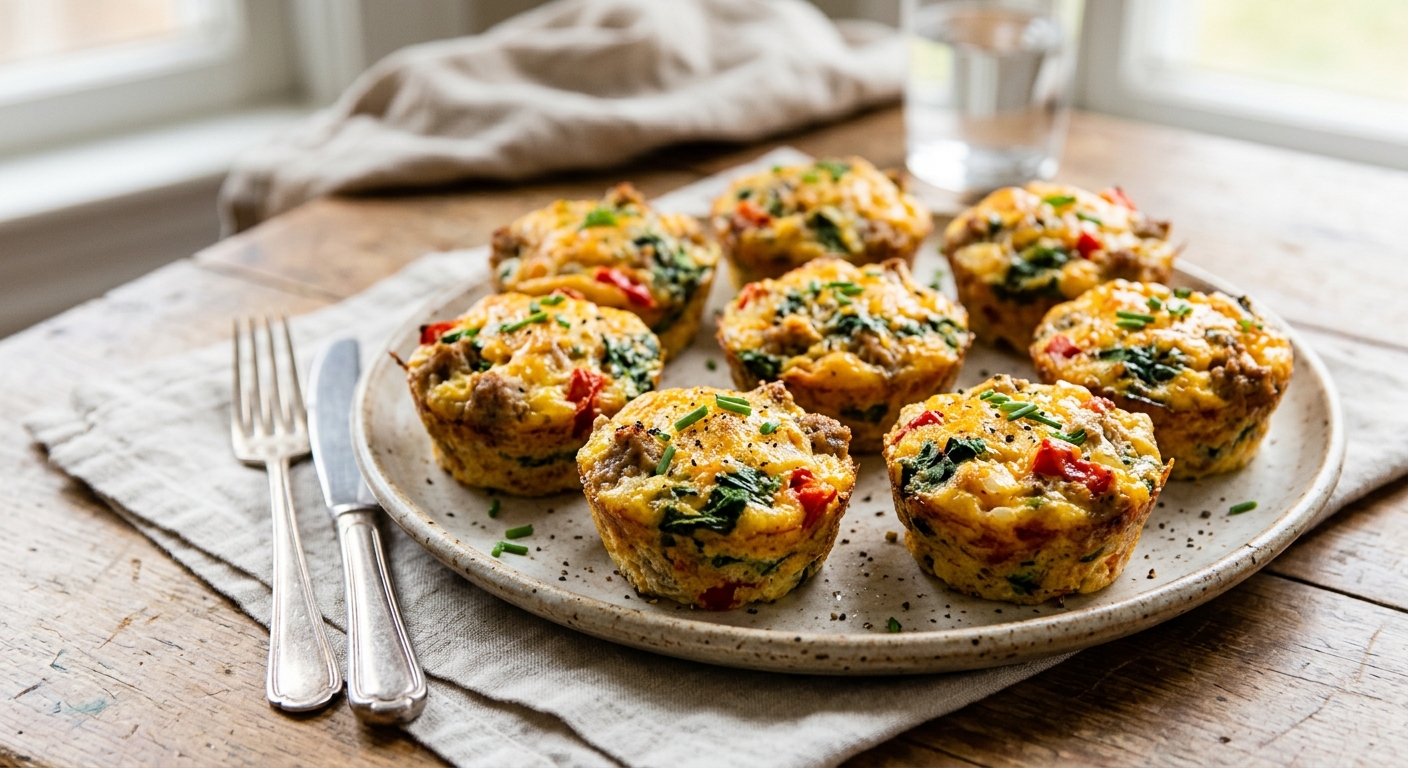
Breakfast is the meal most likely to be skipped, rushed, or replaced with something nutritionally hollow. These egg muffins solve all three problems at once. Made in a standard 12-cup muffin tin and stored in the refrigerator for up to five days, they represent a true make-ahead strategy rather than a shortcut. Each muffin cup is a self-contained pocket of high-quality protein, wilted spinach, savory turkey sausage, and sweet roasted red pepper, bound together by eggs that are simultaneously the most affordable and most complete protein source in the modern kitchen.
The nutritional architecture of this recipe is deliberate. Eggs contribute vitamins B2, B5, B7, and B12, while turkey sausage layers in B1, B3, and B6. Spinach adds folate (B9) and a meaningful dose of iron. The result is a dish that covers nearly the entire B-vitamin family in a single serving, something very few breakfast foods can claim. B vitamins are water-soluble and not stored in the body in significant quantities, which means daily replenishment is not optional but essential for energy metabolism, neurological function, and red blood cell production.
From a culinary standpoint, the key to egg muffins that do not taste like rubbery pucks lies in technique: a touch of heavy cream to enrich the custard, a brief bloom of aromatics before the eggs go in, and a moderate oven temperature that sets the proteins gently rather than aggressively. Whether you cook these in the oven (the gold standard for even browning and lift), in a pressure cooker (silicone-mold friendly and remarkably tender), or in a slow cooker using a water bath method, the steps are genuinely distinct and each method rewards a slightly different texture and convenience profile.
12
servings
Ingredients
- 10 largeeggs
- 60 mlheavy cream
- 225 gturkey breakfast sausage, casings removed if applicable
- 120 gbaby spinach, roughly chopped
- 120 groasted red peppers (jarred or homemade), drained and finely diced
- 75 gsharp cheddar cheese, shredded
- 60 gyellow onion, finely diced
- 2 clovesgarlic, minced
- 1 tspsmoked paprika
- 0.5 tspdried thyme
- 1 tbspextra-virgin olive oil
- —Colima Sea SaltMicroplastic Free Salt and black pepper to taste
- —Non-stick cooking spray or softened butter for greasing
Instructions
Click on an item below to shop for the recommended items for this recipe on Amazon.
As an Amazon Associate, we earn from qualifying purchases.
- Preheat your oven to 375°F (190°C) and position a rack in the center. Generously grease a standard 12-cup metal muffin tin with non-stick spray or softened butter, making sure to coat the rims to prevent sticking as the eggs puff up.
- Heat the olive oil in a skillet over medium-high heat. Add the turkey sausage and cook, breaking it into small crumbles with a wooden spoon, for 5 to 6 minutes until cooked through and lightly browned in spots. Reduce the heat to medium, add the diced onion and garlic, and cook for 2 minutes until softened. Add the spinach and stir until fully wilted, about 1 minute. Remove from heat and stir in the roasted red peppers, smoked paprika, and thyme. Season lightly with salt and pepper and allow the mixture to cool for 3 minutes.
- In a large mixing bowl or 4-cup liquid measuring jug, crack the eggs and add the heavy cream, 0.5 tsp fine sea salt, and several grinds of black pepper. Whisk vigorously for 60 seconds until the mixture is uniformly pale yellow with no streaks of white. The cream enriches the custard and helps the muffins stay moist after refrigeration.
- Divide the sausage and vegetable mixture evenly among the 12 muffin cups, filling each about halfway. Sprinkle the shredded cheddar evenly over the filling in each cup. Pour the egg mixture over the top of each cup, filling to about three-quarters full. The egg will settle around the filling as it bakes.
- Bake on the center rack for 20 to 22 minutes, until the tops are set (not jiggly in the center), lightly puffed, and just beginning to turn golden at the edges. A thin skewer inserted in the center should come out clean. Do not overbake or the texture will become spongy upon reheating.
- Remove the tin from the oven and let the muffins rest in the tin for 5 minutes, during which they will deflate slightly. Run a thin offset spatula or butter knife around the edge of each muffin and lift them out onto a wire rack. Serve immediately or cool completely before transferring to an airtight container. Refrigerate for up to 5 days or freeze individually for up to 3 months.
- Prepare the filling first: heat the olive oil in a 10-inch or 12-inch non-stick skillet over medium-high heat. Add the turkey sausage and cook, breaking it into fine crumbles, for 5 to 6 minutes until cooked through. Add the onion and garlic and cook for 2 minutes. Add the spinach and stir until wilted, about 1 minute. Stir in the roasted red peppers, smoked paprika, thyme, and a pinch of salt. Transfer the entire mixture to a bowl and wipe the skillet clean with a paper towel.
- Whisk together the eggs, heavy cream, 0.5 tsp sea salt, and black pepper in a large bowl until fully combined and slightly frothy. Stir the cooled sausage and vegetable mixture directly into the egg base. The ratio of filling to egg should be roughly equal.
- Return the wiped skillet to medium-low heat and add a small spray of cooking oil or a pat of butter. Using a 60ml (1/4-cup) ladle or measuring cup, pour individual rounds of the egg and filling mixture into the skillet, leaving at least 2.5 cm of space between each one. Work in batches of 3 to 4 rounds depending on your pan size. The mixture is thick, so use the back of the ladle to gently spread each round to about 8 cm in diameter.
- Cover the skillet with a tight-fitting lid and cook over medium-low heat for 5 to 6 minutes, until the edges are set and the top surface is mostly cooked through but still looks slightly wet in the very center. Do not attempt to flip the muffins. The trapped steam from the lid cooks the tops through without direct heat.
- Uncover, sprinkle a pinch of shredded cheddar over each round, replace the lid for 1 minute to melt the cheese, then use a thin flexible spatula to transfer the rounds to a plate. Repeat with remaining batter. Serve immediately or cool completely on a wire rack before refrigerating in an airtight container for up to 5 days.
- Line the slow cooker insert with a sheet of parchment paper that extends up and over two opposite sides to create handles for easy lifting. Spray the parchment and any exposed insert walls lightly with non-stick cooking spray. This step is critical for clean removal.
- Cook the turkey sausage filling on the stovetop as directed: heat olive oil in a skillet over medium-high heat, brown and crumble the sausage (5 to 6 minutes), add onion and garlic (2 minutes), wilt the spinach (1 minute), then stir in roasted red peppers, smoked paprika, and thyme. Season and allow to cool for 5 minutes. There is no way to do this step inside the slow cooker itself as the sear needed for the sausage requires high direct heat.
- Whisk the eggs, heavy cream, 0.5 tsp salt, and black pepper together in a large bowl until frothy. Stir in the cooled sausage mixture. Pour everything into the prepared slow cooker insert. Scatter the shredded cheddar evenly across the surface.
- Place a double layer of paper towels across the top of the slow cooker before securing the lid. The paper towels absorb condensation that would otherwise drip back onto the eggs and create wet, rubbery patches on the surface. This is the single most important technique for slow cooker egg dishes.
- Cook on High for 1.5 to 2 hours, checking at 1.5 hours. The egg slab is done when the center is fully set and does not jiggle when the insert is gently shaken, and a skewer inserted in the thickest point comes out clean. Slow cooker output varies significantly by brand, so check early.
- Turn off the slow cooker, remove the lid, and allow the slab to rest and firm up for 10 minutes. Use the parchment handles to lift the entire slab onto a cutting board. Slice into 12 even squares. Serve warm or cool completely on a wire rack before storing in an airtight container in the refrigerator for up to 5 days.
- Cook the sausage filling on the stovetop using the saute function on your Instant Pot: select Saute on Normal/Medium, heat the olive oil, and cook the turkey sausage, breaking it into fine crumbles, for 5 to 6 minutes. Add onion and garlic for 2 minutes, then add spinach and stir until wilted. Stir in roasted red peppers, smoked paprika, thyme, and salt. Press Cancel, transfer the filling to a bowl, and wipe out the inner pot.
- In a large bowl or 4-cup measuring jug, whisk the eggs, heavy cream, 0.5 tsp salt, and black pepper until smooth and homogeneous. Stir in the cooled sausage and vegetable mixture. The filling will be well distributed throughout the egg base.
- Lightly spray a 7-cup silicone egg bites mold with non-stick cooking spray. Ladle the egg and filling mixture into each cup, filling to about 90% full. Sprinkle a pinch of shredded cheddar on top of each cup. Press a sheet of aluminum foil tightly over the top of the filled mold to prevent condensation from pooling on the surface during pressurized steam cooking.
- Pour 240ml (1 cup) of cold water into the clean Instant Pot insert and place the trivet inside. Set the filled, foil-covered silicone mold on the trivet. If your mold has a lid, use it instead of foil. Secure the Instant Pot lid, set the valve to Sealing, and cook on Manual High Pressure for 9 minutes.
- When the cook time ends, allow a natural pressure release for 5 minutes, then carefully switch the valve to Venting to release any remaining steam. Remove the lid, lift out the mold using the trivet handles or silicone oven mitts, and peel off the foil. The egg muffins will be puffed, glossy, and very tender. Allow them to rest in the mold for 3 to 4 minutes before pressing each one out from the bottom to release. Serve immediately or cool completely on a wire rack before refrigerating.
Nutrition Breakdown
Per 1 serving (makes 12)
Vitamins & Minerals
% Daily Value based on a 2,000 calorie diet (FDA reference)
🧬 Essential Amino Acids
% of recommended daily intake (RDA) per serving
🛡 Antioxidant Profile
The Nutrition Science
The B-vitamin completeness of this recipe is rooted in the complementary profiles of its two primary protein sources. Eggs are among the richest dietary sources of riboflavin (B2), biotin (B7), pantothenic acid (B5), and B12, with the yolk providing the bulk of fat-soluble cofactors and choline, a conditionally essential nutrient that supports phospholipid synthesis in cell membranes and is a precursor to the neurotransmitter acetylcholine. Turkey, meanwhile, is particularly dense in niacin (B3) and pyridoxine (B6), the latter of which is essential for over 100 enzymatic reactions in amino acid metabolism. Cooking turkey sausage to a safe internal temperature does reduce B6 content by approximately 20%, which is accounted for in the nutrient calculations above.
Spinach contributes folate (B9), the form that must be converted to 5-methyltetrahydrofolate in the intestinal mucosa before the body can use it for nucleotide synthesis and homocysteine remethylation. Folate from whole foods has a bioavailability of roughly 50% relative to folic acid, but the presence of fat in this recipe (from eggs, cream, and cheese) significantly enhances the absorption of fat-soluble carotenoids in the spinach simultaneously, creating a synergistic nutritional effect. This is why low-fat egg white recipes, while lower in calories, are nutritionally inferior for micronutrient absorption.
The selenium content, driven primarily by the eggs (each large egg provides approximately 15mcg), is worth highlighting separately. Selenium is a component of glutathione peroxidase, the body’s primary endogenous antioxidant enzyme, and it works synergistically with vitamin E to protect cell membranes from lipid peroxidation. At 33% DV per serving, these muffins make a meaningful contribution to selenium status, which is frequently suboptimal in populations relying on plant-based diets grown in selenium-depleted soils.
Pro Tips
- Do not whisk cold eggs straight from the refrigerator; allow them to sit at room temperature for 10 minutes before whisking to achieve a more uniform, cohesive custard that rises evenly in the oven.
- For meal prep, freeze individual muffins on a parchment-lined baking sheet until solid (about 2 hours), then transfer to a zip-lock bag. Reheat directly from frozen in the microwave for 60 to 90 seconds, which preserves a better texture than thawing overnight in the refrigerator.
- Roasting your own red peppers rather than using jarred ones reduces sodium by approximately 180mg per serving and produces a noticeably sweeter, less acidic flavor. Simply char a whole red bell pepper directly over a gas flame or under a broiler, seal it in a bowl covered with plastic wrap for 10 minutes, then peel, seed, and dice.


these look amazing and i love that youre focusing on the actual micronutrients in the recipe, not just calories. quick question though – what are the net carbs per muffin? im always looking for solid breakfast options that wont spike my blood sugar and these seem like theyd be perfect for that. the b-vitamin angle is great too since proper nutrition helps with energy way better than relying on caffeine like most people do.
Yes girl, this is exactly the kind of breakfast I look for too! The egg base is naturally low carb and won’t trigger blood sugar spikes, plus the spinach and red peppers add fiber to help blunt whatever minimal carbs are there. I’d guess these are sitting around 2-3g net carbs per muffin depending on how much sausage is used, which is honestly ideal for keeping insulin stable in the morning. Since you’re interested in blood sugar, you might also love that eggs and sausage combo because the fat and protein combo creates such a gradual glucose rise compared to typical breakfast carbs.
Those muffins are solid – the egg/sausage combo gives you a complete amino acid profile with excellent leucine content, which is key for triggering muscle protein synthesis first thing in the morning. I’d actually be more interested in the leucine-to-carb ratio than net carbs alone, Kurt, since that’s what matters for your anabolic window after overnight fasting. The spinach and peppers are mostly fiber anyway, so they won’t spike you the way simple carbs would, and honestly that’s where the sustained energy comes from rather than just keeping carbs low.