
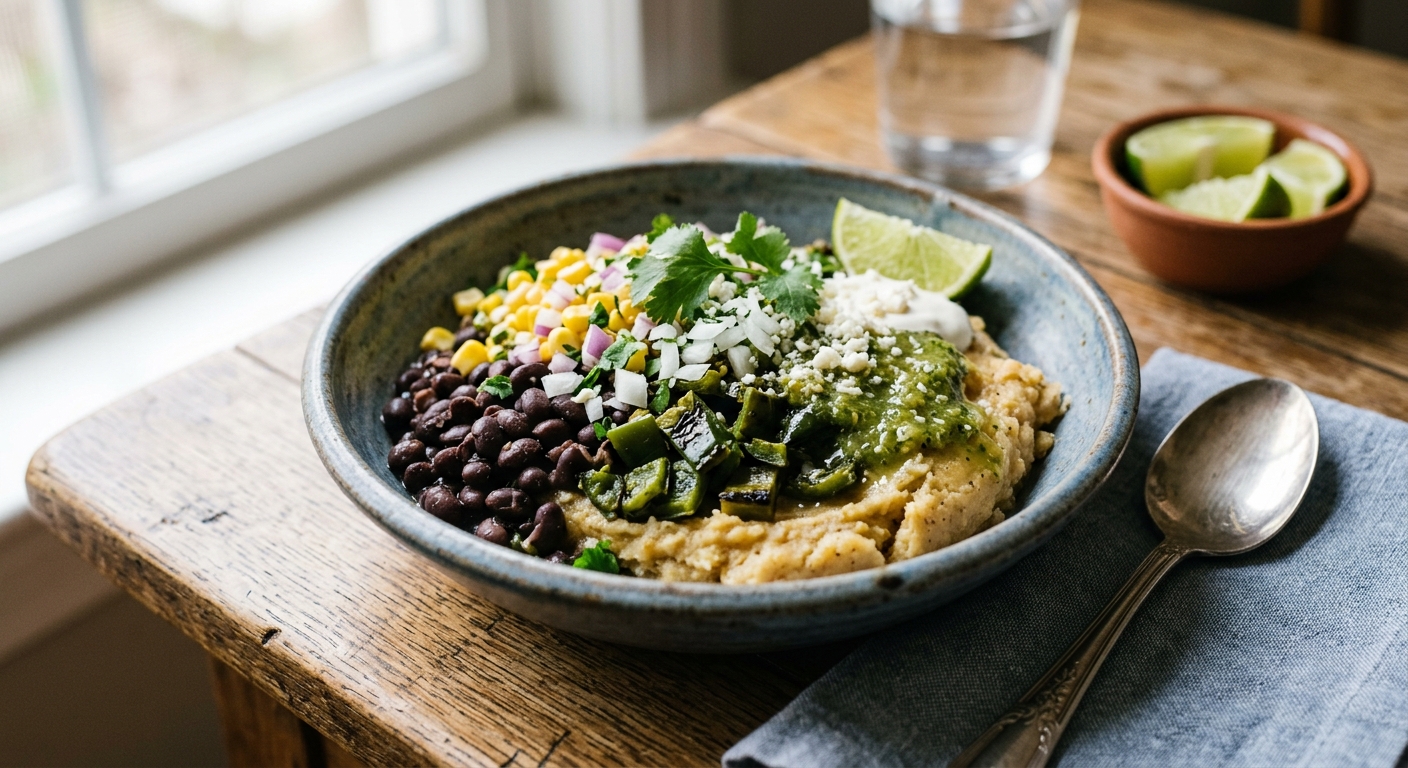
The tamale is one of Mesoamerica’s oldest complete foods, and for good reason: masa (nixtamalized corn) paired with beans creates a nutritional partnership that has sustained civilizations for millennia. This Tamale Bowl deconstructs that ancient formula into a weeknight-friendly format, layering creamy masa polenta with spiced black beans, charred poblano strips, and a vivid tomatillo salsa verde. Every component is chosen not just for flavor, but because it moves the nutritional needle in a meaningful way.
What makes this bowl genuinely exceptional is the synergy between its iron sources and its vitamin C delivery. Black beans and masa both carry non-heme iron, and the tomatillo salsa verde provides roughly 23mg of vitamin C per serving, which clinical research consistently shows can increase non-heme iron absorption by two to four times. The folate story is equally compelling: black beans alone contribute over 120mcg per half-cup cooked, and the combination of beans, masa, and tomatillos pushes a single serving close to 70% of the daily recommended intake, making this bowl particularly valuable for anyone in a high-folate-demand life stage.
Beyond the headline minerals, the fiber architecture here is worth understanding. The resistant starch in masa, the soluble fiber in black beans, and the pectin in tomatillos work as a prebiotic ensemble, feeding distinct populations of beneficial gut bacteria. At 18 grams of fiber per serving, this bowl delivers 64% of the daily value while keeping the glycemic load firmly in the medium range, thanks to the slow-digesting complex carbohydrates and the buffering effect of protein and fat from the beans and olive oil.
4
servings
Ingredients
- 240 gmasa harina (nixtamalized corn flour)
- 900 mllow-sodium vegetable broth, divided
- 2 tbspextra-virgin olive oil, divided
- 500 gdried black beans, soaked overnight and drained (or 800g canned, rinsed)
- 1200 mlwater (for cooking dried beans)
- 3 mediumpoblano chiles (about 300g total)
- 1 mediumwhite onion, finely diced
- 4 clovesgarlic, minced
- 2 tspground cumin
- 1 tspsmoked paprika
- 0.5 tspdried oregano (Mexican preferred)
- 600 gfresh tomatillos, husked and rinsed (or two 400g cans, drained)
- 1 mediumjalapeño, roughly chopped (seeds removed for mild heat)
- 30 gfresh cilantro, stems and leaves separated
- 2 tbspfresh lime juice (about 2 limes)
- 0.5 tspsugar (optional, to balance tomatillo acidity)
- 60 gpepitas (pumpkin seeds), toasted
- 1 mediumavocado, sliced
- —Colima Sea SaltMicroplastic Free Salt and freshly cracked black pepper to taste
Instructions
Click on an item below to shop for the recommended items for this recipe on Amazon.
As an Amazon Associate, we earn from qualifying purchases.
- Cook the black beans: If using soaked dried beans, place them in a large saucepan with 1200ml water and a generous pinch of salt. Bring to a vigorous boil over high heat, skim any foam, then reduce to a steady simmer. Cook uncovered for 45 to 55 minutes until beans are completely tender but still holding their shape. Drain and set aside. If using canned beans, rinse thoroughly and proceed.
- Char the poblanos: Place poblanos directly over a gas burner on high heat, turning with tongs every 60 to 90 seconds, until the skin is completely blackened and blistered on all sides, about 6 to 8 minutes. Transfer to a bowl, cover tightly with plastic wrap, and let steam for 10 minutes. Peel away the charred skin, remove stems and seeds, and slice the flesh into strips about 1cm wide. If you have an electric cooktop, use the broiler method described in the oven section.
- Make the salsa verde: Combine tomatillos, jalapeño, and cilantro stems in a medium saucepan. Add just enough water to barely cover the tomatillos (about 250ml) and bring to a boil. Reduce heat and simmer for 10 minutes until tomatillos are completely soft and have lost their bright green color, turning olive-drab. Drain and transfer to a blender. Add lime juice, half the cilantro leaves, and the sugar if using. Blend until smooth. Season generously with salt. The salsa should be pourable but not watery. Keep warm over very low heat.
- Build the spiced beans: In a large skillet or Dutch oven over medium heat, warm 1 tablespoon olive oil. Add the onion with a pinch of salt and cook, stirring occasionally, for 7 to 8 minutes until softened and lightly golden at the edges. Add garlic, cumin, smoked paprika, and oregano, stirring constantly for 90 seconds until the spices are fragrant and slightly deepened in color. Add the cooked black beans and 120ml of vegetable broth. Stir well, crushing about one-quarter of the beans against the pan with the back of a spoon to create a creamy, cohesive texture. Simmer for 5 minutes, season with salt and pepper, and fold in the roasted poblano strips. Keep warm.
- Cook the masa polenta: In a medium heavy-bottomed saucepan, bring 780ml vegetable broth and 1 tablespoon olive oil to a gentle boil over medium-high heat. Gradually whisk in the masa harina in a slow, steady stream, whisking vigorously to prevent lumps. Reduce heat to medium-low immediately. Switch to a wooden spoon and stir continuously for 8 to 10 minutes, scraping the bottom and sides of the pan, until the masa is thick, smooth, and pulls away slightly from the sides. It should hold a soft mound on a spoon. Season with salt.
- Assemble the bowls: Spoon a generous mound of masa polenta into each of four wide, shallow bowls. Top with the spiced bean and poblano mixture. Ladle warm salsa verde over everything. Arrange avocado slices to one side, scatter toasted pepitas across the top, and finish with remaining cilantro leaves. Serve immediately while the masa is still creamy.
- Load the slow cooker with beans and aromatics: Do not pre-soak the beans for this method. Add the dried black beans directly to the slow cooker insert. Add the diced onion, minced garlic, cumin, smoked paprika, oregano, 1 tablespoon olive oil, and 1 teaspoon salt. Pour in 1200ml water and 120ml vegetable broth. Stir briefly. Do not add the lime juice or cilantro at this stage as acid inhibits bean softening. Set to Low and cook for 7 to 8 hours until beans are completely tender and creamy throughout.
- Roast and prepare the poblanos during the day: About 30 minutes before the beans are done, char the poblanos under your oven broiler. Position them on a foil-lined baking sheet about 10cm from the broiler element. Broil on high for 12 to 15 minutes, turning halfway, until fully charred. Seal in a bowl with plastic wrap for 10 minutes, then peel, seed, and slice into strips as described in the stovetop method.
- Make the blended salsa verde: While poblanos rest, combine tomatillos, jalapeño, and cilantro stems in a saucepan with 250ml water. Bring to a boil and simmer 10 minutes until soft. Blend with lime juice, cilantro leaves, optional sugar, and salt until smooth. Keep warm.
- Finish the beans in the slow cooker: Once the beans are tender, use a potato masher or the back of a large spoon to crush roughly one-quarter of the beans directly in the insert, creating a thick, stewlike consistency. Fold in the roasted poblano strips. Replace the lid and switch the slow cooker to Warm while you prepare the masa.
- Cook the masa polenta on the stovetop: In a medium heavy-bottomed saucepan, bring 780ml vegetable broth and 1 tablespoon olive oil to a gentle boil. Whisk in the masa harina in a thin, steady stream. Reduce heat to medium-low and stir continuously with a wooden spoon for 8 to 10 minutes until thick, smooth, and creamy. Season with salt.
- Assemble and serve: Ladle masa polenta into bowls, top with the slow-cooked bean and poblano mixture straight from the insert, pour over salsa verde, and finish with avocado slices, pepitas, and fresh cilantro leaves.
- Pressure-cook the beans from dry: Add the unsoaked dried black beans to the pressure cooker insert. Cover with 1400ml cold water (beans expand significantly and need ample liquid). Add 1 teaspoon salt and 1 tablespoon olive oil (the oil helps prevent foaming that can clog the vent). Seal the lid and set the steam release valve to Sealing. Cook on High Pressure for 35 minutes. Allow a natural pressure release for 15 minutes, then carefully switch the valve to Venting to release any remaining steam. The beans should be completely tender. Drain, reserving 250ml of the starchy bean-cooking liquid, and set aside.
- Build the salsa verde while beans cook: During the pressure-cook cycle, combine tomatillos, jalapeño, cilantro stems, and 250ml water in a medium saucepan on the stovetop. Bring to a boil, simmer 10 minutes, then blend with lime juice, cilantro leaves, optional sugar, and salt until smooth. Set aside. Also char poblanos over a gas burner or under the broiler, steam, peel, and slice into strips (see stovetop method steps 2).
- Saute the spiced bean mixture in the same pot: Once beans are drained and the insert is returned to the base, select the Saute (Normal) function. Add the remaining 1 tablespoon olive oil. When shimmering, add onion and cook for 5 to 6 minutes, stirring, until softened. Add garlic, cumin, paprika, and oregano, stirring for 60 seconds. Add the cooked beans back to the pot along with 120ml of the reserved bean-cooking liquid. Crush about one-quarter of the beans with a spoon for a creamy texture. Fold in the poblano strips. Season with salt and pepper. Press Cancel to stop the Saute function and keep warm.
- Cook the masa polenta on the stovetop: In a medium saucepan, bring 780ml vegetable broth and 1 tablespoon olive oil to a gentle boil. Whisk in masa harina steadily, reduce heat to medium-low, and stir with a wooden spoon for 8 to 10 minutes until thick, smooth, and glossy. Season with salt.
- Assemble the bowls: Divide masa polenta among four bowls. Spoon the pressure-cooked spiced beans and poblanos over the top. Ladle salsa verde generously over each bowl. Garnish with avocado slices, toasted pepitas, and fresh cilantro. Serve immediately.
- Preheat and prepare: Position one oven rack in the center and one in the upper third. Preheat to 180C (350F). Soak dried beans for at least 4 hours or overnight if possible for this method, as braising time is fixed. Drain and rinse.
- Roast the tomatillos and poblanos together: On a large rimmed baking sheet, arrange the whole husked tomatillos, halved jalapeño, and whole poblanos in a single layer. Drizzle with 1 teaspoon olive oil and toss lightly. Roast on the upper rack at 220C (425F) for 20 to 25 minutes until tomatillos are soft, blistered, and beginning to caramelize at the edges, and poblano skins are deeply charred. Remove poblanos to a bowl to steam. Transfer tomatillos and jalapeño with all their roasting juices to a blender. Add lime juice, cilantro leaves and stems, optional sugar, and salt. Blend until smooth. Taste and adjust seasoning. Reduce oven temperature back to 180C (350F).
- Braise the spiced beans in the oven: In a large Dutch oven over medium-high heat on the stovetop, warm 1 tablespoon olive oil. Saute onion for 6 minutes until softened. Add garlic, cumin, paprika, and oregano, stirring for 90 seconds. Add the drained soaked beans and 1000ml vegetable broth. Bring to a boil, then cover the Dutch oven tightly with its lid and transfer to the center oven rack at 180C (350F). Braise for 1 hour to 1 hour 15 minutes, checking at the 1-hour mark, until beans are completely tender. Remove from oven, crush one-quarter of the beans for creaminess, season with salt and pepper, and fold in peeled, sliced roasted poblanos.
- Bake the masa polenta cake: While beans braise, whisk masa harina into 780ml warm vegetable broth in a bowl until fully combined and smooth. Add 1 tablespoon olive oil and 1 teaspoon salt. Pour into a well-oiled 20x20cm (8×8 inch) baking dish. The batter will be about 2.5cm deep. Bake uncovered at 180C (350F) alongside the beans for 35 to 40 minutes, until the surface is set and lightly golden and the edges have pulled away slightly from the sides. Let cool for 5 minutes before cutting into four squares.
- Assemble: Place a masa cake square in the center of each wide, shallow bowl. Spoon the braised spiced beans and poblanos generously over and around the masa. Ladle the roasted tomatillo salsa verde over everything. Top with avocado slices, toasted pepitas, and cilantro leaves. The roasted salsa verde will have a deeper, sweeter flavor than the simmered version, complementing the caramelized beans beautifully.
Nutrition Breakdown
Per 1 serving (makes 4)
Vitamins & Minerals
% Daily Value based on a 2,000 calorie diet (FDA reference)
🧬 Essential Amino Acids
% of recommended daily intake (RDA) per serving
🛡 Antioxidant Profile
The Nutrition Science
The iron-folate synergy in this bowl is not accidental. Black beans are among the most folate-dense whole foods available, delivering roughly 128mcg per 100g cooked, while also contributing 3.6mg of non-heme iron per 100g. Non-heme iron, unlike the heme iron in meat, has absorption rates that are highly sensitive to dietary context. The tomatillo salsa verde provides approximately 34mg of vitamin C per serving, and multiple randomized controlled trials have demonstrated that consuming vitamin C alongside non-heme iron in the same meal can increase absorption efficiency from a baseline of 2 to 8% up to 15 to 20%, a meaningful clinical difference for anyone managing iron-deficiency risk.
Nixtamalization, the alkaline lime-water process used to make masa harina, is one of food science’s most consequential culinary innovations. Raw corn is rich in niacin and B vitamins, but they exist in a bound, biologically unavailable form called niacytin. Nixtamalization breaks these bonds, liberating niacin and dramatically increasing the bioavailability of folate and amino acids simultaneously. It also raises the calcium content of the grain and introduces a small but meaningful amount of dietary calcium from the processing lime itself. This is why populations that adopted corn as a dietary staple but skipped nixtamalization historically suffered from pellagra, while Mesoamerican cultures who invented the process did not.
The prebiotic fiber profile of this bowl deserves attention. Black beans are an excellent source of resistant starch type 2 and oligosaccharides, particularly raffinose and stachyose, which selectively feed Bifidobacterium and Lactobacillus species in the colon. Masa harina contributes resistant starch type 3, formed when cooked starch is cooled. Tomatillos supply pectin, a soluble fiber that forms a gel in the gut and is fermented by a distinct bacterial community to produce short-chain fatty acids including butyrate, the primary fuel source for colonocytes. Consuming all three fiber types together in one meal may provide broader microbiome support than any single fiber source alone.
Pro Tips
- For significantly better iron absorption, eat this bowl as your primary meal rather than pairing it with coffee or tea: both beverages contain polyphenols and tannins that competitively bind non-heme iron in the gut and can reduce absorption by up to 60% when consumed within an hour of the meal.
- The salsa verde freezes beautifully in ice-cube trays. Once solid, transfer cubes to a zip-lock bag and freeze for up to 3 months. A few cubes reheated in a saucepan with a splash of broth make a fast weeknight sauce for grain bowls, eggs, or roasted vegetables.
- If the masa polenta begins to stiffen before serving (it sets quickly once off the heat), whisk in warm vegetable broth one tablespoon at a time over low heat until it returns to a pourable, creamy consistency. Adding a drizzle of olive oil at this stage also enriches the mouthfeel.
this looks amazing and those micronutrient numbers are legit impressive, but im curious what the net carb count is on this one? the masa polenta and black beans are gonna have some carbs obviously, but id love to know the total before i dive in. ive found that even nutrient dense foods can spike my blood sugar if im not tracking carefully, so id probably sub the polenta for cauliflower mash and maybe go lighter on the beans, but the roasted poblanos and salsa verde combo sounds perfect either way
I totally get the concern, especially if you’re tracking CGM data like I do. Masa polenta does hit around 20-24g net carbs per serving depending on portion, and black beans add another 15-18g, so you’re probably looking at 35-40g total carbs which would def cause a noticeable spike for a lot of people. That said, I’d actually suggest keeping the polenta but trying it with the beans on the side rather than subbing entirely, since the resistant starch in cooled black beans has been shown to blunt glycemic response significantly (that 2015 study from Nutrition and Metabolism is wild). The cauliflower swap works too,
ok so this is right up my alley because ive been experimenting with higher iron intake on back to back long run days and this looks like exactly the kind of whole food approach i need instead of just relying on supplements. the masa polenta base is genius for carbs too, so im already thinking this could work as a solid post run meal when combined with some protein. do you have any thoughts on timing this with training, like would you eat it closer to a run or is it better as a full recovery meal a few hours after? also curious if the raw salsa verde keeps its nutritional punch or if cooking it down would change the folate availability.