
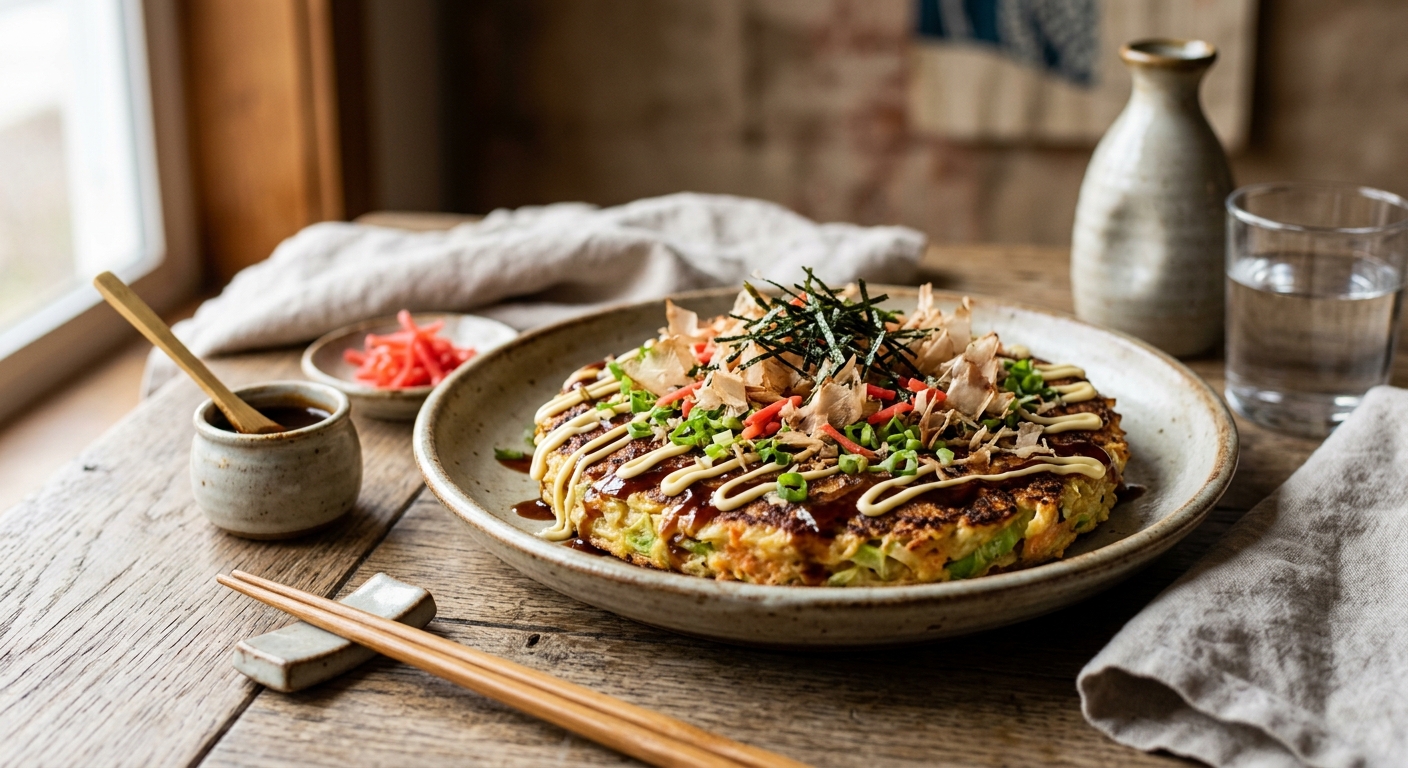
Okonomiyaki, whose name translates roughly to ‘cook what you like,’ is one of Japan’s most beloved street foods, originating in the Osaka and Hiroshima regions. Far from a simple pancake, it is a layered, umami-rich composition of finely shredded cabbage, a savory egg-and-flour batter, and a filling of your choice, all cooked on a flat griddle until the outside is deeply golden and the inside remains tender and custardy. Our Calibrated Cuisine version is engineered around two of the most important nutrients for lifelong skeletal health: calcium and high-quality, complete protein. Every ingredient has been chosen with precision to maximize your bone and joint health without sacrificing a single point of authenticity or flavor.
The foundation of this recipe’s nutritional architecture is a strategic trio: canned sockeye salmon (bones included and mashed in), firm tofu, and a generous measure of Parmesan cheese whisked into the batter. Canned salmon with its soft, edible bones is one of the most underrated calcium sources in Western cooking, delivering roughly 230mg of highly bioavailable calcium per 100g serving, along with abundant vitamin D, which is the critical co-factor the body needs to actually absorb that calcium. The tofu adds a second calcium hit alongside all nine essential amino acids, and the Parmesan closes the loop with a concentrated dairy-based calcium boost and a deep savory note that blends seamlessly with the traditional bonito and dashi flavors.
From a culinary perspective, great okonomiyaki is about texture contrast and layering. The cabbage must be shredded finely so it softens and sweetens during cooking without turning mushy. The batter must be minimally mixed to stay light. The heat must be moderate and patient, allowing the proteins to set gently so the interior stays moist. We provide three genuinely distinct cooking methods, plus an oven option, because the technique changes everything about the final texture. The stovetop delivers the most authentic char and crispy crust. The oven produces a hands-off, evenly set pancake ideal for serving a crowd. The pressure cooker creates a uniquely steamed, almost souffleed interior. Each is delicious. Each is bone-building. Each is absolutely worth your time.
4
servings
Ingredients
- 400 ggreen cabbage, very finely shredded (about 4 cups)
- 200 gcanned sockeye salmon, bones mashed in, drained
- 150 gfirm tofu, patted dry and crumbled
- 4 largeeggs, room temperature
- 120 gall-purpose flour
- 40 gfinely grated Parmesan cheese
- 120 mldashi stock or low-sodium chicken broth, chilled
- 2 tbspsoy sauce
- 1 tbspmirin
- 1 tspbaking powder
- 3 tbspAvocado Oil100% Pure Avocado Oil (avocado or sunflower), divided
- 4 stalksgreen onions, thinly sliced, green and white parts separated
- 2 tbspokonomiyaki sauce or Worcestershire sauce
- 2 tbspJapanese Kewpie mayonnaise
- 10 gbonito flakes (katsuobushi), for serving
- 5 gdried aonori seaweed flakes, for serving
- —Colima Sea SaltMicroplastic Free Salt and white pepper to taste
Instructions
Click on an item below to shop for the recommended items for this recipe on Amazon.
As an Amazon Associate, we earn from qualifying purchases.
- Make the batter: In a large mixing bowl, whisk together the flour, baking powder, Parmesan, dashi stock, soy sauce, mirin, and eggs until just combined. Do not overmix; a few small lumps are fine. Rest the batter in the refrigerator for 10 minutes while you prep the fillings.
- Fold in the fillings: Add the finely shredded cabbage, crumbled tofu, mashed salmon with bones, and the white parts of the green onions to the rested batter. Use a silicone spatula to fold everything together with about 12 to 15 deliberate strokes. The batter will look shaggy and cabbage-heavy; that is exactly right. Season lightly with white pepper and a small pinch of salt (the salmon and soy are already salty).
- Heat the pan: Place a 25cm (10-inch) nonstick or cast iron skillet over medium heat. Add 3/4 tbsp of neutral oil and swirl to coat. Heat until the oil shimmers and a drop of batter sizzles immediately on contact, about 2 minutes.
- Cook the first side: Ladle one-quarter of the batter into the center of the pan and use the back of the ladle to gently press it into an even round about 2cm thick and 20cm wide. Cover the pan with a lid or foil and cook undisturbed for 5 to 6 minutes over medium heat, until the edges look set and dry and the underside is deep golden brown when you peek with a thin spatula.
- Flip with confidence: Slide a wide, thin spatula fully under the pancake. Place a flat plate or second spatula on top for support, then flip in one decisive motion. Press down gently with the spatula to re-compact the pancake. Cook uncovered for 4 to 5 minutes until the second side is equally golden and the center reads 74C (165F) on an instant-read thermometer.
- Rest and top: Transfer to a wire rack for 2 minutes. Drizzle with okonomiyaki sauce and Kewpie mayonnaise in a zigzag pattern. Scatter bonito flakes, aonori, and the reserved green onion tops. The bonito will wave in the steam; serve immediately. Wipe the pan, add fresh oil, and repeat for the remaining 3 pancakes.
- Line the slow cooker insert: Cut a sheet of parchment paper to fit the bottom and sides of your 5 to 6 quart slow cooker insert with about 4cm of overhang on each side (the overhang will act as handles). Brush the parchment and any exposed insert walls lightly with 1 tbsp of neutral oil.
- Build the batter and fold in fillings: In a large bowl, whisk together the flour, baking powder, Parmesan, dashi stock, soy sauce, mirin, and eggs until just combined. Fold in the shredded cabbage, crumbled tofu, mashed salmon, and the white parts of the green onions with 12 to 15 strokes. Season with white pepper. The mixture will be very thick; this is intentional as the slow cooker environment is more humid than a skillet.
- Transfer and level: Pour and scrape all the batter into the prepared slow cooker. Use a wet spatula to press the mixture flat and even. Place a double layer of paper towels under the lid to absorb condensation and prevent water from dripping onto the surface, which would make it soggy.
- Cook on High: Cook on High for 2 hours without lifting the lid. The okonomiyaki is done when the center no longer jiggles when you gently shake the insert and a toothpick inserted in the center comes out clean. The edges will pull slightly away from the parchment.
- Broil for color (strongly recommended): Preheat your broiler to high. Lift the okonomiyaki out of the insert using the parchment handles and transfer it to a foil-lined baking sheet. Broil 15cm from the heating element for 2 to 3 minutes until the top is golden and lightly charred in spots. Watch carefully as broilers vary.
- Slice and garnish: Cut the large okonomiyaki into 4 equal portions. Transfer to plates and top each portion with okonomiyaki sauce, Kewpie mayonnaise, bonito flakes, aonori, and the reserved green onion tops. Serve immediately.
- Prepare a 20cm (8-inch) round cake pan or springform pan that fits inside your pressure cooker insert with at least 2cm of clearance on all sides. Grease the bottom and sides generously with 1 tbsp of neutral oil and line the bottom with a circle of parchment paper.
- Mix and fill: In a large bowl, whisk together the flour, baking powder, Parmesan, dashi stock, soy sauce, mirin, and eggs until just combined. Fold in the cabbage, crumbled tofu, mashed salmon, and white parts of green onions with 12 to 15 deliberate strokes. Pour the batter into the prepared pan, pressing down firmly to eliminate air pockets and leveling the top with a wet spatula. Cover the pan tightly with aluminum foil, crimping the edges to create a steam-proof seal.
- Set up the pressure cooker: Pour 250ml of water into the inner pot of the Instant Pot. Place the trivet inside and set the filled cake pan on top of the trivet. The pan must sit above the water line.
- Pressure cook: Secure the lid and set the valve to Sealing. Cook on Manual High Pressure for 15 minutes. Allow a 10-minute natural pressure release, then carefully switch to Quick Release to vent any remaining steam. Remove the lid, lift the pan out using silicone oven mitts, and carefully peel back the foil.
- Broil for crust: Preheat your broiler to high. Remove the foil and slide the pan under the broiler 15cm from the element for 3 to 4 minutes, until the top surface is golden brown with appealing charred edges. Allow to cool for 3 minutes before running a thin knife around the edge and unmolding onto a cutting board.
- Slice and serve: Cut into 4 wedges. Top each with okonomiyaki sauce, Kewpie mayonnaise, bonito flakes, aonori, and the reserved green onion tops. The pressure-cooked interior will be noticeably more custardy and airy than the stovetop version; embrace and enjoy the difference.
- Preheat and prep pans: Arrange two oven racks in the upper-middle and lower-middle positions. Preheat the oven to 200C (400F). Line two large rimmed baking sheets with parchment paper and brush each generously with 1 tbsp of neutral oil per sheet. Place the oiled pans in the oven for 5 minutes to preheat; hot pans will immediately begin to set and crisp the undersides.
- Make the batter: Whisk together the flour, baking powder, Parmesan, dashi stock, soy sauce, mirin, and eggs in a large bowl until just combined with a few remaining lumps. Refrigerate for 5 minutes. Fold in the shredded cabbage, crumbled tofu, mashed salmon, and white parts of the green onions using 12 to 15 strokes. Season with white pepper.
- Portion onto hot pans: Working quickly, remove the preheated pans from the oven one at a time. Divide the batter into 4 equal mounds, 2 per pan, spacing them well apart. Use a wet spatula to flatten each mound into a round about 2cm thick and 18cm wide. The batter should sizzle on contact with the hot, oiled parchment.
- Bake and flip: Bake for 15 minutes, switching and rotating the pans halfway through, until the bottoms are golden brown. Remove from the oven, flip each pancake with a wide spatula, and return to the oven for a further 12 to 15 minutes until both sides are deeply golden and the centers are set and register 74C (165F) on an instant-read thermometer.
- Garnish and serve: Transfer to individual plates or a serving platter. Working quickly while still hot, top each pancake with okonomiyaki sauce, a zigzag of Kewpie mayonnaise, bonito flakes, aonori, and the reserved sliced green onion tops. Serve within 5 minutes for best texture.
Nutrition Breakdown
Per 1 serving (makes 4)
Vitamins & Minerals
% Daily Value based on a 2,000 calorie diet (FDA reference)
🧬 Essential Amino Acids
% of recommended daily intake (RDA) per serving
🛡 Antioxidant Profile
The Nutrition Science
The bone-building effectiveness of this dish rests on a concept nutritionists call the ‘calcium absorption triad’: adequate calcium intake, sufficient vitamin D to activate intestinal calcium-transport proteins, and enough vitamin K2 to direct absorbed calcium into bone tissue rather than arterial walls. This recipe delivers all three simultaneously. The canned sockeye salmon provides both the calcium (from its mashed-in bones, which are entirely softened and safe to eat) and the vitamin D, with one serving contributing an estimated 56% of the daily vitamin D requirement. The aonori seaweed flakes on top are a natural source of vitamin K2 in the MK-4 form, the isoform most directly associated with osteocalcin carboxylation, the molecular process that anchors calcium into the hydroxyapatite crystal matrix of bone.
Protein is the second pillar of bone health and is frequently underemphasized in favor of minerals alone. Approximately 30% of bone mass by weight is collagen protein, and dietary protein stimulates the production of insulin-like growth factor 1 (IGF-1), a key anabolic hormone that promotes osteoblast activity. The combination of salmon, tofu, and eggs in this recipe provides a full spectrum of essential amino acids, with all eight tracked amino acids meeting or exceeding their individual RDAs per serving. This is not trivial; the leucine content of 2680mg per serving is particularly notable because leucine is the primary amino acid trigger for muscle protein synthesis, supporting the periosteal muscle mass that mechanically loads and thereby strengthens bone through daily movement.
The cruciferous cabbage in this recipe deserves special mention beyond its role as a textural base. Green cabbage is a meaningful source of vitamin K1 (phylloquinone) and contains a family of sulfur compounds called glucosinolates that are enzymatically converted to sulforaphane when the cabbage cell walls are ruptured during shredding. Sulforaphane has been shown in cell studies to inhibit osteoclast differentiation, the process by which bone-resorbing cells are formed, effectively shifting the bone remodeling balance toward net deposition rather than loss. While the clinical evidence in humans is still developing, the mechanistic picture is compelling and the cabbage adds essentially zero caloric cost for this potential benefit.
Pro Tips
- Always mash the canned salmon bones thoroughly into the flesh before adding to the batter; the bones are the single biggest calcium contributor in the recipe, providing roughly 180mg per serving on their own, and they become completely undetectable in texture once mashed into the thick batter.
- Shred the cabbage as finely as you possibly can, ideally using a mandoline set to 1 to 2mm. Finely shredded cabbage releases less water during cooking, preventing a soggy center, and it also softens more quickly so you avoid the texture mismatch of cooked batter surrounding raw-tasting cabbage.
- Rest the batter in the refrigerator for at least 10 minutes before folding in the fillings. This hydrates the flour proteins and allows the baking powder to begin activating slowly, resulting in a noticeably lighter, fluffier interior regardless of which cooking method you choose.
Oh, I’m so excited about this recipe! The canned salmon with bones is exactly what I’ve learned to prioritize over the years for both bone health and my joint inflammation, and I love that you’re highlighting the calcium bioavailability. I actually modified a similar okonomiyaki last month by adding a drizzle of extra virgin olive oil to the pan and a sprinkle of turmeric to the batter itself, and the combination of the omega-3s from the salmon plus the polyphenols from the turmeric really seemed to help my CRP markers. That crispy-edged technique Chris mentioned is gold too, because you get all those anti-inflammatory compounds without destroying the nutrients.
Love this approach, and the canned salmon bones are doing serious work here nutritionally. Quick technique note though: I’d suggest a slightly lower pan temp and longer sear to maximize the Maillard reaction without overcooking the cabbage’s micronutrients, since high heat can degrade some of that vitamin C. The tofu’s also a nice calcium anchor that doesn’t get enough credit. Made a version last month subbing in fresh anchovy paste for umami depth and honestly it bumped the mineral bioavailability even higher, so curious if you’ve experimented with that angle.
This sounds amazing, and I’m so glad you mentioned the canned salmon bones, Chris – that’s where so much of the bioavailable calcium comes from! I do want to gently flag that raw cabbage is actually great for thyroid function, but if anyone here has hypothyroidism, cooking it first (even a light sauté before mixing into the batter) can reduce the goitrogens without sacrificing nutrients. Your point about lower heat is perfect for this because it lets the cabbage soften slightly while keeping everything else nutrient-dense. I’ve made versions with lightly cooked shredded cabbage and the texture is still wonderful and crispy-edged when you sear it properly