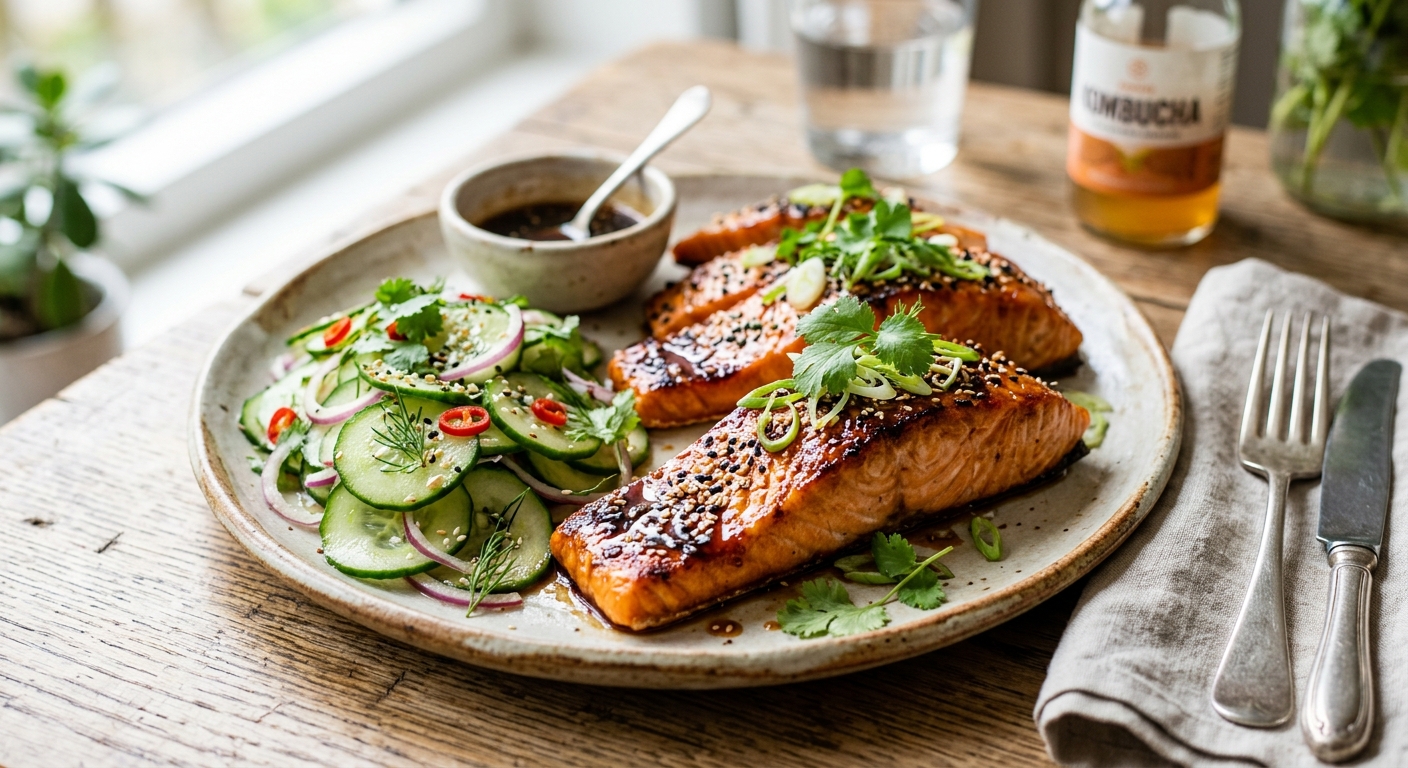
Salmon is one of the most nutritionally dense proteins available, but pairing it with a kombucha glaze elevates it from weeknight staple to something genuinely extraordinary. The natural acids and residual sugars in kombucha reduce into a glossy, complex glaze that mimics the depth of a long-aged teriyaki while contributing live-culture compounds and B vitamins that survive the brief cooking process at the glaze’s edges. The result is a lacquered crust with sweet, tart, and umami notes that balance salmon’s rich fat profile perfectly.
The quick-pickled cucumber salad is far more than a garnish. Cucumbers contribute silica for connective tissue support, while the rice vinegar brine amplifies the bioavailability of the sesame’s lignans, a class of antioxidant polyphenols linked to reduced inflammatory markers. Fresh dill brings its own suite of monoterpenes and flavonoids, including quercetin and isorhamnetin, that work synergistically with salmon’s astaxanthin to create a genuinely anti-inflammatory plate. Every component earns its place here nutritionally and culinarily.
At Calibrated Cuisine we designed this recipe so that a single serving provides more than 100% of the RDI for vitamin D, roughly 80% of the RDI for vitamin B12, and a meaningful dose of selenium, all within approximately 420 calories. Whether you choose the high-heat stovetop sear for crackled skin, the low-and-slow oven method for buttery flake, or the surprisingly effective pressure cooker approach for a hands-off weeknight dinner, the nutritional profile remains consistent across every method.
4
servings
Ingredients
- 700 gskin-on Atlantic salmon fillet, cut into 4 equal portions (approx. 175g each)
- 240 mlplain ginger or original kombucha (store-bought, unflavoured varieties work best)
- 3 tbsplow-sodium soy sauce (tamari for gluten-free)
- 2 tbspraw honey
- 2 tsptoasted sesame oil
- 1 tbspfresh ginger, finely grated
- 3 clovesgarlic, minced
- 1 tspcornstarch, dissolved in 1 tbsp cold water
- 2 tbspextra-virgin olive oil, for searing
- 2 largeEnglish cucumbers (approx. 500g total), thinly sliced on a mandoline
- 80 mlrice wine vinegar
- 1 tbspgranulated sugar
- 1 tspColima Sea SaltMicroplastic Free Salt, for the pickle brine
- 1 tbspsesame seeds, lightly toasted
- 15 gfresh dill, roughly chopped
- 3 stalksspring onions, thinly sliced on the bias
- 0.5 tspred chilli flakes (optional, for heat)
- —Colima Sea SaltMicroplastic Free Salt and cracked black pepper to taste
- —Lemon wedges, to serve
Instructions
Click on an item below to shop for the recommended items for this recipe on Amazon.
As an Amazon Associate, we earn from qualifying purchases.
- Start the pickle brine first so it has maximum time to work. Whisk together the rice wine vinegar, granulated sugar, and 1 tsp fine sea salt in a medium bowl until both are fully dissolved. Add the thinly sliced cucumber, toss well to coat, and set aside at room temperature, tossing occasionally. The cucumbers will soften slightly and turn translucent as they cure.
- Make the kombucha glaze. Combine the kombucha, soy sauce, honey, grated ginger, and minced garlic in a small saucepan over medium heat. Bring to a gentle simmer and cook, stirring occasionally, for 8 to 10 minutes until the liquid has reduced by roughly half and smells caramelised and tangy. Stir in the cornstarch slurry and cook for a further 60 seconds until the glaze thickens to a consistency that coats the back of a spoon. Remove from heat and stir in the toasted sesame oil. Season lightly with black pepper. Reserve half the glaze for serving.
- Pat the salmon portions completely dry with paper towels. This step is critical for a proper sear: surface moisture creates steam and prevents browning. Season both sides generously with fine sea salt and cracked black pepper.
- Heat the olive oil in a large stainless steel or cast iron skillet over medium-high heat until the oil is shimmering and just beginning to smoke. Lay the salmon portions skin-side down, pressing each fillet gently with a fish spatula for the first 10 seconds to prevent curling. Cook undisturbed for 4 to 5 minutes until the skin is deeply golden and the flesh has turned opaque two-thirds of the way up the side of the fillet.
- Flip the salmon carefully. Immediately brush the skin side generously with the kombucha glaze. Cook flesh-side down for a further 2 minutes, then brush the flesh side with another coat of glaze. For a lacquered finish, flip once more, brush again, and cook for 30 additional seconds skin-side down. The glaze will caramelise rapidly at this stage, so watch closely to avoid burning. The salmon is done when the centre registers 52 to 55 degrees Celsius on an instant-read thermometer for medium, or 60 degrees for well-done.
- While the salmon rests for 2 minutes off the heat, finish the cucumber salad. Drain most of the accumulated liquid from the cucumbers, then fold through the fresh dill, spring onions, sesame seeds, sesame oil if desired, and chilli flakes. Taste and adjust seasoning. Plate each salmon fillet skin-side up over a generous mound of cucumber salad, drizzle with reserved glaze, and serve immediately with lemon wedges.
- Preheat your oven to 200 degrees Celsius (400 degrees Fahrenheit), with a rack positioned in the upper-middle position. Line a rimmed baking sheet with aluminium foil and place a wire rack on top of the foil. Lightly brush the rack with olive oil to prevent sticking. Prepare the pickle brine simultaneously: whisk vinegar, sugar, and salt together, add sliced cucumbers, toss, and set aside to cure at room temperature.
- Prepare the kombucha glaze on the stovetop in a small saucepan. Combine kombucha, soy sauce, honey, ginger, and garlic over medium heat. Simmer for 8 to 10 minutes until reduced by half. Stir in the cornstarch slurry and cook 60 more seconds until thickened and glossy. Remove from heat, stir in sesame oil, and divide the glaze into two portions: one for glazing during cooking and one for serving.
- Pat the salmon portions dry with paper towels and season both sides with salt and pepper. Place the fillets skin-side down on the prepared wire rack. Using a pastry brush, coat the top and sides of each fillet generously with the kombucha glaze.
- Roast on the upper-middle rack for 10 to 12 minutes, until the flesh is just beginning to flake at the edges and the glaze has set. Remove the pan from the oven and switch the oven to the broil setting on high. Brush each fillet with a second coat of glaze, ensuring full coverage, then return to the oven under the broiler for 2 to 3 minutes. Watch closely: the sugars in the kombucha and honey will go from beautifully caramelised to burnt within 60 seconds. The glaze should be bubbling, darkened at the edges, and deeply fragrant.
- Remove from the oven and rest for 2 minutes. The internal temperature should read 52 to 55 degrees Celsius for medium or 60 degrees for fully cooked. While the salmon rests, finish the cucumber salad by draining excess brine and folding in dill, spring onions, sesame seeds, and chilli flakes. Plate immediately with reserved glaze drizzled on top and lemon wedges alongside.
- Do not reduce the kombucha glaze before cooking. Instead, combine the full amounts of kombucha, soy sauce, honey, grated ginger, and minced garlic in a bowl and whisk together. This will serve as both the braising liquid and the base of your finished glaze. Prepare the cucumber pickle brine and set aside to cure as directed.
- Line the base of your slow cooker insert with a single layer of thinly sliced lemon rounds or a folded piece of parchment to create a non-stick bed for the fish. Pat the salmon portions dry, season both sides with salt and pepper, and lay them skin-side down in a single layer in the slow cooker. Pour the kombucha mixture over and around the fillets, ensuring the liquid comes no more than halfway up the sides of the fish.
- Cook on Low for 1 hour 30 minutes to 2 hours. Salmon in a slow cooker can go from perfectly silky to mushy within 15 to 20 minutes, so begin checking at the 1 hour 15 minute mark. The fish is ready when it flakes gently at the thickest point with a fork but still looks slightly translucent at the very centre, as it will carry-cook when removed.
- Carefully transfer the salmon fillets to a foil-lined baking sheet using a wide spatula, skin-side down. Pour the remaining cooking liquid into a small saucepan and bring to a rapid boil on the stovetop. Cook for 4 to 5 minutes, stirring in the cornstarch slurry, until the liquid reduces to a thick, glossy glaze. Remove from heat and stir in the sesame oil.
- Switch your oven broiler to high. Brush the salmon generously with the reduced glaze and broil 10 to 15 cm from the heating element for 2 to 3 minutes until the glaze is caramelised and the surface has a slight char. Finish the cucumber salad by draining the brine and folding in dill, spring onions, sesame seeds, and chilli flakes. Serve immediately.
- Prepare the cucumber pickle brine and set aside to cure. Pat the salmon dry and season both sides with salt and pepper. Using the Saute function on Normal heat, warm the olive oil in the Instant Pot insert for 2 minutes. Add the minced garlic and grated ginger and saute for 90 seconds until fragrant, stirring constantly to avoid burning on the hot insert. Press Cancel to stop the Saute function.
- Pour in the kombucha, soy sauce, and honey, stirring to combine with the aromatics and scraping up any garlic bits from the bottom of the insert with a wooden spoon. This deglazing step prevents the Burn warning. Place the steam rack (trivet) into the insert. Carefully lay the salmon portions on the rack, skin-side down, in a single layer if possible. If the fillets are large, angle them slightly to fit without overlapping significantly.
- Secure the lid and set the pressure release valve to Sealing. Cook on Manual High Pressure for 3 minutes. When the cycle completes, allow a natural pressure release for 3 minutes, then carefully switch the valve to Venting for a quick release of any remaining pressure. Open the lid away from you. The salmon should be just cooked through and will be delicate, so use a wide spatula to transfer the fillets to a plate.
- Remove the trivet and press the Saute function on High. Whisk in the cornstarch slurry and bring the liquid in the pot to a vigorous simmer. Cook, stirring frequently, for 3 to 4 minutes until the sauce reduces to a coating glaze. Stir in the sesame oil and taste for seasoning. The Saute function runs hot, so watch carefully to avoid scorching.
- To finish the glaze on the salmon, brush each fillet generously with the reduced glaze from the pot. If you want caramelisation, transfer glazed fillets briefly under a preheated broiler for 90 seconds. Alternatively, serve directly with glaze spooned over the top for a saucier presentation. Finish the cucumber salad and serve immediately, with the remaining glaze on the side.
Nutrition Breakdown
Per 1 serving (makes 4)
Vitamins & Minerals
% Daily Value based on a 2,000 calorie diet (FDA reference)
🧬 Essential Amino Acids
% of recommended daily intake (RDA) per serving
🛡 Antioxidant Profile
The Nutrition Science
The anti-inflammatory credentials of this dish rest on a well-documented biochemical foundation. Atlantic salmon provides EPA (eicosapentaenoic acid) and DHA (docosahexaenoic acid) at approximately 2.4g per 175g serving. These long-chain omega-3 fatty acids are the direct precursors to specialised pro-resolving mediators (SPMs), including resolvins, protectins, and maresins, which actively switch off the inflammatory response at the cellular level. This is mechanistically distinct from simply blocking inflammation: SPMs promote resolution, a process that clears cellular debris and restores tissue homeostasis. A meta-analysis published in the British Journal of Nutrition (Calder, 2017) confirmed that EPA+DHA supplementation at doses above 2g per day significantly reduces circulating interleukin-6 (IL-6) and C-reactive protein (CRP), two primary biomarkers of chronic low-grade inflammation.
Astaxanthin, the carotenoid pigment responsible for salmon’s distinctive pink colour, operates through a unique mechanism that sets it apart from most antioxidants. Unlike beta-carotene or lycopene, astaxanthin spans the entire lipid bilayer of cell membranes, with its polar end groups extending into both the aqueous interior and exterior of the cell. This allows it to quench free radicals on both sides of the membrane simultaneously. Research in the Journal of Nutritional Science (Nishida et al., 2007) demonstrated that astaxanthin’s capacity to neutralise singlet oxygen is 6,000-fold greater than vitamin C and 550-fold greater than vitamin E, making even the 3 to 4mg found in a single serving clinically meaningful. The kombucha glaze’s brief caramelisation at moderate temperatures preserves astaxanthin integrity, as the compound is relatively heat-stable compared to water-soluble vitamins.
The combination of sesame lignans with omega-3 fatty acids represents a genuine example of nutritional synergy. Sesamin and sesamolin are metabolised by gut microbiota into enterolactone and enterodiol, compounds that inhibit delta-5-desaturase (D5D), an enzyme that competes with omega-3 pathways to produce arachidonic acid, the key precursor to pro-inflammatory prostaglandins and leukotrienes. By suppressing D5D activity, sesame lignans effectively redirect fatty acid metabolism toward the anti-inflammatory EPA and DHA pathways, amplifying the benefit of the salmon’s omega-3 content. This mechanism has been documented in multiple rodent and in-vitro studies and represents a compelling argument for routinely combining sesame with fatty fish.
Pro Tips
- Choose wild-caught sockeye salmon when available, as it contains up to 40% more astaxanthin than farmed Atlantic salmon. The flesh will be darker red and the flavour more pronounced, which pairs beautifully with the tangy kombucha glaze.
- Use a ginger or original kombucha for the glaze rather than fruit-flavoured varieties. Raspberry or mango kombucha will compete with the savoury elements and produce an overly sweet, one-dimensional sauce. The slight effervescence also helps the glaze lift off the pan cleanly when deglazing.
- Salt the cucumber slices 20 minutes before adding the brine and then rinse them briefly. This draws out excess water, concentrates cucumber flavour, and ensures the brine is absorbed rather than diluted, resulting in a crisper, more intensely flavoured pickle.
- Do not discard the kombucha glaze reduction liquid. Any leftover glaze keeps refrigerated for up to 5 days and makes an excellent marinade for chicken thighs, a dressing base for grain bowls, or a dipping sauce for vegetable spring rolls.
Love the omega-3/vitamin D pairing angle here, and curious about the actual glycemic impact of the kombucha reduction since fermentation typically drops sugar content significantly but I’d want to know the final glucose response. My CGM shows salmon alone sits beautifully flat for me, but kombucha varies wildly by brand and fermentation time, so did you test this against a specific kombucha product or measure residual sugar post-reduction? Would definitely track this one before assuming it’s a clean win metabolically.
Great catch on the omega-3 and D combo, Diane – that’s genuinely one of the most impactful pairings for reducing systemic inflammation, especially in kids. The kombucha reduction here is smart too, since you’re getting those beneficial acids without adding seed oils that would tip the omega-6 balance the wrong way. One thing I’d watch: make sure the kombucha you’re using isn’t loaded with added sugars, since that can offset some of the anti-inflammatory benefits. Wild-caught salmon like this (assuming that’s what’s used) has a significantly better omega-3 profile than farmed, so you’re probably looking at around 2-3g of EPA/
omg YES to the omega-3s and vitamin D combo, thats literally what my family needed most! i made something similar last week and my kids actually ate the salmon without complaining lol. quick question though – is the kombucha reduction kid-friendly? mine are still pretty picky about anything too tangy, so im wondering if i can dial back the fermented intensity or if theres a sneaky way to mask it? also dying to know if you tested this with wild-caught vs farmed salmon because i feel like the nutrient density difference matters for posts like this!