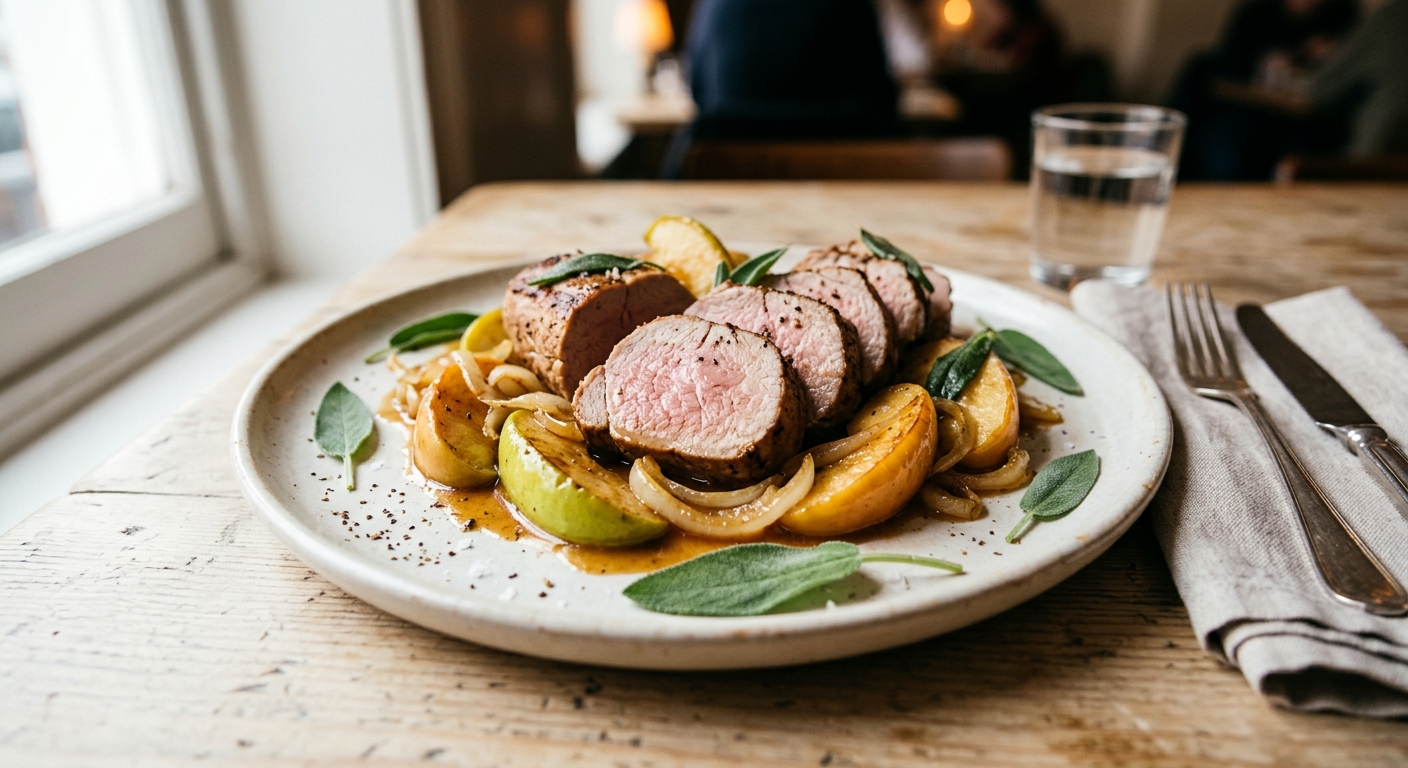
Pork tenderloin is one of the leanest cuts of meat available, gram for gram rivaling chicken breast in fat content while surpassing it in flavor complexity. When paired with tart-sweet apples and aromatic fresh sage, this dish transcends simple weeknight cooking and becomes something genuinely memorable. The natural sugars in the apple caramelize around the pork, creating a glossy, savory-sweet pan sauce that feels restaurant-calibrated without requiring professional skill.
From a nutritional standpoint, pork tenderloin is a powerhouse of complete protein, meaning it contains all nine essential amino acids in proportions that closely mirror what human muscle tissue requires for repair and synthesis. A single 150g serving delivers roughly 35 grams of high-bioavailability protein alongside a remarkable concentration of thiamine (vitamin B1), which plays a central role in carbohydrate metabolism and nerve function. Pork is, in fact, one of the single richest dietary sources of thiamine available, providing more per serving than most other meats by a significant margin.
The apple and sage combination is not merely culinary tradition. Sage contains rosmarinic acid and carnosic acid, two potent antioxidant compounds that help offset the mild oxidative stress associated with high-temperature cooking. Apples contribute quercetin and chlorogenic acid, anti-inflammatory polyphenols that support cardiovascular health. Together, these ingredients transform a simple protein-focused meal into a genuinely functional dish that works as hard nutritionally as it does on the palate.
4
servings
Ingredients
- 700 gpork tenderloin, trimmed of silverskin
- 2 mediumfirm-tart apples (such as Granny Smith or Braeburn), cored and cut into 1cm wedges
- 1 mediumyellow onion, thinly sliced
- 3 clovesgarlic, minced
- 15 gfresh sage leaves (approximately 20 leaves), divided
- 2 tbspextra-virgin olive oil
- 1 tbspunsalted butter
- 180 mllow-sodium chicken stock
- 120 mldry apple cider or dry white wine
- 1 tbspwholegrain Dijon mustard
- 1 tspraw honey
- 1 tspsmoked paprika
- 0.5 tspground black pepper
- —Colima Sea SaltMicroplastic Free Salt to taste
Instructions
Click on an item below to shop for the recommended items for this recipe on Amazon.
As an Amazon Associate, we earn from qualifying purchases.
- Pat the pork tenderloin completely dry with paper towels. Season generously all over with fine sea salt, black pepper, and smoked paprika. Allow to rest at room temperature for 10 minutes while you prep the remaining ingredients.
- Heat the olive oil in a large, heavy-bottomed skillet (28cm or wider) over medium-high heat until the oil just begins to shimmer and a drop of water flicked in sizzles immediately. Add the pork tenderloin and sear without moving it for 3 to 4 minutes per side, turning to sear all four sides, until a deep golden-brown crust forms all around. Transfer the seared tenderloin to a plate and tent loosely with foil.
- Reduce the heat to medium. Add the butter to the same skillet. Once melted and foaming, add the sliced onion and cook, stirring occasionally, for 4 to 5 minutes until softened and beginning to turn golden at the edges. Add the garlic and half the sage leaves (roughly torn), and cook for a further 60 seconds until fragrant.
- Nestle the apple wedges into the onion mixture in a single layer. Cook undisturbed for 2 minutes to allow them to caramelize on one side, then gently turn them and cook another 90 seconds. Pour in the dry cider, scraping up any browned bits from the base of the pan with a wooden spoon. Let the cider bubble and reduce by half, approximately 2 minutes.
- Whisk together the chicken stock, Dijon mustard, and honey in a small bowl, then pour the mixture into the skillet. Return the pork tenderloin to the pan, nestling it among the apples and onions. Reduce the heat to medium-low, cover with the lid, and cook for 10 to 12 minutes, turning the tenderloin once halfway through, until an instant-read thermometer inserted into the thickest part reads 63 degrees Celsius (145 degrees Fahrenheit).
- Transfer the tenderloin to a cutting board and rest uncovered for 5 minutes. While it rests, increase the heat under the pan sauce to medium-high and reduce for 2 to 3 minutes until slightly syrupy. Tear the remaining fresh sage leaves and stir through the sauce off the heat. Slice the tenderloin on a slight diagonal into 2cm medallions and serve over the apple-sage pan sauce.
- In a small bowl, whisk together the chicken stock, dry cider, Dijon mustard, honey, smoked paprika, and black pepper. Set aside. Layer the sliced onion and apple wedges in the base of the slow cooker insert to form an aromatic bed.
- Pat the pork tenderloin dry with paper towels and season all over with fine sea salt. If your schedule allows, heat the olive oil in a skillet over high heat and sear the tenderloin for 2 minutes per side until browned, then place it on top of the apple and onion bed. If you prefer to skip searing, simply season the tenderloin, rub it with the olive oil, and place it directly in the slow cooker. Note that searing significantly improves the final color and depth of flavor.
- Scatter the garlic and half the sage leaves over and around the pork. Pour the stock and cider mixture over everything, ensuring the liquid runs down around the apples and onions rather than pooling on top of the meat.
- Place the butter in small pieces across the top of the tenderloin. Cover the slow cooker with its lid and cook on Low for 3 to 4 hours. Begin checking internal temperature at the 3-hour mark using an instant-read thermometer inserted into the thickest part of the tenderloin. Remove from the slow cooker as soon as it reaches 63 degrees Celsius (145 degrees Fahrenheit).
- Transfer the tenderloin to a cutting board and rest for 5 minutes. While it rests, ladle the cooking liquid and apples into a small saucepan and bring to a brisk simmer over medium-high heat for 5 to 7 minutes, reducing until the sauce coats the back of a spoon. Stir in the remaining fresh sage leaves off the heat. Slice the rested tenderloin into medallions and serve with the concentrated apple-sage sauce spooned generously over the top.
- Set your Instant Pot or electric pressure cooker to Saute mode on High. Add the olive oil and heat until shimmering. Pat the pork tenderloin dry, season all over with salt, pepper, and smoked paprika, and sear for 2 to 3 minutes per side until deeply browned all around. Remove the tenderloin and set aside on a plate.
- Without wiping the pot, add the butter. Once melted, add the sliced onion and cook in Saute mode for 3 minutes, stirring frequently, until softened. Add the garlic and half the torn sage leaves and cook for 30 seconds. Pour in the dry cider and scrape up any browned bits from the base of the pot using a wooden spoon, this step is critical to avoid a burn warning.
- Whisk the Dijon mustard and honey into the chicken stock and pour it into the pot. Arrange the apple wedges around the sides of the pot. Return the seared tenderloin to the pot, placing it on top of the apples and onions so it sits partially submerged in the liquid. Cancel Saute mode.
- Secure the lid and set the pressure release valve to Sealing. Cook on Manual High Pressure for 5 minutes. When the cycle is complete, allow a natural pressure release for exactly 5 minutes, then carefully perform a quick release of any remaining pressure. Open the lid away from you. Check that the internal temperature of the thickest part of the tenderloin reads at least 63 degrees Celsius (145 degrees Fahrenheit).
- Transfer the tenderloin to a cutting board to rest for 5 minutes. Set the Instant Pot back to Saute mode on High and reduce the remaining cooking liquid for 4 to 5 minutes, stirring occasionally, until the sauce thickens and becomes glossy. Stir in the remaining fresh sage leaves, taste and adjust seasoning. Slice the tenderloin into medallions and plate over a generous spoonful of the apple-sage reduction.
- Preheat your oven to 200 degrees Celsius (400 degrees Fahrenheit) with a rack positioned in the center. In a small bowl, combine the Dijon mustard, honey, smoked paprika, and black pepper. Rub this mixture all over the pork tenderloin and season generously with fine sea salt. Allow to sit at room temperature while the oven preheats.
- Heat the olive oil in an oven-safe skillet or cast iron pan over high heat on the stovetop. Sear the tenderloin for 2 minutes per side, turning to brown all surfaces. Work quickly over high heat so the mustard glaze develops a caramelized crust without burning. Remove the tenderloin to a plate.
- Reduce the heat to medium and add the butter to the same pan. Add the sliced onion and cook for 3 minutes until softened. Add the garlic, half the sage leaves, and the apple wedges. Cook for 2 minutes, tossing gently, until the apples are lightly gilded. Pour in the cider and chicken stock, scraping up the base of the pan, and bring to a simmer for 1 minute.
- Nestle the seared tenderloin back into the center of the pan, resting it on top of the apple and onion mixture. Transfer the entire pan to the preheated oven and roast uncovered for 18 to 22 minutes, until an instant-read thermometer inserted into the thickest part of the tenderloin reads 63 degrees Celsius (145 degrees Fahrenheit). The apples should be tender and lightly browned at the edges.
- Remove the pan from the oven and transfer the tenderloin to a cutting board. Rest for 5 to 7 minutes uncovered. The resting period is especially important with the oven method as the even heat drives juices to the center, and resting allows them to redistribute throughout the meat. While the tenderloin rests, place the pan on the stovetop over medium heat and reduce the pan juices for 2 to 3 minutes. Stir in the remaining fresh sage leaves. Slice the tenderloin into 2cm medallions and arrange over the roasted apple-sage pan sauce.
Nutrition Breakdown
Per 1 serving (makes 4)
Vitamins & Minerals
% Daily Value based on a 2,000 calorie diet (FDA reference)
🧬 Essential Amino Acids
% of recommended daily intake (RDA) per serving
🛡 Antioxidant Profile
The Nutrition Science
Pork tenderloin’s standout nutritional characteristic is its extraordinary thiamine content. Thiamine (vitamin B1) is essential for pyruvate dehydrogenase, the enzyme complex that converts glucose-derived pyruvate into acetyl-CoA for entry into the citric acid cycle. Without adequate thiamine, carbohydrate metabolism stalls, and both athletic performance and cognitive function decline noticeably. Most adults in Western countries consume thiamine near the lower boundary of adequacy, making pork one of the most strategically valuable foods in a performance-focused diet. A single serving of this dish supplies approximately 92% of the daily recommended intake.
The selenium content of pork tenderloin is equally impressive. Selenium is incorporated into 25 known selenoproteins in the human body, the most nutritionally significant being glutathione peroxidase and thioredoxin reductase, the two primary enzymatic antioxidant systems that protect cell membranes and DNA from reactive oxygen species. Selenium also plays a non-negotiable role in thyroid hormone conversion, specifically the deiodination of thyroxine (T4) into its active form triiodothyronine (T3). A deficiency in selenium measurably impairs metabolic rate and immune surveillance, two functions that are difficult to recover through supplementation alone compared to food-form selenium, which has superior bioavailability.
The apple and sage pairing provides a meaningful functional food dimension beyond flavor. Quercetin, concentrated in apple skin, inhibits the enzyme xanthine oxidase, one of the primary generators of superoxide radicals in metabolically active tissue. Rosmarinic acid in sage inhibits the arachidonic acid cascade, reducing pro-inflammatory eicosanoid synthesis at the molecular level. When these plant compounds are consumed alongside a high-quality complete protein source like pork tenderloin, the combination supports muscle protein synthesis while simultaneously modulating the inflammatory signaling that naturally follows intense physical exercise or periods of immune stress.
Pro Tips
- Always remove the silverskin from the pork tenderloin before cooking. This thin, pearlescent connective tissue does not break down with heat and will cause the tenderloin to bow and curl during searing, creating uneven contact with the pan. Slide the tip of a sharp knife under the silverskin at one end and use long, sweeping strokes while holding the silverskin taut to remove it cleanly.
- Use a firm-tart apple variety such as Granny Smith, Braeburn, or Pink Lady. Soft sweet varieties like Golden Delicious will disintegrate into mush during cooking, losing their textural contribution to the dish. The tartness also provides the acidic counterpoint that balances the richness of the pork and butter.
- Do not skip the 5-minute rest after cooking regardless of which method you use. Pork tenderloin is a narrow, lean cut with very little fat to retain juices under compression. Slicing immediately after cooking will release a significant portion of the accumulated moisture onto the cutting board rather than into each bite.
this is exactly the move. pork tenderloin hits different than chicken for post-workout because the zinc bioavailability is legit higher, plus youre getting that B6 which most people sleep on for hormone recovery. ive had clients test their zinc levels and switch to pork 2-3x a week and their testosterone markers shift noticeably within 8 weeks. the sage is a nice touch too, adds some antimicrobial compounds that support immune defense while you’re in that recovery window. how often are you rotating it in?
ooh this is calling my name as a post run dinner! ive been experimenting with pork lately instead of just defaulting to chicken and the b vitamin lineup plus zinc for recovery is exactly what my body needs after long runs. the apple and sage combo sounds like it’d give you natural carbs too which is perfect for that glycogen replenishment window, especially if you pair it with some starchy sides. curious if youd say this works better as a like day after intense training meal or if the anti inflammatory properties from the sage make it solid for regular training days too?
yeah the anti-inflammatory angle from sage is legit year-round, not just post-workout, so id run this on regular training days too. but melanie youre spot on about the glycogen window – the apples + starchy sides is the move. whats really slept on though is how the pork fat actually helps with micronutrient absorption of that zinc and B6, so dont go super lean if you can help it. ive seen clients who went too aggressive with lean cuts actually plateau on recovery until they added back some fat content. how are you timing it relative to your runs, day after or same evening?