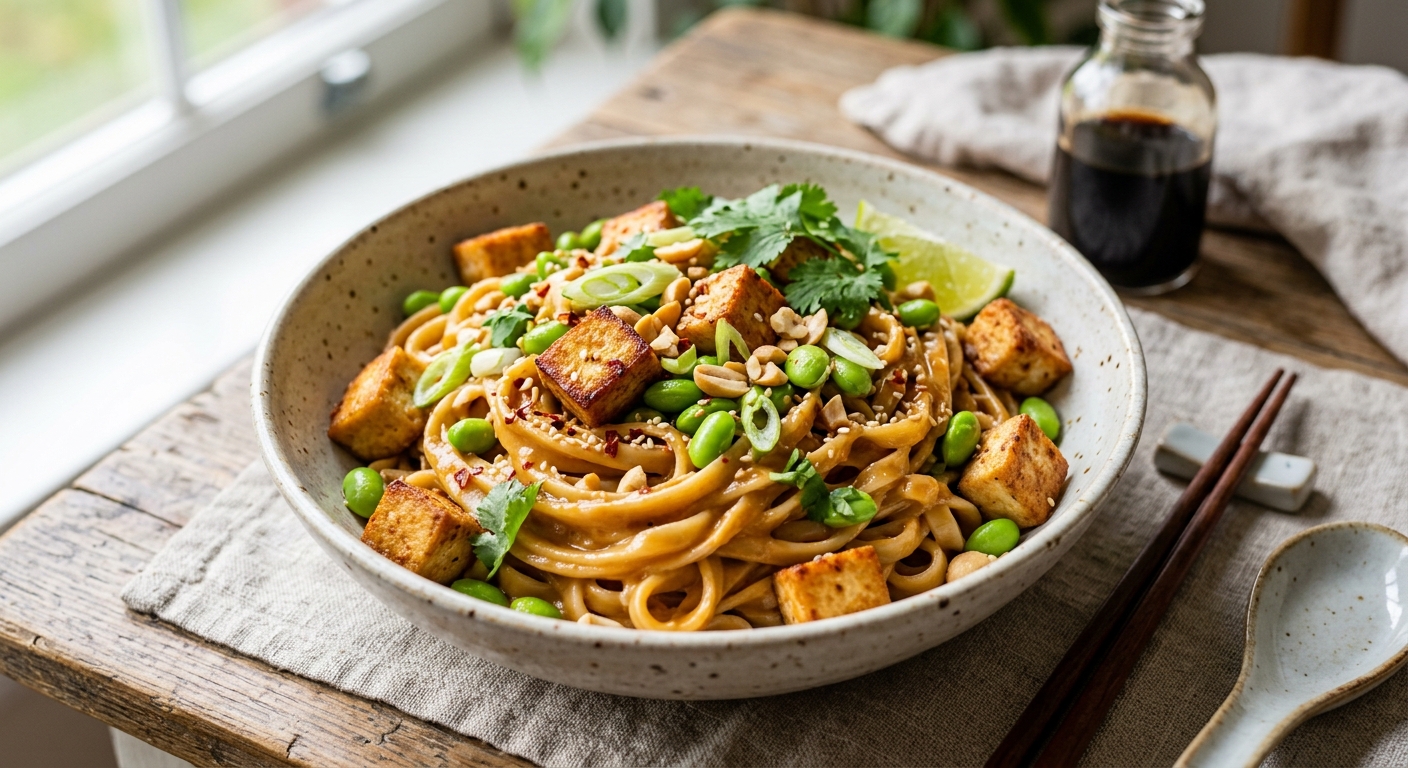
There is a persistent myth that plant-based eating means sacrificing protein quality. This dish dismantles that myth with authority. By pairing tofu, edamame, and natural peanut butter in a single bowl, you are combining three of the most protein-dense whole plant foods available, each contributing a distinct amino acid signature that, together, forms a complete and highly bioavailable protein package. The creamy peanut sauce clings to every strand of noodle, the tofu develops a golden crust, and the edamame pops with grassy sweetness to create a dish that is as satisfying as it is nourishing.
The nutritional architecture here is deliberate. Edamame (immature soybeans) is one of the few plant foods that qualifies as a complete protein on its own, containing all nine essential amino acids in meaningful quantities. Firm tofu, pressed and seared, adds another soy-derived protein hit alongside bone-supporting calcium and metabolism-regulating selenium. Peanut butter rounds out the macronutrient picture with heart-healthy monounsaturated fats and a generous dose of niacin and magnesium. Together, these three ingredients push the dish well past the 30g protein threshold that sports nutrition researchers associate with maximal muscle protein synthesis per meal.
Rice noodles keep the dish gluten-free and provide a gentle, medium glycemic carbohydrate base that pairs well with the fat and protein load to blunt blood sugar spikes. The sauce, built from natural peanut butter, tamari, rice vinegar, ginger, and a touch of sesame oil, delivers depth without relying on processed condiments. Whether you are fuelling a training day, feeding a hungry family, or simply craving something bold and comforting on a weeknight, this bowl covers every base.
4
servings
Ingredients
- 400 gfirm tofu, pressed for 15 minutes and cut into 2cm cubes
- 200 gdried flat rice noodles (8mm width)
- 300 gfrozen shelled edamame, thawed
- 120 gnatural smooth peanut butter (no added sugar)
- 60 mltamari (gluten-free soy sauce)
- 30 mlrice vinegar
- 20 mltoasted sesame oil
- 15 mlpure maple syrup
- 15 gfresh ginger, finely grated
- 4 clovesgarlic, minced
- 1 tbspsriracha or chili-garlic sauce, plus more to taste
- 120 mlhot water, for thinning the sauce
- 2 tbspAvocado Oil100% Pure Avocado Oil (avocado or sunflower), for cooking
- 2 stalksgreen onions, thinly sliced
- 30 groasted peanuts, roughly chopped, for garnish
- 1 tbsptoasted sesame seeds, for garnish
- 1 mediumcarrot, julienned or grated
- 1 mediumred bell pepper, thinly sliced
- —Colima Sea SaltMicroplastic Free Salt and white pepper to taste
- —Fresh cilantro or Thai basil, to serve (optional)
- —Lime wedges, to serve
Instructions
Click on an item below to shop for the recommended items for this recipe on Amazon.
As an Amazon Associate, we earn from qualifying purchases.
- Make the peanut sauce: In a medium bowl, whisk together the peanut butter, tamari, rice vinegar, sesame oil, maple syrup, grated ginger, minced garlic, and sriracha until smooth. Gradually whisk in the hot water, a tablespoon at a time, until the sauce is pourable but still thick enough to coat a spoon. Taste and adjust seasoning with salt, white pepper, or extra sriracha. Set aside.
- Sear the tofu: Heat a large non-stick skillet or cast-iron pan over medium-high heat until a drop of water evaporates on contact. Add the neutral oil and swirl to coat. Add the tofu cubes in a single layer, spacing them apart to avoid steaming. Cook undisturbed for 3 to 4 minutes until the underside is deep golden brown. Flip each cube and cook a further 2 to 3 minutes on the opposite side. Transfer to a plate lined with paper towel and season lightly with salt.
- Cook the noodles and vegetables: Bring a large pot of salted water to a rolling boil. Add the rice noodles and cook according to package instructions (typically 4 to 6 minutes for 8mm flat noodles), stirring occasionally to prevent sticking. In the final 2 minutes of noodle cooking, add the thawed edamame to the boiling water to heat through. Drain everything together in a colander and rinse briefly under cool water to stop cooking and prevent clumping.
- Stir-fry the aromatics and vegetables: Return the now-empty skillet to medium heat. Add a drizzle of oil if needed and stir-fry the julienned carrot and sliced red bell pepper for 2 to 3 minutes until just tender but still crisp. Add the drained noodles and edamame to the pan. Pour the peanut sauce over the noodles and toss everything together using tongs or two large spoons for 1 to 2 minutes over low heat until the sauce is evenly distributed and coats every strand.
- Finish and serve: Return the seared tofu cubes to the pan and fold gently through the noodles to warm through without breaking them apart. Divide into four bowls. Top each with sliced green onions, chopped roasted peanuts, toasted sesame seeds, and fresh cilantro or Thai basil. Serve immediately with lime wedges on the side.
- Build the slow cooker sauce base: In the insert of your slow cooker, combine the peanut butter, tamari, rice vinegar, sesame oil, maple syrup, grated ginger, minced garlic, and sriracha. Add 180ml of hot water (more than the stovetop version, as the slow cooker traps steam) and whisk until smooth and homogenous. The sauce will be slightly thinner than the stovetop version at this stage and will reduce gently during cooking.
- Add the vegetables and edamame: Stir the julienned carrot, sliced red bell pepper, and thawed edamame directly into the peanut sauce in the insert. These vegetables benefit from the slow cooker’s gentle heat and will soften into the sauce beautifully. Season with a pinch of white pepper.
- Brown and add the tofu: In a skillet over medium-high heat, sear the pressed tofu cubes in neutral oil for 3 to 4 minutes per side until golden. This step is done separately because the slow cooker environment steams rather than crisps. Add the browned tofu to the insert on top of the vegetable and sauce mixture. Do not stir yet; let the tofu sit on top so it does not break apart during the slow cook.
- Slow cook and develop the sauce: Place the lid on the slow cooker and cook on Low for 3 to 4 hours. The garlic and ginger will mellow and sweeten, the vegetables will become silky, and the peanut sauce will deepen in flavour. Stir gently once at the halfway point to recombine the sauce without breaking the tofu. If the sauce looks too thick, stir in an additional 2 to 3 tablespoons of water.
- Cook the noodles and assemble: About 10 minutes before serving, cook the rice noodles in a large pot of boiling salted water according to package directions. Drain and rinse under cool water. Portion the noodles into bowls, ladle the slow-cooker peanut and vegetable mixture generously over the top, and fold gently to combine at the table. Garnish with green onions, chopped peanuts, sesame seeds, fresh herbs, and a squeeze of lime.
- Saute the tofu in the Instant Pot: Set the Instant Pot to Saute mode on High. Add the neutral oil and let it heat until shimmering. Add the pressed tofu cubes in a single layer (work in batches if needed to avoid crowding) and cook for 3 to 4 minutes without stirring until a golden crust forms on the bottom. Flip the cubes and sear for another 2 minutes. Remove the tofu to a plate and set aside. Press Cancel.
- Deglaze and build the sauce: While the pot is still hot from Saute mode, add a splash of the rice vinegar to deglaze, scraping up any browned bits from the bottom with a wooden spoon. This step is critical for pressure cooking: any stuck solids will trigger the burn warning. Add the peanut butter, tamari, remaining rice vinegar, sesame oil, maple syrup, grated ginger, minced garlic, sriracha, and 150ml of hot water. Whisk until the peanut butter is fully dissolved into the liquid. The consistency should be thin and broth-like, as it will concentrate under pressure.
- Add vegetables and pressure cook: Stir in the julienned carrot, sliced red bell pepper, and thawed edamame. Nestle the seared tofu back into the sauce on top. Do not stir the tofu into the sauce aggressively. Seal the lid and set the valve to Sealing. Cook on Manual High Pressure for 4 minutes.
- Quick release and reduce: Once the 4-minute cook is complete, perform an immediate Quick Release by carefully turning the valve to Venting. Once all the steam has escaped and the float valve drops, open the lid. The sauce may look slightly thin. Switch back to Saute mode on Low and simmer for 2 to 3 minutes, stirring gently, until the sauce thickens to a coating consistency.
- Cook noodles and finish: While the sauce reduces, cook the rice noodles in a separate pot of boiling salted water according to package directions (or soak in just-boiled water off heat for 5 to 6 minutes). Drain and portion into four bowls. Spoon the peanut-edamame-tofu mixture over the noodles. Top with green onions, chopped roasted peanuts, toasted sesame seeds, fresh cilantro, and lime wedges.
- Preheat and prepare: Position two oven racks in the upper-middle and lower-middle positions. Preheat the oven to 220C (425F) convection or 230C (450F) conventional. Line two rimmed baking sheets with parchment paper. In a large bowl, toss the pressed tofu cubes with 1 tablespoon of neutral oil, 1 tablespoon of tamari, and a pinch of white pepper until evenly coated. Spread onto one baking sheet in a single layer with space between each cube.
- Season and roast the vegetables and edamame: On the second baking sheet, toss the julienned carrot, sliced red bell pepper, and thawed edamame with the remaining 1 tablespoon of neutral oil and a pinch of salt. Spread in a single layer. Place both baking sheets in the oven. Roast the tofu on the upper rack for 25 to 30 minutes, flipping halfway, until deeply golden and chewy. Roast the vegetables and edamame on the lower rack for 20 to 22 minutes until the peppers are lightly charred and the edamame skins are blistered.
- Make the peanut sauce: While everything roasts, whisk together the peanut butter, remaining tamari, rice vinegar, sesame oil, maple syrup, grated ginger, minced garlic, and sriracha in a bowl. Whisk in the hot water gradually until the sauce is smooth and pourable. Taste for balance and adjust with extra sriracha, a pinch of salt, or a splash more rice vinegar.
- Cook the noodles: About 8 minutes before the tofu finishes roasting, cook the rice noodles in a large pot of boiling salted water according to package directions. Drain and rinse briefly with cool water. Transfer to a large serving bowl and immediately toss with half the peanut sauce to prevent the noodles from sticking together.
- Assemble and serve: Remove the baking sheets from the oven. Add the roasted vegetables and edamame to the noodle bowl and toss to combine. Divide among four bowls and top each with roasted tofu cubes. Drizzle with the remaining peanut sauce. Finish with green onions, chopped roasted peanuts, toasted sesame seeds, fresh herbs, and lime wedges for brightness.
Nutrition Breakdown
Per 1 serving (makes 4)
Vitamins & Minerals
% Daily Value based on a 2,000 calorie diet (FDA reference)
🧬 Essential Amino Acids
% of recommended daily intake (RDA) per serving
🛡 Antioxidant Profile
The Nutrition Science
The protein quality story in this dish is rooted in amino acid complementarity. Both tofu and edamame derive from soybeans, which are classified as a complete protein because they supply all nine essential amino acids above the WHO minimum threshold. Peanut butter contributes exceptionally high levels of arginine (not an essential amino acid but critical for nitric oxide synthesis and blood vessel dilation) and meaningful quantities of leucine, the branched-chain amino acid that acts as the primary signalling molecule for muscle protein synthesis via the mTORC1 pathway. At 38g of protein per serving, this bowl provides a stimulus for muscle protein synthesis that is on par with a 170g chicken breast, but delivered entirely from plants.
The iron in this dish is non-haem iron, the form found in plant foods, which has a lower baseline absorption rate than the haem iron in red meat. However, this dish contains two strategic enhancers. The red bell pepper provides over 60mg of vitamin C per serving, and research consistently shows that consuming vitamin C alongside non-haem iron increases intestinal iron absorption by two to four fold by reducing ferric iron (Fe3+) to the more soluble and absorbable ferrous form (Fe2+). Simultaneously, the tamari-based sauce contributes glutathione precursors that further support iron metabolism in the enterocytes of the small intestine.
The folate content, 60% of the daily value per serving, comes predominantly from edamame, which is one of the richest dietary sources of this B vitamin. Folate is essential for DNA synthesis, red blood cell maturation, and the methylation cycle that regulates homocysteine levels in the blood. High homocysteine is an independent risk factor for cardiovascular disease, and adequate folate intake is one of the most effective dietary strategies for keeping it in a healthy range. The combination of folate from edamame, magnesium from peanut butter, and calcium from tofu makes this dish a particularly strong choice for anyone monitoring cardiovascular health markers.
Pro Tips
- Press the tofu for at least 15 minutes using a dedicated tofu press or by wrapping it in a clean kitchen towel and placing a heavy skillet on top. The more moisture you remove, the crispier the exterior will be, and the more readily the tofu will absorb the peanut sauce.
- Do not rinse the peanut butter jar out. Once you have spooned out all the peanut butter, pour the hot water directly into the jar, screw on the lid, shake well, and pour the thinned residue into your sauce bowl. You will recover every last gram of protein and fat with zero waste.
- For meal prep, store the peanut sauce, cooked noodles, seared tofu, and edamame-vegetable mixture in separate airtight containers in the refrigerator for up to 4 days. Reheat noodles by briefly soaking them in hot water, and warm the sauce in a small pan over low heat with a splash of water to loosen it before assembling bowls to order.


This looks amazing for protein content! Quick heads up though, if you have histamine sensitivities like I do: peanut butter is a major histamine liberator, and sesame paste/tahini can be problematic depending on freshness. I’ve had great success swapping in sunflower seed butter (fresh jar only) and using coconut aminos instead of traditional soy sauce if that’s in the sauce. The tofu and edamame themselves are fine, but just wanted to flag those two ingredients in case anyone else here deals with mast cell stuff!
omg YES this is exactly what im always looking for since my kids wont touch meat half the time! quick question though – how do the tofu and edamame hold up texture wise after tossing with the sauce? i made something similar last week and my picky eaters complained everything got mushy lol. also dying to know if theres any magnesium in the peanut sauce because if theres sesame seeds involved thats literally a micronutrient goldmine and my family needs ALL the mg they can get haha
looks delicious and that protein count is solid, but id definitely check the net carb situation on those rice noodles – regular ones can sneak up on you with carbs even in a modest portion. ive found that swapping to shirataki or kelp noodles keeps the same vibe without spiking blood sugar, which was a game changer when i was trying to reverse my diabetes. the tofu and edamame combo is perfect though, both super clean protein sources