
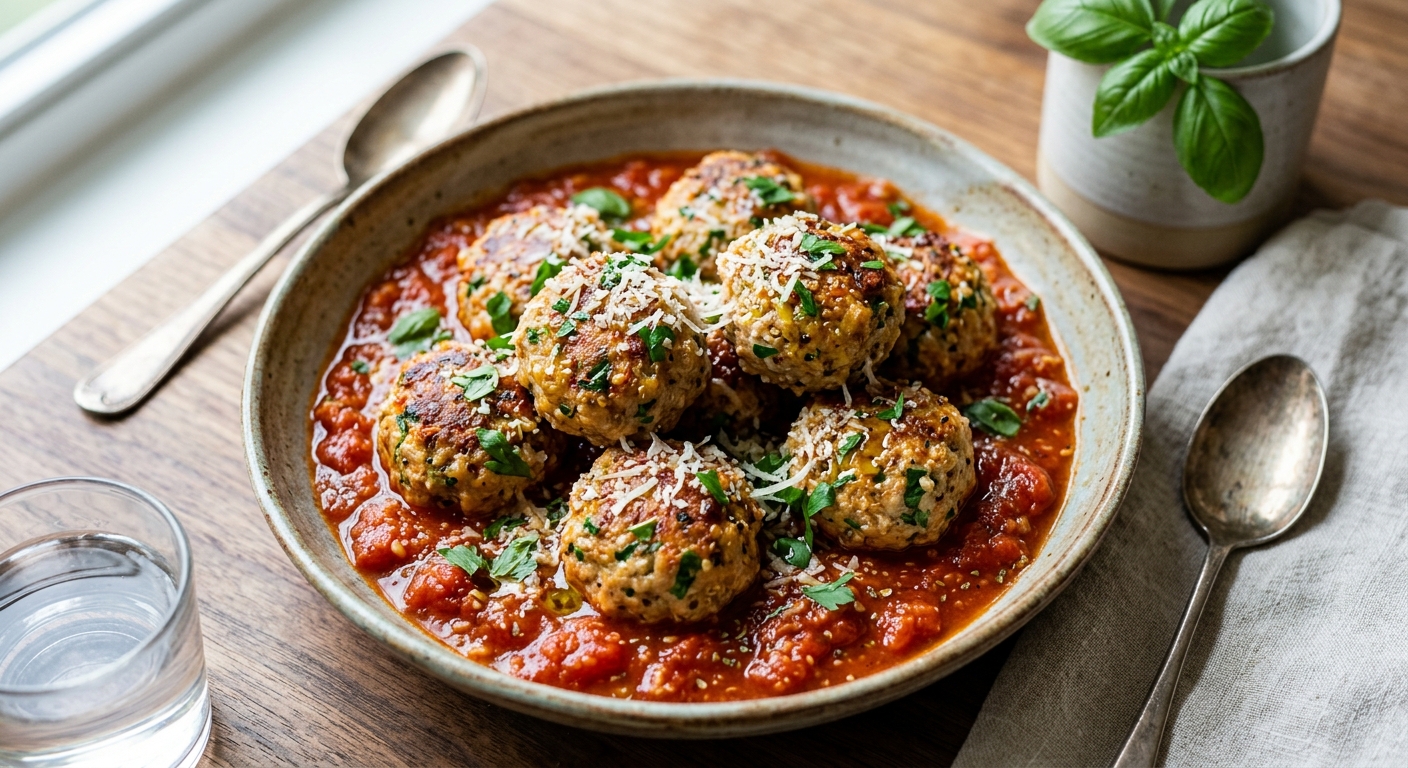
Most meatball recipes treat the binder as an afterthought, reaching for breadcrumbs or oats with little nutritional intention. Here, cooked quinoa replaces those empty fillers entirely, contributing roughly 8 grams of additional protein per serving while simultaneously keeping every meatball gluten-free, light in texture, and packed with all nine essential amino acids. Combined with lean ground turkey, this dish achieves 40 grams of complete protein per serving without relying on red meat, excessive fat, or protein powders.
The tomato sauce is not a shortcut. Crushed San Marzano tomatoes are cooked down with garlic, fresh basil, and a whisper of red pepper flakes into a sauce that is simultaneously bright and deeply savory. The long simmer, whether on the stovetop, in a slow cooker, or under pressure, allows the meatballs to absorb the sauce and finish cooking gently, keeping them moist and tender rather than dense and rubbery. This is the technique professional Italian cooks rely on: finish the meatballs in the sauce, never just on top of it.
From a nutritional standpoint, this dish is a calibrated triumph. Beyond its extraordinary protein content, each serving delivers over 30% of your daily iron needs, significant B-vitamin coverage including B6 and B12 from the turkey, and a meaningful dose of lycopene from the cooked tomatoes. Lycopene bioavailability increases dramatically when tomatoes are cooked and combined with fat, so the olive oil in this sauce is doing double duty as a flavor carrier and a nutrient-delivery vehicle. Whether you are an athlete in a muscle-building phase or simply someone who wants a deeply satisfying dinner that keeps hunger at bay for hours, this recipe was built for you.
4
servings
Ingredients
- 700 glean ground turkey (93% lean)
- 180 gcooked quinoa (about 65g dry), cooled
- 2 largeeggs
- 4 clovesgarlic, minced (divided)
- 30 gfresh flat-leaf parsley, finely chopped
- 40 gParmesan cheese, finely grated
- 1 tspdried oregano
- 1 tsponion powder
- 0.5 tspfennel seeds, lightly crushed
- 0.5 tspred pepper flakes
- 3 tbspextra-virgin olive oil (divided)
- 1 mediumyellow onion, finely diced
- 800 gcrushed San Marzano tomatoes (two 400g cans)
- 200 mllow-sodium chicken stock
- 15 gfresh basil leaves, torn, plus more to serve
- 1 tspcoconut sugar or honey
- —Colima Sea SaltMicroplastic Free Salt and freshly ground black pepper to taste
Instructions
Click on an item below to shop for the recommended items for this recipe on Amazon.
As an Amazon Associate, we earn from qualifying purchases.
- Make the meatball mixture: In a large bowl, combine the ground turkey, cooked quinoa, eggs, half the minced garlic (2 cloves), parsley, Parmesan, oregano, onion powder, fennel seeds, 0.5 tsp salt, and a generous grind of black pepper. Mix with your hands until just combined, being careful not to overwork the meat. Over-mixing develops protein strands that make meatballs tough. Cover and refrigerate for 10 minutes to firm up the mixture.
- Form the meatballs: With lightly dampened hands, roll the mixture into 20 equal balls, roughly 45g each (about the size of a golf ball). Place them on a plate or lined tray as you go.
- Sear the meatballs: Heat 2 tbsp olive oil in a large, wide Dutch oven or deep skillet over medium-high heat until shimmering. Working in two batches to avoid crowding, sear the meatballs for 2 to 3 minutes per side until golden brown on at least two sides. They will not be cooked through at this stage. Transfer to a plate and set aside. Searing develops a Maillard crust that seals in moisture and adds savory depth to the final sauce.
- Build the sauce: Reduce heat to medium. Add the remaining 1 tbsp olive oil to the same pot. Add the diced onion and cook, stirring frequently, for 5 to 6 minutes until softened and lightly golden. Add the remaining 2 cloves of minced garlic and the red pepper flakes, cooking for 1 minute until fragrant. Pour in the crushed tomatoes and chicken stock, stirring to scrape up any browned bits from the pot bottom. Stir in the coconut sugar or honey and torn basil. Season with salt and pepper.
- Simmer the meatballs: Bring the sauce to a gentle simmer over medium heat. Carefully nestle the seared meatballs into the sauce in a single layer. Spoon sauce over the tops, reduce heat to low, and cover partially with a lid. Simmer for 18 to 22 minutes, turning the meatballs once halfway through, until they register an internal temperature of 74C (165F) on an instant-read thermometer and the sauce has thickened. Taste the sauce and adjust seasoning. Garnish with fresh basil and extra Parmesan before serving.
- Prepare the meatball mixture and refrigerate as described in the stovetop method. Form into 20 balls of roughly 45g each.
- Sear for flavor: Heat 2 tbsp olive oil in a large skillet over medium-high heat. Sear the meatballs in two batches for 2 to 3 minutes per side until browned. Transfer directly to the slow cooker insert in a single layer. Do not stack them at this stage.
- Build the sauce in the skillet: Without cleaning the skillet, reduce heat to medium and add the remaining 1 tbsp olive oil. Saute the diced onion for 4 to 5 minutes until softened. Add the remaining garlic and red pepper flakes, cook for 1 minute. Pour in the crushed tomatoes but reduce the chicken stock to 100ml only, as the slow cooker retains liquid and the sauce would otherwise become too thin. Stir in the sugar and half the basil, season with salt and pepper, and pour the sauce over the meatballs.
- Cook on Low: Place the lid on the slow cooker and cook on Low for 4 to 5 hours. Avoid cooking on High, as the rapid bubbling can break apart the meatballs and cause the turkey to become dry and grainy. The gentle, even heat of the Low setting keeps them tender and allows the sauce to develop a rich, slow-cooked character.
- Finish and serve: Once the meatballs reach an internal temperature of 74C (165F) and the sauce has deepened in color, gently stir in the remaining fresh basil. Taste and adjust seasoning. If the sauce is thinner than you prefer, remove the lid and switch to High for 15 to 20 minutes to reduce it before serving.
- Prepare the meatball mixture and refrigerate as described. Form into 20 balls of roughly 45g each. Because pressure cooking is a moist-heat environment, freezing the formed meatballs for 15 minutes before cooking helps them hold together better during pressurization.
- Build the sauce using the Saute function: Set the Instant Pot or pressure cooker to Saute on Medium. Add 2 tbsp olive oil, then cook the diced onion for 4 to 5 minutes until softened. Add all 4 cloves of garlic and the red pepper flakes, cook for 1 minute. Pour in the crushed tomatoes and 150ml chicken stock. Add the sugar, half the basil, oregano, salt, and pepper. Stir well, then press Cancel to stop the Saute function.
- Arrange meatballs and pressure cook: Gently lower the raw meatballs into the sauce one at a time, arranging them in a single layer as much as possible. Spoon sauce over the tops. Secure the lid, set the valve to Sealing, and cook on Manual High Pressure for 7 minutes. Allow a natural pressure release for 5 minutes, then carefully switch to Quick Release to vent the remaining steam.
- Broil for color: Preheat your oven broiler to high. Using a slotted spoon, carefully transfer the meatballs to an oven-safe baking dish or sheet pan. Spoon a little sauce over each one. Broil 10 to 12 cm from the heating element for 3 to 4 minutes until the tops are golden and lightly caramelized. Watch closely as broilers vary significantly in intensity.
- Reduce and finish the sauce: While the meatballs broil, switch the Instant Pot back to Saute on High and cook the sauce, stirring occasionally, for 4 to 5 minutes until it thickens to your liking. Return the broiled meatballs to the pot, stir in the remaining fresh basil, adjust seasoning, and serve immediately.
- Preheat your oven to 220C (425F) with a rack in the upper third. Line a large rimmed baking sheet with foil and place an oven-safe wire rack on top. Lightly spray or brush the rack with olive oil to prevent sticking.
- Prepare and form the meatballs: Make the meatball mixture and refrigerate for 10 minutes as described. Form into 20 balls of roughly 45g each and place them on the prepared wire rack, spaced about 3cm apart. This elevated position allows convective heat to brown all sides evenly without needing to turn them.
- Bake the meatballs: Place the baking sheet on the upper rack of the preheated oven. Bake for 18 to 20 minutes until the meatballs are browned and register an internal temperature of 74C (165F). The dry, high heat of the oven produces a more pronounced crust than stovetop searing with less oil and less hands-on attention.
- Make the tomato sauce on the stovetop while the meatballs bake: Heat 2 tbsp olive oil in a large saucepan or deep skillet over medium heat. Saute the diced onion for 5 to 6 minutes until golden. Add the garlic and red pepper flakes, cook for 1 minute. Stir in the crushed tomatoes, chicken stock, sugar, and half the basil. Season with salt and pepper and simmer over medium-low heat for 15 minutes, stirring occasionally, until slightly thickened.
- Combine and finish: Once the meatballs come out of the oven, transfer them directly into the simmering tomato sauce. Stir gently to coat, then reduce oven temperature to 180C (350F) and transfer the entire saucepan to the oven, if oven-safe, for a final 10-minute bake. Alternatively, continue simmering on the stovetop over low heat for 8 to 10 minutes to let the meatballs absorb the sauce flavors. Stir in the remaining fresh basil, taste, adjust seasoning, and serve with extra Parmesan.
Nutrition Breakdown
Per 1 serving (makes 4)
Vitamins & Minerals
% Daily Value based on a 2,000 calorie diet (FDA reference)
🧬 Essential Amino Acids
% of recommended daily intake (RDA) per serving
🛡 Antioxidant Profile
The Nutrition Science
The combination of ground turkey and cooked quinoa is not accidental from a protein quality standpoint. Turkey is a complete protein with a PDCAAS (Protein Digestibility-Corrected Amino Acid Score) close to 1.0, meaning it supplies all essential amino acids in proportions well matched to human requirements. Quinoa is one of the very few plant foods that also achieves near-complete amino acid status, particularly high in lysine, an amino acid that most grains are critically low in. Together, they produce a protein profile that exceeds 130% of the RDA for every single essential amino acid per serving, which is exceptional for a dish without red meat or dairy as primary protein sources.
The bioavailability of lycopene from this dish deserves special attention. Raw tomatoes provide lycopene in a cis-isomer configuration that is relatively poorly absorbed. Cooking breaks down the cellular matrix and converts lycopene to more bioavailable forms, and the presence of dietary fat (olive oil in this recipe) further enhances absorption through micellarization in the small intestine. Studies published in the Journal of Nutrition have shown that lycopene absorption from cooked tomato products consumed with fat can be three to four times higher than from raw tomatoes. At approximately 18mg of lycopene per serving, this dish places you well within the range associated with cardiovascular protective effects in epidemiological research.
Selenium, often overlooked but critically important, reaches 69% of the daily value per serving here, almost entirely from the turkey. Selenium is a cofactor for glutathione peroxidase and thioredoxin reductase, two antioxidant enzyme systems that defend against lipid peroxidation and DNA damage. It also plays a direct role in thyroid hormone metabolism, immune response regulation, and the recycling of vitamins C and E after they neutralize free radicals. The simultaneous presence of vitamin C from the tomatoes (24% DV) creates a regenerative antioxidant cycle that amplifies the protective effect beyond what either nutrient achieves independently.
Pro Tips
- Do not skip the resting step after mixing the meatball mixture. Ten minutes in the refrigerator allows the quinoa to absorb moisture from the egg and turkey, which results in a firmer, easier-to-roll mixture and meatballs that hold their shape during cooking.
- Use a kitchen scale rather than measuring cups for the ground turkey and quinoa. Even small variations in the protein-to-binder ratio significantly affect the final texture, and a scale ensures consistency across every batch.
- If you want to meal-prep this recipe, the fully cooked meatballs in sauce freeze exceptionally well for up to three months. Cool completely before transferring to airtight containers in serving-sized portions, and reheat gently in a covered saucepan with a splash of stock to restore moisture.
What a beautiful way to honor the whole protein profile, and I love that you’re thinking about both the binding function and nutritional density. I always add a generous pinch of turmeric and black pepper to my tomato-based dishes like this, not just for the earthy warmth it brings to the sauce, but because the curcumin in turmeric gets absorbed so much more efficiently with black pepper along with the fat from the ground turkey. In Ayurveda, we’d say this combination helps with digestion and reduces inflammation, and it feels like exactly what your gut might appreciate alongside those complete proteins.
Love the turmeric and black pepper combo here, especially since you’re hitting the bioavailability angle – that piperine in black pepper genuinely enhances curcumin absorption, and paired with the fat from the turkey you’re optimizing that whole anti-inflammatory package. From a protein timing perspective, what I’m most excited about with this recipe is that the quinoa brings ~8g per serving with all nine EAAs including a solid leucine hit, which combines beautifully with the turkey’s leucine density to really maximize that muscle protein synthesis window post-workout. The tomato sauce is the cherry on top since lycopene absorption improves with fat and heat, so you’re getting micronutr
Oh wow, the quinoa as a binder is genius – I’ve been using ground flax for binding but never considered how that would impact the amino acid profile! I’m definitely saving this recipe because my gut has been SO much happier since I started prioritizing complete proteins at dinner / turkey is one of my safer proteins compared to beef. Quick question though – do you know if the tomato sauce is cooked long enough to break down the lectins? I’ve noticed my inflammation markers drop significantly when tomatoes are simmered for 30+ minutes, and I’m curious if your recipe hits that sweet spot!