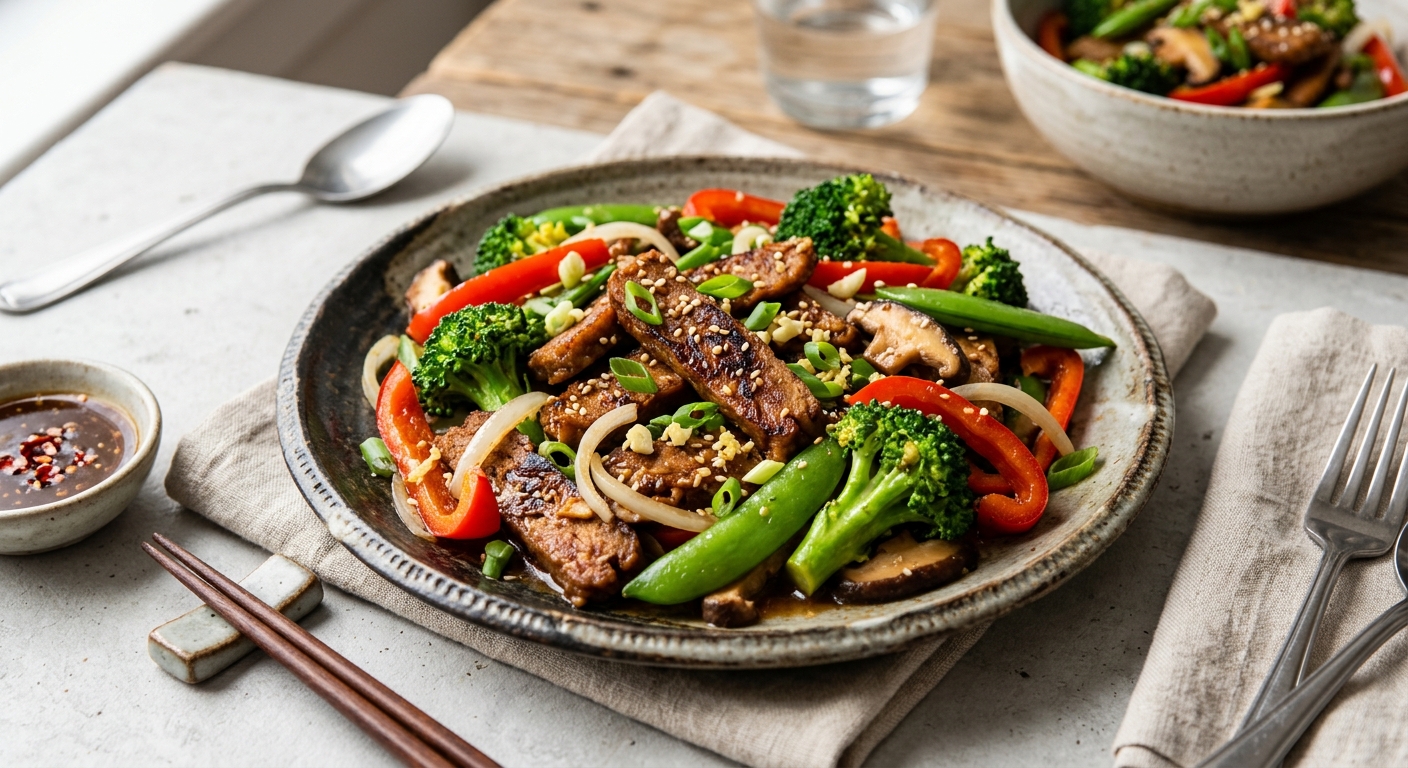
Seitan has quietly become the gold standard of whole-food plant protein, and this stir-fry showcases exactly why. Unlike processed meat alternatives, seitan is simply wheat gluten coaxed into a dense, satisfying chew that absorbs sauces beautifully. Combined with broccoli, red bell pepper, snap peas, and shiitake mushrooms, this dish layers texture upon texture, while a ginger-garlic tamari sauce with toasted sesame oil ties everything together with deep, roasted complexity.
From a nutritional architecture standpoint, this recipe was engineered around a single goal: maximizing plant protein density without sacrificing micronutrient diversity. Seitan contributes the lion’s share of the 34 grams of protein per serving, but the vegetables are not passengers. Broccoli alone supplies a significant hit of vitamin C, vitamin K, and folate, while shiitake mushrooms add a rare plant source of vitamin D and a suite of B vitamins. Snap peas bring in iron and additional vitamin C to enhance that iron’s absorption, and red bell pepper layers on more than 150% of your daily vitamin C requirement across the dish.
What makes Calibrated Cuisine’s version stand apart is the sauce calibration. Most stir-fry sauces rely on sugar or cornstarch as primary flavoring agents. Here, the umami backbone comes from tamari and a touch of rice vinegar, thickened minimally with arrowroot for a clean finish. The result is a glossy, coating sauce that reads as indulgent but is doing serious nutritional work, bringing in selenium from the sesame, additional B6 from the garlic, and manganese from the ginger. This is a dish built to perform.
4
servings
Ingredients
- 600 gstore-bought or homemade seitan, sliced into thin strips
- 250 gbroccoli florets, cut into bite-sized pieces
- 200 gred bell pepper, thinly sliced
- 150 gsnap peas, trimmed
- 150 gshiitake mushrooms, stems removed and caps sliced
- 1 mediumwhite onion, thinly sliced
- 4 clovesgarlic, minced
- 20 gfresh ginger, peeled and grated (about 2 tablespoons)
- 60 mltamari (or low-sodium soy sauce for non-gluten-free)
- 30 mlrice vinegar
- 15 mlhoisin sauce
- 10 mltoasted sesame oil
- 2 tsparrowroot powder (or cornstarch), dissolved in 2 tbsp cold water
- 2 tspcoconut sugar or brown sugar
- 2 tbspAvocado Oil100% Pure Avocado Oil (avocado or refined coconut)
- 2 tbspsesame seeds, toasted, for garnish
- 3 stalksgreen onion, thinly sliced, for garnish
- —Colima Sea SaltMicroplastic Free Salt and white pepper to taste
- —Cooked brown rice or noodles for serving (optional, not included in nutrition data)
Instructions
Click on an item below to shop for the recommended items for this recipe on Amazon.
As an Amazon Associate, we earn from qualifying purchases.
- Whisk together the tamari, rice vinegar, hoisin sauce, coconut sugar, and toasted sesame oil in a small bowl to make the sauce base. Set aside. In a separate small bowl, dissolve the arrowroot powder in 2 tablespoons of cold water and set aside.
- Heat a wok or large (30cm/12-inch) skillet over the highest flame your stovetop allows for 2 full minutes until the surface just begins to smoke. Add 1 tablespoon of the neutral oil and swirl to coat. Working in a single layer, add the seitan strips in one batch and do not stir for 90 seconds, allowing them to develop a deeply golden, slightly charred crust. Toss once, cook another 60 seconds, then transfer to a plate.
- Return the wok to high heat and add the remaining tablespoon of oil. Add the onion and shiitake mushrooms and stir-fry, tossing constantly, for 2 to 3 minutes until the mushrooms have released their moisture and the edges are caramelized.
- Add the broccoli florets and a 2-tablespoon splash of water. Toss vigorously and cook for 2 minutes, allowing the steam to partially cook the broccoli while the wok stays screaming hot. Add the red bell pepper and snap peas and stir-fry for another 90 seconds. The vegetables should be bright, crisp-tender, and lightly charred at the edges.
- Push the vegetables to the outer rim of the wok. Add the garlic and ginger to the center and fry in the residual oil for 30 seconds until fragrant, then toss everything together. Return the seared seitan to the wok.
- Pour the sauce over everything and toss to coat. Give the arrowroot slurry a quick stir, then drizzle it into the wok while tossing continuously. Within 30 to 45 seconds the sauce will thicken to a glossy glaze. Taste and adjust seasoning with salt and white pepper. Remove from heat immediately.
- Divide among bowls, garnish with toasted sesame seeds and sliced green onion, and serve immediately over brown rice or noodles if desired.
- Whisk together the tamari, rice vinegar, hoisin sauce, coconut sugar, garlic, and grated ginger directly in the insert of your slow cooker. This cold-start blooming of the aromatics in the sauce works well here since the long cook will fully develop their flavor without a saute step.
- Add the sliced seitan strips and onion to the slow cooker and toss to coat thoroughly in the sauce. Arrange in an even layer. Add the shiitake mushrooms on top of the seitan. Do not add the broccoli, snap peas, or bell pepper yet, as they will become mushy if cooked the entire time.
- Cover and cook on Low for 2 hours 30 minutes. The seitan will absorb the sauce and become deeply flavored. Stir once at the 1-hour mark if you are available, though it is not strictly necessary.
- At the 2 hour 30 minute mark, stir in the broccoli florets and red bell pepper. Replace the lid and cook on Low for an additional 25 to 30 minutes until the broccoli is just tender but still has a slight bite. Stir in the snap peas during the final 5 minutes only, so they stay crisp.
- In a small bowl, dissolve the arrowroot powder in 2 tablespoons of cold water. Stir the slurry into the slow cooker, replace the lid, and cook on High for 10 minutes until the sauce thickens. Stir in the toasted sesame oil now (adding it at the end preserves its aromatic compounds, which degrade with prolonged heat). Taste and adjust salt and white pepper.
- Garnish with sesame seeds and green onion. Serve directly from the slow cooker insert over brown rice or noodles.
- Set your Instant Pot or electric pressure cooker to Saute on High. Add 1 tablespoon of neutral oil and, once shimmering, add the seitan strips in a single layer. Sear undisturbed for 2 minutes, then flip and sear another 90 seconds. Work in two batches if needed to avoid crowding. Press Cancel.
- Add the onion, shiitake mushrooms, garlic, and ginger directly to the pot with the seitan. Stir briefly to combine. Pour in the tamari, rice vinegar, hoisin sauce, and coconut sugar. Add 60ml (1/4 cup) of water. Stir to combine and scrape up any browned bits from the bottom of the pot, as this is critical for preventing a burn warning.
- Secure the lid and set the valve to Sealing. Cook on Manual or Pressure Cook at High Pressure for 4 minutes. While the pot builds and holds pressure, prepare your vegetables so they are ready for the finishing step.
- When the timer ends, perform a Quick Release by carefully switching the valve to Venting. Once the pin drops, open the lid. The seitan will have absorbed the sauce and the mushrooms will be silky and tender.
- Set the pot back to Saute on High. Add the broccoli florets, red bell pepper, and snap peas to the pot and stir-fry in the residual liquid for 3 to 4 minutes until the broccoli is bright green and crisp-tender. Do not cover the pot during this step as you want the moisture to evaporate, not steam the vegetables soft.
- Stir the arrowroot slurry (arrowroot dissolved in 2 tbsp cold water) into the pot while stirring continuously. The sauce will thicken within 30 to 60 seconds on Saute. Press Cancel, stir in the toasted sesame oil, and taste for seasoning. Garnish with sesame seeds and green onion and serve immediately.
- Preheat your oven to 220C (425F) with two rimmed baking sheets inside so they get screaming hot. This hot-pan technique is essential for achieving caramelization rather than steaming. Position one rack in the upper third and one in the lower third of the oven.
- In a large bowl, whisk together the tamari, rice vinegar, hoisin sauce, coconut sugar, garlic, ginger, and 1 tablespoon of neutral oil to create the marinade. Add the seitan strips, broccoli, onion, and shiitake mushrooms and toss aggressively to coat every surface. Let sit for 5 minutes while the oven finishes preheating.
- Working quickly, carefully remove both hot baking sheets from the oven. Drizzle each sheet with half a tablespoon of neutral oil and tilt to coat. Spread the seitan and vegetables in a single layer across both sheets, ensuring nothing is overlapping. Crowding is the enemy of caramelization. Pour any remaining marinade from the bowl over the top.
- Roast for 15 minutes on the initial heat. Remove both sheets from the oven, add the red bell pepper and snap peas (which need less cooking time) to the pans, and toss everything with tongs. Swap the top and bottom sheet positions for even browning. Return to the oven for another 12 to 15 minutes until the seitan is deeply caramelized and the broccoli edges are charred and crispy.
- While the pan is in its final minutes, warm the arrowroot slurry with the toasted sesame oil in a small saucepan over medium heat for 1 to 2 minutes, stirring, until just lightly thickened into a drizzling sauce.
- Remove both sheets from the oven. Transfer everything to a large serving platter or divide among bowls. Drizzle the warm sesame-arrowroot sauce over the top, then garnish with toasted sesame seeds and sliced green onion. Serve immediately over brown rice or noodles.
Nutrition Breakdown
Per 1 serving (makes 4)
Vitamins & Minerals
% Daily Value based on a 2,000 calorie diet (FDA reference)
🧬 Essential Amino Acids
% of recommended daily intake (RDA) per serving
🛡 Antioxidant Profile
The Nutrition Science
Seitan is among the most protein-dense whole foods available, delivering roughly 25 grams of protein per 100 grams of cooked product, which is comparable to chicken breast by weight. Its protein comes almost entirely from gluten, a complex of two proteins, gliadin and glutenin, that are exceptionally high in several essential amino acids including leucine, isoleucine, valine, and phenylalanine. These branched-chain and aromatic amino acids make seitan an unusually complete plant protein source, though it is worth noting that lysine is its limiting amino acid. Pairing it with legumes (edamame, lentils, or even the sesame seeds used as garnish here) across the day effectively resolves this gap and produces a complete amino acid profile functionally equivalent to animal protein.
The vegetable combination in this recipe was not arbitrary. Vitamin C from the red bell pepper (one of the highest dietary sources at roughly 128mg per 100g raw) dramatically enhances the absorption of non-heme iron provided by the seitan and snap peas. Research published in the American Journal of Clinical Nutrition demonstrates that consuming vitamin C alongside non-heme iron sources can increase iron absorption by two to four times. This is why the bell pepper is not just a textural element but a genuine nutritional catalyst. Similarly, the sulforaphane in broccoli is only formed enzymatically when the vegetable’s cell walls are broken, which means the chopping and brief high-heat cooking in this recipe is timed deliberately: enough to break cells and initiate sulforaphane formation, but not so much as to denature the myrosinase enzyme that drives the conversion.
Shiitake mushrooms contribute ergothioneine, a compound so nutritionally unique that some researchers have proposed designating it a conditionally essential nutrient. Unlike most antioxidants that are consumed in the neutralization process, ergothioneine is actively transported into cells via a dedicated transporter (OCTN1) and accumulates in mitochondria, where it provides ongoing protection against oxidative damage to DNA and lipid membranes. Shiitakes are also among the rare plant foods to contain vitamin D2 (ergocalciferol), particularly when the mushrooms have been dried in sunlight, making this stir-fry one of the few plant-based meals to contribute meaningfully to vitamin D intake without fortification.
Pro Tips
- Slice seitan strips against the grain at a 45-degree angle and make them no thicker than 5mm. Thin, angled cuts maximize surface area for searing, which creates the Maillard reaction responsible for the deep savory crust that makes seitan taste genuinely meaty rather than bland.
- Never skip the hot-pan preheat for the stovetop and oven methods. A wok or baking sheet that is fully heated before the food touches it is the single biggest difference between a restaurant-quality stir-fry and a steamed, limp one. Give your wok at least 2 full minutes over the highest heat before adding oil.
- Add the toasted sesame oil at the very end of cooking regardless of which method you use. Sesame oil’s characteristic flavor compounds, including sesamol and sesaminol, are volatile and will largely evaporate if subjected to prolonged heat, reducing both flavor impact and antioxidant content by up to 60% compared to a finishing addition.

looks delicious and the protein density is solid, but quick q – what’s the net carb count on this? seitan’s basically vital wheat gluten so it should be pretty low, but im curious what the sauce adds since soy sauce and cornstarch can sneak in more carbs than people realize. ive found that even small amounts of hidden sugars can throw off blood sugar for me, so i always check those umami sauces carefully – would love to know the full macro breakdown if you have it!
This looks amazing, and I’m really intrigued by the protein angle here! I’ve been curious about seitan’s amino acid profile in my thesis work, and I’m wondering if you’re getting that complete protein claim from the combination of seitan plus any other sources in the dish (like sesame seeds in the sauce, maybe?). Also, I’m dying to know if you’re using any dark leafy greens in this stir-fry, because I’d love to see chlorophyll-rich vegetables incorporated here / the magnesium-bound chlorophyll in spinach or kale would be such a beautiful synergy with the umami flavors you’re going for!
Oh this is such a practical recipe for my clients who are skeptical about plant protein! I’m curious about the veggie combo you chose here too, since I’m always looking for stir-fry formulas that layer in complementary amino acids. Seitan is fantastic for lysine density, so pairing it with something like sesame seeds or a tahini-forward sauce would really round out that complete protein profile. Did you intentionally structure the veggies and sauce that way, or was it more of a happy accident?