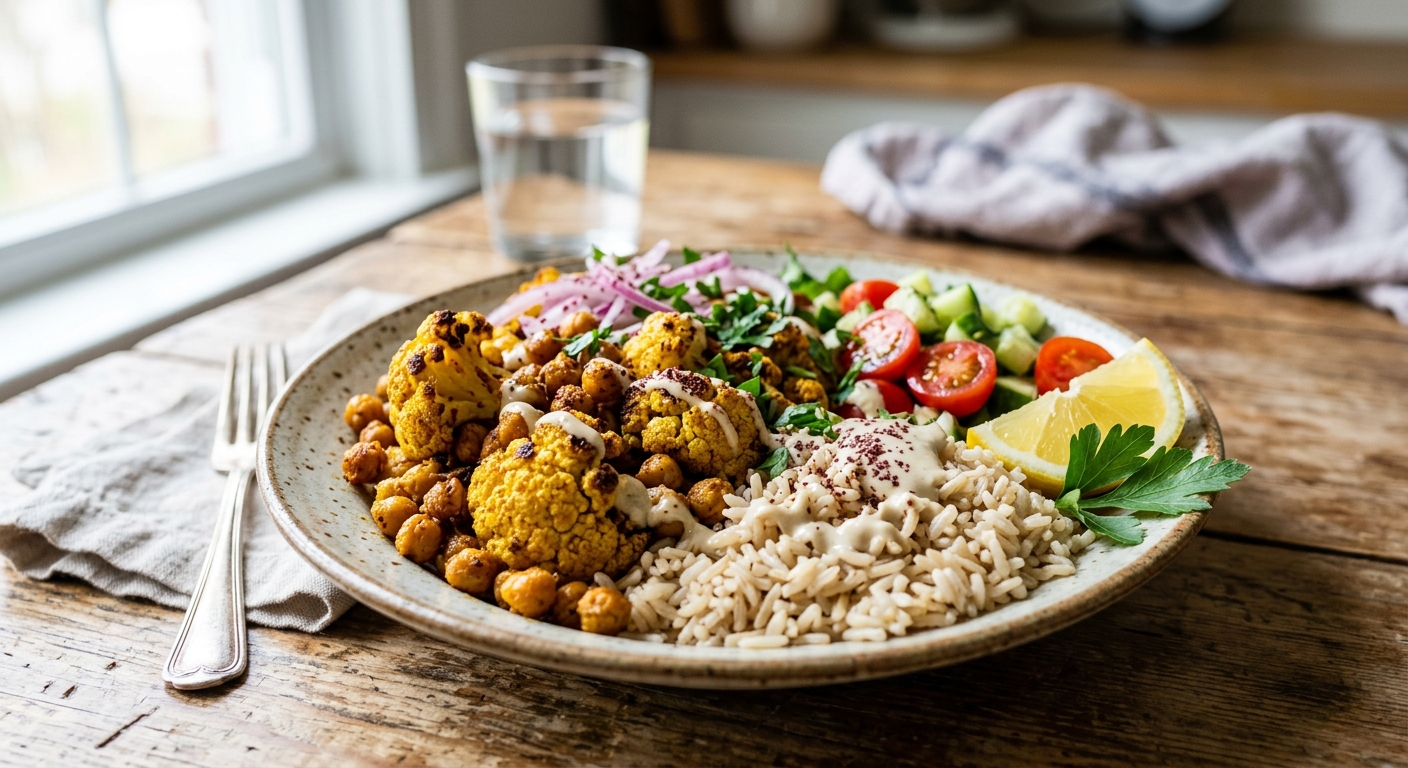
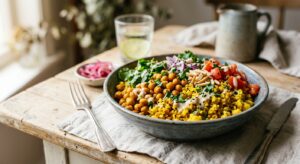
The shawarma bowl reimagined for nutritional precision: this recipe takes the warm, cumin-forward spice profile of classic street shawarma and builds it around two of the plant kingdom’s most nutrient-dense workhorses. Chickpeas contribute roughly 15 grams of protein per cooked cup alongside a powerful folate punch, while cauliflower brings vitamin C, vitamin K, and a suite of glucosinolate compounds that support cellular detoxification. Together they form a genuinely protein-rich base that competes with many meat-centered meals.
What separates this bowl from ordinary grain bowls is the layering of technique and spice science. The shawarma blend, built on cumin, smoked paprika, turmeric, coriander, cinnamon, and a touch of cayenne, is not merely decorative. Cumin seeds contain significant iron, and the fat from olive oil and tahini improves absorption of the fat-soluble carotenoids in both the spice blend and the cauliflower itself. The lemon juice in the tahini sauce provides ascorbic acid, which is well established to enhance non-heme iron absorption when consumed in the same meal, a pairing that nudges the dish’s iron bioavailability meaningfully upward.
We have calibrated this recipe to four generous servings, each delivering more than 40% of daily iron needs, more than 65% of folate, and a glycemic load firmly in the medium range thanks to the resistant starch in chickpeas and the fiber content of the whole grain rice base. Whether you roast the cauliflower in a blazing oven for maximum caramelization, braise it low and slow in a slow cooker for a saucier weeknight version, or fire the pressure cooker for a 25-minute weeknight miracle, the nutritional outcome is consistent and the flavor is anything but plain.
4
servings
Ingredients
- 1 large headcauliflower (approx. 800g), cut into florets
- 480 gcooked chickpeas (two 400g cans, drained and rinsed, or 240g dried cooked)
- 300 glong-grain brown rice, rinsed
- 720 mllow-sodium vegetable broth
- 3 tbspextra-virgin olive oil, divided
- 6 clovesgarlic, minced
- 1 largeyellow onion, thinly sliced
- 2 tspground cumin
- 2 tspsmoked paprika
- 1 tspground coriander
- 1 tspground turmeric
- 0.5 tspground cinnamon
- 0.25 tspcayenne pepper
- 0.5 tspground black pepper
- 1 tspColima Sea SaltMicroplastic Free Salt, divided, plus more to taste
- 400 gcrushed tomatoes (canned)
- 60 mlwater
- 60 gtahini (sesame paste)
- 3 tbspfresh lemon juice (about 1.5 lemons)
- 1 tbspwater, for tahini sauce
- 80 gbaby spinach or chopped flat-leaf parsley, for serving
- 1 mediumcucumber, diced, for serving
- 4 tbsppomegranate seeds, for serving (optional)
- —Colima Sea SaltMicroplastic Free Salt and black pepper to taste
Instructions
Click on an item below to shop for the recommended items for this recipe on Amazon.
As an Amazon Associate, we earn from qualifying purchases.
- Preheat your oven to 220C (425F) with convection if available. Line two large rimmed baking sheets with parchment paper. Cook the brown rice separately: combine rice, vegetable broth, and a pinch of salt in a medium saucepan, bring to a boil, then reduce to the lowest heat, cover tightly, and simmer for 40 to 45 minutes until all liquid is absorbed. Remove from heat and let steam 10 minutes before fluffing.
- In a large mixing bowl, whisk together 2 tablespoons olive oil, half the minced garlic (3 cloves), cumin, smoked paprika, coriander, turmeric, cinnamon, cayenne, black pepper, and half a teaspoon salt to form a thick spice paste. Add the cauliflower florets and drained chickpeas. Toss thoroughly with clean hands or a large spoon until every piece is evenly coated in the spice mixture.
- Spread the cauliflower and chickpeas in a single layer across the two prepared baking sheets, making sure nothing overlaps. Crowding causes steaming rather than roasting and you will lose the caramelized crust. Roast on the top and middle racks for 20 minutes, then remove both sheets, toss the contents with a spatula, and swap the positions of the two sheets. Roast for a further 15 to 20 minutes until the cauliflower is deeply golden at the edges and the chickpeas are slightly crispy.
- While the cauliflower roasts, heat the remaining 1 tablespoon olive oil in a small skillet over medium heat. Add the sliced onion with a pinch of salt and cook, stirring occasionally, for 18 to 22 minutes until the onion is soft, golden, and beginning to caramelize. Add the remaining 3 cloves of garlic and cook 1 minute more. Add the crushed tomatoes and 60ml water, stir to combine, and simmer for 8 to 10 minutes until the sauce thickens. Season with salt and pepper.
- Prepare the tahini sauce: in a small bowl whisk together the tahini, fresh lemon juice, 1 tablespoon water, and a pinch of salt. The mixture will seize up at first but keep whisking; it will loosen into a creamy, pourable consistency. Thin with additional water one teaspoon at a time if needed.
- To assemble: divide the herbed brown rice between four bowls. Spoon the tomato-onion sauce over the rice, then pile on the roasted cauliflower and chickpeas. Drizzle generously with tahini sauce. Top with baby spinach or parsley, diced cucumber, and pomegranate seeds if using. Serve immediately.
- Begin the brown rice first as it takes the longest: combine the rinsed rice with vegetable broth and a pinch of salt in a medium saucepan. Bring to a boil over high heat, then reduce to the lowest simmer, cover with a tight-fitting lid, and cook for 40 to 45 minutes until liquid is absorbed. Do not lift the lid during cooking. Remove from heat and rest 10 minutes.
- While the rice cooks, combine the cumin, smoked paprika, coriander, turmeric, cinnamon, cayenne, and black pepper in a small bowl. Heat 2 tablespoons of olive oil in a wide, heavy-bottomed pot or Dutch oven over medium-high heat until shimmering. Add the cauliflower florets in a single layer, working in two batches if needed, and sear undisturbed for 3 to 4 minutes until golden brown on one side. Flip and sear 2 minutes more. Transfer to a plate.
- Reduce heat to medium. Add the remaining 1 tablespoon oil to the same pot. Add the sliced onion and cook, stirring frequently, for 8 minutes until softened and lightly golden. Add all the minced garlic and the spice blend, and cook stirring constantly for 60 to 90 seconds until the spices are very fragrant and beginning to toast on the bottom of the pan.
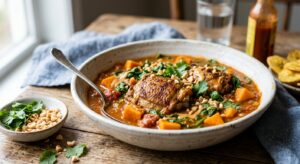
- Pour in the crushed tomatoes and 60ml water, scraping up any spiced bits from the bottom of the pot with a wooden spoon. Stir in the drained chickpeas and return the seared cauliflower to the pot. Season with three-quarters of a teaspoon salt. Reduce heat to medium-low, cover the pot, and braise for 15 to 18 minutes, stirring gently twice, until the cauliflower is tender when pierced with a knife and the sauce has thickened and clung to everything. Taste and adjust seasoning.
- Whisk together the tahini, lemon juice, 1 tablespoon water, and a pinch of salt in a small bowl until smooth and pourable. To assemble bowls, add a scoop of brown rice, ladle the braised cauliflower-chickpea mixture generously over the top, drizzle with tahini sauce, and finish with spinach or parsley, cucumber, and pomegranate seeds.
- In a dry skillet over medium heat, toast the cumin, smoked paprika, coriander, turmeric, cinnamon, cayenne, and black pepper for 60 seconds, stirring constantly, until fragrant. Add 1 tablespoon of olive oil, the sliced onion, and all the minced garlic directly to the skillet. Cook for 5 minutes, stirring, until the onion softens and the spices bloom in the fat. This step is done on the stovetop and takes only 6 to 7 minutes but makes a substantial difference to the final depth of flavor.
- Transfer the spiced onion mixture to the insert of a 5 to 6 quart slow cooker. Add the crushed tomatoes, 60ml water, drained chickpeas, remaining 2 tablespoons olive oil, and three-quarters of a teaspoon salt. Stir to combine. Nestle the cauliflower florets into the sauce, pressing them down gently so they are mostly submerged. The sauce will be relatively thick; this is correct because the cauliflower will release moisture as it cooks.
- Place the lid on the slow cooker. Cook on High for 4 hours or on Low for 7 to 8 hours. The cauliflower is done when it yields easily to a fork but has not completely collapsed. If you prefer firmer florets, check at 3 hours on High or 6 hours on Low. Taste and adjust salt and pepper in the final 30 minutes of cooking.
- About 50 minutes before the slow cooker finishes, cook the brown rice: combine the rinsed rice, vegetable broth, and a pinch of salt in a medium saucepan. Bring to a boil, cover, and simmer on the lowest heat for 40 to 45 minutes until absorbed. Rest 10 minutes off heat before fluffing with a fork.
- When ready to serve, whisk the tahini, lemon juice, 1 tablespoon water, and a pinch of salt in a small bowl until smooth. Assemble bowls with rice, a generous ladle of the slow-cooked cauliflower and chickpeas with its sauce, a drizzle of tahini, and fresh toppings of spinach or parsley, diced cucumber, and pomegranate seeds.
- Set the Instant Pot or electric pressure cooker to Saute mode on High. Add 2 tablespoons olive oil and heat until shimmering. Add the sliced onion and cook for 4 minutes, stirring, until beginning to soften. Add all the minced garlic, cumin, smoked paprika, coriander, turmeric, cinnamon, cayenne, black pepper, and remaining tablespoon of olive oil. Stir constantly for 60 seconds until deeply fragrant. Press Cancel to turn off Saute mode.
- If cooking rice in the same pot first (sequential method), remove the sauteed onion-spice mixture to a bowl and set aside. Rinse the inner pot, add the rice and vegetable broth, seal the lid, and pressure cook on High for 22 minutes with a 10-minute natural release. Remove rice and keep warm. Return the spiced onion mixture to the pot.
- To the pot with the spiced onion mixture, add the crushed tomatoes, 60ml water, drained chickpeas, and three-quarters of a teaspoon salt. Stir to deglaze any spice bits from the bottom of the pot, which prevents a burn notice. Add the cauliflower florets on top and press gently into the liquid. Do not stir the cauliflower into the sauce; keeping it on top helps it cook through without disintegrating.
- Seal the lid with the valve set to Sealing. Pressure cook on High for 5 minutes. When the cycle ends, allow a natural pressure release for 5 minutes, then carefully switch the valve to Venting to release any remaining steam. Open the lid and gently stir to coat the cauliflower in the sauce. The florets should be completely tender. If the sauce seems thin, press Saute and simmer uncovered for 3 to 4 minutes, stirring carefully, until it thickens to your liking.
- Whisk together tahini, lemon juice, 1 tablespoon water, and a pinch of salt until creamy. Assemble bowls with the brown rice, a generous portion of the pressure-cooked cauliflower and chickpeas, tahini drizzle, and fresh toppings of spinach or parsley, diced cucumber, and pomegranate seeds. Serve immediately.
Nutrition Breakdown
Per 1 serving (makes 4)
Vitamins & Minerals
% Daily Value based on a 2,000 calorie diet (FDA reference)
🧬 Essential Amino Acids
% of recommended daily intake (RDA) per serving
🛡 Antioxidant Profile
The Nutrition Science
The iron story in this bowl is as much about chemistry as quantity. Chickpeas and brown rice both supply non-heme iron, the plant-based form that has a baseline absorption rate of 2 to 20% depending on the meal matrix. The tahini-lemon sauce is a deliberate nutritional lever: the 82mg of vitamin C per serving (from cauliflower and fresh lemon juice combined) reduces ferric iron (Fe3+) to ferrous iron (Fe2+) in the gut lumen, the only form that enterocytes can absorb via the DMT-1 transporter. Studies suggest that 25 to 75mg of vitamin C consumed in the same meal can increase non-heme iron absorption by two- to fourfold, which means the effective iron yield of this dish is substantially higher than raw milligram figures imply.
Folate (vitamin B9) is the second nutritional headline. Chickpeas are among the richest whole-food sources of dietary folate, providing roughly 170mcg per cooked cup, while the spinach garnish and fortified spices add further. Folate is indispensable for one-carbon metabolism, specifically for the synthesis of purines and thymidylate required in DNA replication, which makes adequate intake especially important for rapidly dividing cells. Turmeric’s curcumin has also been shown in vitro to modulate DNMT enzyme activity, an intriguing epigenetic dimension to a spice blend that is already doing significant antioxidant work via its inhibition of reactive oxygen species and NF-kB signaling pathways.
The resistant starch in chickpeas deserves particular attention in the context of glycemic management. A meaningful fraction of chickpea starch arrives in the colon largely intact, where it is fermented by Bifidobacterium and Lactobacillus species into short-chain fatty acids, particularly butyrate, which is the preferred fuel of colonocytes and has been associated with reduced colorectal cancer risk and improved gut barrier integrity. This fermentable fraction also delays gastric emptying and attenuates the postprandial glucose response, contributing to the medium rather than high glycemic load classification of this bowl despite its substantial carbohydrate content.
Pro Tips
- Dry your chickpeas thoroughly with a clean kitchen towel before tossing them in the spice paste for the oven method; surface moisture creates steam and prevents the crispy exterior that makes the textural contrast of this bowl so satisfying.
- Tahini sauce thickens considerably as it sits; if making ahead, store it undiluted and whisk in water to loosen just before serving. It keeps refrigerated for up to five days.
- For maximum iron absorption, avoid drinking black tea or coffee with this meal as tannins chelate non-heme iron in the gut. Save your tea for at least an hour after eating.

Love that you’re thinking about bioavailability, Zack, because honestly that’s where so many nutrition discussions fall short! The tahini-lemon combo is definitely doing heavy lifting here, but I’d actually push this even further – if you’re making the rice with a chickpea cooking liquid or adding some of the spices like turmeric, you’re layering in even more absorption support beyond just the vitamin C. I always remind people that in traditional Middle Eastern and African cooking, these ingredient combinations weren’t accidents, they evolved specifically because they work together nutritionally, and it’s wild how often that ancestral wisdom lines up with what modern micronutrient science confirms!
ok this is exactly the kind of pre/post run fuel ive been testing lately! the iron bioavailability question is so real – ive noticed my recovery inflammation markers actually improve when i pair plant iron sources with vitamin c rich stuff, so the lemon here is definitely working hard. im wondering if you’ve experimented with serving this warm vs cold, bc ive found that temperature affects how my gut handles the chickpeas on longer training days, and the herbed rice makes me think this could actually work as a portable race-day bowl if you dial down the tahini dressing slightly. have you tested this with any endurance athletes or thought about tweaking it for refueling post workout?
solid build here, but im curious about your iron bioavailability strategy with this one. chickpea iron is non-heme so the absorption hits different than animal sources – are you counting the vitamin c from the lemon to boost uptake or are those numbers more theoretical? ive found pairing legume dishes with actual citrus juice rather than just a drizzle makes a real difference in how clients feel energy-wise after eating.