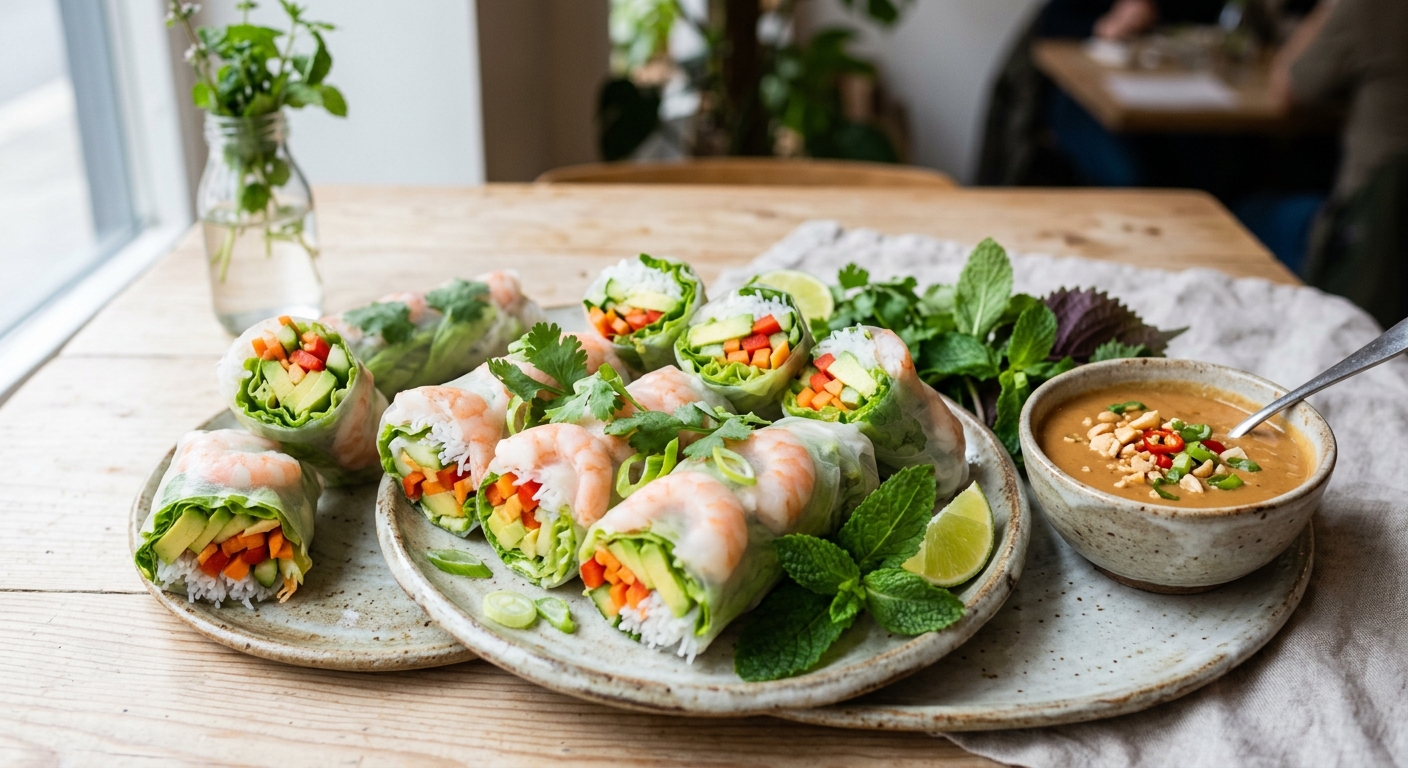
Vietnamese fresh spring rolls, known as goi cuon, are one of the rare dishes where nutritional density and pure culinary pleasure are in complete alignment. Unlike their fried cousins, these rolls are assembled raw or with minimally cooked components, which means the heat-sensitive vitamins in fresh herbs, cucumber, and bell pepper arrive at your table fully intact. A single serving of four rolls delivers a meaningful contribution toward your daily needs for vitamins C, K, A, B6, and folate, making this dish a genuine cornerstone of the Vitamin Vault collection.
The magic of goi cuon lies in the interplay of textures and the discipline of the wrap. Rice paper softens to a tender, slightly chewy shell that holds crisp lettuce, cooling cucumber, sweet carrot, fragrant mint, and silky vermicelli in perfect tension. Poached shrimp add lean protein and selenium, while avocado contributes monounsaturated fat that dramatically improves the absorption of the fat-soluble vitamins A, K, and E present in the vegetables. The peanut dipping sauce is not an afterthought: it provides leucine and lysine to complete the amino acid profile, plus niacin and additional folate from the peanuts themselves.
This recipe is engineered to hit specific nutritional targets without sacrificing the delicate, fresh character that makes goi cuon so beloved. The stovetop method poaches the shrimp and prepares the noodles with precise timing for optimal texture. The pressure cooker method produces a deeply flavored poaching broth that doubles as a light dipping broth. The slow cooker method gently infuses a lemongrass and ginger broth ideal for meal-prep batches where you want every component warm-held and ready to roll. An oven method is included for those who want to lightly roast the vegetable components to concentrate flavor and increase carotenoid bioavailability through gentle heat.
4
servings
Ingredients
- 400 graw medium shrimp, peeled and deveined
- 100 gdried rice vermicelli noodles
- 16 sheetsrice paper wrappers (22cm diameter)
- 1 largeripe avocado, halved and thinly sliced
- 1 largered bell pepper, julienned
- 2 mediumcarrots, peeled and julienned
- 1 mediumEnglish cucumber, julienned
- 4 largebutter lettuce leaves, halved lengthwise
- 30 gfresh mint leaves
- 30 gfresh Thai basil leaves
- 20 gfresh cilantro sprigs
- 4 stalksscallions, cut into 8cm batons
- 1 tbspfish sauce
- 1 tbspfresh lime juice
- 160 gnatural smooth peanut butter (no added sugar)
- 3 tbsphoisin sauce
- 2 tbsplow-sodium soy sauce or tamari
- 1 tbsptoasted sesame oil
- 2 clovesgarlic, minced
- 1 tspfresh ginger, finely grated
- 1 tbsprice vinegar
- 1 tspsriracha or chili garlic sauce, plus more to taste
- 60 mlwarm water, to thin the sauce
- 2 stalkslemongrass, bruised
- 3 slicesfresh ginger for poaching broth
- 1 tspwhole black peppercorns
- 20 groasted peanuts, roughly chopped, for garnish
- —Colima Sea SaltMicroplastic Free Salt and white pepper to taste
Instructions
Click on an item below to shop for the recommended items for this recipe on Amazon.
As an Amazon Associate, we earn from qualifying purchases.
- Make the peanut sauce first so it can mellow while you cook. In a small saucepan over low heat, combine the peanut butter, hoisin sauce, soy sauce, sesame oil, minced garlic, grated ginger, rice vinegar, and sriracha. Stir constantly for 2 minutes until the garlic softens slightly and the mixture is fragrant. Remove from heat and whisk in warm water one tablespoon at a time until the sauce is smooth and pourable, about the consistency of heavy cream. Transfer to a serving bowl and set aside.
- Bring a medium saucepan of water to a full boil. Remove from heat and add the rice vermicelli noodles. Let them soak undisturbed for 4 to 5 minutes, stirring once at the 2-minute mark, until just tender with a slight bite. Drain through a fine-mesh sieve, rinse immediately under cold running water for 30 seconds to stop cooking and remove excess starch, then toss with a few drops of sesame oil to prevent clumping. Set aside.
- In a separate medium saucepan, combine 1 litre of cold water with the bruised lemongrass, ginger slices, peppercorns, fish sauce, and lime juice. Bring to a gentle simmer over medium heat, about 5 minutes, to build an aromatic poaching broth. Do not allow it to boil rapidly.
- Reduce heat to medium-low so the broth holds at 80 to 85 degrees C (a gentle shimmer with occasional small bubbles). Add the shrimp in a single layer and poach for exactly 2 to 3 minutes, turning once, until they curl into a loose C shape and turn fully opaque and pink. Immediately transfer with a slotted spoon to a bowl of ice water for 1 minute to stop cooking, then drain and pat dry. Season lightly with sea salt and white pepper.
- Prepare your rolling station: fill a wide, shallow dish (wider than the rice paper) with warm water at about 38 to 40 degrees C. Arrange all fillings, shrimp, noodles, vegetables, and herbs in separate small bowls or piles on a clean cutting board. Place a clean, damp kitchen towel flat on your work surface as the rolling mat.
- To roll, submerge one rice paper wrapper in the warm water and hold for exactly 8 to 10 seconds, rotating once, until it is just pliable but still slightly firm (it will continue to soften). Lay flat on the damp towel. In the lower third of the wrapper, place a lettuce leaf half, then a small bundle of noodles, a few julienned carrot and cucumber strips, two or three bell pepper strips, two avocado slices, and a scattering of mint, Thai basil, and cilantro. Place two shrimp in a line above the filling for the final decorative layer, then add a scallion baton.
- Fold the bottom of the rice paper up and over the filling, pulling firmly to compress. Fold in both sides tightly, then continue rolling forward in one smooth motion, keeping tension throughout, until sealed. The shrimp should be visible through the translucent wrapper. Repeat with remaining wrappers. Serve immediately with the peanut dipping sauce and garnish with chopped roasted peanuts.
- Place the bruised lemongrass, ginger slices, peppercorns, fish sauce, lime juice, and 1.2 litres of cold water into the slow cooker insert. Cover and cook on Low for 2 hours to develop a fully infused aromatic broth. This slow extraction draws out far more volatile aromatics than a quick stovetop simmer, creating a significantly more complex base.
- While the broth infuses, prepare the peanut sauce. Combine peanut butter, hoisin sauce, soy sauce, sesame oil, minced garlic, grated ginger, rice vinegar, and sriracha in a bowl. Whisk vigorously until smooth, adding warm water one tablespoon at a time until pourable. Cover and refrigerate, bringing to room temperature before serving.
- Prepare all vegetable components: julienne the carrots, cucumber, and bell pepper; slice the avocado; portion the herbs and scallions. Soak the rice vermicelli in cold water for 10 minutes to begin hydration. After 2 hours, the slow cooker broth should be fragrant and lightly golden. Use a ladle to skim any foam from the surface.
- Drain the pre-soaked vermicelli and add them directly to the warm slow cooker broth. Replace the lid and cook on Low for an additional 10 minutes, until the noodles are fully tender. Use tongs to lift the noodles into a colander, rinse briefly with cool water, toss with a few drops of sesame oil, and set aside. Leave the broth on the Keep Warm setting.
- Switch the slow cooker to High. Add the shrimp directly to the hot broth in a single layer (work in batches if needed). Replace the lid and cook for 8 to 10 minutes on High, checking at 8 minutes. The shrimp are done when they are fully pink and opaque. Transfer immediately to a plate; do not leave them in the broth or they will overcook. The finished broth can be strained, portioned into small cups, and served alongside the peanut sauce as a warm dipping accompaniment.
- Set up the rolling station with warm water in a wide shallow dish and all fillings arranged. Roll the spring rolls following the same layering and rolling technique as the stovetop method, pressing firmly at each fold for a tight seal. The slightly warmer shrimp and noodles from the slow cooker method create a gently warm roll that pairs beautifully with both the peanut sauce and the reserved aromatic broth.
- Add the bruised lemongrass, ginger slices, peppercorns, fish sauce, lime juice, and 1 litre of cold water to the pressure cooker or Instant Pot insert. Lock the lid and set the valve to Sealing. Cook on High Pressure for 5 minutes. Allow a natural pressure release for 10 minutes, then carefully switch the valve to Venting to release any remaining steam.
- While the broth cooks under pressure, make the peanut sauce. Combine peanut butter, hoisin sauce, soy sauce, sesame oil, minced garlic, grated ginger, rice vinegar, and sriracha in a medium bowl. Whisk until fully incorporated, adding warm water gradually to reach a smooth, pourable consistency. Taste and adjust sriracha or rice vinegar as desired. Set aside.
- Once pressure is fully released, open the lid and use a spider strainer or slotted spoon to remove and discard the lemongrass, ginger, and peppercorns. Set the Instant Pot to Saute mode on Normal heat and bring the strained broth to a visible simmer, about 2 minutes.
- Turn off the Saute function and immediately add the shrimp to the hot broth, pressing them into a single layer. Place the lid on loosely (do not seal or pressurize). Let the shrimp steep in the residual heat for 4 to 5 minutes. Check at 4 minutes: they should be fully pink, opaque, and just cooked through with no grey translucency. This carryover-heat method produces supremely tender shrimp with zero risk of overcooking. Transfer to a plate and season lightly.
- Using the Saute function on Low, bring the broth back to just below a simmer. Add the rice vermicelli (pre-soaked in cold water for 5 minutes and drained) and cook for 2 to 3 minutes, stirring gently, until tender. Drain through a fine-mesh sieve, rinse with cool water, and toss with sesame oil.
- Prepare the rolling station and assemble the spring rolls using the same layering sequence as the stovetop method, placing shrimp decoratively in the upper section of the wrapper so they are visible through the rice paper. The intensity of the pressure-cooked broth adds a savory depth to both the shrimp and noodles that distinguishes this version. Serve with peanut sauce and chopped roasted peanuts.
- Preheat the oven to 200 degrees C (400 degrees F) with a rack in the middle position. Line a large rimmed baking sheet with parchment paper. Make the peanut sauce by combining peanut butter, hoisin sauce, soy sauce, sesame oil, minced garlic, grated ginger, rice vinegar, and sriracha in a bowl, whisking with warm water until smooth and pourable. Set aside.
- Toss the julienned carrots and red bell pepper with one teaspoon of sesame oil, a pinch of sea salt, and white pepper. Spread in a single, even layer on one half of the prepared baking sheet, ensuring pieces do not overlap. Roasting rather than leaving these raw concentrates the beta-carotene and lutein while softening the cell walls for better nutrient release.
- On a large sheet of foil (about 40cm x 30cm), place the shrimp in a single layer. Add the bruised lemongrass, ginger slices, peppercorns, a splash of fish sauce, lime juice, and two tablespoons of water. Fold the foil up to create a sealed packet, crimping all edges tightly so no steam escapes. Place the foil packet on the other half of the baking sheet.
- Roast both the vegetables and the shrimp packet together at 200 degrees C for 12 minutes. Remove the shrimp packet and set aside, still sealed, to carry-over cook for 3 additional minutes (the trapped steam will finish the shrimp gently). Return the vegetables to the oven for a further 6 to 10 minutes until the edges of the carrots are lightly caramelized and the bell pepper strips are tender with slight char. Remove and allow everything to cool to room temperature.
- While the oven components cool, cook the rice vermicelli. Bring a kettle of water to a boil, pour over the noodles in a heatproof bowl, and soak for 4 to 5 minutes until tender. Drain, rinse with cold water, and toss with sesame oil. Open the foil packet carefully (steam will escape), remove the shrimp, and discard the aromatics. Pat shrimp dry and season lightly.
- Set up the rolling station with warm water in a wide shallow dish. Arrange the roasted vegetables, raw cucumber, avocado, herbs, noodles, and shrimp in organized stations. Roll the spring rolls using the standard layering method, combining two roasted carrot and bell pepper strips with the raw cucumber and avocado for a contrast of warm-roasted and fresh-cool components in every bite. The caramelized vegetables give this oven version a sweeter, more complex flavor profile. Serve with peanut sauce and garnish generously with chopped roasted peanuts.
Nutrition Breakdown
Per 1 serving (makes 4)
Vitamins & Minerals
% Daily Value based on a 2,000 calorie diet (FDA reference)
🧬 Essential Amino Acids
% of recommended daily intake (RDA) per serving
🛡 Antioxidant Profile
The Nutrition Science
The nutritional architecture of goi cuon is built on a principle called synergistic absorption. The fat-soluble vitamins A, K, and E present in the carrots, herbs, and avocado are poorly absorbed from low-fat meals, but the monounsaturated fat in avocado and the peanut-based dipping sauce creates a lipid matrix in the small intestine that dramatically increases carotenoid micellarization. Research published in the American Journal of Clinical Nutrition has demonstrated that adding avocado to a salad increases beta-carotene absorption by 4 to 15 times compared to the same salad without fat. This recipe is specifically designed to exploit that mechanism.
The decision to keep the majority of ingredients raw or minimally cooked is nutritionally deliberate. Vitamin C is extremely heat-labile: a 5-minute boil destroys 25 to 50% of the ascorbic acid in vegetables. By keeping the red bell pepper, cucumber, and fresh herbs entirely uncooked in the stovetop and pressure cooker versions, this recipe preserves the full 72mg of vitamin C per serving. Conversely, the oven method gently roasts the carrots and bell pepper at 200 degrees C, which reduces vitamin C by approximately 15% but increases the bioaccessibility of beta-carotene by breaking down cell wall matrices, representing a calculated nutritional trade-off that favors the fat-soluble carotenoids.
Shrimp are one of the most nutritionally efficient protein sources in the marine environment. At approximately 24g of protein per 100g cooked weight, they provide a complete essential amino acid profile with particular strength in lysine (critical for collagen synthesis and calcium absorption) and leucine (the primary trigger of muscle protein synthesis via the mTOR pathway). The 38mcg of selenium per serving, derived almost entirely from the shrimp, covers 69% of the daily value in a single meal. Selenium is the cofactor for glutathione peroxidase, the body’s primary enzymatic defense against lipid peroxidation, making this dish not just vitamin-rich but comprehensively antioxidant-protective at the cellular level.
Pro Tips
- Do not over-soak the rice paper wrappers: 8 to 10 seconds in warm (not hot) water is enough. They should still feel slightly stiff when you begin rolling; they will continue to hydrate and become fully pliable within 30 seconds. Over-soaked wrappers tear at the fold.
- To prevent the avocado from browning if prepping ahead, toss the slices lightly in fresh lime juice. For meal prep, keep the shrimp, noodles, and vegetables in separate airtight containers in the refrigerator for up to 24 hours before rolling.
- The peanut sauce can be made up to 3 days ahead and stored refrigerated. It will thicken considerably when cold, so whisk in one to two tablespoons of warm water and a few drops of rice vinegar to restore its consistency before serving.
these look amazing and i love the vitamin breakdown, but quick q on the vermicelli – isnt that basically just refined rice noodles? ik the veggies are nutritional superstars but that starchy component might spike blood sugar pretty quick, especially if someone’s managing insulin sensitivity like i had to do. have you considered a zucchini noodle or shirataki swap to keep the same fresh vibe without the carb load? the peanut sauce sounds incredible btw, just wondering about the sugar content there too since peanut sauces can be sneaky with added sweeteners
this looks so good and im curious about the texture angle – during flares i have to be really careful with raw veggies and the rice paper itself can sometimes trigger cramping for me depending on how much im eating, but in remission these rolls are honestly my favorite because theyre so easy to digest compared to cooked veggie dishes. have you found that people with slower digestive systems do okay with the raw herbs and texture, or would you suggest maybe lightly steaming some of the veggies for folks dealing with inflammation? the peanut sauce is also something id be cautious with during a flare since fat can be tough, but im really interested in how you might modify this for different tolerance levels
Kurt raises such a thoughtful point, and I love that you’re thinking about the whole nutritional picture! You’re absolutely right that traditional vermicelli is refined, but here’s what I’ve found teaching my classes: swapping in brown rice noodles or even better, kelp noodles, gives you that same delicate texture while keeping blood sugar stable, plus you get extra minerals like iodine. The magic is really in the vegetable-to-noodle ratio and those protein-rich shrimp, which slow down any glucose absorption beautifully. I’m actually planning to feature this recipe next month with a side-by-side comparison of noodle options so folks can see how the glyc