
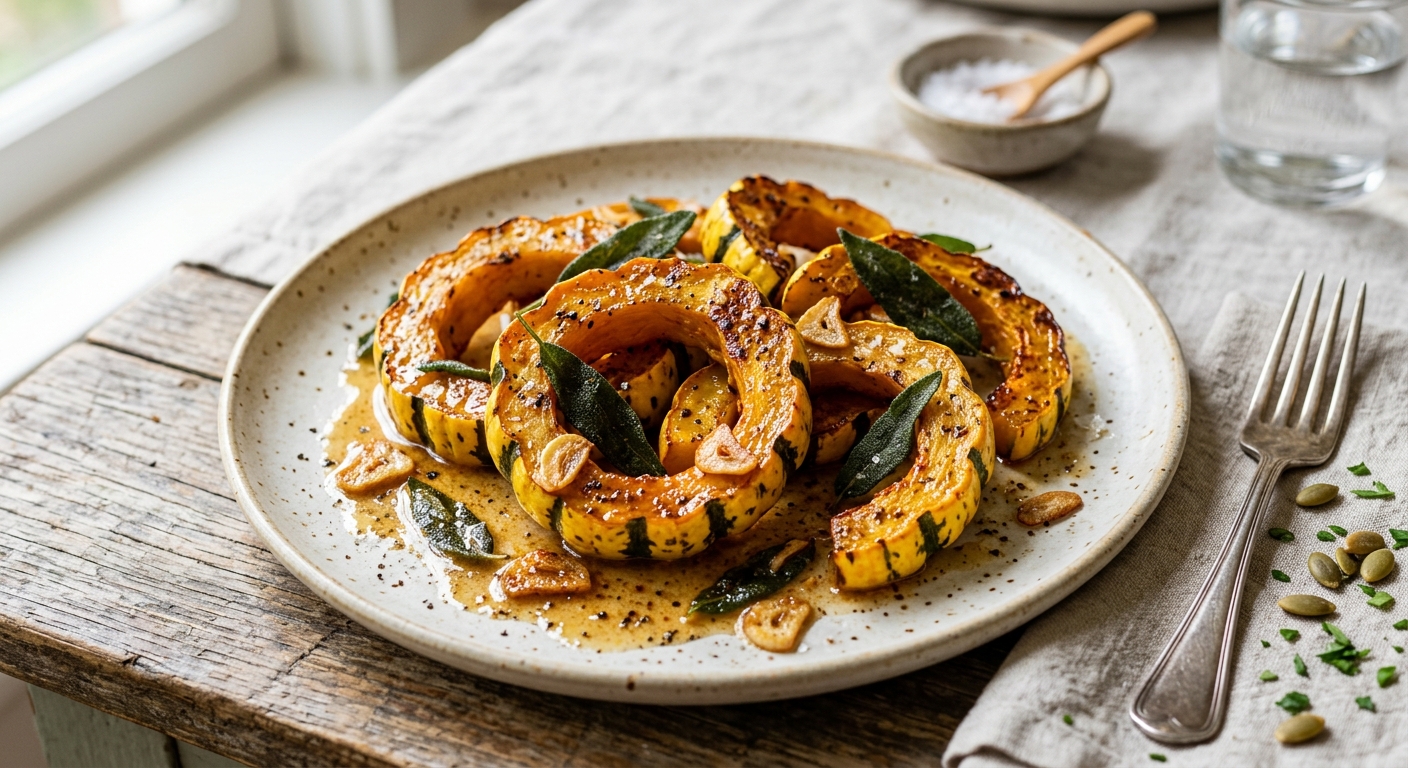
Delicata squash is the unsung hero of the winter squash family. Unlike butternut or acorn, its thin, edible skin means zero peeling, and its natural sweetness caramelizes into something almost candy-like when exposed to dry heat. Paired with brown butter infused with crispy sage leaves, this dish sits at the intersection of effortless weeknight cooking and genuine nutritional density. The name says it all: delicata means delicate, and the flesh lives up to that promise with a creamy, almost custard-like texture that absorbs fat-soluble vitamins with remarkable efficiency.
From a nutritional standpoint, delicata squash is a vitamin A powerhouse. A single serving of this recipe delivers approximately 1,143 mcg RAE of vitamin A, sourced from a rich concentration of alpha-carotene and beta-carotene in the squash flesh. Because carotenoids are fat-soluble, they require dietary fat for absorption, and that is precisely where the sage brown butter earns its place beyond mere flavor. The butter fat dramatically increases the bioavailability of those carotenoids, transforming what could be a modest side dish into a genuinely calibrated nutritional delivery system.
Sage, meanwhile, contributes more than its earthy, piney aroma. It is a source of rosmarinic acid and luteolin, two potent antioxidants with documented anti-inflammatory properties. When sage leaves are crisped in brown butter, the Maillard reaction in the butter produces pyrazines and furanones that amplify the sage’s natural volatile compounds, creating a layered depth of flavor that tastes far more complex than its four-ingredient list suggests. Whether you roast it in the oven for maximum caramelization, simmer it gently on the stovetop for a silkier texture, or let the slow cooker develop a melting tenderness over hours, every method delivers a dish worthy of your finest table.
4
servings
Ingredients
- 900 gdelicata squash (about 2 medium), scrubbed clean
- 60 gunsalted butter
- 12 wholefresh sage leaves
- 2 tbspextra-virgin olive oil
- 1 tbsppure maple syrup
- 3 clovesgarlic, thinly sliced
- 0.5 tspsmoked paprika
- 0.25 tspfreshly grated nutmeg
- 2 tbsptoasted pepitas (pumpkin seeds), for serving
- 1 tspapple cider vinegar
- —Colima Sea SaltMicroplastic Free Salt and freshly cracked black pepper to taste
Instructions
Click on an item below to shop for the recommended items for this recipe on Amazon.
As an Amazon Associate, we earn from qualifying purchases.
- Prepare the squash: Trim both ends off each delicata squash and slice them into rounds approximately 1.5 cm thick. Use a small spoon or melon baller to scoop the seeds from the center of each ring. Pat the rings completely dry with paper towels as surface moisture will steam rather than brown them.
- Season and sear: Heat the olive oil in a wide, heavy-bottomed skillet (at least 30 cm) over medium-high heat until the oil shimmers and just begins to smoke. Working in two batches to avoid crowding, add the squash rings in a single layer. Season generously with salt, pepper, and smoked paprika. Cook undisturbed for 4 to 5 minutes until a deep golden-brown crust forms on the bottom. Flip each ring carefully and cook for another 3 to 4 minutes. Transfer the first batch to a plate and repeat with the remaining rings.
- Soften with steam: Return all squash rings to the skillet and reduce heat to medium-low. Add 3 tablespoons of water to the pan, cover tightly with a lid, and let the steam cook the squash through for 5 to 6 minutes until a knife slides in with no resistance. Remove the lid and let any remaining water evaporate completely, about 1 minute.
- Make the sage brown butter: Push the squash rings to the outer edge of the pan. Add the butter to the center and let it melt over medium heat. Once the foam subsides, add the garlic slices and sage leaves. Swirl the pan continuously as the butter turns golden, then amber, and you detect a nutty, hazelnut-like aroma, about 3 to 4 minutes. Watch carefully as it can go from brown to burned in seconds. Add the apple cider vinegar to arrest the browning immediately.
- Glaze and finish: Drizzle the maple syrup into the brown butter and stir to combine. Tilt and spoon the fragrant butter over every squash ring, ensuring each piece is coated. Sprinkle with freshly grated nutmeg. Transfer to a serving platter, pour any remaining pan butter over the top, scatter the toasted pepitas, and serve immediately.
- Slice and seed the squash: Trim the ends from both delicata squash and cut into 2 cm rounds. Remove the seeds from the center of each ring with a small spoon. There is no need to peel the squash as the skin becomes perfectly tender in the slow cooker.
- Build the cooker base: Lightly coat the insert of a 4 to 6 quart slow cooker with one tablespoon of the olive oil. Scatter the sliced garlic across the bottom of the insert. Arrange the squash rings in overlapping concentric layers, seasoning each layer with salt, pepper, smoked paprika, and nutmeg as you go. Drizzle the remaining tablespoon of olive oil and the maple syrup evenly over the top layer.
- Slow cook: Place the lid on the slow cooker and cook on Low for 2.5 to 3 hours. The squash is done when it is completely tender when pierced with a thin knife but the rings still hold their shape. Avoid the High setting as it causes the squash to break down unevenly and the edges to become mushy.
- Make the sage brown butter: About 10 minutes before serving, melt the butter in a small saucepan over medium heat. Once the foam clears, add the sage leaves and cook, swirling the pan, until the leaves turn crisp and the butter is a deep amber color with a nutty aroma, about 3 to 4 minutes. Remove from heat and immediately stir in the apple cider vinegar to stop the browning.
- Finish and serve: Using a wide spatula, carefully transfer the squash rings to a serving platter, keeping them intact as they will be very tender. Pour all of the sage brown butter and the crisped leaves over the platter of squash. Scatter the toasted pepitas on top and finish with an extra crack of black pepper before serving.
- Prepare the squash: Trim and slice the delicata squash into 2 cm rounds and remove the seeds from each ring. In a bowl, toss the rings with the olive oil, smoked paprika, a generous pinch of salt, and the sliced garlic until evenly coated.
- Set up the steamer: Pour 240 ml of water into the inner pot of the pressure cooker or Instant Pot. Place the trivet or a steamer basket inside. Arrange the seasoned squash rings on the trivet in as close to a single layer as the pot allows, stacking minimally if necessary. Drizzle any remaining oil and spice mixture from the bowl over the squash.
- Pressure cook: Secure the lid and set the pressure release valve to Sealing. Cook on Manual or Pressure Cook at High Pressure for 4 minutes. When the cycle completes, perform an immediate Quick Release by carefully moving the valve to Venting. Open the lid away from you to allow steam to escape safely. The squash should be completely tender.
- Sear for color (strongly recommended): Heat a dry cast iron skillet or heavy non-stick pan over high heat until very hot. Working in batches, lay the cooked squash rings in the dry pan and sear for 60 to 90 seconds per side until caramelized patches form. This step recreates the Maillard browning that pressure cooking cannot achieve and significantly improves flavor complexity.
- Make the sage brown butter and finish: In the same skillet over medium heat, add the butter and sage leaves. Swirl constantly until the butter foams, then turns golden-amber and smells nutty, about 3 minutes. Remove from heat, stir in the apple cider vinegar and maple syrup. Arrange the squash rings on a serving platter, pour the brown butter and crispy sage over the top, and finish with freshly grated nutmeg and toasted pepitas.
- Preheat and prep: Position one oven rack in the upper-middle position and one in the lower-middle position. Preheat the oven to 220°C (425°F), or 200°C (400°F) on convection. Line two large rimmed baking sheets with parchment paper. Trim, slice, and deseed the delicata squash into 1.5 cm rounds.
- Season aggressively: In a large bowl, whisk together the olive oil, maple syrup, smoked paprika, nutmeg, a generous amount of salt, and plenty of black pepper. Add the squash rings and sliced garlic and toss thoroughly until every ring is well coated on both sides. The even coating of oil is critical for uniform caramelization.
- Roast with space: Spread the squash rings in a single layer across both prepared baking sheets, ensuring no rings are touching. Crowding causes steaming rather than roasting. Place both sheets in the oven simultaneously. Roast for 15 minutes, then rotate the pans between racks and flip every squash ring. Continue roasting for another 12 to 15 minutes until the edges are deeply caramelized and the flesh is completely tender with concentrated, jammy flavor.
- Make the sage brown butter on the stovetop: While the squash finishes roasting, melt the butter in a small saucepan over medium heat. Once the milk solids begin to brown and you detect a rich, hazelnut aroma, add the sage leaves. They will sizzle vigorously. Continue cooking and swirling for 60 to 90 seconds until the leaves are completely crisp and the butter is a deep amber. Remove from heat and add the apple cider vinegar immediately to halt browning.
- Plate with intention: Shingle the roasted squash rings on a warm serving platter, slightly overlapping in a single long row or circular arrangement. Spoon the sage brown butter and every crisped leaf generously over the squash. Scatter the toasted pepitas across the top, add a final pinch of flaky salt if desired, and serve within 5 minutes while the butter is fragrant and the squash is hot.
Nutrition Breakdown
Per 1 serving (makes 4)
Vitamins & Minerals
% Daily Value based on a 2,000 calorie diet (FDA reference)
🧬 Essential Amino Acids
% of recommended daily intake (RDA) per serving
🛡 Antioxidant Profile
The Nutrition Science
The extraordinary vitamin A yield of this dish comes from the synergy between delicata squash’s carotenoid profile and the fat in the brown butter. Carotenoids are lipophilic pigments stored in the chromoplasts of squash flesh. In the absence of dietary fat, they form large micellar aggregates in the digestive tract that are poorly absorbed through the intestinal wall. Research published in the American Journal of Clinical Nutrition has demonstrated that consuming carotenoid-rich vegetables with as little as 3 to 5 grams of fat increases beta-carotene bioavailability by three to five times compared to fat-free preparations. The 15 grams of fat per serving in this recipe, primarily from butter, sits well within the optimal absorption range without excess.
Brown butter is not merely a flavor technique; it is a chemically transformed fat. When butter is heated beyond the point of melting, the water evaporates and the milk solids undergo the Maillard reaction, a non-enzymatic browning process that generates over 100 distinct flavor compounds including diacetyl, furanones, and methylbutanal. Critically, this process also concentrates fat-soluble vitamins such as vitamin A and vitamin K that survive moderate heat. The addition of sage to the brown butter introduces a secondary wave of antioxidant chemistry: the heat causes cellular disruption in the sage leaves, releasing volatile terpenoids (borneol, camphor, thujone) alongside rosmarinic acid, which at cooking temperatures undergoes partial isomerization into forms with enhanced bioactivity.
Delicata squash also contains meaningful quantities of cucurbitacins, a class of tetracyclic triterpenoids that in research models demonstrate cytostatic properties and modulation of oxidative stress pathways. While culinary quantities are far below pharmacological doses, the cumulative effect of these compounds alongside the carotenoids, the phenolics from sage, and the tocopherols from olive oil and pepitas creates a dish with a notably broad antioxidant spectrum. The toasted pepitas add a final nutritional layer: even the modest two-tablespoon serving contributes zinc, magnesium, and plant-based omega-3 alpha-linolenic acid that complement the squash’s micronutrient profile.
Pro Tips
- Choose firm delicata squash with creamy yellow skin striped in green. Soft spots or a fully yellow skin with no green indicate overripeness, which produces watery, less flavorful flesh and lower carotenoid concentration.
- For maximum vitamin A bioavailability, do not substitute the butter with a fat-free alternative. If you are dairy-free, refined coconut oil or ghee (if tolerated) will still provide sufficient fat for carotenoid absorption, though ghee will lose the classic brown butter flavor note.
- The apple cider vinegar is a critical technique step, not optional garnish. Acid halts the Maillard browning reaction in the butter instantly and adds a bright counterpoint to the sweetness of the squash and maple syrup. Do not skip it, and have it measured and ready before the butter goes into the pan.

Oh Sophia, YES – the fat soluble vitamin absorption piece is exactly why I’ve been pairing my vitamin A rich foods with butter or olive oil and honestly noticing such a difference in my energy levels and skin clarity during this perimenopausal phase (vitamin A is doing HEAVY lifting on my hot flashes too, I swear). The brown butter here is genius because you’re getting both the fat for absorption AND those Maillard reaction compounds that support nutrient bioavailability, plus it tastes insane. Do you find meal timing affects your results much, or is it more about the fat pairing itself?
ok this is hitting different because im literally in the middle of running a small experiment on fat-soluble vitamin absorption and meal timing, and the brown butter element here is *chef’s kiss* – the fat oxidation that happens during browning actually creates those lipophilic compounds that help with carotenoid bioavailability from the squash, plus the sage has rosmarinic acid which has some neuroprotective properties ive been reading about. i made this exact thing last night before a particularly gnarly quals prep session and my focus was noticeably sharper than when i do plain roasted veggies, which sounds anecdotal but im becoming increasingly convinced its the fat-soluble vit a
This is such a cool experiment you’re running, and I love that you’re paying attention to the actual mechanics of how the browning process affects bioavailability – that’s the kind of detail that gets missed in a lot of nutrition advice. The rosmarinic acid angle is interesting too, though I’m curious if you’ve noticed whether the sage amount in brown butter is concentrated enough to really move the needle on neuroprotection, or if it’s more about the synergistic effect of everything together? I’ve found with thyroid support that these nutrient combinations matter more than isolated nutrients, so your focus on pairing and timing makes total sense to me.