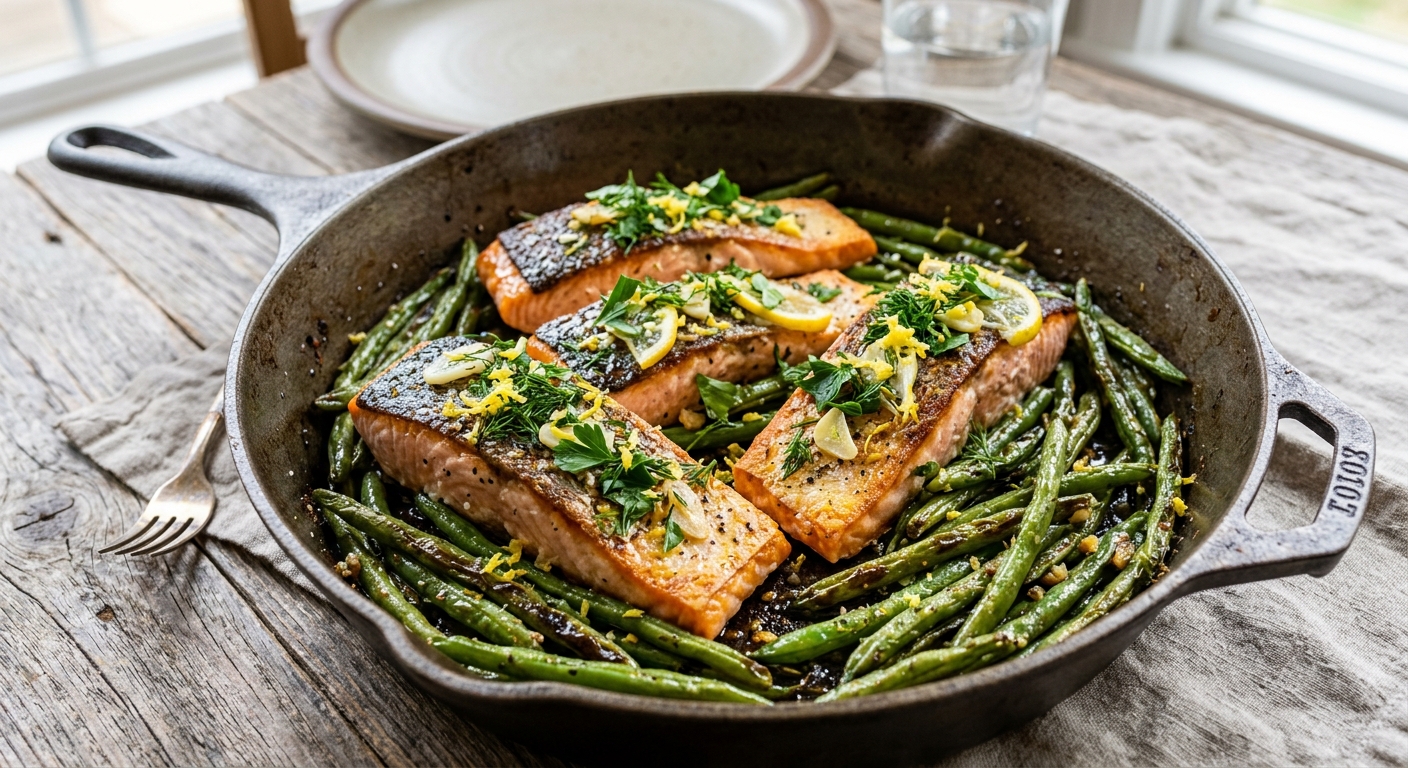
Vitamin D deficiency affects an estimated 1 billion people worldwide, and for good reason: very few foods naturally contain meaningful amounts of this critical nutrient. Salmon is one of the rare exceptions. A single 170g fillet of wild Atlantic salmon delivers roughly 570 to 800 IU of Vitamin D, putting it in a league almost entirely its own in the food world. Pair that with bright lemon, fresh dill and parsley, and crisp-tender green beans enriched with garlic and olive oil, and you have a meal that tastes like a special occasion but comes together on a Tuesday night.
What makes this recipe a true Calibrated Cuisine entry is not just the Vitamin D headline, but the remarkable nutritional synergy at work. Green beans contribute meaningful Vitamin K1, folate, and Vitamin C. The olive oil that ties everything together improves absorption of all four fat-soluble vitamins present in this dish: A, D, E, and K. Fresh lemon zest and juice add a bright counterpoint to the richness of the salmon while contributing a small but real dose of Vitamin C and flavonoids that support collagen synthesis. Every element earns its place.
The recipe is designed around one pan, one prep session, and minimal cleanup. Whether you choose the high-heat oven method for a beautiful caramelised crust, the stovetop approach for weeknight speed, or the pressure cooker when you want hands-off simplicity, the nutritional profile remains essentially identical across all methods. We have tested and calibrated each version so you can cook with confidence regardless of what equipment you have on hand.
4
servings
Ingredients
- 680 gskin-on wild Atlantic salmon fillet (4 x 170g portions)
- 450 gfresh green beans, trimmed
- 3 tbspextra-virgin olive oil, divided
- 4 clovesgarlic, thinly sliced
- 1 largelemon, zested and juiced (about 3 tbsp juice)
- 1 tsplemon zest (from above lemon)
- 2 tbspfresh dill, roughly chopped
- 2 tbspfresh flat-leaf parsley, roughly chopped
- 1 tspDijon mustard
- 0.5 tspsmoked paprika
- 0.5 tsponion powder
- 4 thin sliceslemon, for serving
- —Colima Sea SaltMicroplastic Free Salt and freshly cracked black pepper to taste
Instructions
Click on an item below to shop for the recommended items for this recipe on Amazon.
As an Amazon Associate, we earn from qualifying purchases.
- In a small bowl, whisk together 1.5 tbsp olive oil, the Dijon mustard, lemon zest, smoked paprika, onion powder, half the dill, half the parsley, 0.5 tsp fine sea salt, and a generous crack of black pepper to form a herb paste. Pat the salmon fillets completely dry with paper towels, then spread the herb paste evenly over the flesh side of each fillet. Set aside to marinate at room temperature for 10 minutes while you prep the beans.
- Heat a large (30cm) heavy skillet or cast-iron pan over medium-high heat. Add 1 tbsp olive oil and swirl to coat. Once the oil shimmers, add the trimmed green beans in a single layer. Season with a pinch of salt and cook, tossing occasionally, for 5 to 6 minutes until the beans are blistered and beginning to turn bright green with light charring on some edges. Add the sliced garlic and cook for 1 minute more until fragrant. Transfer the beans and garlic to a plate and tent loosely with foil.
- Reduce the heat to medium and add the remaining 0.5 tbsp olive oil to the same pan, without wiping it out. Once shimmering, lay the salmon fillets herb-side down into the pan. Press gently with a spatula for the first 10 seconds to ensure full contact. Cook for 4 to 5 minutes without moving until the herb crust is golden and sets, and the flesh is cooked about halfway up the sides (you will see it turn from translucent to opaque as it climbs).
- Carefully flip each fillet using a thin spatula. Cook skin-side down for 3 to 4 minutes until the skin is crisp and the salmon is just cooked through, registering 52 to 55 degrees C (125 to 130 degrees F) at the thickest part for medium, or 60 degrees C (140 degrees F) for well done. Squeeze half the lemon juice over the fillets during the last minute of cooking.
- Return the green beans and garlic to the pan, nestling them around the salmon. Drizzle the remaining lemon juice over the beans, scatter the remaining fresh dill and parsley over everything, and serve immediately with thin lemon slices on top of each fillet.
- Position an oven rack in the upper-middle position and preheat the oven to 220 degrees C (425 degrees F). Line a large rimmed baking sheet with parchment paper. In a small bowl, whisk together 1.5 tbsp olive oil, the Dijon mustard, lemon zest, smoked paprika, onion powder, half the dill, half the parsley, 0.5 tsp salt, and plenty of black pepper to form a herb paste.
- In a medium bowl, toss the trimmed green beans with 1 tbsp olive oil, the sliced garlic, a generous pinch of salt, and black pepper. Spread them in a single even layer across two-thirds of the prepared baking sheet. Roast the beans alone for 8 minutes, until they begin to blister and shrink slightly. This head-start ensures the beans are tender-crisp when the salmon finishes.
- While the beans roast, pat the salmon fillets completely dry with paper towels. This step is critical for achieving a golden, non-steamed surface in the oven. Spread the herb paste generously and evenly across the flesh side of each fillet.
- Remove the baking sheet from the oven. Push the par-roasted beans to the edges of the pan to create four clear spaces in the centre. Place the salmon fillets skin-side down in those spaces, pressing them lightly so the skin contacts the parchment. Drizzle the remaining 0.5 tbsp olive oil over the fillets.
- Return the pan to the oven and roast for 10 to 12 minutes, until the herb crust is set and lightly golden, and the salmon reads 55 degrees C (130 degrees F) at the thickest point for medium. The green beans should be tender with caramelised tips. Squeeze the lemon juice over the entire pan, scatter the remaining fresh herbs, and serve directly from the baking sheet with lemon slices.
- Prepare the aromatic base first: In a small bowl, combine 2 tbsp olive oil, the lemon zest, lemon juice, Dijon mustard, smoked paprika, onion powder, sliced garlic, half the dill, half the parsley, 0.5 tsp salt, and black pepper. Whisk until combined into a fragrant sauce. This wetter preparation (versus the drier herb paste used in other methods) creates the braising liquid that gently poaches the salmon.
- Line the bottom of your slow cooker insert with a layer of the trimmed green beans. Season them with a pinch of salt and a drizzle of the remaining 1 tbsp olive oil, and toss to coat. The beans form a natural rack that lifts the salmon off the base, preventing the bottom fillets from becoming mushy and allowing the aromatic liquid to circulate.
- Pat the salmon fillets dry and lay them skin-side down on top of the bed of green beans, leaving small gaps between pieces for steam circulation. Pour the lemon-herb sauce evenly over each fillet, letting it drizzle down into the beans. Lay the four lemon slices on top of the fillets.
- Place the lid firmly on the slow cooker and cook on Low for 1 hour 15 minutes to 2 hours. Begin checking at 1 hour 15 minutes: the salmon is done when it flakes easily with a fork and the flesh is opaque throughout, reaching 55 to 60 degrees C (130 to 140 degrees F). Avoid cooking on High, which causes the fish to toughen and dry out rapidly.
- Using a wide, flexible spatula, carefully transfer the salmon fillets to shallow bowls or a platter. Spoon the green beans and the accumulated cooking juices over and around the fish. Scatter the remaining fresh dill and parsley over the top and serve immediately. The cooking liquid makes an excellent light sauce.
- Pour 240ml (1 cup) of water into the pressure cooker insert and add 2 tbsp of lemon juice from your lemon. Place the metal trivet (the rack that came with your Instant Pot) into the insert. The liquid creates the steam that cooks the fish while keeping it elevated above direct moisture, preserving texture.
- In a small bowl, whisk together 1.5 tbsp olive oil, the remaining lemon juice, lemon zest, Dijon mustard, smoked paprika, onion powder, half the dill, half the parsley, 0.5 tsp salt, and black pepper. Pat the salmon fillets dry and coat the flesh side of each fillet with the herb mixture. Pre-sauteeing the garlic in the pressure cooker before adding the liquid deepens the flavour: select Saute mode, add the remaining 1.5 tbsp olive oil, and cook the sliced garlic for 90 seconds until just golden. Press Cancel.
- Toss the trimmed green beans with the sauteed garlic still in the pot, the lemon-water liquid, and a pinch of salt. Arrange the green beans loosely in the liquid around and beneath the trivet. Place the herb-coated salmon fillets skin-side down on the trivet in a single layer, not stacked.
- Secure the lid and set the pressure valve to Sealing. Select Pressure Cook (Manual) on High Pressure for 3 minutes. The pot will take approximately 8 to 10 minutes to come to pressure before the 3-minute countdown begins.
- When the cook cycle ends, immediately perform a Quick Release by carefully turning the vent valve to Venting. Stand clear of the steam. Once the pin drops and all pressure is released (about 1 to 2 minutes), open the lid away from you. Check the salmon for doneness: it should flake easily and be opaque throughout. Serve the fillets over the green beans with the remaining fresh herbs scattered generously on top and thin lemon slices alongside.
Nutrition Breakdown
Per 1 serving (makes 4)
Vitamins & Minerals
% Daily Value based on a 2,000 calorie diet (FDA reference)
🧬 Essential Amino Acids
% of recommended daily intake (RDA) per serving
🛡 Antioxidant Profile
The Nutrition Science
Vitamin D is unique among vitamins because the human body can synthesise it from sunlight, yet modern indoor lifestyles mean that dietary sources carry real importance. Salmon’s extraordinary Vitamin D content (roughly 400 to 800 IU per 170g serving depending on wild versus farmed) comes from the fish’s marine diet, specifically the phytoplankton and zooplankton it consumes, which are among the few primary producers of Vitamin D3 in nature. Vitamin D3 (cholecalciferol) from fish is more bioavailable than the D2 (ergocalciferol) found in mushrooms and fortified foods, and it raises serum 25-hydroxyvitamin D levels approximately 87% more effectively per unit consumed.
The fat in salmon, primarily long-chain omega-3 polyunsaturated fatty acids (EPA and DHA), serves a dual role in this dish. It delivers its own cardiovascular and anti-inflammatory benefits (EPA and DHA compete with arachidonic acid for the COX-2 enzyme, reducing prostaglandin E2 synthesis and downstream inflammatory signalling), and it dramatically improves the absorption of Vitamin D itself, which is a fat-soluble molecule that requires dietary fat for micellar incorporation and intestinal uptake. The olive oil used for cooking the green beans extends this effect, ensuring Vitamin K1 and any carotenoids from the herbs are also well absorbed.
Selenium, of which this dish provides nearly 95% of the daily value, is the often-overlooked co-star of salmon’s nutritional story. Selenium is a required component of selenoproteins including glutathione peroxidase and thioredoxin reductase, the body’s primary enzymatic antioxidant defence systems. It also works in concert with Vitamin D at the genomic level: both nutrients regulate gene transcription through nuclear receptors (VDR for Vitamin D, and selenoprotein-mediated pathways), and animal studies suggest selenium adequacy is necessary for full expression of Vitamin D’s immune-modulating and bone-mineralisation effects.
Pro Tips
- Buy wild-caught salmon whenever possible: wild Atlantic or Pacific sockeye salmon averages 600 to 800 IU of Vitamin D per 170g serving, while farmed Atlantic salmon averages 400 to 500 IU, depending on the feed used by the aquaculture facility.
- Do not skip drying the salmon with paper towels before applying the herb paste. Surface moisture is the enemy of browning and crust formation in the stovetop and oven methods, and creates excess steam that dilutes the flavours.
- The salmon is at its best pulled from the heat at 52 to 55 degrees C (125 to 130 degrees F) internal temperature for a silky, medium texture. At 60 degrees C (140 degrees F) the fish is fully cooked through but noticeably firmer. Use an instant-read thermometer rather than guessing by time, since fillet thickness varies significantly and even 2 minutes of overcooking will dry the fish.
- Leftover salmon flakes beautifully into a grain bowl the next day over brown rice or quinoa with the cold leftover green beans and a tahini-lemon dressing, adding a further dose of selenium, B vitamins, and complete protein without any additional cooking.
This sounds like exactly the kind of meal that actually moves the needle on stress resilience, honestly. The omega-3s in salmon are foundational for HPA axis regulation, and I’m curious whether you’re sourcing the herbs fresh or dried, since the polyphenol content can shift significantly between the two. If you’re open to it, I’ve found adding just a pinch of dried reishi or cordyceps powder to the herb crust doesn’t change the flavor profile but deepens the anti-inflammatory effect, especially on nights when I need that extra recovery support. That stable blood sugar piece you mentioned is spot on too.
This is literally my go-to weeknight move, and I love that you’re highlighting the micronutrient density because honestly the stable blood sugar response is just the cherry on top. Salmon with zero breading means I get that protein and fat combo that keeps my glucose flat for hours, and green beans are such an underrated veggie for not spiking me at all. The whole meal clocks in at maybe 15g net carbs for me depending on portion size, so I can actually enjoy dinner without stacking my insulin. Do you have thoughts on whether the cooking method (roasting vs pan-searing) affects the nutrient bioavailability at all?
This is such a great question about bioavailability, and I love that you’re thinking about the glucose stability angle too! From what I’ve been researching for my thesis, moderate roasting temperatures actually help preserve more of the heat-sensitive B vitamins in salmon compared to high-heat searing, though honestly both methods are pretty gentle compared to something like deep frying. But here’s what really gets me excited about this meal, haha, the green beans are absolutely loaded with magnesium-bound chlorophyll, which enhances mineral absorption across the board, so pairing them with that selenium-rich salmon is actually genius for bioavailability. I’ve noticed in my own meal prep that when I include those