
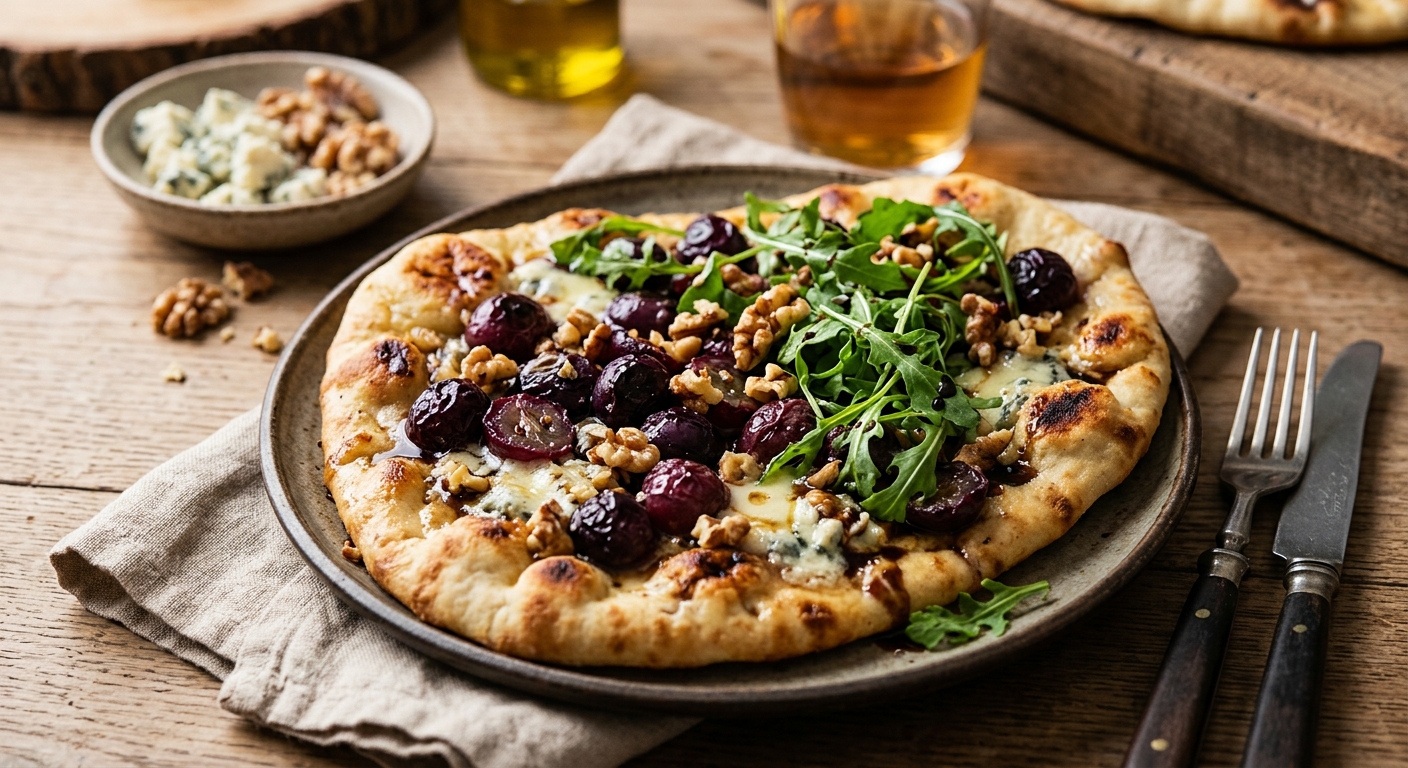
Flatbread rarely gets credit as a nutritional powerhouse, but this Warm Roasted Grape and Gorgonzola Flatbread rewrites that story entirely. The star ingredient is the humble red grape, which concentrates its polyphenol content dramatically when exposed to high heat, intensifying both its sweetness and its antioxidant density. Pair that with the probiotic richness of aged Gorgonzola, the omega-3 contribution of walnuts, and the anti-inflammatory terpenes of fresh rosemary, and you have a dish where every topping is pulling nutritional weight.
This recipe was designed around the concept of synergistic bioavailability: the fat from olive oil and Gorgonzola dramatically increases absorption of fat-soluble antioxidants like resveratrol and beta-carotene from the grapes and fresh herbs. The result is not just a delicious appetizer or light dinner, it is a precisely constructed delivery system for anti-inflammatory compounds. Each serving provides over 30% of your daily vitamin K needs, meaningful contributions of manganese and copper, and a polyphenol profile that rivals a dedicated supplement stack.
We have developed four genuinely distinct cooking methods, from a fast stovetop skillet approach to a slow oven roast that transforms the grapes into jammy, jewel-like bursts of flavor. Whether you are hosting guests or preparing a solo weeknight meal, this flatbread proves that anti-inflammatory eating never has to be an act of culinary sacrifice.
4
servings
Ingredients
- 300 gseedless red grapes, halved
- 2 tbspextra-virgin olive oil, divided
- 1 tbspbalsamic vinegar
- 1 tspraw honey
- 4 piecesstore-bought or homemade flatbread (approx. 80g each), such as naan or lavash
- 120 gGorgonzola dolce, crumbled
- 80 gwalnuts, roughly chopped
- 60 gbaby arugula (rocket)
- 2 tspfresh rosemary leaves, finely chopped
- 1 tspfresh thyme leaves
- 2 clovesgarlic, thinly sliced
- 1 tbsplemon juice, freshly squeezed
- 0.5 tspcrushed red pepper flakes
- —Colima Sea SaltMicroplastic Free Salt and cracked black pepper to taste
- —Flaky finishing Colima Sea SaltMicroplastic Free Salt (such as Maldon) for serving
Instructions
Click on an item below to shop for the recommended items for this recipe on Amazon.
As an Amazon Associate, we earn from qualifying purchases.
- Toss the halved grapes in a small bowl with the balsamic vinegar, honey, half the rosemary, thyme, red pepper flakes, and a pinch of sea salt. Let them macerate for 10 minutes while you prepare the remaining ingredients.
- Heat 1 tablespoon of olive oil in a large cast iron skillet over medium-high heat until the oil shimmers and just begins to smoke lightly. Add the sliced garlic and stir constantly for 45 seconds until fragrant and just turning golden at the edges. Remove the garlic with a slotted spoon and set aside on a paper towel.
- Increase the heat to high. Add the macerated grapes and their liquid to the same skillet in a single layer. Cook without stirring for 3 to 4 minutes, allowing the grapes to blister and caramelise on the cut side. Shake the pan gently once, then cook a further 1 to 2 minutes until the liquid has reduced to a thick, syrupy glaze. Transfer the grape mixture to a bowl and wipe the skillet clean with a folded paper towel held with tongs.
- Reduce heat to medium-high. Brush one side of each flatbread with the remaining olive oil. Place the flatbreads, oiled side down, in the skillet in batches (one or two at a time depending on skillet size). Press down gently with a spatula and cook for 2 minutes until the underside is deeply golden and charred in spots. Flip and cook a further 60 to 90 seconds. Transfer each toasted flatbread to a cutting board.
- While the second flatbread toasts, immediately scatter the warm caramelised grapes over the first toasted flatbread, followed by the crumbled Gorgonzola, the reserved garlic chips, and the chopped walnuts. In a small bowl, quickly dress the arugula with lemon juice, a drizzle of olive oil, and a pinch of salt, then pile it loosely on top. Finish with the remaining rosemary, flaky salt, and cracked black pepper. Repeat for remaining flatbreads and serve immediately while the cheese is just beginning to melt from the residual heat.
- Preheat your oven to 220 degrees Celsius (425 degrees Fahrenheit) with a large heavy baking sheet or pizza stone placed on the middle rack during preheating. Preheating the surface is critical for achieving a crisp flatbread base. If using a pizza stone, allow it at least 30 minutes to fully heat.
- In a medium bowl, combine the halved grapes, balsamic vinegar, honey, rosemary, thyme, red pepper flakes, sliced garlic, 1 tablespoon of olive oil, and a generous pinch of sea salt. Toss well to coat. Spread the grape mixture in a single layer on a small rimmed baking tray. Roast on the upper rack of the oven for 15 minutes, turning once halfway through, until the grapes are blistered, shrunken, and the liquid has become a thick glaze. Remove and set aside.
- Brush both sides of each flatbread lightly with the remaining olive oil. Carefully slide the flatbreads directly onto the preheated baking sheet or stone. Bake for 5 to 6 minutes until the edges are crisp and the undersides are golden brown with lightly charred spots. If your baking sheet is not large enough for all four, work in two batches, keeping finished flatbreads warm on a wire rack.
- Remove the flatbreads from the oven. Working quickly, spoon the roasted grape mixture evenly across each flatbread, then scatter the crumbled Gorgonzola generously over the top. Return the loaded flatbreads to the oven for 3 to 4 minutes, just until the Gorgonzola begins to melt and slump into pockets around the grapes.
- Remove from the oven and allow to rest for 2 minutes. While resting, dress the arugula with lemon juice, a light drizzle of olive oil, and a pinch of salt. Top each flatbread with the dressed arugula, a scatter of chopped walnuts, flaky finishing salt, and cracked black pepper. Slice into portions and serve immediately for maximum crispness.
- Combine the halved grapes, balsamic vinegar, honey, rosemary, thyme, red pepper flakes, sliced garlic, 1 tablespoon of olive oil, salt, and pepper directly in the slow cooker insert. Stir to combine. Do not add any water; the grapes will release their own liquid as they cook.
- Place a double layer of paper towels or a clean kitchen towel under the lid of the slow cooker before closing it. This absorbs condensation and prevents the grape compote from becoming watery, which is essential for achieving a glossy, concentrated glaze rather than a thin sauce. Cook on High for 2 hours, stirring once at the 1-hour mark.
- After 2 hours, remove the lid and paper towels. Switch the slow cooker to the Keep Warm setting and use a fork to gently crush about one third of the grapes to release their juice into the syrup, creating a chunky compote texture. Taste and adjust with a small pinch of salt or an extra drizzle of honey. The compote will hold on Keep Warm for up to 2 hours without degrading.
- When ready to serve, heat a large skillet or griddle pan over medium-high heat. Brush one side of each flatbread with the remaining olive oil and toast, oiled side down, pressing with a spatula for 2 to 3 minutes until golden and crisped. Flip and toast the second side for 1 minute. Transfer to a cutting board.
- Spoon the warm grape compote generously over each toasted flatbread. The heat of the compote will begin to melt the Gorgonzola as you crumble it over the top, creating a creamy, sauce-like effect. Add the chopped walnuts, dress the arugula with lemon juice and a drizzle of olive oil, then pile it over the flatbreads. Finish with flaky salt and cracked black pepper before slicing and serving.
- Combine the halved grapes, balsamic vinegar, honey, rosemary, thyme, red pepper flakes, garlic, and 1 tablespoon of olive oil in the pressure cooker pot. Add 2 tablespoons of water to ensure sufficient liquid for pressurization. Stir to combine, season with a pinch of salt, then secure the lid and set the valve to the sealing position.
- Cook on Manual High Pressure for 4 minutes. When the cycle is complete, perform a quick release by carefully switching the valve to venting. Open the lid away from you to allow the steam to escape safely. The grapes will have completely burst and collapsed into a vibrant, loose compote.
- Switch the pressure cooker to the Saute function (or transfer the grape liquid to a small saucepan over medium-high heat on the stovetop). Cook uncovered for 4 to 6 minutes, stirring frequently, until the liquid reduces by approximately half and the mixture thickens into a syrupy, jammy compote that coats the back of a spoon. This reduction step is critical for flavor concentration. Taste and adjust seasoning.
- While the compote reduces, heat a dry skillet or griddle pan over high heat. Brush one side of each flatbread with the remaining olive oil. Toast oiled side down for 2 minutes until deeply golden, then flip and toast for 1 further minute. The dry, high heat creates maximum crispness to contrast the soft compote.
- Remove the skillet from heat. Immediately spread the hot grape compote over each toasted flatbread, using the back of a spoon to create an even layer. Scatter the crumbled Gorgonzola directly onto the hot compote so it begins to melt on contact. Add the walnuts, top with arugula dressed in lemon juice and the last drizzle of olive oil, then finish with flaky salt and cracked black pepper. Slice and serve within 5 minutes for the best texture contrast.
Nutrition Breakdown
Per 1 serving (makes 4)
Vitamins & Minerals
% Daily Value based on a 2,000 calorie diet (FDA reference)
🧬 Essential Amino Acids
% of recommended daily intake (RDA) per serving
🛡 Antioxidant Profile
The Nutrition Science
The anti-inflammatory power of this flatbread is rooted in the convergence of four well-researched phytochemical pathways. Red grapes contain resveratrol and a diverse anthocyanin profile including malvidin-3-glucoside, the compound most strongly associated with reductions in circulating C-reactive protein (CRP), a primary biomarker of systemic inflammation. Crucially, roasting the grapes at high heat ruptures the vacuoles within the fruit’s cells, releasing these compounds from the skin into the flesh and the cooking liquid, which is why the caramelised glaze that forms during cooking is arguably the most antioxidant-dense component of the entire dish.
The fat matrix provided by extra-virgin olive oil, Gorgonzola, and walnuts serves a dual purpose that goes beyond flavor. Resveratrol, quercetin, and rosmarinic acid are all lipophilic or semi-lipophilic compounds, meaning their intestinal absorption is significantly enhanced in the presence of dietary fat. A 2016 study published in the Journal of Nutritional Biochemistry demonstrated that co-ingestion of olive oil with grape polyphenols increased resveratrol bioavailability by up to 40% compared to aqueous delivery. The oleic acid in olive oil additionally stimulates the production of oleoylethanolamide (OEA), a gut-derived molecule that activates PPAR-alpha receptors and suppresses inflammatory gene expression independently of COX inhibition.
Walnuts contribute alpha-linolenic acid (ALA), a plant-based omega-3 fatty acid that the body partially converts to EPA, shifting the tissue ratio of omega-6 to omega-3 toward a less pro-inflammatory balance. Meanwhile, the aged Gorgonzola provides a modest but meaningful dose of vitamin K2 in the form of menaquinones, compounds increasingly linked to the regulation of osteocalcin and matrix Gla protein, which play a role in suppressing vascular calcification and systemic low-grade inflammation. This flatbread is genuinely greater than the sum of its parts.
Pro Tips
- Do not skip the macerating or marinating step for the grapes. The balsamic vinegar begins breaking down the grape skin during this time, accelerating polyphenol release during cooking and producing a more intensely flavored glaze regardless of which cooking method you choose.
- For the best Gorgonzola melt, remove the cheese from the refrigerator at least 20 minutes before using it. Gorgonzola dolce at room temperature is significantly creamier than cold and will slump into beautiful pockets rather than sitting in firm crumbles on top of the flatbread.
- If you want to increase the nutritional density further, swap half the flatbread base for a whole wheat or spelt variety to add an additional 3 to 4g of fiber per serving and increase the manganese and magnesium content by approximately 15%, without meaningfully changing the flavor profile of the finished dish.
This looks like exactly the kind of dish I’ve been trying to incorporate more of, especially the walnut component for omega-3s and the roasted grapes for anthocyanins. I’m curious whether you have thoughts on pairing this with a B12 source, maybe a simple arugula salad with some nutritional yeast beforehand? The gorgonzola has some B12 but I’ve found I need to be intentional about hitting my targets. Thank you for breaking down the actual anti-inflammatory mechanisms here, it helps me understand not just *what* to eat but *why* it works for managing neuroinflammation.
ooh this sounds gorgeous, but im curious about the iron story here since walnuts do have some iron but the gorgonzola and those anthocyanins are actually going to compete with absorption a bit. i’ve been managing my ferritin through diet and learned that while roasted grapes are amazing for antioxidants, pairing them with calcium rich cheese does block iron uptake, so if youre eating this regularly maybe balance it with a separate heme iron source like red meat or fish on the side? the vitamin c angle would really help here too if you could squeeze some lemon or add a bright acidic element to the flatbread itself, that would totally unlock better nutrient bioavail
Great catch, Francesca – you’re thinking like a true micronutrient detective! The polyphenols in those anthocyanins do compete with iron absorption, which is why if someone’s managing ferritin levels, pairing this with a vitamin C source (citrus dressing, tomatoes, or even a glass of OJ nearby) would be smart to boost non-heme iron bioavailability. I had a patient on iron supplementation who was frustrated by her levels until we realized her beautiful salad habit with lots of tea and cheese was working against her absorption, so context really matters here. For the B12 angle, Nadia, the Gorgonzola itself is a