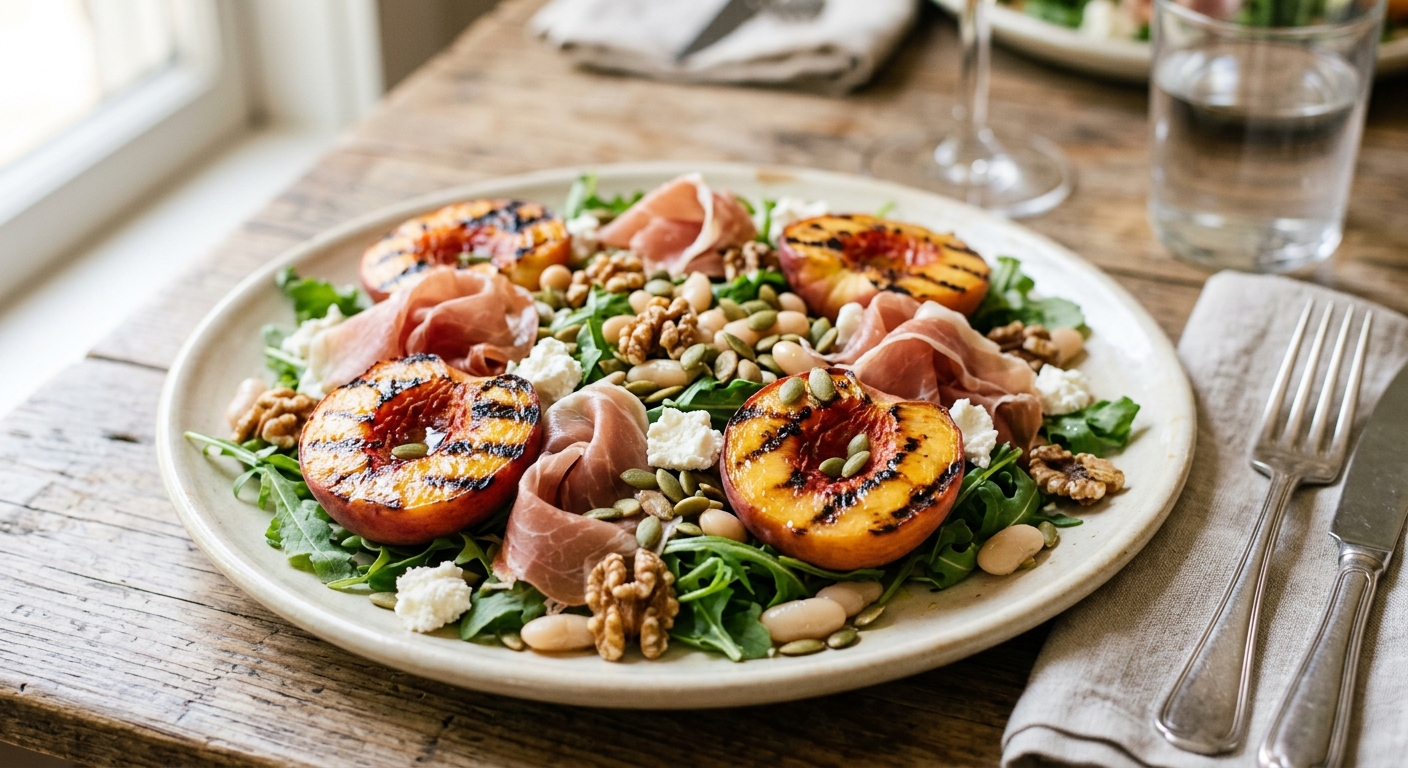
Most people think of salads as a vehicle for vitamins, but this Grilled Peach and Prosciutto Salad is something more deliberate: a precision-built iron-delivery system disguised as a stunning summer plate. Prosciutto contributes heme iron, the most bioavailable form, while arugula, pepitas, and white beans add a substantial layer of non-heme iron. The real genius lies in the peaches and the lemon vinaigrette, both loaded with vitamin C, which chemically reduces ferric iron to the ferrous form your intestinal cells can actually absorb.
Beyond the iron story, this salad punches well above its caloric weight. Arugula brings glucosinolates and vitamin K. Walnuts deliver alpha-linolenic acid and ellagitannins. White beans provide resistant starch and folate. A crumble of ricotta salata adds a salty, creamy counterpoint without overwhelming the delicate sweetness of the caramelised peaches. Every component earns its place both on the palate and on the nutrient ledger.
While a salad might seem like an unlikely candidate for multiple cooking methods, the prosciutto and peaches can be prepared via a stovetop grill pan, a sheet-pan oven roast, or even a pressure-cooker-softened warm version ideal for cooler months. Each approach coaxes different textures and flavour compounds from the same ingredients, giving you a genuinely versatile recipe for every season and every kitchen setup.
4
servings
Ingredients
- 4 mediumripe but firm peaches, halved and pitted (approx. 600g total)
- 120 gprosciutto, thinly sliced (about 8 slices)
- 150 gbaby arugula, washed and dried
- 240 gcanned white beans (cannellini), rinsed and drained
- 60 gpepitas (pumpkin seeds), raw
- 50 gwalnut halves
- 80 gricotta salata, crumbled
- 3 tbspextra-virgin olive oil
- 2 tbspfresh lemon juice (from 1 large lemon)
- 1 tsplemon zest
- 1 tbspraw honey
- 1 tspDijon mustard
- 1 tbspaged balsamic vinegar
- 1 tspfresh thyme leaves
- 0.5 tspchilli flakes (optional, for heat)
- —Colima Sea SaltMicroplastic Free Salt and cracked black pepper to taste
Instructions
Click on an item below to shop for the recommended items for this recipe on Amazon.
As an Amazon Associate, we earn from qualifying purchases.
- Make the vinaigrette first so the flavours have time to meld. Whisk together the olive oil, lemon juice, lemon zest, honey, Dijon mustard, and balsamic vinegar in a small bowl until fully emulsified. Season with a pinch of sea salt and cracked black pepper. Set aside.
- Heat a cast iron grill pan over medium-high heat for at least 3 minutes until smoking hot. Brush the cut faces of the peach halves lightly with a neutral oil or a thin swipe of olive oil. Place them cut-side down on the grill pan without moving them. Cook for 3 to 4 minutes until deep char marks appear and the flesh softens slightly at the edges. Flip and cook the skin side for 1 to 2 minutes. Transfer to a plate and drizzle immediately with the aged balsamic vinegar to deepen the caramel notes. Allow to cool for 5 minutes before slicing each half into 3 wedges.
- Without wiping the pan, reduce heat to medium. Lay the prosciutto slices flat in a single layer, working in batches if needed. Cook undisturbed for 90 seconds per side until deeply golden and crisp. The residual peach sugars on the pan will caramelise onto the prosciutto, creating a sweet-savoury crust. Drain on a paper towel and break into large shards once cooled.
- In the same pan over medium heat, add the pepitas and walnut halves. Toast for 2 to 3 minutes, shaking the pan frequently, until the pepitas begin to pop and the walnuts smell nutty and fragrant. Season with a pinch of salt and the chilli flakes if using. Remove from heat immediately to prevent burning.
- Arrange the arugula on a wide serving platter. Scatter the white beans evenly across the greens. Nestle the peach wedges and prosciutto shards over the top. Sprinkle the toasted pepitas and walnuts across the salad. Crumble the ricotta salata over everything. Drizzle the vinaigrette around the perimeter and over the centre. Finish with fresh thyme leaves and a final crack of black pepper. Serve immediately while the peaches and nuts are still warm against the cool greens.
- Preheat your oven to 220 degrees Celsius (425 degrees Fahrenheit), with the convection fan on if available. Line a large rimmed baking sheet with parchment paper and a second smaller baking sheet with a wire rack (for the prosciutto).
- While the oven heats, prepare the honey-balsamic glaze: combine the raw honey, aged balsamic vinegar, and fresh thyme leaves in a small bowl. Whisk until smooth. Place the peach halves cut-side up on the parchment-lined baking sheet. Brush each one generously with the honey-balsamic glaze, reserving about a third of the glaze for the vinaigrette.
- Roast the peaches on the upper-middle rack for 12 to 15 minutes until the cut surfaces are bubbling, golden, and beginning to char at the edges, and the flesh yields easily to a paring knife but still holds its shape. Remove from the oven and allow to cool on the pan for 5 minutes before slicing each half into 3 wedges.
- While the peaches roast, lay the prosciutto slices in a single layer on the wire rack set over the second baking sheet. Roasting on a rack allows hot air to circulate underneath, creating an all-over crispness that a flat pan cannot achieve. Place on the lower rack of the oven and roast for 7 to 9 minutes until the prosciutto is deeply mahogany, rigid, and papery. Watch carefully after the 7-minute mark as it can go from perfectly crisp to bitter within 60 seconds. Transfer to paper towels and cool completely before breaking into shards.
- Spread the pepitas and walnut halves on a small dry baking sheet. Toast in the oven for 5 to 6 minutes alongside the prosciutto, shaking the pan once halfway through. Remove when fragrant and the pepitas have puffed slightly.
- Build the vinaigrette by whisking the olive oil, lemon juice, lemon zest, Dijon mustard, the reserved honey-balsamic glaze, salt, and pepper together. Assemble the salad on a platter: arugula as the base, white beans scattered throughout, peach wedges and prosciutto shards arranged on top, followed by the toasted nuts and seeds. Crumble over the ricotta salata, drizzle with vinaigrette, and serve while the roasted components are still warm.
- Place the peach halves cut-side up in the slow cooker insert in a single layer, fitting them snugly so they support each other. Drizzle the aged balsamic vinegar and raw honey directly over the cut faces. Scatter the fresh thyme leaves across the top and season lightly with sea salt and cracked black pepper. Do not add any water; the peaches will release their own liquid.
- Cover and cook on Low for 1 hour 45 minutes to 2 hours. The peaches should be tender all the way through and have absorbed the balsamic-honey syrup into their flesh, but they should still hold their shape enough to be sliced. If your peaches are very ripe, check at 1 hour 30 minutes. Using a wide spatula, gently transfer them to a cutting board and allow to cool for 10 minutes before slicing into wedges. Reserve all the liquid from the slow cooker insert.
- While the peaches rest, crisp the prosciutto using your preferred quick method: either lay the slices flat in a dry skillet over medium heat for 2 minutes per side, or use your oven at 200 degrees Celsius for 8 minutes on a wire rack. The slow cooker cannot crisp the prosciutto, so this stovetop or oven step is essential to providing textural contrast in the warm salad.
- Build the vinaigrette by combining the olive oil, lemon juice, lemon zest, Dijon mustard, and 2 tablespoons of the reserved peach-balsamic braising liquid from the slow cooker insert. This braising liquid is intensely concentrated and replaces the need for additional balsamic in the dressing. Whisk until emulsified.
- Toast the pepitas and walnuts in a dry skillet over medium heat for 3 minutes until fragrant. To assemble the warm salad, place the arugula in wide shallow bowls (it will wilt slightly from the warm peaches, which is intentional here). Add white beans, warm peach wedges, and prosciutto shards. Scatter the toasted seeds and nuts over the top. Crumble on the ricotta salata. Drizzle each bowl generously with the braising-liquid vinaigrette. Serve immediately as a warm bowl salad.
- Pour 120ml of water into the pressure cooker pot along with the aged balsamic vinegar, raw honey, and fresh thyme leaves. Stir briefly to combine. Add the peach halves cut-side up in a single layer or stacked minimally. If using an Instant Pot, place them on the trivet if you want the peaches to poach rather than submerge. Lock the lid and set the valve to sealing.
- Cook on High Pressure for 3 minutes. For ripe peaches, use a quick release immediately after the cook time ends. For firm, underripe peaches, allow a 2-minute natural pressure release before switching to quick release. Open the lid carefully. The peaches will have softened significantly and absorbed the balsamic and honey. Remove the peaches with a slotted spoon and set aside. Switch the cooker to Saute mode on high and reduce the remaining liquid for 4 to 5 minutes until it becomes a thick, glossy syrup. Reserve this syrup for the dressing.
- Without cleaning the pot, keep it on Saute mode. Add a small drizzle of olive oil. Place the peach halves cut-side down directly in the hot pot and sear for 2 to 3 minutes without moving them. This two-stage approach, pressure-poaching for interior texture followed by a contact sear for caramelised crust, achieves what neither method alone can accomplish. Remove the peaches and slice each half into 3 wedges.
- In the same pot still on Saute mode, add the prosciutto slices in batches. Sear for 60 to 90 seconds per side until crisp. The residual syrup in the pot will help the prosciutto lacquer beautifully. Remove and drain on paper towels. Add the pepitas and walnuts to the pot and toast for 2 minutes, stirring constantly, until golden.
- Whisk together the olive oil, lemon juice, lemon zest, Dijon mustard, and 2 tablespoons of the reduced balsamic syrup to form the vinaigrette. Season to taste. Assemble the salad by layering arugula, white beans, the seared peach wedges, and prosciutto shards on a platter. Top with toasted pepitas, walnuts, crumbled ricotta salata, and the chilli flakes. Drizzle liberally with the balsamic-syrup vinaigrette and finish with thyme leaves.
Nutrition Breakdown
Per 1 serving (makes 4)
Vitamins & Minerals
% Daily Value based on a 2,000 calorie diet (FDA reference)
🧬 Essential Amino Acids
% of recommended daily intake (RDA) per serving
🛡 Antioxidant Profile
The Nutrition Science
The pairing of vitamin C with iron-rich foods is one of the most well-validated nutritional strategies in human dietetics. Ascorbic acid works through two distinct mechanisms: it chelates ferric iron (Fe3+) to form a soluble complex that resists the alkaline pH of the duodenum, and it chemically reduces Fe3+ to Fe2+, the only form recognised by the DMT-1 transporter on intestinal enterocytes. Research published in the American Journal of Clinical Nutrition has consistently demonstrated that as little as 25mg of vitamin C consumed simultaneously with a non-heme iron source can increase absorption by 67% to 300%, depending on baseline iron status and the presence of inhibitors like phytates. This recipe deliberately delivers both the iron source and the vitamin C enhancer in the same bite, rather than relying on separate courses.
Prosciutto provides heme iron, which travels via a separate, more direct pathway through the heme carrier protein HCP-1, achieving absorption rates of 15% to 35% independent of vitamin C status. The combination of heme and non-heme iron in one dish is strategically advantageous: the heme fraction absorbs readily, while the vitamin C from peaches, lemon juice, and arugula maximises uptake of the non-heme iron from white beans, pepitas, and arugula itself. White beans are a particularly underrated iron source, providing approximately 3.3mg of iron per 100g cooked, alongside folate that supports red blood cell synthesis downstream of iron incorporation into haemoglobin.
The walnuts and ricotta salata introduce a notable consideration: calcium and polyphenols can inhibit non-heme iron absorption when consumed in very large amounts. However, the quantities used here are calibrated to stay well below inhibitory thresholds. The ellagitannins in walnuts are present in milligram amounts that are unlikely to significantly reduce iron bioavailability, particularly when robust vitamin C is present to outcompete chelation. The overall iron bioavailability of this dish is estimated at 12% to 18% for the non-heme fraction, which is meaningfully higher than the 3% to 8% typical of plant-iron sources consumed without vitamin C enhancers.
Pro Tips
- Select peaches that are ripe but still firm enough to resist a firm thumb press; overly soft fruit will collapse during cooking regardless of method, turning to mush rather than holding clean wedge shapes.
- The iron-vitamin C absorption window is real but time-sensitive: vitamin C begins to degrade once the fruit is sliced and exposed to air, so dress and serve the salad within 15 minutes of assembly to preserve maximum ascorbic acid activity.
- To make this dish a complete iron powerhouse for menstruating women or those with diagnosed iron-deficiency anaemia, swap the white beans for black beans, which contain approximately 3.6mg of iron per 100g cooked, and increase the pepita quantity to 80g, pushing the total iron per serving above 6mg.
This is such a thoughtful pairing! I’m curious though, does the recipe include any nightshade vegetables I should watch for? I’ve found that my thyroid does better when I’m careful about nightshades, so I’m wondering if the arugula is the only green here or if there are tomatoes involved. Also, I’d love to know the iodine content you’re working with, since the prosciutto likely adds some but I’m always balancing it carefully with my Hashimoto’s. If this is as written, it sounds like something I could definitely adapt for AIP by swapping the walnuts for macadamia nuts, and I’m really excited to try it!
This is such a smart pairing because you’re not just hitting iron intake, you’re optimizing the methylation cycle that depends on iron-dependent enzymes like MTHFR variants. I started experimenting with strategic vitamin C timing around my iron-rich meals last year and noticed significant improvements in my energy and focus, which made me wonder if my methylation capacity was finally getting the cofactors it needed. The walnuts are a nice touch too since they’re bringing in alpha-linolenic acid which supports the methylation donors your body needs. Have you noticed whether your readers report better outcomes when they pair their iron sources with specific vitamin C foods versus just taking them together, or is the bioavailability boost
ooh this is genius for recovery nutrition, especially after hard efforts when youre depleted! ive been experimenting with iron timing around my runs since i noticed i was dragging in the second half of ultras, and pairing it with vitamin c makes such a difference in how i feel the next day. the prosciutto and walnuts also give you that fat for satiety which is clutch if youre eating this as a post-race meal instead of just a side salad – definitely trying this before my next 50k!