
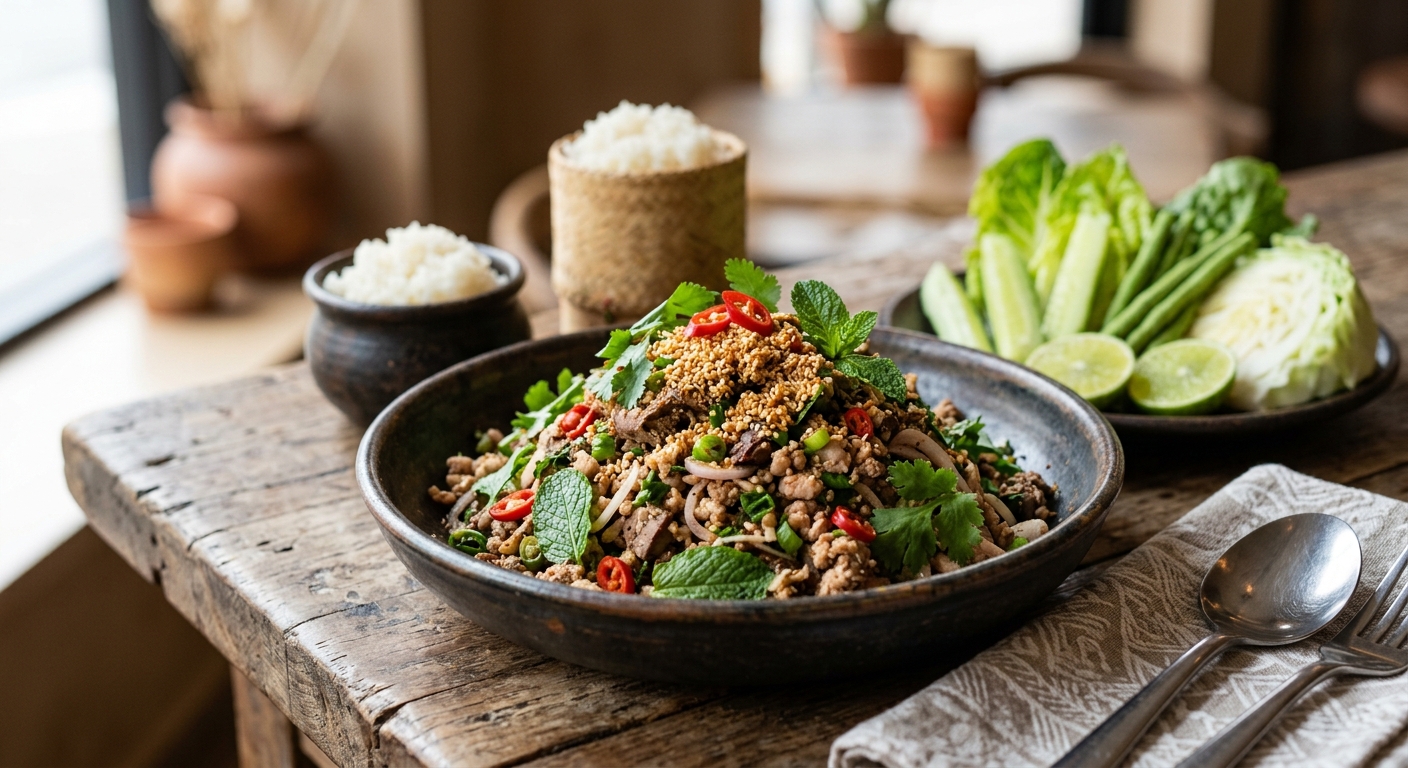
Larb (also spelled laab or laap) is the unofficial national dish of Laos, a bright and ferociously herby minced-meat salad that is eaten warm, at room temperature, or even cold the next day. Unlike the heavy, sauce-laden dishes of many cuisines, larb is fundamentally about contrast: savory toasted rice powder for nuttiness and texture, explosive handfuls of fresh mint and cilantro, shallots for sharpness, dried chillies for heat, and a dressing of fish sauce and lime juice so clean and direct it feels like a palate reset. What makes this Calibrated Cuisine version extraordinary is the addition of chicken liver, which transforms an already nutritious dish into a genuine iron delivery system backed by serious nutritional science.
Each serving of this larb provides approximately 85% of the recommended daily intake for iron, drawing from both the heme iron in the chicken and liver (the most bioavailable form) and the plant-based non-heme iron from fresh herbs. The vitamin C in the lime juice actively enhances non-heme iron absorption, a pairing that is not accidental here but baked into the dish’s centuries-old architecture. Chicken liver also contributes an extraordinary hit of folate, vitamin B12, vitamin A, and copper, making this one of the most micronutrient-dense salads you will ever encounter outside a clinical setting.
Do not be intimidated by liver. Chicken liver is mild, creamy, and fast-cooking, and when properly seasoned and finely minced into the ground chicken, it becomes nearly indistinguishable in texture while dramatically amplifying the nutritional profile. The toasted rice powder (khao khua) is a traditional Laotian technique that you should not skip: it adds a smoky, popcorn-like depth that no other ingredient replicates. Make a larger batch and store it in a jar; it elevates everything from grilled meats to roasted vegetables.
4
servings
Ingredients
- 400 gground chicken (thigh meat preferred)
- 200 gfresh chicken livers, trimmed and finely chopped
- 3 tbspjasmine rice (raw, for toasting into khao khua)
- 4 tbspfish sauce
- 4 tbspfresh lime juice (about 3 limes)
- 1 tsppalm sugar or light brown sugar
- 6 wholeshallots, thinly sliced (about 120g)
- 4 wholespring onions (scallions), thinly sliced
- 3 wholefresh bird’s eye chillies, finely sliced (adjust to heat preference)
- 1 tspdried chilli flakes (Laotian or Thai)
- 40 gfresh mint leaves, roughly torn
- 30 gfresh cilantro (coriander), roughly chopped, stems and leaves
- 20 gfresh dill fronds, roughly chopped
- 2 tbspAvocado Oil100% Pure Avocado Oil (such as avocado or grapeseed)
- 1 tbsptoasted sesame oil
- —Colima Sea SaltMicroplastic Free Salt and white pepper to taste
- —Butter lettuce leaves or steamed jasmine rice, to serve
- —Lime wedges, to serve
Instructions
Click on an item below to shop for the recommended items for this recipe on Amazon.
As an Amazon Associate, we earn from qualifying purchases.
- Make the toasted rice powder (khao khua): place the raw jasmine rice in a dry skillet or wok over medium heat. Toast, stirring constantly, for 8 to 10 minutes until the grains are deep golden brown and smell nutty and smoky, like popcorn. Transfer immediately to a spice grinder or mortar and pestle, grind to a coarse powder (not fine flour), and set aside. This can be done up to a week ahead and stored in a sealed jar.
- Make the dressing: whisk together the fish sauce, lime juice, and palm sugar in a small bowl until the sugar dissolves. Taste and adjust: it should be sharply sour, savory, and just barely sweet. Set aside.
- Heat the neutral oil in a large wok or wide skillet over high heat until shimmering and just starting to smoke. Add the ground chicken in a single layer without stirring for the first 60 seconds, allowing a golden crust to develop on the bottom. Break it apart and cook, stirring, for a further 3 to 4 minutes until cooked through with some caramelized edges.
- Push the chicken to the sides of the wok. Add the chopped chicken livers to the center and sear without stirring for 45 seconds. Stir to break them apart and cook for another 60 to 90 seconds until just cooked through but still slightly pink in the center (they will finish cooking from residual heat). Overcooked liver turns grainy, so pull the pan from the heat the moment no red remains.
- Remove the wok from the heat entirely. Add the sliced shallots, spring onions, fresh chillies, and dried chilli flakes directly to the hot meat mixture and toss to combine; the residual heat will soften the shallots slightly while keeping them crisp.
- Pour the dressing over the mixture and toss well. Add 3 tablespoons of the toasted rice powder and the sesame oil and toss again. The rice powder will absorb some of the dressing and coat everything in a fragrant, nutty layer.
- Fold in the mint, cilantro, and dill gently. Taste and adjust seasoning with additional fish sauce, lime juice, or salt as needed. Serve immediately on butter lettuce cups or alongside steamed jasmine rice, with extra lime wedges and the remaining rice powder on the side for guests to add as desired.
- Prepare the toasted rice powder ahead of time using the stovetop method: toast raw jasmine rice in a dry skillet over medium heat for 8 to 10 minutes, stirring constantly, until deep golden. Grind coarsely and set aside. Prepare the dressing by whisking fish sauce, lime juice, and palm sugar until sugar dissolves, and set aside.
- Place the ground chicken in the slow cooker insert and break it apart into small pieces with a wooden spoon. Add the sliced shallots, spring onions, dried chilli flakes, and sesame oil. Do not add the fresh chillies, fresh herbs, or dressing yet as they will lose all brightness over extended heat.
- Add 3 tablespoons of water to the insert to provide enough initial moisture for the slow cooker environment. Stir everything together, cover, and cook on Low for 2 hours. The chicken will steam and braise gently, resulting in tender, uniform texture throughout.
- At the 1 hour 50 minute mark, open the lid and add the finely chopped chicken livers directly into the hot chicken mixture, folding them in well. Replace the lid and cook for the remaining 10 minutes on Low. The residual heat and gentle steam will cook the livers through without over-firming them.
- Turn off the slow cooker. Use a slotted spoon to transfer the meat mixture to a large mixing bowl, leaving behind any excess liquid in the insert (this prevents the salad from becoming watery). Add the dressing, 3 tablespoons of toasted rice powder, and fresh chilli slices and toss to coat.
- Allow the mixture to cool for 5 minutes until it is warm rather than steaming hot, then fold in the mint, cilantro, and dill. The slight cooling is important: adding herbs to very hot food wilts them before serving. Taste and adjust seasoning. Serve on lettuce leaves or with rice, with extra rice powder on the side.
- Before using the pressure cooker, prepare the toasted rice powder using your stovetop burner: dry-toast jasmine rice in a skillet over medium heat for 8 to 10 minutes until deep golden and fragrant, then grind coarsely. Prepare the dressing by combining fish sauce, lime juice, and palm sugar, stirring until sugar dissolves. Set both aside.
- Set the pressure cooker to the Saute function (or use the stovetop pressure cooker over medium-high heat). Add the neutral oil and heat until shimmering. Add the sliced shallots and cook, stirring, for 2 minutes until beginning to soften and turn translucent. This step builds a flavor base that compensates for the lack of open-flame searing.
- Add the ground chicken to the pot and stir to break apart, cooking for 2 minutes until the chicken is no longer fully raw on the outside (it does not need to be cooked through at this stage). Add the chopped chicken livers, dried chilli flakes, and sesame oil and stir to combine. Turn off the Saute function.
- Add 2 tablespoons of water to the pot (just enough to create steam without diluting the final dish). Seal the lid, set the valve to Sealing, and pressure cook on High for 3 minutes. When the cycle completes, perform an immediate quick release by carefully moving the valve to Venting.
- Open the lid and check that the chicken is cooked through and the livers show no remaining pink. Use a slotted spoon to transfer the meat mixture to a large mixing bowl, discarding excess liquid. Add the dressing, toasted rice powder, fresh chilli slices, and spring onions and toss thoroughly.
- Allow to cool for 3 to 5 minutes, then fold in the mint, cilantro, and dill. Taste and correct seasoning with additional lime juice or fish sauce. Serve immediately on butter lettuce cups or over jasmine rice, finishing each plate with an extra pinch of rice powder and fresh lime wedges.
- Preheat your oven to 220C (425F) with a rack in the upper third. Line a large rimmed baking sheet with parchment paper. Prepare the toasted rice powder using a stovetop skillet (toast raw jasmine rice over medium heat for 8 to 10 minutes, stirring constantly, until deep golden; grind coarsely). Prepare the dressing by whisking fish sauce, lime juice, and palm sugar, and set aside.
- In a large bowl, combine the ground chicken, sliced shallots, dried chilli flakes, neutral oil, and sesame oil. Season with a pinch of white pepper and toss well to distribute the oil and seasoning evenly throughout the meat. Spread the seasoned chicken mixture across the lined baking sheet in an even layer no more than 1.5cm thick. Thin, even layers are essential for caramelization; thick piles will steam rather than roast.
- Roast on the upper rack for 14 minutes, then remove the baking sheet from the oven. Use a spatula to break apart any large clumps and flip sections for even browning. Scatter the finely chopped chicken livers evenly across the top of the partially roasted chicken mixture.
- Return to the oven and roast for a further 6 to 8 minutes until the chicken has golden, slightly crisped edges and the livers are cooked through but not dried out. Watch carefully during this final stage as chicken liver can overcook quickly at this temperature.
- Remove the baking sheet from the oven and immediately scrape all of the meat and caramelized juices from the pan into a large mixing bowl. Pour the dressing over the hot mixture and toss quickly; the heat will allow the dressing to slightly reduce and cling to the meat. Add the toasted rice powder, spring onions, and fresh chilli slices and toss again.
- Let the mixture rest for 4 minutes until warm rather than piping hot, then fold in the mint, cilantro, and dill. The brief rest prevents the herbs from wilting while still allowing them to mingle with the warm dressing. Taste and adjust seasoning with more lime juice or fish sauce. Serve piled onto butter lettuce leaves with lime wedges, and pass the remaining rice powder at the table.
Nutrition Breakdown
Per 1 serving (makes 4)
Vitamins & Minerals
% Daily Value based on a 2,000 calorie diet (FDA reference)
🧬 Essential Amino Acids
% of recommended daily intake (RDA) per serving
🛡 Antioxidant Profile
The Nutrition Science
The iron story in this larb is a masterclass in synergistic nutrition. Chicken liver delivers approximately 9mg of highly bioavailable heme iron per 100g serving, a form absorbed at a rate of 15 to 35% regardless of other dietary factors. Ground chicken thigh meat contributes an additional layer of heme iron, and the two together place a single serving of this dish well above the 18mg RDI for adult women of reproductive age. Crucially, the lime juice dressing is not merely for flavor: the ascorbic acid (vitamin C) it provides directly reduces ferric iron (Fe3+) to the more absorbable ferrous form (Fe2+), enhancing non-heme iron absorption by up to 300% in the presence of even modest vitamin C quantities like those found here.
Chicken liver’s contribution extends far beyond iron. It is among the most concentrated dietary sources of preformed vitamin A (retinol), providing nearly the full daily requirement per serving, which supports immune function, vision, and cellular differentiation. The folate content, at 80% DV per serving, is clinically relevant for DNA synthesis and homocysteine regulation, and the vitamin B12 at over 400% DV provides a genuine therapeutic dose for anyone with absorption concerns or dietary restriction recovery. Copper, also abundant in liver, acts as a co-factor for ceruloplasmin, the ferroxidase enzyme that is directly required for iron to be released from storage and transported in blood. In other words, the copper in this dish helps your body mobilize the iron it contains.
The fresh herb blend of mint, cilantro, and dill is not decorative. These three herbs collectively contribute rosmarinic acid, apigenin, luteolin, and quercetin, polyphenols with measurable anti-inflammatory activity that may help mitigate the pro-oxidative stress associated with very high iron loads. The toasted rice powder (khao khua) contributes resistant starch and Maillard reaction compounds that slow glucose absorption and add genuine antioxidant complexity. This is a dish where every ingredient earns its place not just in flavor but in function.
Pro Tips
- To remove any bitterness from chicken liver, soak the trimmed livers in cold milk or lightly salted water for 20 minutes before chopping. Drain, rinse, and pat completely dry before cooking.
- Khao khua (toasted rice powder) keeps for up to 2 weeks in an airtight jar at room temperature and loses flavor quickly once ground, so grind only what you need each time and store the rest as whole toasted grains.
- For the most vibrant herb flavor, tear or roughly chop the mint and cilantro by hand rather than using a knife; blade pressure bruises the cells and accelerates oxidation, dulling both color and taste within minutes of cutting.
This is such a smart pick for iron bioavailability! I love that you’re highlighting organ meats because so many of my plant-based clients ask how to match that heme iron absorption rate. The combination of the vitamin C from lime with the iron-rich liver is textbook nutrient synergy. Have you found that clients respond differently to this kind of traditional preparation versus more common iron sources? I’m curious whether the aromatic herbs (especially the mint) play any role in reducing antinutrients, or if that’s just a flavor bonus here.
What a thoughtful question, Priya! I’ve noticed in my own practice that the aromatic herbs in larb, especially the mint and cilantro, do seem to support digestive ease in ways that go beyond flavor, which the Ayurvedic tradition actually recognizes through the concept of agni, or digestive fire. The mint cools and the cilantro has mild chelating properties, so together they likely help with absorption while making the heavier iron from liver feel less dense in the belly. I’ve found that clients who struggle with organ meats do better when there’s this kind of herb-forward preparation rather than a simple sautee, though I’m always curious whether it’s the bioav
ok so im really intrigued by this one but im nervous about the texture, especially with the liver. during my flares the chunkier organ meats can be rough on my gut, but when ive been in remission ive actually tolerated ground liver pretty well if its mixed in really thoroughly. does the recipe call for finely mincing everything together or is there distinction between the chicken and liver texture? also curious about the toasted rice powder – is that something thats gentle on digestion or does it add a grittiness that might irritate? the iron boost is honestly exactly what i need since crohns makes absorption tricky anyway, just want to make sure i can actually tolerate it!