
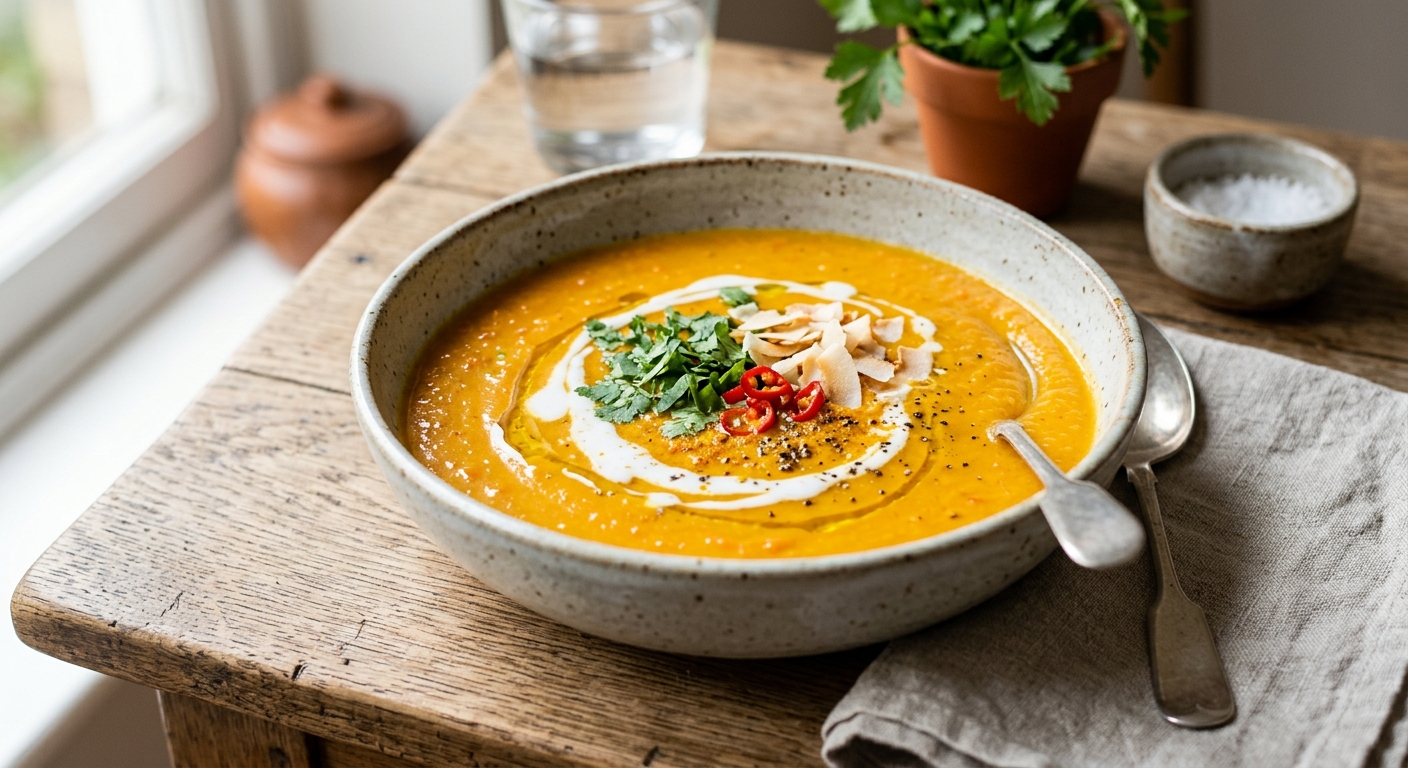
There are soups that warm you, and then there are soups that genuinely transform your nutritional day. This carrot, ginger, and coconut milk soup sits firmly in the second category. Built on a foundation of deeply caramelised carrots, pungent fresh ginger, and aromatic spices, it achieves a velvety smoothness that belies how straightforward it is to make. The coconut milk adds a luxurious body and a subtle sweetness that rounds out the heat of the ginger, creating a bowl that feels indulgent while delivering one of the most nutrient-dense profiles of any soup in our repertoire.
The star of the show is beta-carotene, the orange pigment that gives carrots their characteristic colour and converts in your body to retinol, the active form of Vitamin A. A single 500g batch serving of this soup provides approximately 18mg of beta-carotene, which translates to well over 300% of the recommended daily intake for Vitamin A. Crucially, this recipe is designed to maximise absorption: beta-carotene is fat-soluble, meaning it requires dietary fat to be absorbed efficiently. The coconut milk and olive oil in this recipe provide exactly that vehicle, turning a simple vegetable soup into a bioavailability-optimised delivery system for one of the body’s most essential micronutrients.
Ginger brings far more than heat to this bowl. Gingerols and shogaols, the primary bioactive compounds in fresh and dried ginger respectively, are potent anti-inflammatory agents with well-documented effects on digestive comfort, nausea reduction, and oxidative stress. Paired with turmeric’s curcumin and the quercetin naturally present in onion, this soup is a genuine anti-inflammatory powerhouse. Whether you make it on the stovetop in under an hour, let it develop deep slow-cooked sweetness in a slow cooker, or have it on the table in 30 minutes with a pressure cooker, every method delivers the same nutritionally exceptional result.
4
servings
Ingredients
- 800 gcarrots, peeled and roughly chopped into 3cm pieces
- 1 largeyellow onion, roughly chopped
- 4 clovesgarlic, smashed and peeled
- 40 gfresh ginger, peeled and roughly sliced
- 400 mlfull-fat coconut milk (one standard can)
- 750 mllow-sodium vegetable broth
- 2 tbspextra-virgin olive oil
- 1 tspground turmeric
- 1 tspground cumin
- 0.5 tspground coriander
- 0.25 tspcayenne pepper
- 1 tbspfresh lime juice
- 1 tsppure maple syrup
- —Colima Sea SaltMicroplastic Free Salt and black pepper to taste
- —To serve: a swirl of coconut cream, toasted pumpkin seeds, fresh coriander leaves, and a pinch of smoked paprika
Instructions
Click on an item below to shop for the recommended items for this recipe on Amazon.
As an Amazon Associate, we earn from qualifying purchases.
- Heat the olive oil in a large Dutch oven or heavy-bottomed pot over medium heat. Once the oil shimmers, add the chopped onion with a pinch of salt and cook, stirring occasionally, for 7 to 8 minutes until the onion is soft, translucent, and just beginning to take on a light golden colour at the edges. This initial caramelisation builds the foundational sweetness that balances the ginger’s heat.
- Add the smashed garlic and sliced ginger to the pot. Cook, stirring constantly, for 90 seconds until fragrant. The garlic should soften but not brown. Immediately add the ground turmeric, cumin, coriander, and cayenne, stirring everything together and pressing the spices into the onion mixture. Toast the spices in the oil for exactly 60 seconds, stirring constantly. This step blooms the fat-soluble spice compounds, dramatically intensifying their flavour and the curcumin’s bioavailability.
- Add the chopped carrots to the pot and stir to coat them thoroughly in the spiced onion mixture. Pour in the vegetable broth and stir to deglaze, scraping up any browned bits from the bottom of the pot. Bring the liquid to a full boil over high heat, then reduce to a steady simmer. Cook uncovered for 20 to 25 minutes, until the carrots are completely tender and a fork slides through the largest piece with no resistance.
- Remove the pot from the heat. Using an immersion blender directly in the pot, blend the soup until completely smooth. Start on a low speed and increase gradually to avoid splashing hot liquid. Alternatively, work in batches using a countertop blender, filling it no more than halfway and holding a folded kitchen towel firmly over the lid. Blend each batch for a full 60 seconds on high for the silkiest texture.
- Return the blended soup to low heat. Stir in the coconut milk, lime juice, and maple syrup. Simmer gently for 5 minutes, stirring occasionally. Taste and adjust seasoning with salt, black pepper, and additional lime juice. The soup should be vibrantly savoury with a bright citrus finish. Ladle into warm bowls and finish with a swirl of coconut cream, toasted pumpkin seeds, fresh coriander, and a pinch of smoked paprika.
- Place the chopped carrots, roughly chopped onion, smashed garlic, sliced ginger, turmeric, cumin, coriander, and cayenne directly into the slow cooker insert. Drizzle the olive oil over the vegetables and toss everything together until the vegetables are evenly coated in the oil and spices. No pre-cooking or blooming is required; the extended low-heat environment will develop the spice flavours over time, producing a rounder, mellower profile than the stovetop version.
- Pour the vegetable broth over the vegetables, scraping down any spices clinging to the sides of the insert. The broth should just barely cover the carrots. Season with half a teaspoon of fine sea salt and several grinds of black pepper. Place the lid on the slow cooker and cook on Low for 6.5 to 7 hours, or on High for 3 to 3.5 hours, until the carrots are completely soft and the onion has broken down entirely.
- Once the vegetables are tender, remove the lid and add the coconut milk, lime juice, and maple syrup directly to the insert. Stir gently to combine. Replace the lid and cook on High for a further 20 to 30 minutes until the coconut milk is heated through and the flavours have melded. The aroma at this point should be deeply sweet and warmly spiced.
- Use an immersion blender directly in the slow cooker insert to blend the soup until silky smooth. If using a countertop blender, allow the soup to cool for 10 minutes first, then blend in batches with the lid firmly held. Return blended soup to the insert on the Keep Warm setting.
- Taste and adjust seasoning. Because slow cooking concentrates flavours more than stovetop, you may find the ginger and spice intensity is slightly more pronounced. Balance with an extra squeeze of lime juice or a small additional drizzle of maple syrup as needed. Serve in warm bowls with coconut cream, toasted pumpkin seeds, fresh coriander, and smoked paprika.
- Select the Saute function on your Instant Pot or electric pressure cooker and set it to Medium heat. Add the olive oil and allow it to heat for 1 minute. Add the onion with a pinch of salt and saute for 4 to 5 minutes, stirring often, until softened and lightly golden. Add the garlic and ginger and saute for a further 60 seconds. Add all four ground spices and stir vigorously for 30 seconds, toasting them briefly in the residual oil. Press Cancel to end the Saute function.
- Add the chopped carrots to the pot and stir to coat in the spiced base. Pour in 600ml of the vegetable broth only, reserving the remaining 150ml. The reduced liquid volume is important for pressure cooking; the carrots will release moisture during cooking and you should not exceed the maximum fill line. Stir to deglaze the bottom of the pot thoroughly, scraping up any browned spice bits to prevent a burn notice.
- Secure the lid and set the pressure valve to Sealing. Select Pressure Cook (or Manual) on High Pressure and set the timer for 8 minutes. The pot will take approximately 8 to 10 minutes to come to full pressure before the cooking timer begins. Once the 8-minute cook time is complete, allow the pressure to release naturally for 10 minutes, then carefully turn the valve to Venting to release any remaining pressure.
- Open the lid away from you. The carrots should be completely soft. Use an immersion blender directly in the pot to blend until perfectly smooth, about 60 to 90 seconds. Add the reserved 150ml broth to adjust the consistency if needed. Stir in the full can of coconut milk, the lime juice, and maple syrup. Select Saute on Low and heat gently for 3 to 4 minutes, stirring, until the coconut milk is fully incorporated and the soup is steaming. Do not bring it to a boil at this stage.
- Taste and season generously with salt and black pepper. The pressure cooking method produces a slightly more concentrated flavour profile, so the lime juice is especially important here to lift the richness. Serve immediately in warm bowls with all garnishes.
- Preheat your oven to 210C (410F) with a rack in the centre position. Line a large rimmed baking sheet with parchment paper. Spread the chopped carrots, onion pieces, smashed garlic cloves, and ginger slices in a single layer across the baking sheet. Drizzle the olive oil over the vegetables and sprinkle over the turmeric, cumin, coriander, cayenne, half a teaspoon of salt, and a generous amount of black pepper. Toss everything together directly on the sheet until evenly coated, then spread back out into a single layer.
- Roast in the preheated oven for 40 to 45 minutes, flipping the vegetables once at the 20-minute mark. The carrots should be fork-tender with deeply caramelised, slightly charred edges. The garlic should be golden and jammy. The ginger slices will be soft and intensely fragrant. Some dark spots on the carrot edges are desirable as they add bittersweet complexity to the final soup.
- Transfer all roasted vegetables and any caramelised juices from the baking sheet into a large pot on the stovetop over medium heat. Pour in the vegetable broth, scraping the baking sheet with a spatula to capture all the concentrated flavour. Bring to a simmer and cook for 5 minutes to allow the roasted vegetables to fully relax into the broth.
- Remove the pot from heat and blend with an immersion blender until very smooth, at least 90 seconds of blending. Because roasted carrots have slightly less moisture than boiled ones, the texture will be thicker at this stage. Add additional broth, a few tablespoons at a time, to reach your preferred consistency.
- Return the pot to low heat and stir in the coconut milk, lime juice, and maple syrup. Simmer gently for 5 minutes. Taste carefully; the roasted version will have a noticeably richer, sweeter, and more complex flavour than other methods. You may want slightly more lime juice to balance the caramelised sweetness. Adjust salt, add garnishes, and serve immediately.
Nutrition Breakdown
Per 1 serving (makes 4)
Vitamins & Minerals
% Daily Value based on a 2,000 calorie diet (FDA reference)
🧬 Essential Amino Acids
% of recommended daily intake (RDA) per serving
🛡 Antioxidant Profile
The Nutrition Science
Beta-carotene absorption is one of the most striking examples of the importance of food pairing in nutrition science. Studies published in the American Journal of Clinical Nutrition have demonstrated that consuming beta-carotene with as little as 3 to 5 grams of fat increases its absorption by three to five times compared to consuming it without fat. Each serving of this soup delivers approximately 18 grams of fat, predominantly from the medium-chain triglycerides (MCTs) in coconut milk, creating an ideal lipid environment for micellar solubilisation, the process by which carotenoids are packaged into lipid droplets for absorption across the intestinal wall. This is not a happy accident; it is a deliberate formulation that transforms carrots from a merely nutritious vegetable into a high-efficiency Vitamin A delivery mechanism.
Vitamin A itself is essential for at least four distinct physiological systems. In vision, retinal (the aldehyde form of Vitamin A) is a structural component of rhodopsin, the photoreceptor pigment that allows the eye to detect light in low-visibility conditions. In immunity, retinoic acid regulates the differentiation of T-cells and B-cells and maintains the integrity of mucosal barriers in the respiratory and gastrointestinal tracts. In cellular growth, retinoic acid receptors (RARs) act as transcription factors that control gene expression involved in cell differentiation and embryonic development. Deficiency in Vitamin A, even sub-clinical deficiency, compromises all four systems simultaneously, making consistent dietary intake through foods like this soup genuinely important rather than merely aspirational.
The anti-inflammatory synergy between ginger and turmeric in this recipe is also worth examining. Gingerols, the pungent compounds in fresh ginger, inhibit the enzyme 5-lipoxygenase, which produces leukotrienes, a class of inflammatory mediators involved in asthma and allergic responses. Curcumin from turmeric simultaneously inhibits NF-kB, the transcription factor that switches on the production of inflammatory cytokines including interleukin-6 and TNF-alpha. Because these two compounds operate on different nodes of the inflammatory cascade, their combination produces a broader anti-inflammatory effect than either could achieve alone, a phenomenon known in pharmacology as polypharmacological synergy.
Pro Tips
- For maximum beta-carotene content, choose the deepest orange carrots you can find. Heirloom varieties like Chantenay or Nantes tend to have higher carotenoid concentrations than standard supermarket carrots, and older, thicker carrots generally outperform young baby carrots on carotene density.
- Do not substitute light or reduced-fat coconut milk. The fat content is nutritionally functional here, not merely for flavour. Full-fat coconut milk (typically 17 to 19% fat) provides the lipid matrix necessary for optimal beta-carotene absorption. Using a low-fat version will reduce the bioavailability of Vitamin A significantly.
- Ginger intensity varies considerably between pieces. After blending, always taste the soup before serving and add freshly grated ginger directly to your bowl if you want a sharper, more pronounced ginger hit without cooking off the volatile aromatic compounds that give fresh ginger its bright heat.
- This soup freezes exceptionally well for up to three months. Portion it into individual servings before freezing and reheat gently on the stovetop over low heat rather than in a microwave, which can cause the coconut milk to break and separate. Add garnishes only after reheating.
- To turn this into a complete one-bowl meal without adding another dish, stir 200g of rinsed red lentils into the broth before cooking. They will blend completely into the soup, adding approximately 9g of protein and 8g of fiber per serving while barely altering the flavour.
This is exactly what I’ve been looking for, honestly. The vitamin A is crucial for me since neuroinflammation can compromise barrier function, and I’ve noticed real differences in my symptoms when I dial in my micronutrient intake. I’m equally interested in Carsten’s question about carbs because blood sugar stability has become part of my MS management too, so knowing the full nutrient breakdown would help me figure out if this works better as a side dish or light lunch for my particular protocol. Thank you for putting the science front and center here instead of just calling it “healthy” – that specificity actually changes whether something fits into what my body needs.
This looks solid for recovery days or easy spin sessions when I’m not worried about carb loading, but I’m curious what the total carb count is per serving? Carrots can be surprisingly glycemic depending on portion size, and that coconut milk adds fat which could slow absorption. Have you tested this on actual training days vs rest days, or is it more of a general wellness bowl? The Vitamin A density is definitely impressive though, I’ve been looking for micronutrient-dense options that don’t spike blood sugar during my periodization phases.
omg YES to the vitamin a focus, nadia! ive been sprouting mung beans and lentils to boost bioavailability in our soups and my kids brains seem sharper on days when were really dialing in the micronutrients, its wild. my question is whether the poster did anything to enhance the absorption here – like adding black pepper for the piperine or a fat source beyond the coconut? because vitamin a is fat soluble and i want to make sure my family is actually getting the most bang for buck, especially since my oldest has some sensory processing stuff that seems to correlate with nutrient density. cant wait to try this!