
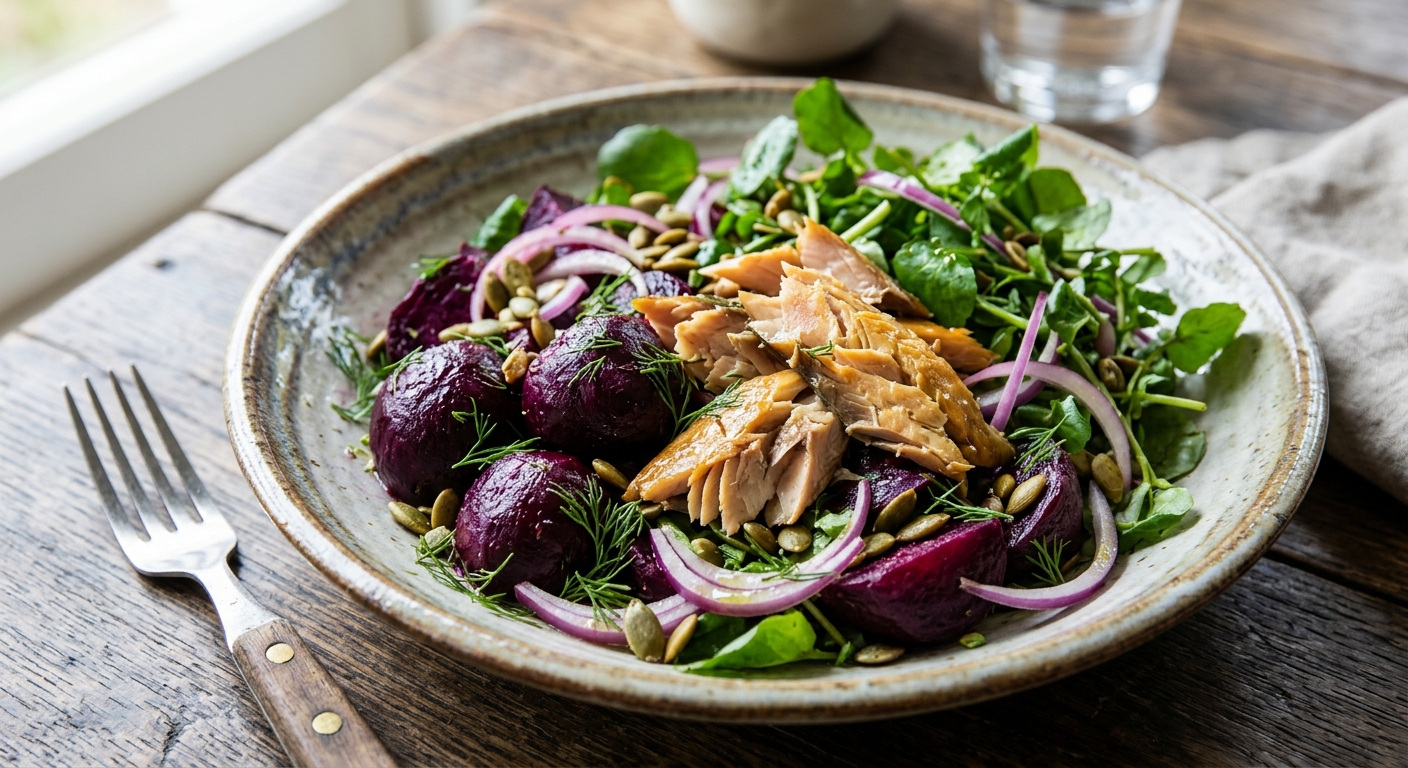
Some dishes earn their place on the table purely through flavour, and others earn it through nutritional brilliance. This smoked mackerel and beet salad does both at once. Earthy, caramelised beets meet the bold, oceanic smokiness of mackerel fillets, then the whole composition is lifted by a punchy horseradish and apple cider vinegar dressing, finished with toasted pumpkin seeds, peppery watercress, and a scatter of fresh dill. The result is a salad that feels genuinely satisfying, not like a compromise.
From a nutritional standpoint, this recipe is extraordinary. A single serving provides roughly 3,200 mg of combined EPA and DHA, the long-chain omega-3 fatty acids that are the subject of thousands of clinical studies on cardiovascular health, neuroinflammation, and joint function. Mackerel is one of the richest dietary sources of these fats on the planet, surpassing salmon in EPA and DHA content gram for gram. The beets contribute meaningful iron and folate, while the vitamin C in the watercress and lemon dressing actively enhances non-heme iron absorption from the beet and pumpkin seeds, a nutritional synergy that is easy to engineer when you know where to look.
What makes this recipe particularly interesting from a culinary science perspective is the beet preparation method. We give you four genuine options: stovetop simmering, slow cooker braising, pressure cooker steaming, and oven roasting. Each method produces beets with a distinct texture and flavour profile. Roasted beets are sweet and concentrated with caramelised edges. Pressure-cooked beets are silky and quick. Slow-cooked beets absorb any aromatics you add to the liquid, developing a deeper, wine-like earthiness. The smoked mackerel requires no cooking at all, which means your effort focuses entirely on getting the beets exactly right for your preferred result.
4
servings
Ingredients
- 600 graw whole beets, scrubbed (approximately 4 medium beets)
- 320 gsmoked mackerel fillets, skin removed and flaked
- 120 gwatercress, thick stems trimmed
- 80 gpumpkin seeds (pepitas)
- 1 mediumred onion, thinly sliced into half-moons
- 20 gfresh dill fronds, roughly chopped
- 3 tbspextra-virgin olive oil
- 2 tbspapple cider vinegar
- 1 tbspfreshly squeezed lemon juice
- 1 tbspprepared horseradish (jarred, not cream-style)
- 1 tspraw honey
- 1 tspDijon mustard
- 2 tbspcapers, drained and rinsed
- 1 tbsplemon zest (from 1 large lemon)
- —Colima Sea SaltMicroplastic Free Salt and black pepper to taste
Instructions
Click on an item below to shop for the recommended items for this recipe on Amazon.
As an Amazon Associate, we earn from qualifying purchases.
- Place the whole, scrubbed, unpeeled beets in a large saucepan. Cover with cold water by at least 5 cm. Add 1 teaspoon of fine sea salt and 1 tablespoon of apple cider vinegar to the water. This helps set the colour. Bring to a boil over high heat, then reduce to a steady simmer.
- Simmer uncovered for 35 to 40 minutes, depending on the size of your beets. To test doneness, pierce the largest beet through the centre with a thin knife or skewer. It should slide in with very little resistance. Medium beets (about 150 g each) are usually done in 38 minutes.
- While the beets simmer, toast the pumpkin seeds. Place them in a dry skillet over medium heat and toast, stirring constantly, for 3 to 4 minutes until they begin to pop and turn golden. Transfer immediately to a plate and season lightly with sea salt. Set aside to cool.
- Prepare the horseradish dressing by whisking together the extra-virgin olive oil, apple cider vinegar, lemon juice, prepared horseradish, honey, Dijon mustard, and lemon zest in a small bowl. Season with salt and black pepper. Taste and adjust the balance of acid, heat, and sweetness to your preference. The dressing should be bold enough to stand up to the smoked fish.
- When the beets are tender, drain them and transfer to a bowl of cold water. Let them cool for 5 minutes, then rub off the skins using your hands or a paper towel. They will slip off easily. Wear gloves if you want to avoid staining. Slice the peeled beets into wedges about 1.5 cm thick.
- Arrange the watercress across a large serving platter or divide among four bowls. Scatter the warm beet wedges over the greens. Distribute the flaked smoked mackerel across the top. Add the red onion slices, capers, and toasted pumpkin seeds. Drizzle generously with the horseradish dressing, scatter fresh dill over everything, and finish with a few grinds of black pepper. Serve immediately while the beets are still slightly warm.
- Place the whole, scrubbed, unpeeled beets into the slow cooker insert in a single layer if possible. Pour in 120 ml of water and 60 ml of red wine (or substitute with additional water and 1 tablespoon of balsamic vinegar). Add 2 sprigs of fresh thyme, 1 crushed garlic clove, and half a teaspoon of fine sea salt. The liquid does not need to cover the beets as the slow cooker traps steam.
- Place the lid on firmly and cook on Low for 6 to 7 hours or on High for 3 to 3.5 hours. Resist lifting the lid during cooking as it releases essential steam and extends cooking time. The beets are done when a skewer inserted into the centre meets no resistance.
- While the beets finish cooking, toast the pumpkin seeds in a dry skillet over medium heat for 3 to 4 minutes, stirring constantly, until golden and fragrant. Season with a pinch of sea salt and cool on a plate. Prepare the horseradish dressing by whisking together the olive oil, apple cider vinegar, lemon juice, horseradish, honey, Dijon mustard, and lemon zest. Season with salt and black pepper.
- When the beets are done, carefully lift them out of the liquid using tongs and set them on a cutting board. Let them cool for 10 minutes until handleable. Discard the aromatics and cooking liquid. Peel by rubbing with a folded paper towel or using gloves. The slow cooking makes the skins particularly easy to remove. Cut into 1.5 cm wedges. Note that slow-cooked beets will be exceptionally tender and slightly softer than other methods, which gives them a silky, almost yielding texture.
- Build the salad by spreading the watercress across a large platter. Arrange the beet wedges in an overlapping pattern, then drape the flaked smoked mackerel loosely over the top. Scatter the red onion, capers, and toasted pumpkin seeds. Spoon the horseradish dressing over everything, finish with fresh dill and black pepper, and serve. The deeper, wine-braised flavour of these beets pairs especially well with the smoky mackerel.
- Pour 240 ml of cold water into the Instant Pot or pressure cooker insert. Place the trivet inside. Set the whole, scrubbed, unpeeled beets on the trivet. If your beets vary significantly in size, cut any very large ones in half so everything cooks at the same rate. Secure the lid and set the steam release valve to Sealing.
- Cook on Manual High Pressure for 18 minutes for medium beets (about 150 g each). If your beets are smaller (under 100 g), reduce to 13 minutes. If larger (over 200 g), increase to 22 minutes. When the cook time finishes, perform a quick release by carefully turning the steam valve to Venting. Stand back from the steam.
- While the pressure builds and the beets cook, prepare everything else. Toast the pumpkin seeds in a dry skillet over medium heat, stirring constantly for 3 to 4 minutes until they pop and turn golden. Transfer to a plate, season with salt, and cool. Whisk together the horseradish dressing: olive oil, apple cider vinegar, lemon juice, horseradish, honey, Dijon mustard, lemon zest, salt, and black pepper. Flake the smoked mackerel into large pieces and prepare all salad components.
- When the pressure has fully released and the pin drops, open the lid away from you. Test the beets with a skewer. They should yield easily. If any beet is still firm, reseal the lid and pressure cook on High for an additional 3 minutes with another quick release. Remove beets with tongs and cool in a bowl of ice water for 5 minutes. Peel by rubbing under the cold water. The pressure-cooked beets will be firm enough to hold their shape when sliced but tender all the way through. Slice into 1.5 cm wedges.
- Assemble the salad immediately. Layer the watercress on a platter, arrange the beet wedges, then the flaked mackerel. Top with red onion, capers, and pumpkin seeds. Drizzle with horseradish dressing, scatter dill, and finish with black pepper. Pressure-cooked beets release very little residual steam and are ready to use almost immediately after peeling, making this the ideal method when time is short.
- Preheat your oven to 200 degrees C (400 degrees F, Gas Mark 6). Lightly rub each whole, scrubbed, unpeeled beet with a small amount of olive oil and a pinch of salt. Wrap each beet individually in a double layer of aluminium foil, sealing the edges tightly. For the deepest flavour, tuck a small sprig of thyme or a thin slice of orange inside each foil parcel before sealing.
- Place the foil-wrapped beets directly on the centre oven rack or on a baking sheet. Roast for 55 to 65 minutes. The time depends on the size of your beets. Medium beets (about 150 g) take approximately 60 minutes. To test doneness without unwrapping, press firmly on the outside of the foil parcel. The beet should yield noticeably under pressure. Alternatively, carefully unwrap one parcel and pierce with a knife at the 55-minute mark.
- While the beets roast, toast the pumpkin seeds on a separate small baking sheet in the same oven for 7 to 8 minutes at 200 degrees C, shaking the pan once at the halfway point. Watch carefully as oven-toasted seeds can burn quickly. Remove when golden and fragrant, season with salt immediately, and cool on the pan. This hands-off method frees you to prepare the rest of the components.
- Prepare the horseradish dressing: whisk together the olive oil, apple cider vinegar, lemon juice, horseradish, honey, Dijon mustard, and lemon zest until emulsified. Season generously with salt and black pepper. The bold, acidic dressing is especially important here to cut through the concentrated sweetness of roasted beets. Flake the smoked mackerel and prepare the watercress, red onion, capers, and dill while the beets finish roasting.
- When the beets are tender, remove them from the oven and let them rest, still wrapped in foil, for 10 minutes. This resting time allows the residual steam inside the parcel to finish the cooking and makes peeling effortless. Unwrap carefully, as there will be hot steam inside. Peel by rubbing with a paper towel or using gloves. The skin will come away in one or two clean pieces. Slice into wedges about 1.5 cm thick. Notice the deeper, more caramelised colour compared to boiled beets.
- Build the salad on a large platter: lay down the watercress, then the roasted beet wedges in an overlapping fan. Add the flaked mackerel in generous pieces across the beets. Scatter the red onion, capers, and oven-toasted pumpkin seeds. Drizzle with the full quantity of horseradish dressing, then finish with fresh dill, lemon zest, and a generous grind of black pepper. The roasted beets hold their shape well and are striking when sliced. Serve at room temperature for the fullest flavour.
Nutrition Breakdown
Per 1 serving (makes 4)
Vitamins & Minerals
% Daily Value based on a 2,000 calorie diet (FDA reference)
🧬 Essential Amino Acids
% of recommended daily intake (RDA) per serving
🛡 Antioxidant Profile
The Nutrition Science
The anti-inflammatory credentials of this salad are rooted in two distinct but complementary mechanisms. Mackerel’s EPA and DHA are the direct precursors to a class of lipid mediators called resolvins, protectins, and maresins, collectively known as specialised pro-resolving mediators (SPMs). Unlike NSAIDs, which block the initiation of inflammation, SPMs actively resolve existing inflammatory processes, essentially switching off the inflammatory cascade after it has served its purpose. Clinical research published in journals including the American Journal of Clinical Nutrition consistently shows that regular oily fish consumption is associated with lower circulating levels of CRP, IL-6, and TNF-alpha.
Beets deserve equal attention. Their vivid crimson colour comes from betalains, a class of nitrogen-containing pigments found almost exclusively in plants of the order Caryophyllales. Unlike anthocyanins, which are pH-sensitive and unstable under heat, betalains are relatively heat-stable and survive cooking reasonably well, particularly in low-moisture environments like foil-wrapping. Betalains have been shown in cell culture and animal models to downregulate the NF-kB signalling pathway, one of the master switches of the inflammatory response. Beets also supply inorganic nitrate at levels of approximately 250 mg per 100 g of raw weight, which is converted via salivary bacteria to nitric oxide, a vasodilatory compound that reduces arterial stiffness and systolic blood pressure.
The nutritional synergy between watercress and the iron-containing ingredients in this dish is deliberate. The non-heme iron in beets and pumpkin seeds is inherently less bioavailable than the heme iron in red meat, absorbing at roughly 5 to 12 percent efficiency under normal conditions. However, the simultaneous presence of vitamin C, found in both watercress (43 mg per 100 g raw) and the lemon juice in the dressing, chemically reduces ferric iron (Fe3+) to ferrous iron (Fe2+), the form that is transported across intestinal epithelial cells by the DMT1 transporter. Studies suggest that consuming 25 to 75 mg of vitamin C alongside a meal can increase non-heme iron absorption by two to four times. The horseradish dressing, which contains both lemon juice and apple cider vinegar, further acidifies the digestive environment in a way that independently supports mineral solubility.
Pro Tips
- Choose beets of uniform size whenever possible. A 30 g difference between the smallest and largest beet can mean a 15-minute difference in cooking time, leaving smaller beets overcooked and mushy by the time the largest ones are done.
- Smoked mackerel varies considerably in salt content between brands. Taste your fillets before seasoning the dressing. If the fish is aggressively salty, reduce or omit the added salt from the dressing and use unsalted capers.
- The horseradish dressing can be made up to 3 days ahead and stored in a sealed jar in the refrigerator. Whisk or shake vigorously before using as the olive oil will solidify slightly when cold. The beets can also be cooked 2 days ahead and refrigerated, which actually intensifies their flavour.
- For a more substantial main course salad, add a 400 g can of drained cannellini beans to the base. This increases the serving protein to approximately 35 g and adds a further 6 g of fiber, bringing the glycemic load down further and pushing the meal firmly into high-satiety territory.
Oh, I’m so glad you featured smoked mackerel here – I’ve been eating fatty fish like this at least three times a week for years and it’s made such a measurable difference in my joint pain and CRP levels. The combination with beets is brilliant too, since the betalains in those deep reds have their own anti-inflammatory properties that work beautifully alongside the omega-3s. I’d actually love to know if you tested adding some turmeric or fresh ginger to that horseradish dressing, as I find it amplifies the whole anti-inflammatory effect even more when I make versions at home.
This is such a beautiful pairing, and I love that Irene mentioned the anti-inflammatory effect she’s noticed – that’s really the magic of those omega-3s working at a cellular level. I’d add that if you want to amplify the anti-inflammatory potential even further, a sprinkle of black pepper over those beets could be transformative, especially since you’re already getting the natural compounds from the horseradish. In Ayurveda, we see beets as deeply nourishing for the blood and liver, and pairing them with black pepper actually enhances the bioavailability of the beet’s own micronutrients while supporting digestion of those rich omega-3
This looks solid for a recovery day meal, but I’m curious about the macronutrient breakdown here. Smoked mackerel is obviously excellent for EPA/DHA, but what’s the total carb load on this with the beets? I’ve been experimenting with whether the natural sugars from beets work well in a post-ride window versus a true low-carb day, and the iron bioavailability with the vitamin C from the dressing is smart. Have you tested this on athletes doing any periodized training, or is this more of a general wellness focused recipe?