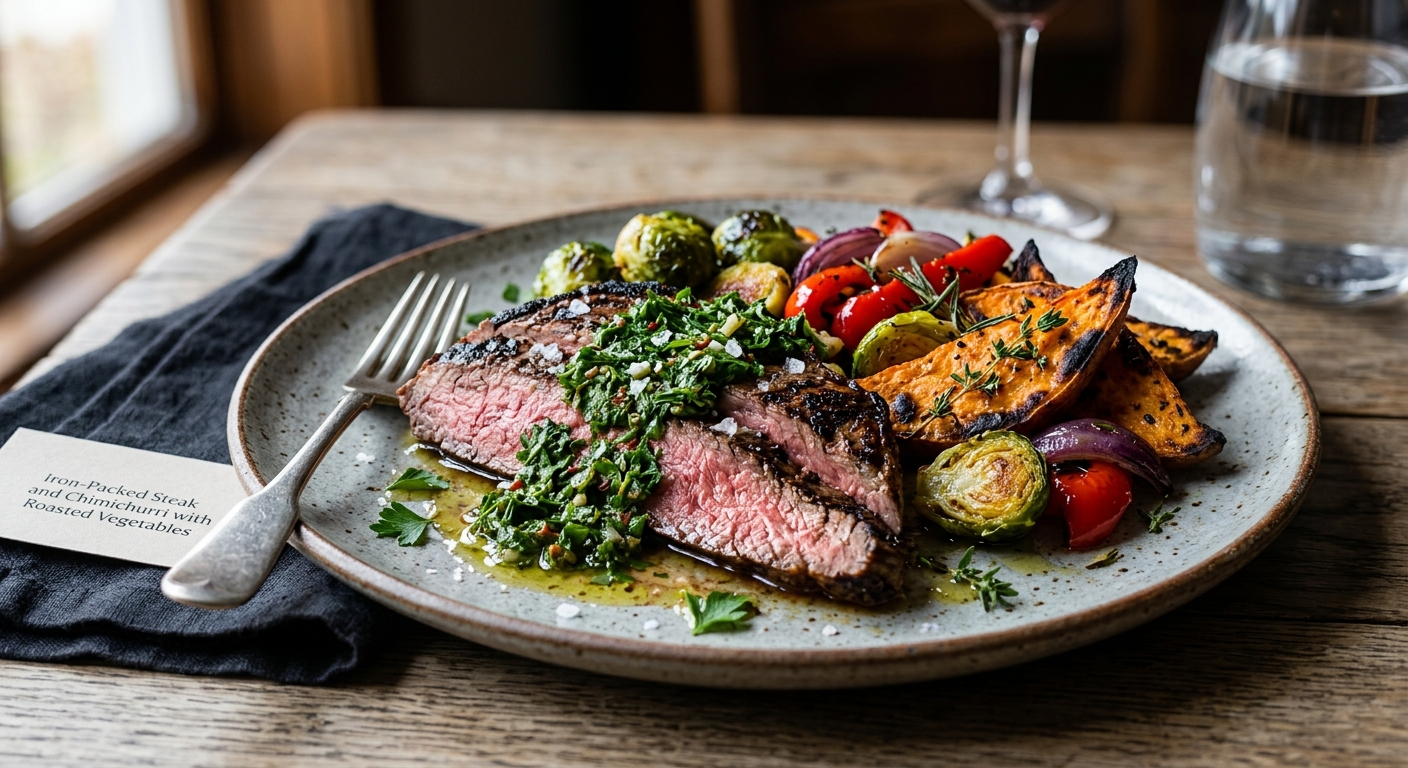
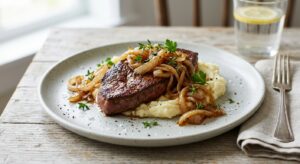
Few meals deliver the nutritional impact of a well-prepared steak paired with a sauce as nutrient-dense as chimichurri. Flank steak is one of the leanest cuts of beef available, offering extraordinary protein density and a remarkably bioavailable form of heme iron that the body absorbs at rates three to five times higher than plant-based iron sources. When you add a chimichurri built on flat-leaf parsley, fresh oregano, and extra-virgin olive oil, you are layering in fat-soluble chlorophyll, vitamin K1, vitamin C, and a collection of powerful polyphenols that work synergistically to enhance iron absorption even further.
The roasted vegetables are not an afterthought here. Red bell peppers contribute over 150% of your daily vitamin C requirement, which directly boosts non-heme iron uptake from any plant foods in the meal. Zucchini adds potassium, B6, and a gentle fiber load that moderates the glycemic response of the dish, while red onion brings quercetin and prebiotic fructooligosaccharides for gut health. Together, the vegetables transform this from a simple steak dinner into a comprehensively calibrated plate that covers iron, zinc, B12, vitamins A, C, and K, and a meaningful share of your daily magnesium and selenium in one sitting.
Chimichurri originates from Argentina and Uruguay, where it has served as the traditional accompaniment to wood-fired beef for centuries. What those gaucho cooks understood intuitively, nutritional science now confirms: pairing red meat with a high-vitamin-C herb sauce is not just delicious, it is metabolically intelligent. We use a 48-hour dry-brine technique for the stovetop and oven methods to develop the Maillard crust that creates those deeply savoury heterocyclic flavour compounds, while the pressure cooker and slow cooker methods transform the same cut into a fork-tender braise that is just as nutritionally complete.
4
servings
Ingredients
- 700 gflank steak, trimmed of excess fat
- 2 tbspextra-virgin olive oil, for the steak
- 3 tbspextra-virgin olive oil, for the chimichurri
- 2 tbspextra-virgin olive oil, for the vegetables
- 60 gfresh flat-leaf parsley, leaves and tender stems, tightly packed
- 15 gfresh oregano leaves
- 4 clovesgarlic, minced
- 2 tbspred wine vinegar
- 1 tspcrushed red pepper flakes
- 2 largered bell peppers, deseeded and cut into 3cm strips
- 2 mediumzucchini (courgettes), cut into 1cm half-moons
- 1 largered onion, cut into 2cm wedges
- 200 gcherry tomatoes, halved
- 1 tspsmoked paprika
- 1 tspground cumin
- 60 mllow-sodium beef stock (for slow cooker and pressure cooker methods only)
- —Colima Sea SaltMicroplastic Free Salt and cracked black pepper to taste
Instructions
Click on an item below to shop for the recommended items for this recipe on Amazon.
As an Amazon Associate, we earn from qualifying purchases.
- Remove the flank steak from the refrigerator 30 minutes before cooking. Pat it completely dry with paper towels and season generously on both sides with fine sea salt and cracked black pepper. Set aside at room temperature while you prepare the chimichurri and vegetables.
- Make the chimichurri: combine the parsley, oregano, garlic, red wine vinegar, red pepper flakes, and 3 tablespoons of olive oil in a food processor. Pulse 8 to 10 times until the herbs are finely chopped but not pureed. You want texture, not a smooth sauce. Season with salt and pepper, then transfer to a bowl and let it sit at room temperature for at least 15 minutes to allow the flavours to meld.
- Cook the vegetables in a large skillet over medium-high heat. Add 2 tablespoons of olive oil and heat until shimmering. Add the red onion wedges and cook undisturbed for 3 minutes until charred on one side. Add the bell pepper strips and cook, tossing occasionally, for 4 minutes. Add the zucchini and smoked paprika, season with salt and cumin, and cook for a further 3 minutes. Add the cherry tomatoes and cook for 2 minutes until they begin to burst. Transfer to a warm serving dish and tent loosely with foil.
- Wipe out the skillet (or use a separate heavy cast iron pan) and heat over the highest flame your stovetop allows for 3 to 4 minutes until the pan is very nearly smoking. Add 2 tablespoons of olive oil and swirl to coat. Carefully lay the steak in the pan away from you. Sear undisturbed for 3 to 4 minutes until a deep mahogany crust forms. Flip once using tongs and sear the second side for 3 minutes for medium-rare (internal temperature 54 to 57 degrees Celsius). Add 1 minute per side for medium.
- Transfer the steak to a cutting board and rest uncovered for 8 to 10 minutes. Do not tent it or the crust will steam and soften. After resting, identify the direction of the muscle fibres and slice thinly against the grain at a 45-degree angle. This is critical for flank steak: cutting with the grain produces a tough, chewy result, while cutting against it shortens the fibres and delivers a tender bite.
- Fan the steak slices over the roasted vegetables, spoon the chimichurri generously over the top, and serve immediately with any resting juices drizzled over the plate.
- Prepare the slow cooker chimichurri base: place the garlic, red wine vinegar, red pepper flakes, smoked paprika, cumin, and 3 tablespoons of olive oil in a small bowl and stir together. Roughly chop only half of the parsley and oregano and stir into this mixture. Reserve the remaining fresh herbs for the finishing chimichurri you will make just before serving.
- Season the flank steak on both sides with salt and pepper, then place it in the slow cooker insert. Pour the beef stock around the base of the steak, not over the top. Spoon the herb and garlic mixture directly over the steak, spreading it to coat the surface evenly. Layer the red onion wedges and bell pepper strips around and partially under the steak. These vegetables will braise and become deeply sweet and soft.
- Place the zucchini half-moons on top of the steak and vegetables rather than at the bottom, as they will overcook if submerged for the full cooking time. Place the halved cherry tomatoes on top as well. Cover the slow cooker and cook on Low for 7 to 8 hours or on High for 3 to 4 hours, until the steak is completely tender and pulls apart easily with two forks.
- While the steak finishes cooking, prepare the fresh finishing chimichurri: finely chop the reserved parsley and oregano and combine with 1 tablespoon of olive oil, a splash of red wine vinegar, and salt to taste. This bright, raw sauce is added at the end to preserve its vitamin C content, as prolonged heat degrades ascorbic acid significantly.
- Use two forks to shred the steak directly in the slow cooker, pulling it apart into thick strips and tossing it in the braising juices. Use a slotted spoon to transfer the shredded steak and vegetables to a serving platter. Spoon some of the concentrated braising liquid over the top, then finish with a generous drizzle of the fresh chimichurri.
- Set the Instant Pot to Saute mode on High. While it heats, pat the steak completely dry and season aggressively with salt and pepper on both sides. This step is even more important than in other methods because the pressure environment is wet and the surface crust you build now is the only browning the steak will receive.
- Add 2 tablespoons of olive oil to the hot pot. When the oil shimmers and just begins to smoke, sear the flank steak for 3 minutes per side until a deep brown crust forms. Work in sections if your insert is too small for the full piece; do not crowd the meat or it will steam rather than sear. Remove the steak and set aside on a plate.
- With the Saute mode still active, add the red onion and bell pepper strips to the pot. Cook for 2 minutes, scraping up any browned bits from the bottom of the insert with a wooden spoon. These caramelised fond deposits will enrich the braising liquid and, critically, prevent a burn warning during pressurisation. Pour in the beef stock and stir to deglaze fully.
- Return the seared steak to the pot, placing it on top of the vegetables. Scatter the zucchini and cherry tomatoes around the steak. Add the smoked paprika and cumin. Secure the lid and set the pressure release valve to Sealing. Cancel Saute mode and select Pressure Cook on High for 25 minutes.
- When the cook time ends, allow the pressure to release naturally for 15 minutes, then carefully move the valve to Venting to release any remaining pressure. While the pressure releases, make the finishing chimichurri: finely chop all of the parsley and oregano and combine with the garlic, red wine vinegar, red pepper flakes, 3 tablespoons of olive oil, salt, and pepper.
- Open the lid away from you. Transfer the steak to a cutting board. For a sliceable result (if the steak held its structure), slice thinly against the grain. For a fully braised result, shred it with two forks. Plate the steak over the vegetables, pour over a spoonful of the concentrated cooking liquid, and finish with the freshly made chimichurri.
- Preheat the oven to 230 degrees Celsius (210 degrees Celsius fan-forced, 450 degrees Fahrenheit) with two large rimmed baking sheets inside the oven as it heats. Preheating the pans is essential: it ensures the vegetables begin caramelising immediately on contact rather than steaming, and it accelerates the browning of the steak’s surface.
- Make the chimichurri first so it has maximum time to develop flavour: combine the parsley, oregano, garlic, red wine vinegar, red pepper flakes, and 3 tablespoons of olive oil in a food processor. Pulse to a coarse, textured sauce. Season with salt and pepper and set aside covered at room temperature.
- Toss the bell pepper strips, zucchini, red onion wedges, and cherry tomatoes in a large bowl with 2 tablespoons of olive oil, smoked paprika, cumin, salt, and pepper. Spread in a single layer across one of the preheated baking sheets, ensuring pieces do not overlap. Crowding causes steaming. Return to the oven and roast for 20 to 25 minutes, tossing once at the halfway point, until the edges are deeply caramelised.
- Pat the flank steak completely dry, rub with 2 tablespoons of olive oil, and season very generously with salt and pepper on both sides. Place on the second preheated baking sheet. Roast on the oven’s highest rack for 8 to 10 minutes for medium-rare, or 12 to 14 minutes for medium. Use an instant-read thermometer: remove the steak at 52 degrees Celsius for medium-rare (carryover cooking will bring it to 55 to 57 degrees Celsius during resting).
- Remove the steak from the oven and rest it on a cutting board for 10 minutes without covering it. Meanwhile, if the vegetables need additional caramelisation, switch the oven to the broil or grill setting on High and return the vegetable tray to the top rack for 2 to 3 minutes, watching closely to prevent burning.
- Slice the rested steak thinly against the grain at a 45-degree angle. Arrange the roasted vegetables on a large platter, lay the sliced steak over the top, and spoon the chimichurri liberally over everything. Drizzle any accumulated resting juices from the cutting board over the plate as a final seasoning.
Nutrition Breakdown
Per 1 serving (makes 4)
Vitamins & Minerals
% Daily Value based on a 2,000 calorie diet (FDA reference)
🧬 Essential Amino Acids
% of recommended daily intake (RDA) per serving
🛡 Antioxidant Profile
The Nutrition Science
The iron story in this dish is unusually compelling because it operates on two levels simultaneously. Flank steak supplies heme iron, the form bound to haemoglobin and myoglobin in animal tissue, which is absorbed directly through dedicated intestinal transporters at rates of 15 to 35 percent regardless of dietary context. The chimichurri and red bell peppers then contribute significant vitamin C, which enhances the absorption of any non-heme iron present in the meal (from the herbs and vegetables) by reducing ferric iron to the more soluble ferrous form that intestinal epithelial cells can transport. A single serving of this dish can contribute meaningfully to replenishing depleted iron stores, particularly relevant for premenopausal women, endurance athletes, and individuals on predominantly plant-based diets who occasionally include meat.
The zinc content (71% DV per serving) is equally important and often overlooked. Zinc from beef is in the form of zinc-protein complexes that are substantially more bioavailable than the phytate-bound zinc in plant foods. Zinc is required as a cofactor for over 300 enzymatic reactions, including those governing protein synthesis, immune cell proliferation, and the activity of superoxide dismutase, one of the body’s primary endogenous antioxidant enzymes. The combination of high zinc with high vitamin C in this meal creates a synergistic immune-supportive effect that is difficult to replicate with supplementation alone, because the food matrix modulates absorption kinetics in ways isolated nutrients cannot.
The polyphenol profile of fresh chimichurri deserves particular attention. Flat-leaf parsley is one of the most concentrated dietary sources of apigenin, a flavone with demonstrated anti-inflammatory and neuroprotective properties in cell culture and animal studies. The red wine vinegar in the sauce contributes acetic acid, which lowers the postprandial glycaemic index of the entire meal by slowing gastric emptying. Meanwhile, the oleocanthal in extra-virgin olive oil has been shown in multiple studies to inhibit the same COX enzymes targeted by non-steroidal anti-inflammatory drugs, suggesting that a chimichurri built on quality olive oil is not merely a condiment but a genuinely functional food component.
Pro Tips
- Always slice flank steak against the grain and at a 45-degree angle. Flank steak has long, clearly visible muscle fibres running along its length; cutting perpendicular to those fibres shortens them and produces tenderness, while cutting parallel to them results in a stringy, chewy texture that no amount of resting or technique can rescue.
- Make the chimichurri at least 15 to 30 minutes ahead. The flavour transforms significantly as the acid in the red wine vinegar mellows the raw garlic and draws the volatile aromatic compounds out of the fresh herbs. Made more than 2 hours ahead and refrigerated, bring it back to room temperature before serving and stir in a teaspoon of fresh olive oil to revive the texture.
- To maximise caramelisation on the roasted vegetables, ensure they are completely dry before oiling and seasoning. Wet vegetables steam rather than roast. Pat them with paper towels after washing, and make sure the baking sheets or pan is genuinely hot before the vegetables make contact.
This looks amazing, and I love that you’re highlighting the vitamin C pairing with iron, Nadia – that’s such a game changer for absorption! I’m curious whether the chimichurri herbs here are all AIP-compliant, or if there’s flexibility with the recipe? I’ve been working around nightshade sensitivities since my Hashimoto’s diagnosis, so I’m always wondering if recipes like this could swap in different fresh herbs if needed. Also, has anyone tested the iodine content of the parsley or cilantro in the chimichurri? I know it varies, but I’ve found tracking it helps me stay in that sweet spot for thyroid support without overdoing it
This is exactly the kind of recipe I need to see more of, honestly. The iron content is crucial for me, especially since MS and some of my medications can affect absorption, but pairing it with the vitamin C from those roasted veggies and the fresh herbs in chimichurri actually maximizes bioavailability in a way that feels effortless. The B vitamins in beef are also part of my protocol for supporting myelin health, so I’m genuinely grateful you’re thinking about the micronutrient density alongside the flavor. Definitely making this soon.
This is such a thoughtful approach to your nutrition, and I really appreciate you highlighting the bioavailability angle! One quick flag if you haven’t already considered it, the traditional chimichurri uses parsley and oregano which are generally okay, but if your recipe includes any aged garlic, vinegar, or red pepper flakes, those can be histamine liberators for some people with absorption issues like mine. If you’re sensitive to those, I’ve had great success swapping the vinegar for fresh lemon juice and using fresh garlic instead of aged, which keeps all that bright flavor while being gentler on mast cell activation. The steak and roasted veggies combo is genuinely brilliant for iron