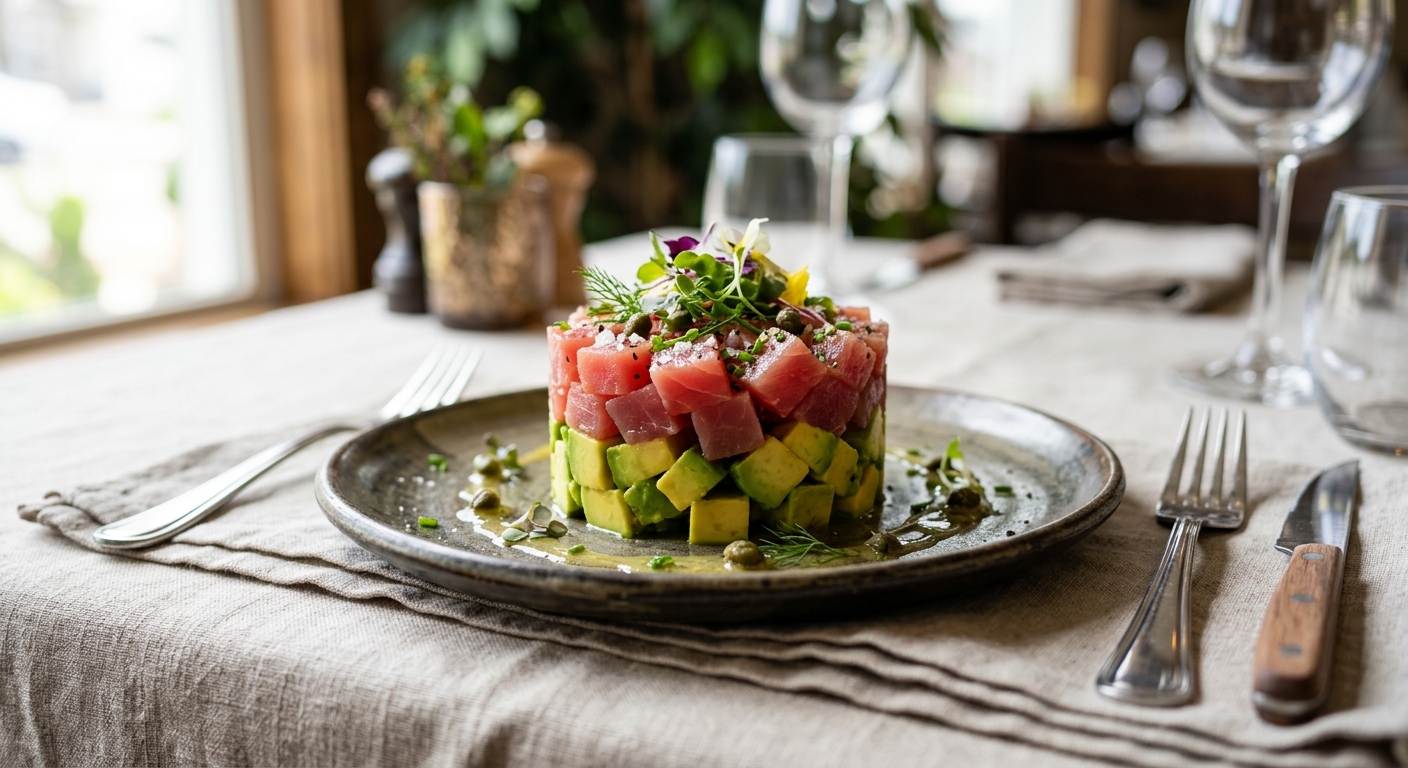
Some dishes earn their place on the table through sheer flavour alone. This tuna and avocado stack earns its place on both counts: it is the kind of plate you would pay good money for at a coastal bistro, and it happens to be one of the most concentrated sources of three chronically under-consumed fat-soluble vitamins you can assemble in a home kitchen. Vitamin D deficiency affects an estimated one billion people worldwide, vitamin B12 is the nutrient most likely to be borderline in omnivores over 50 and nearly everyone following a reduced-animal-protein diet, and vitamin E falls short in roughly 90% of American adults. This one dish addresses all three in a single sitting.
The hero ingredient is tuna, specifically a thick cut of fresh yellowfin or albacore. A 150-gram portion of yellowfin tuna delivers approximately 6.3 micrograms of vitamin D (126% DV) and 4.9 micrograms of vitamin B12 (204% DV). Beneath it, half a large Hass avocado contributes around 2.7 milligrams of vitamin E (18% DV) while also supplying the monounsaturated fat that makes all three fat-soluble vitamins significantly more bioavailable. The citrus dressing, built on lemon juice, extra-virgin olive oil, and a touch of Dijon, adds a further 0.8 milligrams of vitamin E and brightens every component on the plate. This is precision nutrition that does not taste like it.
Because this recipe includes a stovetop sear, a slow-poached method, a pressure-steamed approach, and a low oven confit, each technique produces a genuinely different texture and flavour profile from the same core ingredients. The sear is bold and caramelised. The slow poach is silky and pale pink throughout. The pressure steam is firm and flaky. The oven confit is buttery and almost melting. Choose your method based on your equipment, your time, and the texture you are after, knowing that the nutritional payload remains essentially the same across all four approaches.
4
servings
Ingredients
- 600 gfresh yellowfin or albacore tuna steaks, cut 3 to 4 cm thick (about 150 g per person)
- 2 largeripe Hass avocados, halved and pitted
- 3 tbspextra-virgin olive oil, divided
- 2 tbspfresh lemon juice
- 1 tspDijon mustard
- 1 tspraw honey
- 2 clovesgarlic, finely minced
- 1 tbspcapers, rinsed and roughly chopped
- 2 tbspfresh chives, finely sliced
- 2 tbspfresh flat-leaf parsley, finely chopped
- 1 tspsmoked paprika
- 0.5 tspground cumin
- 1 mediumshallot, very finely diced
- 100 gcherry tomatoes, quartered
- 1 tbsptoasted sesame seeds
- 4 handfulsbaby rocket (arugula), to serve
- —Colima Sea SaltMicroplastic Free Salt and freshly cracked black pepper to taste
- —Lemon wedges to serve
Instructions
Click on an item below to shop for the recommended items for this recipe on Amazon.
As an Amazon Associate, we earn from qualifying purchases.
- Remove the tuna steaks from the refrigerator 15 minutes before cooking so they are at room temperature. This ensures even heat penetration and prevents the outside from overcooking before the centre warms. Pat the steaks completely dry with paper towels, as surface moisture is the enemy of a proper crust.
- Mix the smoked paprika, cumin, a generous pinch of salt, and plenty of cracked black pepper in a small bowl. Press this spice blend firmly onto all flat surfaces of each tuna steak. Drizzle 1 tablespoon of the olive oil over the steaks and rub it in so the spices adhere.
- Heat a large cast iron skillet or heavy stainless steel pan over high heat for at least 2 minutes until it is smoking. Add 1 tablespoon of olive oil to the pan, swirl once, and immediately lay the tuna steaks in. Do not crowd the pan; cook in two batches if necessary. Sear for exactly 90 seconds on each flat side for rare, or 2 minutes per side for medium-rare. The crust should be deep brown and the centre should show a band of pink when you press gently with a fingertip. Transfer to a resting board and rest for 3 minutes.
- While the tuna sears, whisk together the remaining 1 tablespoon of olive oil, lemon juice, Dijon mustard, honey, minced garlic, capers, half the chives, and half the parsley in a small bowl. Season with salt and pepper and set aside.
- Scoop each avocado half cleanly from its skin using a large spoon. Place each half cut-side up on a board and slice crosswise into 8 to 10 thin fans, keeping the slices together. Using the flat of your knife, press gently to fan the slices and transfer each fanned avocado half to the centre of a serving plate.
- Scatter the diced shallot and cherry tomatoes over the avocado base, then drizzle about one third of the citrus dressing over each portion. Slice each rested tuna steak on the bias into 4 thick pieces and arrange them on top of the avocado fan, slightly overlapping. Drizzle generously with the remaining dressing, scatter the remaining chives and parsley, finish with toasted sesame seeds, and serve immediately with a handful of rocket and a lemon wedge alongside.
- Make a quick poaching liquid by whisking together 200 ml of extra-virgin olive oil, the lemon juice, minced garlic, capers, smoked paprika, cumin, and a pinch of salt directly in the slow cooker insert. Stir in the diced shallot. This fragrant oil bath will gently cook and simultaneously season the tuna from all sides.
- Place the tuna steaks in a single layer in the poaching liquid. They should be mostly submerged; if not, spoon the liquid over the top surfaces. Lay a sheet of baking paper directly on the surface of the oil to keep the tuna from drying out at the exposed top. Set the slow cooker to Low.
- Cook for 45 minutes, then check by pressing the thickest steak with a fingertip. It should feel just firm with a little give, registering an internal temperature of 54 to 57 degrees Celsius for a medium-done result that remains moist and flaky. If you prefer fully cooked tuna with no translucency, continue for up to 15 more minutes. Do not exceed 60 degrees Celsius internally or the texture will become dry and mealy.
- Using a wide fish spatula, carefully lift each tuna steak out of the oil and transfer to a paper-towel-lined plate to drain briefly. Reserve 3 tablespoons of the flavoured poaching oil and whisk it with the honey, Dijon mustard, half the parsley, and half the chives to create a rich, tuna-infused dressing with far more depth than a freshly made version.
- Prepare the avocado fans on serving plates exactly as described in the stovetop method: scoop, slice, and fan. Scatter cherry tomatoes and shallot over the base. Break the slow-poached tuna into generous rustic chunks rather than slicing (the texture will not hold neat slices) and pile them over the avocado. Spoon the warm poaching-oil dressing over everything, finish with sesame seeds and remaining herbs, and serve with rocket and lemon wedges.
- Pour 250 ml of water into the pressure cooker or Instant Pot insert. Add a strip of lemon zest, 1 smashed garlic clove, and a pinch of salt to the water to lightly perfume the steam. Place the trivet or a steamer basket inside.
- Season the tuna steaks on all sides with the smoked paprika, cumin, salt, and pepper. Lay them in a single layer on the trivet or in the steamer basket. If your cooker is too small for all four steaks side by side, stack them on a small piece of baking paper with a gap between each for steam circulation.
- Seal the lid, set the valve to Sealing, and cook on Manual High Pressure for 3 minutes. For steaks under 3 cm thick, reduce to 2 minutes. When the cycle completes, perform an immediate Quick Release by switching the valve to Venting. This stops the cooking instantly and prevents the carryover heat from pushing the tuna past medium.
- While the pressure builds and the tuna cooks, prepare the full citrus dressing: whisk all the remaining olive oil, lemon juice, Dijon mustard, honey, garlic, capers, and herbs together vigorously. Because the steamed tuna has no added fat on its surface, make the dressing slightly more generous and season it assertively.
- Open the lid and check the tuna. It should be opaque throughout and flake cleanly when pressed with a fork. Transfer steaks to a board and allow to rest for 2 minutes. Prepare the avocado fans on serving plates, scatter tomatoes and shallot, then slice the steamed tuna on the bias and layer it over the avocado. Drizzle with dressing, add sesame seeds, herbs, and rocket, and serve with lemon wedges.
- Preheat the oven to 120 degrees Celsius (250 degrees Fahrenheit), fan off if possible. Fan ovens can dry the surface of the tuna before the interior is done; if you only have fan, reduce to 110 degrees Celsius. Choose a baking dish just large enough to hold the tuna steaks snugly in a single layer with minimal gaps.
- Combine 150 ml of extra-virgin olive oil, the minced garlic, capers, smoked paprika, cumin, a pinch of chilli flakes if desired, and several strips of lemon zest in the baking dish. Stir together, then nestle the tuna steaks into the oil. The steaks should be at least two thirds submerged; top up with a little extra olive oil if needed. Season the exposed tops with salt and pepper.
- Cover the dish tightly with foil and transfer to the preheated oven. Cook for 25 minutes, then remove the foil and use an instant-read thermometer to check the centre of the thickest steak. You are looking for 54 degrees Celsius for a semi-translucent, silky confit texture, or 60 degrees for fully cooked. Return to the oven uncovered for a further 5 minutes if needed. Because there is no direct searing heat, the tuna will not colour at all, it will simply become extraordinarily tender.
- Remove from the oven and allow the tuna to rest in the oil for 5 minutes before lifting it out. This rest lets the juices redistribute throughout the steak. Strain or spoon 3 tablespoons of the aromatic cooking oil into a small bowl and whisk in the lemon juice, Dijon mustard, honey, parsley, and chives to create the dressing. The garlic and caper flavours already infused into this oil make for an intensely savoury result.
- Prepare the avocado fans on plates, scatter with cherry tomatoes and shallot, and drizzle with a little of the dressing. Lift the confit tuna carefully from the baking dish with a fish spatula and place one steak on each avocado fan. Spoon the remaining herb dressing generously over the top, finish with toasted sesame seeds, and serve with rocket and lemon wedges. The confit tuna is also exceptional served at room temperature if you wish to prepare it ahead.
Nutrition Breakdown
Per 1 serving (makes 4)
Vitamins & Minerals
% Daily Value based on a 2,000 calorie diet (FDA reference)
🧬 Essential Amino Acids
% of recommended daily intake (RDA) per serving
🛡 Antioxidant Profile
The Nutrition Science
The fat-soluble vitamin trio at the centre of this recipe shares a critical biochemical dependency: all three require dietary fat for absorption in the small intestine. Vitamins D, B12, and E are absorbed via different mechanisms (D and E via chylomicron-mediated lymphatic transport, B12 via intrinsic-factor-mediated active transport in the ileum), but the presence of fat in the same meal substantially enhances the bioavailability of D and E. Research published in the American Journal of Clinical Nutrition demonstrated that consuming vitamin D alongside a fat-containing meal increased absorption by 32% compared to a fat-free control. The avocado and olive oil in this recipe are not just flavour carriers; they are delivery vehicles that make the vitamin D from the tuna meaningfully more bioavailable.
Yellowfin tuna is among the most concentrated food sources of selenium in the human diet, providing around 90 to 100 micrograms per 150-gram portion. Selenium is the essential cofactor for the selenoprotein glutathione peroxidase (GPx), the enzyme responsible for reducing hydrogen peroxide and lipid hydroperoxides within cells. This is nutritionally significant alongside the omega-3 fatty acids also present in tuna: EPA and DHA are highly polyunsaturated and therefore vulnerable to lipid peroxidation, and the selenium-dependent GPx system is one of the primary defences against exactly this type of oxidative damage. The dish is, in effect, self-protecting at the molecular level.
Avocado contributes a nutritionally unusual combination of vitamin E, folate, potassium, lutein, and zeaxanthin within a monounsaturated fat matrix. The monounsaturated oleic acid in avocado has been shown to upregulate the absorption of carotenoids from co-consumed vegetables by three to five fold, which explains why the small amount of lycopene from cherry tomatoes in this recipe is far more bioavailable than it would be from the tomatoes eaten alone. This synergistic interaction between avocado fat and carotenoid absorption is one of the most well-documented food-synergy effects in nutrition science, making the combination of avocado and tomatoes in this stack more than just a flavour decision.
Pro Tips
- Buy sushi-grade or sashimi-grade tuna if you plan to serve the stovetop version rare; this designation indicates the fish has been handled and frozen to parasitic-kill standards, giving you full confidence in a cool pink centre.
- To prevent avocado browning if plating ahead, dress the cut surfaces immediately with lemon juice and keep them face-down on a chilled plate until you are ready to fan and plate; do not slice until the last possible moment.
- The flavoured oil from the slow cooker and oven confit methods can be strained, cooled, and stored in the refrigerator for up to five days; it is exceptional drizzled over grilled vegetables, stirred into mashed potato, or used as a dipping oil for sourdough.
This looks amazing for post-run recovery! Quick heads up though, if you’re using canned tuna, it’s pretty high in histamine from the canning/storage process, which can be a real issue for some people. I’d definitely recommend fresh or frozen tuna if you have any sensitivities to it. The avocado is perfect though, and if you wanted to swap the citrus dressing for something fresh like fresh lemon juice with herbs (avoiding aged vinegars), you’d keep all those micronutrient benefits while staying low-histamine. Such a smart nutrient combo otherwise!
Great point on histamine sensitivity, Lorraine – that’s often overlooked in recovery nutrition. I’d add that fresh or frozen wild-caught tuna also gives you a much better omega-3 profile than canned, which typically has a skewed omega-6 ratio from processing. For post-run recovery specifically, Melanie’s window is ideal for this stack since you’re getting easily absorbed B12, selenium, and those fat-soluble vitamins (D and E from the avocado) right when your body needs them most. The fresh lemon juice suggestion is spot on and won’t compromise the anti-inflammatory benefits.
ok this is literally perfect for my post long run meals, especially after those brutal Saturday morning tempos. ive been experimenting with how much protein and healthy fat i need within like 30-45 mins of finishing to actually feel recovered the next day, and tuna checks every box plus the avocado gives me those anti inflammatory fats that seem to help with soreness. the vitamin d and b12 combo is clutch too because honestly my energy dips in winter training when i cant get enough sunlight. definitely trying this this week and might batch prep the tuna if it holds up in the fridge!