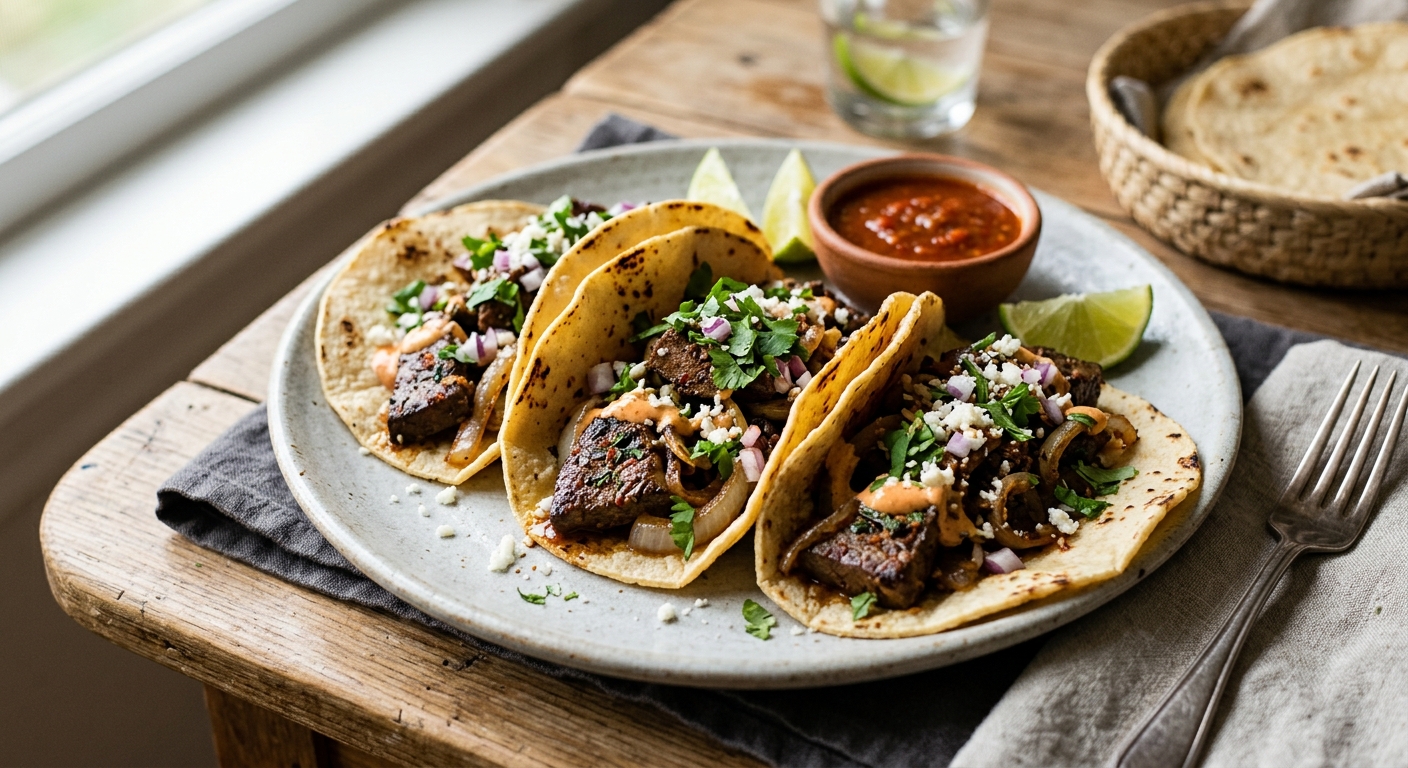
If there is one food that nutritional scientists consistently rank above all others for micronutrient density, it is beef liver. A single 100-gram serving supplies more vitamin B12 than you could eat in a week of chicken breast, more folate than a cup of cooked spinach, and a form of iron (heme iron) that your body absorbs three times more efficiently than the iron in any plant food. The challenge has never been the nutrition; it has always been the cooking. Get it right and liver is silky, deeply savory, and genuinely crave-worthy. Get it wrong and it tastes like regret. This recipe solves that problem permanently.
The taco format is not a gimmick. It is a nutritional masterstroke. The acidity of fresh lime juice and tomatoes in the pico de gallo enhances non-heme iron absorption from the corn tortillas, while the fat in the avocado crema drives uptake of liver’s fat-soluble vitamins A, D, E, and K. The chipotle and cumin add smoky depth that masks any lingering bitterness, and the caramelized onions contribute natural sweetness that balances the mineral richness of the liver. Every element earns its place both nutritionally and culinarily.
Three cooking methods are included here because liver behaves very differently depending on technique. The stovetop sear produces the classic crisp-edged, pink-centered result that converts skeptics on the spot. The slow cooker transforms the liver into a tender, shred-able braise that is forgiving for first-timers and ideal for meal prep. The pressure cooker achieves a deep, stew-like intensity in under 20 minutes. An oven method is also provided for those who want hands-off cooking with slightly caramelized edges. Choose your method, follow the specific steps, and prepare to reassess everything you thought you knew about liver.
4
servings
Ingredients
- 500 gbeef liver, trimmed of sinew and membrane, sliced 8mm thick
- 240 mlwhole milk (for soaking, discarded before cooking)
- 2 tbspextra-virgin olive oil
- 2 largeyellow onions, halved and thinly sliced
- 4 clovesgarlic, minced
- 2 wholechipotle peppers in adobo sauce, minced (about 2 tbsp)
- 1 tspground cumin
- 1 tspsmoked paprika
- 0.5 tspdried oregano
- 240 mllow-sodium beef stock
- 2 tbspfresh lime juice (about 1 lime)
- 12 smallcorn tortillas (15cm diameter)
- 2 mediumripe tomatoes, finely diced
- 0.5 smallwhite onion, finely diced
- 1 wholefresh jalapeño, seeded and finely diced
- 30 gfresh cilantro, roughly chopped (divided use)
- 2 mediumripe avocados
- 60 mlplain full-fat Greek yogurt
- 1 wholelime, zested and juiced
- —Colima Sea SaltMicroplastic Free Salt and freshly cracked black pepper to taste
- —Thinly sliced radishes, for serving
- —Lime wedges, for serving
Instructions
Click on an item below to shop for the recommended items for this recipe on Amazon.
As an Amazon Associate, we earn from qualifying purchases.
- Place the sliced liver in a shallow bowl and pour the milk over it. Let soak at room temperature for 20 minutes (this is included in the prep time). While the liver soaks, combine the diced tomatoes, white onion, jalapeño, half of the cilantro, and a squeeze of lime juice in a bowl. Season with salt, mix well, and refrigerate your pico de gallo until serving.
- Make the avocado crema: mash the avocados with the Greek yogurt, lime zest, lime juice, and a generous pinch of salt until smooth and creamy. Press plastic wrap directly onto the surface and refrigerate to prevent browning.
- Remove the liver from the milk, pat completely dry with paper towels, and season both sides generously with salt, pepper, cumin, smoked paprika, and dried oregano.
- Heat 1 tablespoon of olive oil in a large cast iron skillet or heavy stainless steel pan over medium-high heat until the oil just begins to shimmer and a faint wisp of smoke appears. Working in a single layer (cook in two batches if needed), sear the liver slices for exactly 90 seconds per side. The exterior should be deeply browned and the interior should remain slightly pink. Do not overcook; liver turns chalky and bitter past medium. Transfer to a cutting board and tent loosely with foil.
- Reduce heat to medium and add the remaining tablespoon of olive oil to the same pan. Add the sliced yellow onions with a pinch of salt and cook, stirring occasionally, for 12 to 15 minutes until deeply golden and caramelized. Add the garlic and chipotle peppers, stir for 60 seconds until fragrant, then pour in the beef stock. Scrape up all the browned bits from the bottom of the pan and simmer for 3 minutes until the sauce reduces slightly.
- Slice the rested liver into thin strips and return them to the pan, folding gently into the chipotle-onion sauce over low heat for 60 seconds just to coat and warm through. Stir in the fresh lime juice and remaining cilantro. Taste and adjust seasoning.
- Warm the corn tortillas directly over a gas flame for 20 to 30 seconds per side, or in a dry skillet over medium heat, until pliable and lightly charred. Serve the liver filling in doubled tortillas, topped with pico de gallo, avocado crema, and sliced radishes, with lime wedges alongside.
- Skip the milk soak for this method. Instead, season the liver slices on both sides with salt, pepper, cumin, smoked paprika, and dried oregano. The long braise in acidic, aromatic liquid will mellow any bitterness naturally.
- Heat 1 tablespoon of olive oil in a skillet over medium-high heat. Sear the liver slices in batches for 45 seconds per side, just enough to develop a light crust and build flavor through the Maillard reaction. Do not cook through. Transfer directly to the slow cooker insert.
- In the same skillet, add the remaining olive oil and cook the sliced yellow onions over medium heat for 8 minutes until softened and lightly golden. Add the garlic and chipotle peppers and cook for 60 seconds. Pour in the beef stock and stir, scraping up the browned bits. Pour the entire contents of the skillet over the liver in the slow cooker.
- Cover and cook on Low for 4 hours. The liver will become very tender and will break apart easily when pressed with a spoon. Use two forks to shred it directly in the slow cooker, pulling it into rough, taco-friendly pieces. Stir in the fresh lime juice. Taste the braising liquid: if it tastes thin, switch the slow cooker to High with the lid off for 15 minutes to concentrate the sauce. Stir in the remaining cilantro.
- While the filling finishes, prepare the pico de gallo by combining diced tomatoes, white onion, jalapeño, half the cilantro, a squeeze of lime juice, and salt. Make the avocado crema by mashing avocados with Greek yogurt, lime zest, lime juice, and salt until smooth. Warm the tortillas in a dry skillet or over a gas flame. Serve the shredded liver braise in doubled tortillas with all garnishes.
- Season the liver slices on both sides with salt, pepper, cumin, smoked paprika, and dried oregano. No milk soak is needed; the pressure environment and acidic stock will temper any bitterness.
- Set the Instant Pot or pressure cooker to Saute mode on High. Add 1 tablespoon of olive oil and, once shimmering, sear the liver slices in a single layer for 60 seconds per side to develop a flavorful crust. Work in batches to avoid steaming. Remove and set aside.
- Add the remaining olive oil to the pot (still on Saute mode). Add the sliced yellow onions and cook for 5 minutes, stirring frequently, until softened. Add the garlic and chipotle peppers and cook for 30 seconds. Pour in the beef stock and use a wooden spoon to deglaze thoroughly, scraping every browned bit from the bottom to prevent a burn warning.
- Return the seared liver to the pot, nestling the slices into the liquid. Secure the lid, set the valve to Sealing, cancel Saute mode, and select Pressure Cook (or Manual) on High for 8 minutes.
- Once the cycle completes, allow a natural pressure release for 10 minutes, then carefully switch the valve to Venting to release any remaining pressure. Open the lid and use tongs or two forks to break the liver into strips or shreds directly in the pot. Stir in the fresh lime juice and remaining cilantro. If the sauce is too thin, select Saute mode and simmer uncovered for 3 to 5 minutes to reduce. Prepare pico de gallo and avocado crema during the pressure and release phase. Warm tortillas and serve immediately with all garnishes.
- Preheat the oven to 200C (400F) with the rack in the center position. Perform the 20-minute milk soak as described in the stovetop method, then pat the liver slices completely dry and season on both sides with salt, pepper, cumin, smoked paprika, and dried oregano.
- Heat 1 tablespoon of olive oil in a large oven-safe skillet or roasting pan over medium-high heat on the stovetop. Add the sliced yellow onions and cook for 8 minutes until softened and beginning to turn golden. Add the garlic and chipotle peppers, stir for 30 seconds, then pour in the beef stock and stir to combine into a braising base.
- Lay the seasoned liver slices in a single layer directly on top of the onion and stock mixture in the pan. Drizzle the remaining olive oil over the liver slices. Transfer the pan to the preheated oven.
- Roast uncovered for 10 minutes, then use tongs to flip each liver slice. Return to the oven for a further 8 to 10 minutes until the liver is cooked through with lightly caramelized edges and the braising liquid has reduced into a glossy sauce. The internal temperature should reach 71C (160F). Do not roast beyond this point.
- Remove from the oven and let the liver rest in the pan for 3 minutes. Slice into strips, stir into the pan juices, and finish with fresh lime juice and the remaining cilantro. Taste and adjust seasoning. While the liver rests, prepare the pico de gallo and avocado crema, and warm the tortillas. Serve assembled tacos with radishes, crema, pico, and lime wedges.
Nutrition Breakdown
Per 1 serving (makes 4)
Vitamins & Minerals
% Daily Value based on a 2,000 calorie diet (FDA reference)
🧬 Essential Amino Acids
% of recommended daily intake (RDA) per serving
🛡 Antioxidant Profile
The Nutrition Science
Beef liver’s extraordinary nutrient density is a direct consequence of what the liver does biologically: it is the storage and processing organ for vitamins and minerals in cattle, just as it is in humans. Retinol (preformed vitamin A) is stockpiled in liver stellate cells, which is why a 125g serving provides over 550% of the daily value. Vitamin B12, which is required for myelin synthesis and DNA methylation, is stored in liver at concentrations roughly 100 times higher than in muscle meat. This is not incidental; it reflects millions of years of evolutionary biology in which predators instinctively prioritized organ meats precisely because of this concentration effect.
The heme iron in beef liver exists as part of the hemoglobin and myoglobin complex, embedded within a porphyrin ring structure that is absorbed via a dedicated receptor (HCP1) in intestinal cells. This mechanism bypasses the competitive inhibition that blocks non-heme iron absorption and operates independently of the body’s iron-regulatory proteins when stores are low. Absorption rates of 15 to 35% are typical for heme iron, compared to 2 to 8% for the non-heme iron in spinach or lentils. The lime juice and tomatoes in this recipe also provide ascorbic acid, which reduces ferric iron (Fe3+) to the more absorbable ferrous form (Fe2+), benefiting both the heme and any non-heme iron contributed by the corn tortillas and vegetables.
One important nutritional caveat is worth noting honestly: the vitamin A content of this recipe is exceptionally high at over 550% DV per serving. Preformed retinol, unlike beta-carotene, can accumulate to toxic levels with repeated very high intake. This dish should be enjoyed one to two times per week rather than daily, which is precisely the frequency at which traditional foodways in virtually every culture historically consumed organ meats. At that frequency, the nutritional return is extraordinary and the risk of hypervitaminosis A is negligible. The copper content (over 900% DV) similarly reflects liver’s role as the body’s primary copper storage organ, and regular but not daily consumption is the evidence-based sweet spot.
Pro Tips
- The single most important technique for delicious liver is temperature control. The stovetop and oven methods both require a thermometer: pull the liver off heat the moment the internal temperature hits 68 to 71C (155 to 160F). Residual heat will carry it to safe temperature. Gray, overcooked liver is what gives this ingredient its bad reputation.
- Source grass-fed beef liver when possible. Grass-fed liver has measurably higher concentrations of vitamin A, omega-3 fatty acids (particularly DHA), and coenzyme Q10 compared to conventionally raised cattle, and its flavor is noticeably cleaner and less metallic.
- Freeze the liver for 15 minutes before slicing to firm it up, making it much easier to cut clean, even 8mm slices. A sharp chef’s knife and a confident single stroke (not sawing) will give you neat slices that cook evenly and sear beautifully without tearing.
This is exactly the kind of nutrient density I’ve been tracking for recovery days – liver hits different when you’re trying to replenish iron and B12 after hard efforts without spiking blood glucose. I’ve been incorporating it into post-ride meals on lower carb days and the sustained energy the next morning is noticeably better than chicken or lean beef, especially around my training blocks. The chipotle preparation sounds ideal since you’re getting anti-inflammatory compounds alongside the micronutrient load. Rosa’s point about the low glycemic profile is spot on, though I’m curious whether you’re recommending this as a full meal replacement or pairing it with something like sweet potato to hit glycogen targets on higher car
Oh this is GOLD for PCOS management, honestly. Liver has been a total game changer for my androgens and energy levels, especially the B vitamins and iron which I was deficient in before. The fact that it’s low glycemic and won’t spike insulin is huge, and paired with those corn tortillas (way better than flour for hormone balance) plus all that vitamin A for regulating SHBG… this is literally a recipe I’m saving. Quick question though, does the chipotle prep method affect the nutrient density at all, or is the braising gentle enough to preserve most of that B12?
oh man this is so validating to hear, because my avó used to make liver dishes constantly and we’d joke it was her secret weapon for everything, but turns out she was tapping into something real with the iron and b vitamins. the chipotle braising is actually perfect because youre cooking low and slow which preserves most of the b12, unlike high heat searing which can denature some of it, so that braise is doing you a solid. also love that you connected it to the corn tortillas because in traditional fermented corn preparation the nixtamalization process actually increases bioavailability of those minerals your body needs, so the whole plate is working together. your instinct about supporting hormone regulation