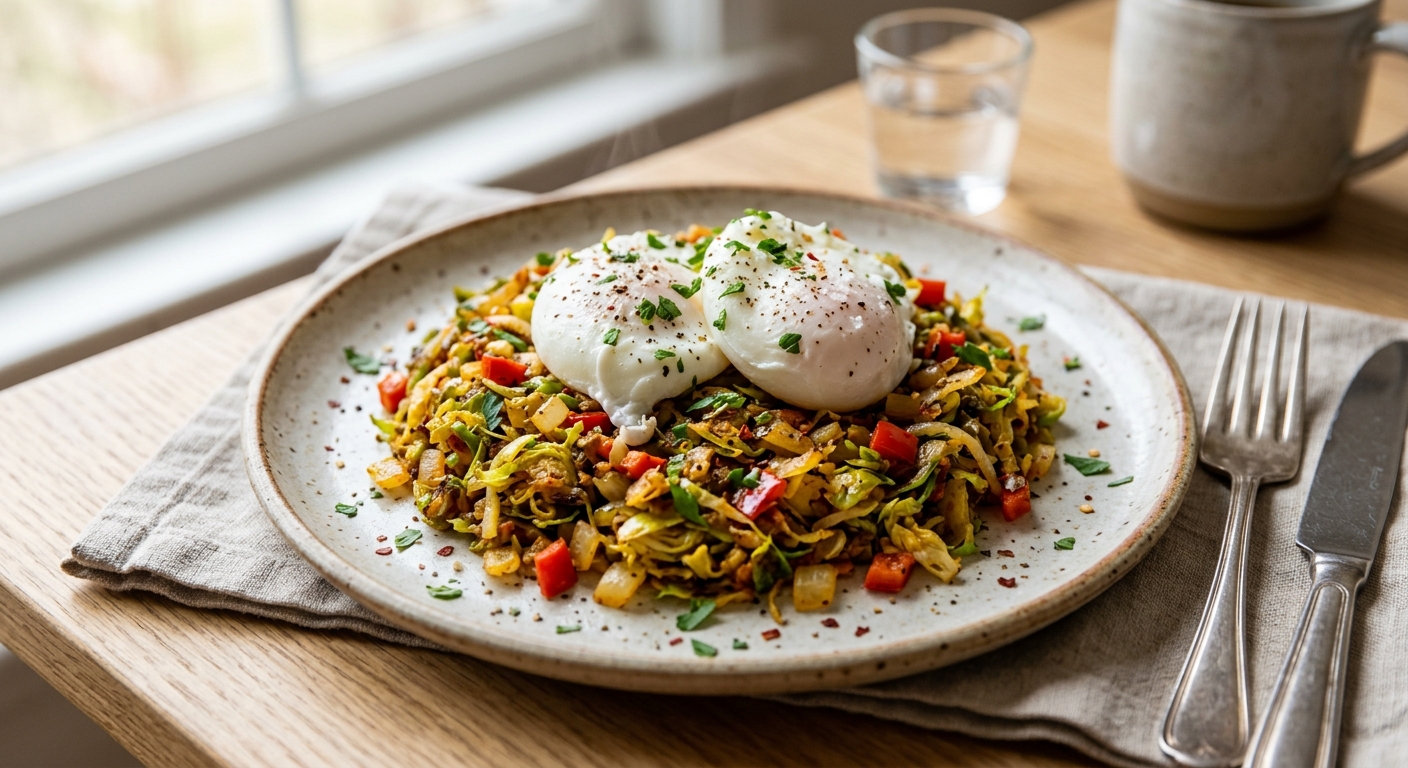
There is a reason Brussels sprouts have earned permanent residency on every nutritionist’s short list: gram for gram, they are one of the most micronutrient-dense vegetables on the planet. When you shred them into a sizzling hash, something magical happens. The high surface area exposed to the hot pan creates thousands of caramelized edges that transform their reputation from divisive side dish into a deeply savory, nutty, almost addictive breakfast centerpiece. Topped with velvety poached eggs whose rich yolks bleed into every crevice, this dish earns its place as the crown jewel of the Vitamin Vault.
Each serving of this hash delivers approximately 160 micrograms of Vitamin K1 from the Brussels sprouts alone, well over the 120 microgram daily adequate intake for adults. Vitamin K is the unsung hero of bone mineralization and blood coagulation, yet surveys consistently show that a large proportion of adults fall short of their daily target. Pairing the sprouts with olive oil is not merely a culinary choice: fat-soluble Vitamin K requires dietary fat for absorption, and the monounsaturated fats in extra-virgin olive oil are among the best vehicles available. The egg yolks contribute an additional dose of Vitamin K2, the form associated with arterial health and calcium regulation.
Vitamin C content in Brussels sprouts rivals that of citrus fruit, with 100 grams of raw sprouts providing roughly 85 milligrams, well above the 75 to 90 milligram RDA for most adults. Shredding and quickly sauteing rather than boiling preserves the majority of this heat-sensitive vitamin, while the lemon juice finish adds a bright acidic note that both lifts the flavor and contributes a final top-up of ascorbic acid. This recipe was built from the ground up to maximize nutrient retention at every step, from knife technique to finishing temperature.
4
servings
Ingredients
- 600 gBrussels sprouts, trimmed and finely shredded (about 2 large handfuls per person)
- 1 mediumyellow onion, finely diced
- 1 mediumred bell pepper, finely diced
- 3 clovesgarlic, minced
- 3 tbspextra-virgin olive oil
- 1 tspsmoked paprika
- 0.5 tspground cumin
- 0.25 tspred pepper flakes
- 8 largeeggs, as fresh as possible
- 2 tbspwhite wine vinegar (for poaching)
- 1 tbspfresh lemon juice
- 30 gParmesan cheese, finely grated
- 2 tbspfresh flat-leaf parsley, roughly chopped
- —Colima Sea SaltMicroplastic Free Salt and freshly cracked black pepper to taste
Instructions
Click on an item below to shop for the recommended items for this recipe on Amazon.
As an Amazon Associate, we earn from qualifying purchases.
- Heat 2 tablespoons of the olive oil in a 12-inch cast iron skillet or heavy stainless steel pan over medium-high heat until the oil shimmers and just begins to smoke at the edges. Add the diced onion and a pinch of salt, and cook undisturbed for 3 minutes until the bottom layer begins to brown. Stir and continue cooking for another 3 to 4 minutes until the onion is deeply golden and fragrant.
- Add the diced red bell pepper and cook for 2 minutes, stirring occasionally, until slightly softened. Push the onion and pepper to the edges of the pan, add the remaining 1 tablespoon of olive oil to the center, and add the minced garlic, smoked paprika, cumin, and red pepper flakes. Stir the spices into the oil and toast for 30 seconds until intensely fragrant, then fold everything together.
- Add all of the shredded Brussels sprouts in one large mound. Do not stir immediately. Press them down firmly with a spatula and let them sit for 2 to 3 minutes over medium-high heat so the bottom layer chars and crisps. Then toss the entire hash, press it down again, and repeat this press-and-wait technique two more times over 8 to 10 minutes total. You are looking for at least one-third of the sprouts to have dark, crispy edges while the remainder stays bright green and just tender.
- Season generously with salt and pepper, squeeze over the lemon juice, and stir to combine. Reduce heat to low to keep the hash warm while you poach the eggs. Transfer the hash to a warmed serving platter or divide among four plates.
- Bring a wide, shallow saucepan or deep skillet of water to a gentle simmer (about 82 to 85 degrees Celsius, small bubbles rising but not a rolling boil). Add the white wine vinegar. Crack each egg into a small ramekin or cup first. Create a gentle whirlpool in the water with a spoon, then slide the first egg from the ramekin into the center. Poach for 3 minutes for a fully runny yolk, or 3 minutes 30 seconds for a slightly jammy yolk. Remove with a slotted spoon, blot on a clean kitchen towel, and season with salt and pepper. Repeat in batches of two eggs at a time.
- Place two poached eggs on top of each portion of hash. Scatter over the grated Parmesan and fresh parsley, finish with an extra crack of black pepper, and serve immediately.
- In a large skillet over medium-high heat, warm 2 tablespoons of the olive oil and saute the diced onion for 5 minutes until lightly golden. Add the diced red bell pepper and garlic and cook for 1 more minute. Stir in the smoked paprika, cumin, and red pepper flakes and toast for 30 seconds. This pre-sauteeing step is critical for a slow cooker recipe because the low, moist environment cannot caramelize aromatics from raw.
- Transfer the sauteed onion mixture to the insert of a 4-quart or larger slow cooker. Add the shredded Brussels sprouts, the remaining 1 tablespoon of olive oil, lemon juice, and a generous seasoning of salt and pepper. Toss everything together thoroughly so the sprouts are evenly coated with the spiced oil and onion mixture.
- Place the lid on the slow cooker and cook on Low for 3 to 4 hours. The sprouts will become tender and absorb the smoky, savory flavors of the spice mixture. Check at the 3-hour mark: the sprouts should be fully tender and have reduced significantly in volume. If there is pooled liquid in the bottom, remove the lid and cook uncovered for a further 20 to 30 minutes to allow it to evaporate and concentrate.
- If you want to partially crisp the hash, transfer it to a foil-lined baking sheet, spread it into an even layer, drizzle lightly with olive oil, and place it under a broiler set to high for 4 to 5 minutes, watching carefully, until the edges begin to brown and crisp.
- While the hash is under the broiler or resting, poach the eggs on the stovetop. Bring a wide saucepan of water to a gentle simmer and add the white wine vinegar. Crack each egg into a ramekin first. Working in batches of two, slide the eggs gently into the barely simmering water and poach for 3 to 3 minutes 30 seconds. Remove with a slotted spoon and blot dry.
- Divide the hash among four bowls or plates, place two poached eggs on each portion, and top with grated Parmesan and fresh parsley. Serve immediately.
- Set your Instant Pot or electric pressure cooker to the Saute function on High. Add 2 tablespoons of the olive oil and heat until shimmering. Add the diced onion with a pinch of salt and saute for 4 minutes, stirring occasionally, until it turns golden at the edges. Add the diced red bell pepper and garlic and cook for 1 minute more.
- Add the smoked paprika, cumin, and red pepper flakes directly to the pot and stir into the aromatics for 30 seconds until very fragrant. Add a splash of water (about 2 tablespoons) to deglaze any spices sticking to the base, scraping up all browned bits with a wooden spoon. This step prevents the burn warning during pressurization.
- Add the shredded Brussels sprouts and toss to coat them in the spiced onion mixture. Add 60ml (about 4 tablespoons) of water, the lemon juice, the remaining tablespoon of olive oil, and a generous seasoning of salt and pepper. Stir to combine. Secure the lid, set the valve to Sealing, and cook on Manual High Pressure for 2 minutes.
- Perform a quick pressure release immediately by carefully moving the valve to Venting. Open the lid and stir the hash. The sprouts will be just tender with a bright green color and concentrated flavor. Switch the Instant Pot back to Saute on High and cook the hash for 3 to 5 minutes, stirring infrequently and pressing the sprouts against the hot base, to drive off excess moisture and develop some browning on the bottom layer.
- While the hash finishes on Saute, poach the eggs in a separate saucepan on the stovetop. Bring water to a gentle simmer, add the white wine vinegar, and poach the eggs in batches of two for 3 to 3 minutes 30 seconds each, transferring to a paper-towel-lined plate to drain.
- Divide the hash into bowls, top each with two poached eggs, scatter over the Parmesan and parsley, and crack over plenty of black pepper. Serve at once.
- Preheat your oven to 220 degrees Celsius (200 degrees Celsius fan, 425 degrees Fahrenheit) with a large rimmed baking sheet (half-sheet pan) inside. Preheating the pan is essential: it acts like a stovetop skillet, immediately searing the undersides of the vegetables when they hit the hot surface.
- In a large mixing bowl, combine the shredded Brussels sprouts, diced onion, and diced red bell pepper. Drizzle over all 3 tablespoons of olive oil and add the minced garlic, smoked paprika, cumin, red pepper flakes, a generous amount of salt, and plenty of black pepper. Toss vigorously until every strand of sprout is coated in the spiced oil.
- Using oven mitts, carefully remove the hot baking sheet from the oven. Working quickly, spread the seasoned vegetable mixture in a single, even layer across the entire surface. Do not pile it up: overcrowding causes steaming rather than roasting. Return the sheet to the top rack of the oven and roast for 15 minutes without opening the door.
- After 15 minutes, remove the baking sheet and use a wide spatula to flip and toss the hash, redistributing it into an even layer again. Return to the oven for a further 12 to 15 minutes until the Brussels sprouts have deep golden-brown edges, the onion is caramelized, and the kitchen smells of roasted hazelnuts and spice. Squeeze the lemon juice over the hot hash as soon as it comes out of the oven and toss to combine.
- While the hash finishes its final roasting, poach the eggs on the stovetop. Bring a wide saucepan of water to a gentle simmer and stir in the white wine vinegar. Poach the eggs in batches of two for 3 to 3 minutes 30 seconds each, removing with a slotted spoon and blotting on a clean towel.
- Divide the roasted hash among four warmed bowls or plates, creating a generous nest in the center of each. Rest two poached eggs in each nest, scatter generously with grated Parmesan and flat-leaf parsley, and serve immediately while the hash is still sizzling hot.
Nutrition Breakdown
Per 1 serving (makes 4)
Vitamins & Minerals
% Daily Value based on a 2,000 calorie diet (FDA reference)
🧬 Essential Amino Acids
% of recommended daily intake (RDA) per serving
🛡 Antioxidant Profile
The Nutrition Science
The extraordinary Vitamin K content of this dish deserves closer examination. Brussels sprouts belong to the Brassica genus, a family of plants that synthesizes Vitamin K1 (phylloquinone) at exceptionally high concentrations within their chloroplasts, where it serves as an electron carrier in photosynthesis. Because Vitamin K is fat-soluble, its bioavailability from plant sources consumed without fat is poor, sometimes as low as 5 to 10%. The olive oil in this recipe raises that absorption figure dramatically, with studies showing that consuming leafy greens alongside as little as 10 grams of fat can increase Vitamin K bioavailability by three to five fold. The egg yolks contribute Vitamin K2 (menaquinone), a form with a longer half-life in the body that research increasingly associates with cardiovascular and bone health outcomes beyond those attributable to K1 alone.
Sulforaphane, arguably the most studied compound in the entire cruciferous vegetable family, is formed only when the enzyme myrosinase contacts its substrate glucoraphanin, a reaction that occurs when plant cells are damaged by chopping, shredding, or chewing. Critically, myrosinase is destroyed by heat, which means cooking whole Brussels sprouts significantly reduces sulforaphane yield. Shredding the sprouts raw before they hit the pan maximizes the enzymatic reaction during the preparation stage, producing a much greater quantity of sulforaphane than cooking whole sprouts would. For the same reason, allowing shredded sprouts to rest for 5 minutes after cutting before they reach heat gives the reaction additional time to proceed, a technique nutritional biochemists call the chop-and-rest method.
The two poached eggs in each serving contribute approximately 250 to 290 milligrams of choline, providing over 50% of the adequate intake for this frequently underconsumed nutrient. Choline is an essential precursor to acetylcholine, the neurotransmitter central to memory and motor function, and to phosphatidylcholine, the primary structural lipid of cell membranes. Despite its importance, dietary surveys in North America and Europe consistently find median choline intakes well below recommended levels, partly because liver and egg yolks are the only common foods providing it in substantial quantities. This recipe quietly addresses that gap without any supplementation required.
Pro Tips
- Shred Brussels sprouts using the slicing disc of a food processor if you are making a large batch: it takes under 60 seconds and produces uniformly thin shreds that cook evenly. Alternatively, halve them through the core and slice thinly with a sharp chef’s knife.
- For the most vivid Vitamin C retention, add the lemon juice only at the very end of cooking, off the heat. Vitamin C degrades rapidly when held at high temperatures, so finishing rather than cooking with it preserves significantly more of the nutrient.
- Egg freshness is the single most important variable for clean poaching. A fresh egg has a tight, compact white that holds together in water. An older egg has a more watery white that spreads. If your eggs are more than 10 days old, add an extra splash of vinegar and keep the water at the gentlest possible simmer to minimize spreading.

this is exactly the kind of breakfast i needed to see – ngl the vitamin k content alone makes my cardiologist happy lol. i’ve been working those brussels sprouts into my slow cooker broths for months now but crispy in a hash sounds like it’d have way better bioavailability, especially with the fat from those egg yolks to help absorption. been tracking my inflammation markers since my heart attack three years ago and the cruciferous veggies seem to make a real difference in my lab work. gonna try this tommorow with a splash of apple cider vinegar if thats ok with you’re approach to the recipe.
This is such a stellar breakfast combo! I’m curious though, are you getting other plant variety in there beyond the Brussels sprouts and onions? I’ve been tracking my plant diversity and realized I was leaning too hard on my favorite cruciferous veggies. What if you added like a handful of chopped fresh herbs, some seeds, or even a different colored veggie to push this into like 5-6 different plants per bowl? The vitamin K and C are already incredible, but that’s where you unlock the whole microbiome magic. Maybe a quick sauté of some greens mixed in with the hash or a sprinkle of pumpkin seeds? Just thinking out loud here, but that’s
oh dude this is the kind of breakfast i can get behind. the brussels sprouts hash sounds amazing and yeah the micronutrient density is no joke, plus the net carbs on that are probably pretty reasonable too? like shredded sprouts caramelize so nicely and the fat from the yolks helps with k absorption which is solid. ive been doing similar stuff for years now and that vitamin k paired with the choline from eggs is legit synergistic for brain health