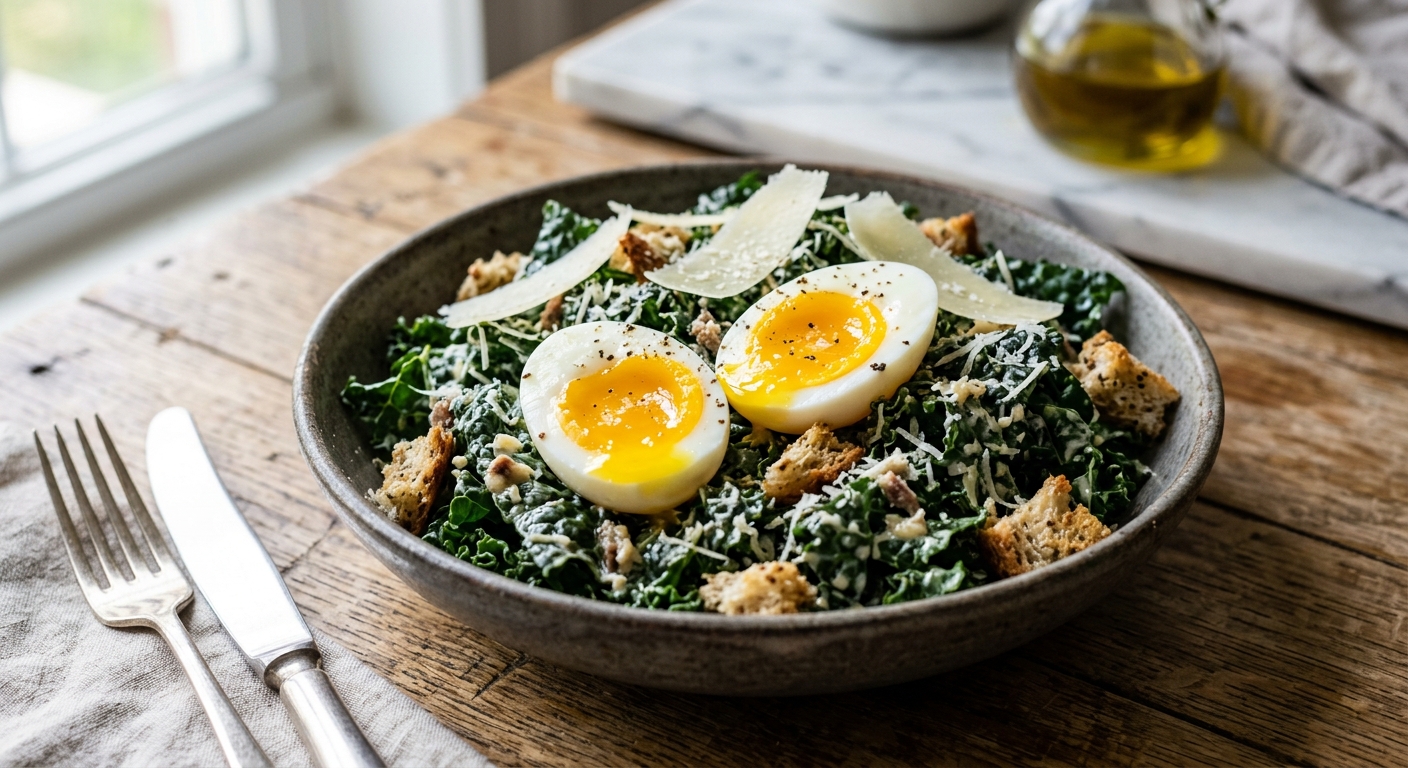
Most Caesar salads are built on romaine, croutons, and a bottled dressing that does little more than coat your conscience. This version flips the formula entirely: we start with lacinato kale, the leafy green that nutritionists genuinely get excited about, and we build a real Caesar dressing from scratch using anchovies, raw garlic, lemon, Worcestershire, Dijon, and freshly grated Parmigiano-Reggiano. The egg on top is not a garnish. It is the nutritional anchor of the entire dish, providing nearly all the B12 a person needs in a day while adding richness that makes the salad feel like a complete, satisfying meal.
The genius of combining kale with egg in a Caesar format is that you are stacking fat-soluble vitamins on top of a fat-rich dressing, which is exactly how your body absorbs them most efficiently. Vitamins A and K are fat-soluble, meaning they require dietary fat for absorption into the bloodstream. The olive oil and parmesan in the dressing, plus the yolk fat in the egg, create the ideal delivery vehicle. Massaging the kale with a small amount of salt and olive oil breaks down its tough cell walls, softening the texture and actually increasing the bioavailability of its carotenoids by rupturing the chloroplast membranes that otherwise slow digestion.
We have engineered this recipe around four cooking methods for the egg component: stovetop poaching or soft-boiling, a slow cooker technique for perfectly set eggs for batch meal prep, a pressure cooker approach for a hands-off hard or soft egg, and an oven method that bakes eggs directly into a warm kale and cheese nest for a dramatic presentation. Each method produces a genuinely different texture and eating experience while delivering the same exceptional nutritional profile. Whether you are meal prepping four lunches on Sunday or making one elegant plate on a weeknight, there is a method here that fits your kitchen and your schedule.
4
servings
Ingredients
- 400 glacinato (Tuscan) kale, ribs removed, leaves torn into bite-sized pieces
- 4 largeeggs, at room temperature
- 60 gParmigiano-Reggiano, freshly grated (plus extra shavings to serve)
- 6 filletsoil-packed anchovy fillets, finely minced
- 3 clovesgarlic, finely minced or grated on a microplane
- 60 mlextra-virgin olive oil
- 30 mlfresh lemon juice (about 1 large lemon)
- 1 tspDijon mustard
- 1 tspWorcestershire sauce
- 1 tsplemon zest
- 2 tbspred wine vinegar
- 100 gsourdough or whole-grain bread, torn into 2cm chunks (for croutons)
- 1 tbspextra-virgin olive oil (for croutons)
- 0.5 tspsmoked paprika (for croutons)
- —Colima Sea SaltMicroplastic Free Salt and freshly cracked black pepper to taste
- —Colima Sea SaltMicroplastic Free Salt for finishing
Instructions
Click on an item below to shop for the recommended items for this recipe on Amazon.
As an Amazon Associate, we earn from qualifying purchases.
- Make the croutons first. Heat a large skillet over medium-high heat. Toss the torn bread chunks with 1 tablespoon olive oil, smoked paprika, a pinch of salt, and pepper. Add to the dry hot skillet in a single layer and toast, tossing every 90 seconds, for 6 to 8 minutes until deeply golden and crisp on all sides. Transfer to a plate and set aside. Do not wash the skillet.
- While the croutons cool, make the Caesar dressing. In a medium bowl, combine the minced anchovies and garlic and use the back of a fork to smash them into a rough paste. Whisk in the Dijon mustard, Worcestershire sauce, lemon juice, lemon zest, and red wine vinegar. Slowly drizzle in the 60ml of olive oil while whisking continuously to create an emulsified dressing. Stir in half the grated Parmigiano-Reggiano. Season with salt (carefully, as anchovies and parmesan are already salty) and plenty of black pepper.
- Massage the kale. Place the torn kale in a large mixing bowl. Sprinkle with a small pinch of fine sea salt and drizzle with 1 teaspoon of olive oil. Using both hands, massage the kale firmly for 2 to 3 minutes, squeezing and rubbing the leaves until they darken in color, reduce in volume by about one-third, and become noticeably tender. This step is essential and not optional.
- Cook the eggs. Bring a medium saucepan of water to a full rolling boil over high heat. Gently lower the eggs into the water using a slotted spoon. Reduce the heat to maintain a gentle boil and cook for exactly 7 minutes for a jammy soft-boil (set white, golden semi-liquid yolk) or 9 minutes for a fully set but still creamy yolk. While the eggs cook, prepare an ice bath in a bowl. Transfer eggs immediately to the ice bath and leave for 5 minutes. Peel carefully under running water.
- Assemble the salad. Pour two-thirds of the dressing over the massaged kale and toss thoroughly to coat every leaf. Add the remaining grated Parmigiano-Reggiano and toss again. Taste and add more dressing as desired. Divide the dressed kale among four bowls or plates. Scatter the warm croutons over each portion.
- Halve each peeled egg lengthwise and place two halves on top of each salad, cut-side up so the yolk is visible. Add extra parmesan shavings, a crack of black pepper, and a pinch of flaky sea salt over the yolk. Serve immediately.
- Set up the slow cooker steam bath. Place a small metal rack or a folded silicone trivet on the bottom of the slow cooker insert. Pour in 250ml of water. Place the room-temperature eggs directly on the rack in a single layer, making sure they are not submerged but sitting above the water. The steam will do the cooking. Place the lid on and set to Low.
- Cook the eggs on Low for 1 hour and 45 minutes for a fully set white with a slightly creamy, dense yolk, or 1 hour and 30 minutes for a softer yolk. Unlike stovetop boiling, the slow cooker method is very forgiving as the temperature stays well below a rolling boil, producing eggs that are tender and easy to peel. When the time is up, transfer eggs to an ice bath and cool for 10 minutes. Peel and refrigerate if prepping ahead (store unpeeled for up to 5 days).
- While the eggs cook, prepare the croutons in the oven for hands-off convenience. Preheat your oven to 200C (400F). Toss the torn bread with 1 tablespoon olive oil, smoked paprika, salt, and pepper directly on a baking sheet. Spread in a single layer and bake for 10 to 12 minutes, tossing halfway, until golden and crisp. Cool completely. Store in an airtight container if making ahead.
- Make the Caesar dressing in a jar for easy meal-prep storage. Combine the minced anchovy fillets and garlic in the jar and mash with a small fork or spoon. Add the Dijon, Worcestershire, lemon juice, lemon zest, red wine vinegar, and olive oil. Seal the jar and shake vigorously for 30 seconds to emulsify. Add half the grated Parmigiano-Reggiano, season with pepper, seal, and shake again. Refrigerate for up to 4 days. Re-shake before each use as the dressing will separate.
- When ready to serve (immediately or from the fridge throughout the week), massage the kale with a pinch of salt and a drizzle of olive oil for 2 to 3 minutes per batch. Dress generously, top with croutons, and place a halved slow-cooked egg on each portion. The slow-cooked egg has a uniquely silky, custard-like texture that is noticeably different from a rapidly boiled egg. Finish with parmesan shavings, flaky salt, and cracked pepper.
- Add 250ml of cold water to the pressure cooker insert. Place the metal steam rack or trivet that came with the appliance inside. Arrange up to 6 room-temperature eggs on the rack. Seal the lid, set the steam release valve to Sealing, and select Manual or Pressure Cook on High Pressure for 5 minutes. For a softer, slightly jammy yolk, use 4 minutes. For a fully set but still creamy yolk, use 6 minutes.
- When the 5-minute cook time ends, do not perform a quick release. Allow the pressure to release naturally for exactly 5 minutes (the display will show time counting up after the cook cycle). After 5 minutes of natural release, carefully switch the valve to Venting to release any remaining steam. Open the lid away from you.
- Immediately transfer all eggs to a bowl of ice water using tongs or a slotted spoon. Leave undisturbed for 5 full minutes. This ice bath stops carryover cooking and creates a small contraction gap between the egg white and shell that makes peeling trivially easy. Tap the wide end of each egg firmly on the counter, peel away a small patch of shell, and then roll the egg gently to crack the rest. The shell should slide off almost in one piece.
- While the eggs are in the ice bath, use the Saute function on the pressure cooker (no need to wash the insert) to toast the croutons. Add 1 tablespoon olive oil to the insert and heat until shimmering. Add the torn bread, smoked paprika, salt, and pepper. Saute, stirring frequently, for 5 to 7 minutes until the bread is golden and crisp on most surfaces. Transfer to a plate. Turn off the Saute function.
- Make the dressing in a small bowl by mashing anchovies and garlic into a paste, then whisking in Dijon, Worcestershire, lemon juice, lemon zest, red wine vinegar, and olive oil until emulsified. Stir in half the parmesan and season with pepper. Massage the kale with salt and olive oil for 2 to 3 minutes, dress, and toss. Plate the salad, top with croutons, halve the pressure-cooked eggs lengthwise, and place cut-side up on each bowl. Finish with parmesan shavings, flaky salt, and black pepper.
- Preheat the oven to 190C (375F). Make the croutons at the same time on a separate baking sheet. Toss the torn bread with 1 tablespoon olive oil, smoked paprika, salt, and pepper. Spread on a baking sheet and place in the oven for 10 to 12 minutes, tossing once at the 6-minute mark, until golden and crisp. Remove and set aside. Leave the oven on.
- While the croutons bake, make the Caesar dressing in a large bowl as described: mash anchovies and garlic into a paste, whisk in Dijon, Worcestershire, lemon juice, lemon zest, red wine vinegar, and olive oil to emulsify. Stir in half the parmesan and season with pepper. Add the torn kale to the bowl. Massage briefly with the dressing for about 90 seconds. The kale does not need to be as intensively massaged for this method as it will continue to soften in the oven heat.
- Lightly brush a large oven-safe baking dish or four individual gratin dishes (each about 15cm wide) with olive oil. Divide the dressed kale among the dishes, pressing it into loose nest shapes with a slight hollow in the center of each portion. Scatter the remaining grated Parmigiano-Reggiano over the top of each kale nest, concentrating a little extra in the hollow to create a base for the egg.
- Crack one egg directly into the hollow of each kale nest, being careful not to break the yolk. Season the egg with a pinch of flaky salt and cracked black pepper. If using a single large baking dish, space the four eggs evenly across the kale. Place the dish on the center rack of the preheated oven.
- Bake for 12 minutes for a runny yolk with a fully set, opaque white, or 14 minutes for a yolk that is set on the outside but still slightly liquid in the center. Watch closely after 11 minutes as oven temperatures vary. The kale edges should be lightly crisped and the parmesan golden. Remove from the oven, scatter croutons directly over the top of each dish, add extra parmesan shavings, and serve immediately in the baking dish. The carryover heat will continue to set the yolk for 1 to 2 minutes after removal, so serve without delay.
Nutrition Breakdown
Per 1 serving (makes 4)
Vitamins & Minerals
% Daily Value based on a 2,000 calorie diet (FDA reference)
🧬 Essential Amino Acids
% of recommended daily intake (RDA) per serving
🛡 Antioxidant Profile
The Nutrition Science
The nutritional architecture of this salad is built around a principle called synergistic absorption. Vitamins A and K are fat-soluble, meaning they require the presence of dietary fats to be packaged into chylomicrons in the small intestine and transported into circulation. A 2015 study published in the American Journal of Clinical Nutrition found that adding as little as 3 grams of fat to a carotenoid-rich salad increased beta-carotene absorption by over 15-fold compared to a fat-free dressing. The olive oil, parmesan, and egg yolk in this recipe ensure that virtually all of the kale’s substantial vitamin A and K content is bioavailable, not just present on paper.
Vitamin K deserves special attention in this dish. A single 100g serving of lacinato kale contains approximately 704mcg of vitamin K1 (phylloquinone), which is the form involved in activating the clotting cascade and, critically, the family of vitamin K-dependent proteins that regulate calcium deposition in bone and arteries. Matrix Gla Protein (MGP) and osteocalcin are both activated by carboxylation reactions that require vitamin K as a cofactor. Chronically low vitamin K intake is associated with arterial calcification and reduced bone mineral density; this salad provides over seven times the daily recommended intake in a single serving, making it one of the most efficient dietary sources of this often-overlooked vitamin. Note that individuals on warfarin anticoagulant therapy should consult their physician before significantly increasing vitamin K intake.
The egg yolk in this recipe is doing double duty that is frequently misunderstood. First, it is the primary source of vitamin B12, providing roughly 0.45mcg per large egg yolk, which accumulates to nearly 80% of the daily value across four yolks in this recipe. B12 is essential for myelin sheath formation around nerve fibers and for the conversion of homocysteine to methionine, and it is found almost exclusively in animal products, making this salad an important dietary source for omnivores. Second, the egg yolk contains approximately 0.6mg of lutein and zeaxanthin per yolk in a highly bioavailable form because these carotenoids are already suspended in yolk fat, meaning they are essentially pre-packaged for absorption. Combined with the 14mg or more of lutein from the kale itself, this salad delivers one of the highest single-meal doses of macular-protective carotenoids found in any non-supplement food source.
Pro Tips
- Always buy lacinato (Tuscan or dinosaur) kale rather than curly kale for this recipe. Its flatter leaves massage more evenly, its flavor is less bitter and more earthy, and its carotenoid density per gram is slightly higher than curly varieties.
- The dressing can and should be made up to 4 days ahead and stored in a sealed jar in the refrigerator. The flavors of the garlic and anchovy mellow and integrate beautifully overnight, and the dressing thickens slightly as the parmesan absorbs the liquid, making it cling to the kale more effectively.
- If you are avoiding raw anchovies, substitute 1 teaspoon of white miso paste plus 1 teaspoon of capers, both finely minced, for a functionally equivalent umami hit that keeps the salad pescatarian-free without losing the depth that makes Caesar dressing taste like Caesar dressing.
- For a folate and iron boost, add a 100g handful of cooked green lentils to the dressed kale before plating. They add negligible flavor impact but push the folate content above 100% DV per serving.
- Do not skip the ice bath for the eggs regardless of cooking method. It is not merely about stopping the cooking; it also prevents the formation of the grey-green ring around the yolk (ferrous sulfide from the reaction between iron in the yolk and hydrogen sulfide released from the white during prolonged heat exposure) that makes hard-boiled eggs look and taste overcooked.
This looks absolutely incredible, and I’m obsessed with how nutrient dense it is. The B12 from the egg is huge for us managing hormone metabolism, and the vitamin K in kale is something I actively seek out since it supports healthy estrogen detoxification. My one question, though: do you have the carb count on this? I’ve found that pairing my leafy greens with protein and fat from the egg and anchovy helps stabilize my blood sugar way better than I’d expect from just a salad, but I’m always curious about the total impact. Would definitely make this weekly if the macro breakdown works for my insulin sensitivity goals.
Love this nutrient breakdown, Rosa! The vitamin K in kale is such a game changer, especially massaged like this since it makes it way more bioavailable. I’m curious about the glycemic load on this though – kale is low glycemic which is perfect, but I’m wondering if the dressing ratio matters for blood sugar stability? I’ve found that adding a bit more fat/protein to balance any carbs in the dressing helps flatten my response, and with that anchovy-parmesan base you’re probably already nailing it. This is the kind of one-bowl meal that actually keeps me stable for hours instead of spiking.
This is exactly the kind of nutrient-dense meal I’ve been building my diet around since my Hashimoto’s diagnosis, so I’m really excited about this one! My main question is around the anchovy-parmesan dressing, since I’m following AIP and need to avoid nightshades – I’m assuming the traditional Caesar doesn’t have any hidden peppers, but would you have a substitute in mind if someone needed to skip it? Also, do you know the iodine content in that particular kale variety you used, or is it something you typically source from a specific region? The egg and kale combo is definitely my go-to for B12 and anti-inflammatory vitamin K, and I