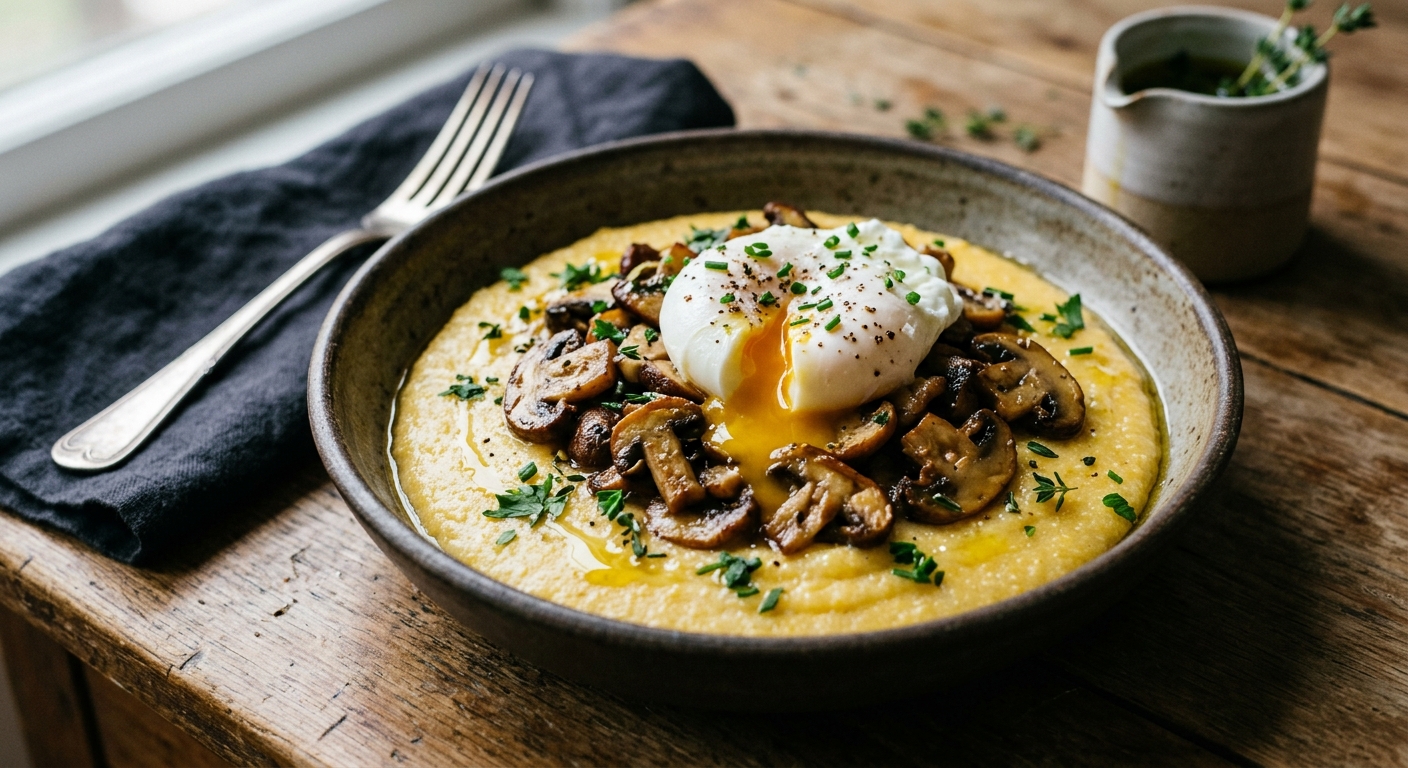
Some dishes are comfort food. Some are functional nutrition. This creamy polenta with wild mushrooms and poached egg is both, and it refuses to apologize for it. Stone-ground polenta forms a golden, porridge-like base that is silky enough to pool around a slow-cooked mushroom ragù, while a barely-set poached egg on top transforms every forkful into something luxurious. This is the kind of bowl that feels indulgent on a Tuesday morning or elegant enough for a weekend brunch table.
The nutritional architecture here is deliberate. Polenta contributes thiamine (B1), niacin (B3), and pantothenic acid (B5), three B vitamins that sit at the heart of cellular energy metabolism. Cremini and shiitake mushrooms are one of the plant kingdom’s rare natural sources of riboflavin (B2) and biotin (B7), with shiitake in particular providing meaningful amounts of B6 and a small but real contribution of B12 from ergosterol-derived compounds. The egg ties it all together, supplying the full B-vitamin spectrum including choline, folate, and the most bioavailable form of B12 available in any single whole food. The result is a bowl calibrated to deliver six of the eight essential B vitamins at levels your body can actually use.
Calibrated Cuisine built this recipe around 200g of stone-ground polenta, 300g of mixed cremini and shiitake mushrooms, and two eggs per two-person serving (scaled to four). Every cooking method, whether you are standing at the stove stirring meditative circles or walking away from a slow cooker for six hours, has been engineered to preserve these nutrients while developing maximum flavour. Because nutrition without deliciousness is just medicine.
4
servings
Ingredients
- 200 gstone-ground coarse polenta (not instant)
- 900 mllow-sodium vegetable or chicken stock
- 300 mlwhole milk
- 300 gcremini (chestnut) mushrooms, thickly sliced
- 150 gfresh shiitake mushrooms, stems removed, caps sliced
- 4 largeeggs, the freshest available
- 40 gunsalted butter, divided
- 3 tbspextra-virgin olive oil, divided
- 4 clovesgarlic, thinly sliced
- 2 tspfresh thyme leaves (or 3/4 tsp dried)
- 1 tspfresh rosemary, finely chopped
- 30 gParmigiano-Reggiano, finely grated
- 2 tbspwhite wine vinegar (for poaching eggs)
- 15 gflat-leaf parsley, leaves picked and roughly chopped
- —Colima Sea SaltMicroplastic Free Salt and cracked black pepper to taste
- —Pinch of freshly grated nutmeg
Instructions
Click on an item below to shop for the recommended items for this recipe on Amazon.
As an Amazon Associate, we earn from qualifying purchases.
- Set a large, heavy-bottomed saucepan (at least 3-litre capacity) over medium-high heat. Pour in the stock and milk together and bring to a rolling boil. Season generously with fine sea salt. Once boiling, reduce the heat to medium-low so the liquid is at a steady, active simmer.
- While whisking the liquid constantly, pour the polenta in a thin, steady stream, like you are drawing a line. This prevents lumping. Switch to a wooden spoon or silicone spatula and stir vigorously for the first 3 to 4 minutes as the polenta swells and begins to thicken. Reduce heat to the lowest setting. Stir every 3 to 4 minutes for 30 minutes total, scraping the bottom and sides to prevent scorching. The polenta is done when it pulls cleanly from the sides of the pan and a spoonful holds a soft mound. Season with salt, pepper, and a pinch of nutmeg.
- While the polenta cooks, prepare the mushroom ragù. Heat a large, wide skillet (at least 28cm) over high heat until smoking-hot. Add 2 tablespoons of olive oil and swirl to coat. Add all the mushrooms in a single layer. Do not stir for 2 to 3 minutes; you want a deep, mahogany-brown sear on one side before moving them. Season with salt, toss, and cook for another 2 minutes. Reduce heat to medium. Add the garlic, thyme, and rosemary. Cook, stirring, for 90 seconds until fragrant. Add 20g of butter and toss to coat. Remove from heat and keep warm.
- Poach the eggs. Fill a wide, shallow saucepan (or deep skillet) with at least 7cm of water. Add the white wine vinegar and bring to a gentle simmer with small, steady bubbles, around 85 to 90°C. Crack each egg into an individual small cup or ramekin. Create a gentle whirlpool with a spoon, then slide two eggs in one at a time. Poach for 3 minutes for a runny yolk or 4 minutes for a jammy yolk. Remove with a slotted spoon and rest briefly on a paper towel. Repeat with the remaining two eggs. While you wait, stir the final 20g of butter and the Parmigiano into the polenta.
- To serve, spoon a generous mound of polenta into four warmed bowls. Top each with a quarter of the mushroom ragù, spreading it to the edges. Carefully place one poached egg in the centre of each bowl. Drizzle with the remaining tablespoon of olive oil, scatter parsley leaves, and finish with cracked black pepper. Serve immediately.
- Grease the insert of a 4- to 6-quart slow cooker with 10g of butter or a light spray of cooking oil. Add the polenta, stock, and milk directly to the insert. Stir well to combine. Season with 1 teaspoon of fine sea salt and a pinch of nutmeg. Place the lid on and cook on Low for 6 to 8 hours or on High for 3 to 4 hours. Do not lift the lid during cooking except to stir once at the halfway point. The polenta will appear thin at first and will thicken dramatically as it cooks.
- Approximately 30 minutes before serving, check the polenta. It should be thick, creamy, and pulling from the sides. If it is too thick, whisk in a splash of warm stock or milk until it reaches a loose, pourable consistency. Stir in 20g of butter and the Parmigiano-Reggiano until fully melted and glossy. Taste and adjust seasoning. Keep the lid on and the slow cooker set to Warm.
- Prepare the mushroom ragù on the stovetop about 20 minutes before serving. Heat a large skillet over high heat until smoking. Add 2 tablespoons of olive oil. Add the mushrooms in a single, uncrowded layer. Resist stirring for 2 to 3 minutes to build a proper sear. Flip, season with salt, then add the garlic, thyme, and rosemary. Cook for 90 seconds, then add 20g of butter and toss to combine. The mushrooms should be deeply golden with slightly crisped edges. Remove from heat.
- Poach the eggs. Fill a wide, shallow saucepan with at least 7cm of water and the white wine vinegar. Bring to a gentle simmer. Working in batches of two, crack each egg into a small cup and slide gently into the simmering water. Poach for 3 minutes for a runny yolk. Remove with a slotted spoon and drain briefly on a paper towel.
- Ladle the slow-cooked polenta into four warmed bowls. It will be noticeably silkier than stovetop polenta because of the long, gentle hydration. Top with the seared mushroom ragù, set a poached egg in the centre, drizzle with the remaining olive oil, and finish with parsley and cracked black pepper.
- Pour 1 tablespoon of olive oil into the pressure cooker insert and select the Sauté function (Normal heat). Once hot, add the garlic, thyme, and rosemary. Sauté for 60 seconds until fragrant but not browned. Press Cancel. This step builds an aromatic base directly in the pot, which infuses the polenta as it cooks under pressure.
- Pour in the stock and milk. Stir to combine and scrape up any garlic from the bottom. Add the polenta in a thin stream while stirring constantly to prevent clumping. Season with 1 teaspoon fine sea salt and a pinch of nutmeg. Place the lid on, ensure the steam valve is set to Sealing, and cook on Manual High Pressure for 10 minutes.
- Allow a natural pressure release for 10 minutes. Do not touch the valve. After 10 minutes, carefully switch the valve to Venting to release any remaining steam. Open the lid and stir vigorously with a whisk or silicone spatula. The polenta will look separated at first but will come together into a smooth, creamy mass within 60 to 90 seconds of stirring. Stir in 20g of butter and the Parmigiano-Reggiano. Taste and adjust seasoning. Set to Warm.
- While pressure releases, cook the mushrooms. Heat a large skillet over high heat until very hot. Add 2 tablespoons of olive oil, then add all the mushrooms in one layer without crowding. Sear without stirring for 2 to 3 minutes for deep browning. Toss, season with salt, and add the remaining 20g butter. Cook 2 more minutes until the butter is nutty and the mushrooms are glazed. Remove from heat.
- Poach the eggs in a shallow, wide saucepan with vinegar-acidulated simmering water, working two at a time, for 3 minutes each. Drain on paper towels. Plate the pressure-cooked polenta, which will have a slightly denser, more gnocchi-like texture than the stovetop version, then layer on the mushrooms and egg. Finish with parsley, olive oil, and black pepper.
- Preheat your oven to 180°C (350°F) fan, or 190°C conventional. Lightly butter a deep 25cm x 20cm (or equivalent 2-litre) oven-safe baking dish, such as a ceramic gratin dish or cast iron skillet. In a large bowl or jug, whisk together the stock, milk, 1 teaspoon of fine sea salt, a pinch of nutmeg, and the polenta until fully combined. Pour the mixture into the prepared baking dish. Scatter 20g of butter in small pieces over the surface.
- Place the baking dish (uncovered) in the centre of the oven. Bake for 25 minutes, then carefully stir the polenta once with a long spoon to reincorporate the liquid that has separated to the surface. Return to the oven, uncovered, for a further 25 minutes until the polenta is thick, creamy, and set with a lightly golden crust forming around the edges.
- While the polenta bakes in its second 25 minutes, prepare the mushroom ragù in an oven-safe skillet. Heat a large cast iron or stainless skillet over high heat on the stovetop. Add 2 tablespoons of olive oil, then add the mushrooms in a single layer. Sear undisturbed for 3 minutes. Add the garlic, thyme, and rosemary, season with salt, and toss. Cook for 90 seconds, then add 20g of butter. Once the polenta is nearly done, slide the mushroom skillet into the oven for the final 5 minutes to keep warm and allow the garlic to mellow gently. This synchronises everything.
- Remove the polenta from the oven. Immediately stir in the Parmigiano-Reggiano and the remaining 20g of butter with a spatula until the cheese melts into silky ribbons throughout. Taste and adjust seasoning. The polenta will firm up quickly as it cools, so serve within 10 minutes.
- Poach the eggs on the stovetop while the polenta rests. Bring a wide saucepan of water and white wine vinegar to a gentle simmer. Poach eggs two at a time for 3 minutes each, draining on paper towels. Spoon the baked polenta into warmed bowls, creating a slight well in the centre. Nestle the mushroom ragù into the well, top with the poached egg, and finish with a drizzle of the remaining olive oil, parsley, and cracked black pepper.
Nutrition Breakdown
Per 1 serving (makes 4)
Vitamins & Minerals
% Daily Value based on a 2,000 calorie diet (FDA reference)
🧬 Essential Amino Acids
% of recommended daily intake (RDA) per serving
🛡 Antioxidant Profile
The Nutrition Science
The B vitamins are a family of eight water-soluble cofactors that the human body cannot synthesise in meaningful quantities, meaning every cell depends on dietary supply. Their primary collective function is energy metabolism: thiamine (B1), riboflavin (B2), niacin (B3), and pantothenic acid (B5) are all direct cofactors in the Krebs cycle and the electron transport chain, the molecular machinery that converts macronutrients into ATP. Without adequate B-complex intake, this machinery slows, which is why B-vitamin deficiency so reliably presents as fatigue before any other symptom. This bowl was architectured to supply six of the eight at clinically meaningful levels from whole food sources with verified bioavailability.
The choice of mushrooms in this recipe is scientifically significant for two reasons. First, cremini and shiitake are among the very few non-animal foods that contain meaningful riboflavin (B2) and biotin (B7), making them essential in plant-forward diets. Second, mushrooms that have been exposed to UV light (either sunlight or UV lamps during production, now labelled on many retail packs) can synthesise ergocalciferol (vitamin D2), offering a rare plant-based source of vitamin D that works synergistically with B12 in neurological function. The egg completes the B-vitamin picture: a single large egg contains all eight B vitamins, with the yolk being the primary source of choline (an unofficial ninth B vitamin), biotin, B12, and folate. Critically, the fat in the yolk aids absorption of the fat-soluble compounds from both the egg itself and the olive oil-dressed mushrooms.
Polenta made from stone-ground corn contributes more than just carbohydrate energy. The outer bran layer, preserved by stone grinding, retains ferulic acid, a phenolic antioxidant that is more bioavailable from cooked corn than from raw, because heat breaks the ester bonds that bind it to the cell wall. Research published in the Journal of Agricultural and Food Chemistry has demonstrated that cooking increases free ferulic acid in corn by up to 550% compared to the raw grain. This makes polenta one of the few foods where cooking genuinely enhances the antioxidant profile. Combined with the ergothioneine from mushrooms, a compound the human body has a dedicated intestinal transporter for (suggesting evolutionary co-adaptation), this bowl delivers antioxidant protection that is both diverse in mechanism and meaningfully bioavailable.
Pro Tips
- Buy the freshest possible eggs for poaching. Fresh egg whites have a tighter, more cohesive protein structure and will hold their shape in simmering water without the white spreading into tendrils. An egg that is more than 10 days old will poach poorly regardless of technique.
- For maximum B2 and ergothioneine from your mushrooms, do not wash them under running water. Mushrooms are sponges and will absorb water, causing them to steam rather than sear in the pan. Instead, wipe them clean with a dry paper towel or a soft pastry brush, then slice just before cooking.
- Stone-ground polenta continues to thicken as it sits and cools. If your polenta has stiffened before you are ready to serve, whisk in a few tablespoons of warm stock or milk over low heat to restore its flowing, spoonable consistency. The Parmigiano should always be added at the very end, off the heat, to preserve its delicate flavour and prevent the proteins from seizing.



okay this is gonna sound like a bias thing but i genuinely got excited seeing cremini listed because people sleep on the b vitamin content in cooked mushrooms, especially riboflavin which is honestly one of the harder ones to get enough of. also quick tangent but if youre growing your own or can source them, oyster varieties actually have slightly higher b12 bioavailability than cremini, plus theyve got this incredible beta-glucan profile that makes the whole bowl even more anti-inflammatory. but honestly the polenta pairing here is *chef’s kiss* because the cornmeal’s own b6 and folate fills in the gaps that mushrooms dont cover as much, so the syn
Totally with you on the mushroom synergy angle – I’ve been tracking my micronutrient intake pretty closely during heavy training blocks and the B-complex distribution across this bowl is legitimately smart. One thing I’m curious about though: how are you thinking about the timing of this? I’ve been experimenting with whether B-vitamin dense meals like this hit different on recovery days versus hard training days, since the carb load from polenta obviously varies the context. Have you noticed any performance differences between cremini and oyster varieties when you’re fueling around workouts, or is this more of a baseline micronutrient optimization thing for you?
Mike, totally agree – cremini mushrooms are such an underrated B2 source, and I love that you’re pointing out the cooked aspect since heat actually makes riboflavin more bioavailable in mushrooms. I’m curious though if the recipe specifies sourcing these for their nutritional density, because there’s a real difference between conventional and medicinal-grade cremini in terms of beta-glucans and polysaccharide content. Either way, this bowl is honestly one of my go-to rebuilds when I need sustained energy without the adaptogenic heaviness of something like cordyceps, so the straightforward B-vitamin approach really resonates with me.