
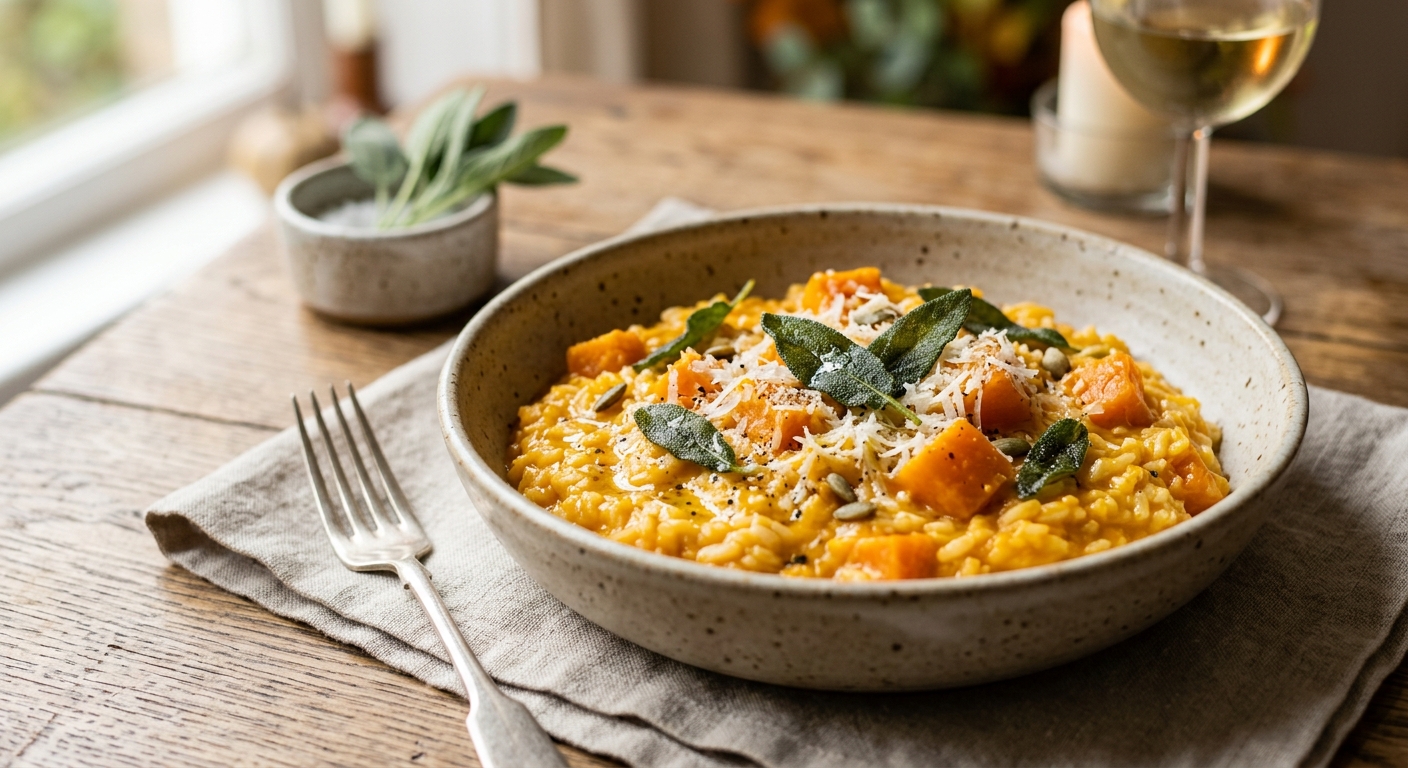
When autumn arrives and pumpkins crowd the market stalls, this is the dish your body has been quietly waiting for. Pumpkin and Sage Risotto is the kind of meal that feels like pure indulgence but is, in fact, a precision-engineered delivery system for some of the most important fat-soluble nutrients your body needs heading into the colder months. The deep orange flesh of a culinary pumpkin, such as a Hokkaido, Crown Prince, or Jarrahdale variety, is dense with beta-carotene, the precursor to retinol that your liver converts to active Vitamin A on demand. Roasting the pumpkin before it enters the risotto concentrates its sugars and carotenoids, making every spoonful nutritionally and gastronomically more powerful.
Risotto has a reputation for being fussy, but the technique is really just a lesson in patience and hydration. As Arborio rice slowly absorbs hot stock ladle by ladle, its starchy exterior dissolves into the liquid, creating the signature silky texture entirely without cream. This means the richness you taste is real: it comes from the fat-soluble carotenoids suspended in olive oil, the starch from the rice, and the earthy depth of aged Parmigiano-Reggiano stirred in at the very end. Sage, crisped in butter until it shatters between your fingers, adds not just fragrance but a genuine hit of Vitamin K and rosmarinic acid, a potent polyphenol antioxidant.
At Calibrated Cuisine, we built this recipe around 700g of raw pumpkin flesh per four servings, a quantity that delivers a scientifically meaningful dose of beta-carotene without tipping the glycemic load into high territory. The risotto base uses a full litre of well-seasoned vegetable stock and a dry white wine deglaze that adds complexity while the alcohol cooks off completely. Whether you make it the traditional stovetop way, surrender it to a slow cooker for a hands-off afternoon, or pressure-cook it to the table in under 30 minutes, the nutritional payload remains essentially intact, and the result is always deeply satisfying autumn comfort food.
4
servings
Ingredients
- 700 gpumpkin (Hokkaido, Crown Prince, or butternut), peeled, seeded, and cut into 2cm cubes
- 300 gArborio rice
- 1000 mlgood-quality vegetable stock, hot
- 1 mediumwhite onion, finely diced
- 3 clovesgarlic, minced
- 150 mldry white wine (such as Pinot Grigio or Vermentino)
- 60 gParmigiano-Reggiano, freshly grated, plus extra to serve
- 30 gunsalted butter, cold and cubed
- 3 tbspextra-virgin olive oil, divided
- 16 leavesfresh sage leaves (about 10g)
- 1 tspfreshly grated nutmeg
- 1 tspsmoked sweet paprika
- —Colima Sea SaltMicroplastic Free Salt and freshly cracked black pepper to taste
- —Colima Sea SaltMicroplastic Free Salt for finishing
Instructions
Click on an item below to shop for the recommended items for this recipe on Amazon.
As an Amazon Associate, we earn from qualifying purchases.
- Preheat your oven to 200C (fan 180C). Toss the pumpkin cubes with 1 tablespoon of olive oil, the smoked paprika, a pinch of fine sea salt, and black pepper. Spread in a single layer on a baking sheet and roast for 25 minutes until tender and caramelised at the edges. Remove from the oven and use a fork to roughly mash about two-thirds of the pumpkin into a coarse puree directly on the tray; leave the remaining third as whole cubes for texture.
- While the pumpkin roasts, heat the vegetable stock in a medium saucepan over low heat and keep it at a bare simmer throughout the cooking process. In a separate wide, heavy-based pan (a Dutch oven or deep saute pan works perfectly), heat 2 tablespoons of olive oil over medium heat. Add the diced onion with a pinch of salt and cook, stirring occasionally, for 8 to 10 minutes until completely softened and translucent but not browned. Add the minced garlic and cook for 1 further minute.
- Add the Arborio rice to the pan and stir vigorously to coat every grain in the oil. Toast the rice for 2 minutes, stirring constantly, until the edges of the grains turn slightly translucent and you can smell a faintly nutty aroma. Pour in the white wine and stir continuously until it has been completely absorbed and the smell of alcohol has cooked off, about 2 minutes.
- Begin adding the hot stock one ladleful (approximately 80ml) at a time, stirring continuously and waiting until each addition is almost fully absorbed before adding the next. Adjust the heat so the risotto is always bubbling gently but never boiling rapidly. After about 15 minutes of adding stock, stir in the pumpkin puree and continue adding stock ladle by ladle until the rice is al dente, with a very slight bite at the centre, approximately 18 to 22 minutes total from the first addition of stock. You may not need every last drop of stock, or you may need a small splash more of hot water. Stir in the freshly grated nutmeg.
- Remove the pan from the heat. Add the cold cubed butter and the grated Parmigiano-Reggiano. Stir energetically using a wooden spoon or spatula for 90 seconds; this vigorous motion is called mantecatura and is what creates the final glossy, emulsified texture. Taste and adjust seasoning. The risotto should be loose enough to slowly spread when you tilt the plate, what Italians call all’onda (in waves). If it is too thick, stir in a small splash of hot stock.
- While the risotto rests for 2 minutes, heat a small skillet over medium-high heat. Add 1 teaspoon of olive oil and fry the sage leaves for 30 to 40 seconds per side until crisp and bright. Transfer to paper towel and sprinkle immediately with flaky salt. Divide the risotto between warm bowls, nestle the reserved whole pumpkin cubes on top, lay the crispy sage leaves over, and finish with extra Parmigiano-Reggiano and a crack of black pepper.
- Preheat your oven to 200C (fan 180C). Toss the pumpkin cubes with 1 tablespoon of olive oil, smoked paprika, salt, and pepper. Roast on a baking sheet for 25 minutes until tender and caramelised. Reserve one-third of the cubes for garnish and blend or mash the remaining two-thirds with 100ml of the measured vegetable stock into a smooth puree. Set aside.
- Heat 2 tablespoons of olive oil in a skillet over medium heat. Saute the diced onion for 8 minutes until soft, then add the garlic and cook 1 minute more. Add the Arborio rice and toast for 2 minutes, stirring constantly. Pour in the white wine and stir until fully absorbed. This pre-toasting step is essential in the slow cooker method because the machine cannot provide the dry, high heat needed to toast rice, and skipping it leads to a starchy, porridge-like result.
- Transfer the toasted rice and onion mixture into the slow cooker insert. Pour in the pumpkin puree and the remaining 900ml of hot vegetable stock. Add the freshly grated nutmeg and stir once to combine. Place the lid on and cook on High for 2 hours 15 minutes to 2 hours 30 minutes, without lifting the lid at all during this time. The rice is done when it is tender and has absorbed almost all the liquid.
- Once the cooking time is complete, quickly stir in the cold cubed butter and the grated Parmigiano-Reggiano. Stir vigorously for 60 seconds to emulsify. The risotto will be very thick immediately after opening; if needed, stir in up to 100ml of hot water or extra warm stock to loosen it to a flowing consistency. Taste and adjust salt and pepper.
- In a small skillet, heat a teaspoon of olive oil over medium-high heat and fry the fresh sage leaves for 30 to 40 seconds per side until crisp. Drain on paper towel and salt immediately. Spoon the risotto into warm bowls, top with the reserved roasted pumpkin cubes, the crispy sage, and extra Parmigiano-Reggiano.
- Set your Instant Pot or pressure cooker to Saute on the Normal or Medium setting. Add 2 tablespoons of olive oil. Once hot, add the diced onion and a pinch of salt and saute for 6 to 7 minutes until softened. Add the garlic and cook 1 minute. Add the raw pumpkin cubes directly (no pre-roasting needed in this method; the high-pressure steam will fully cook them), the smoked paprika, and the nutmeg. Stir to coat.
- Add the Arborio rice and stir for 90 seconds to lightly toast it in the residual oil. Pour in the white wine and stir until absorbed, about 1 to 2 minutes on the Saute setting. Pour in all 1000ml of cold or room-temperature vegetable stock. Stir well to lift any browned bits from the bottom; this step is critical to avoid the burn warning. Press Cancel to turn off Saute.
- Secure the lid and set the pressure valve to Sealing. Cook on High Pressure for 6 minutes. When the cook time finishes, allow a Natural Pressure Release for 5 minutes, then carefully switch the valve to Venting to release the remaining pressure. Open the lid away from you.
- The risotto will look quite wet and soupy at first. Switch back to the Saute function on Low. Using a wooden spoon, stir vigorously for 2 to 3 minutes; the excess liquid will absorb rapidly and the starch will bloom into a glossy sauce. The pumpkin pieces will have become very soft; stir firmly to break about half of them down into the sauce naturally, leaving some chunks for texture.
- Press Cancel. Stir in the cold cubed butter and the grated Parmigiano-Reggiano off the heat and beat for 90 seconds until fully emulsified and glossy. Taste and adjust seasoning. Meanwhile, fry the sage leaves in a small separate pan with 1 teaspoon of olive oil over medium-high heat for 30 to 40 seconds until crisp. Drain on paper towel and sprinkle with flaky salt. Serve the risotto immediately in warm bowls topped with crispy sage and extra Parmigiano-Reggiano.
- Preheat your oven to 200C (fan 180C). Toss the pumpkin cubes in 1 tablespoon of olive oil, smoked paprika, salt, and pepper. Roast on a baking sheet for 20 minutes until just tender but not fully caramelised, as they will continue cooking in the oven with the rice. Remove and set aside. Reduce the oven temperature to 180C (fan 160C).
- Heat 2 tablespoons of olive oil in a large oven-safe Dutch oven or deep casserole over medium heat on the stovetop. Add the diced onion and cook for 8 minutes until soft. Add the garlic and cook 1 minute. Add the Arborio rice and stir to toast for 2 minutes. Pour in the white wine and stir until fully absorbed.
- Pour in all 1000ml of hot vegetable stock at once and stir well. Add the grated nutmeg and the par-roasted pumpkin cubes. Stir to distribute evenly. Taste the liquid and adjust for salt. Bring the liquid to a gentle simmer on the stovetop, which takes about 2 minutes, then immediately cover the Dutch oven tightly with its lid or a double layer of foil.
- Transfer the covered pot to the preheated 180C oven. Bake for 28 to 32 minutes until the rice has absorbed the liquid and is just tender. Check at 28 minutes; the rice should be cooked through with a tiny amount of liquid still pooling at the edges. If too much liquid remains, return to the oven uncovered for 3 to 4 minutes.
- Remove from the oven and let it stand covered for 3 minutes. Uncover, add the cold cubed butter and the grated Parmigiano-Reggiano, and stir vigorously with a wooden spoon for 90 seconds, loosening any crust from the bottom, until the risotto is creamy and emulsified. If it seems stiff, stir in a splash of hot water. While it rests, fry the sage leaves in a small skillet with 1 teaspoon of olive oil over medium-high heat for 30 to 40 seconds until crisp. Drain, salt with flaky sea salt, and scatter over the finished risotto along with extra grated cheese and black pepper.
Nutrition Breakdown
Per 1 serving (makes 4)
Vitamins & Minerals
% Daily Value based on a 2,000 calorie diet (FDA reference)
🧬 Essential Amino Acids
% of recommended daily intake (RDA) per serving
🛡 Antioxidant Profile
The Nutrition Science
The extraordinary Vitamin A density of this risotto comes down to one straightforward biochemistry fact: Hokkaido and Crown Prince pumpkins carry between 3.5mg and 5.5mg of beta-carotene per 100g of raw flesh, placing them among the most beta-carotene-rich whole foods available in a temperate-climate diet. Beta-carotene is a provitamin A carotenoid, meaning the human body cleaves it enzymatically into two molecules of retinal in the intestinal wall, then reduces retinal to retinol (active Vitamin A) as needed. The conversion efficiency averages roughly 1:12 by weight (12mcg of dietary beta-carotene yields approximately 1mcg of retinal activity, or RAE), but this ratio improves significantly when carotenoids are consumed with dietary fat. The olive oil and butter in this recipe provide precisely that fat co-factor, meaning the bioavailability of Vitamin A from this dish is substantially higher than it would be from a fat-free pumpkin preparation.
Roasting the pumpkin is not merely a flavour decision; it is a nutritional one. Heat disrupts the chromoplast membranes that contain carotenoid pigments, releasing them from the food matrix and making them more accessible to micellar incorporation in the gut. A 2012 study in the Journal of Food Science found that cooking increased bioaccessible beta-carotene in orange-fleshed vegetables by 20 to 30% compared to raw preparations. Similarly, the cis-isomers of beta-carotene, which form during heat processing, are actually absorbed more efficiently than the all-trans form dominant in raw pumpkin. In short, this recipe is designed to maximise the nutritional return on every gram of pumpkin.
Sage contributes more to this dish than fragrance. A 10g serving of fresh sage leaves contains meaningful amounts of Vitamin K1 (around 85mcg, roughly 70% of the daily AI), as well as rosmarinic acid and salvianolic acids, a family of hydroxycinnamic acid derivatives with well-characterised antioxidant, anti-inflammatory, and antimicrobial properties. Frying sage in a small amount of fat, as called for in this recipe, does reduce some of its water-soluble volatile compounds but concentrates the fat-soluble polyphenols and leaves the Vitamin K largely intact, since K vitamins are stable to cooking temperatures under 200C.
Pro Tips
- Use a deep-orange fleshed pumpkin variety such as Hokkaido (Red Kuri), Crown Prince, or Jarrahdale for maximum beta-carotene content. Butternut squash is a widely available substitute with slightly lower but still excellent carotenoid levels. Avoid Halloween carving pumpkins, which are bred for size rather than flavour or nutrition.
- The mantecatura (final vigorous stirring with cold butter and cheese off the heat) is non-negotiable for achieving a glossy, restaurant-quality risotto. Cold butter creates a better emulsion than room-temperature butter because the fat melts gradually into the hot starch rather than separating immediately.
- For a fully plant-based version, substitute the butter with an equal weight of cold extra-virgin olive oil stirred in off the heat, and replace the Parmigiano-Reggiano with 40g of nutritional yeast blended with 20g of finely ground toasted cashews. This maintains the umami depth and fat content required for carotenoid absorption while making the dish vegan and dairy-free.
omg this looks amazing and im already thinking about whether itd work as a post long run recovery bowl? like the starch from the risotto would help replenish glycogen and vitamin a is huge for muscle repair, plus all that potassium for electrolyte balance. have you tested this timing wise or know if it sits well on the stomach after a hard effort? im always looking for something more interesting than plain rice + protein and this feels like it could actually work beautifully as a real meal instead of just a refuel snack
Oh yes, this is totally on my try-list! – I’m particularly interested in how the pumpkin puree affects my digestion since I’ve noticed roasted squashes tend to be SO much gentler on my gut than raw veggies, plus that soluble fiber is exactly what my microbiome has been asking for. Melanie, great point about the post-workout angle / I’m curious if the sage’s antimicrobial properties might actually help with my post-exercise bloating too – I’ve been tracking that correlation for a few months now. Definitely testing this one against my food diary and comparing to my usual rice-based meals!
This is such a thoughtful approach, Greta – I love that you’re tracking the digestion piece because you’re absolutely right about cooked squash being gentler, and that soluble fiber is genuinely beneficial for microbiota diversity. One thing I’d gently note from a pharmacist perspective: if you’re on any blood thinners like warfarin, sage does have vitamin K content worth tracking consistently (though one bowl won’t cause issues, consistency matters with anticoagulants). The antimicrobial properties you mentioned are real, but honestly the bloating relief probably comes more from the gentle starch and how well risotto’s creamy texture moves through your system compared to raw veggies –