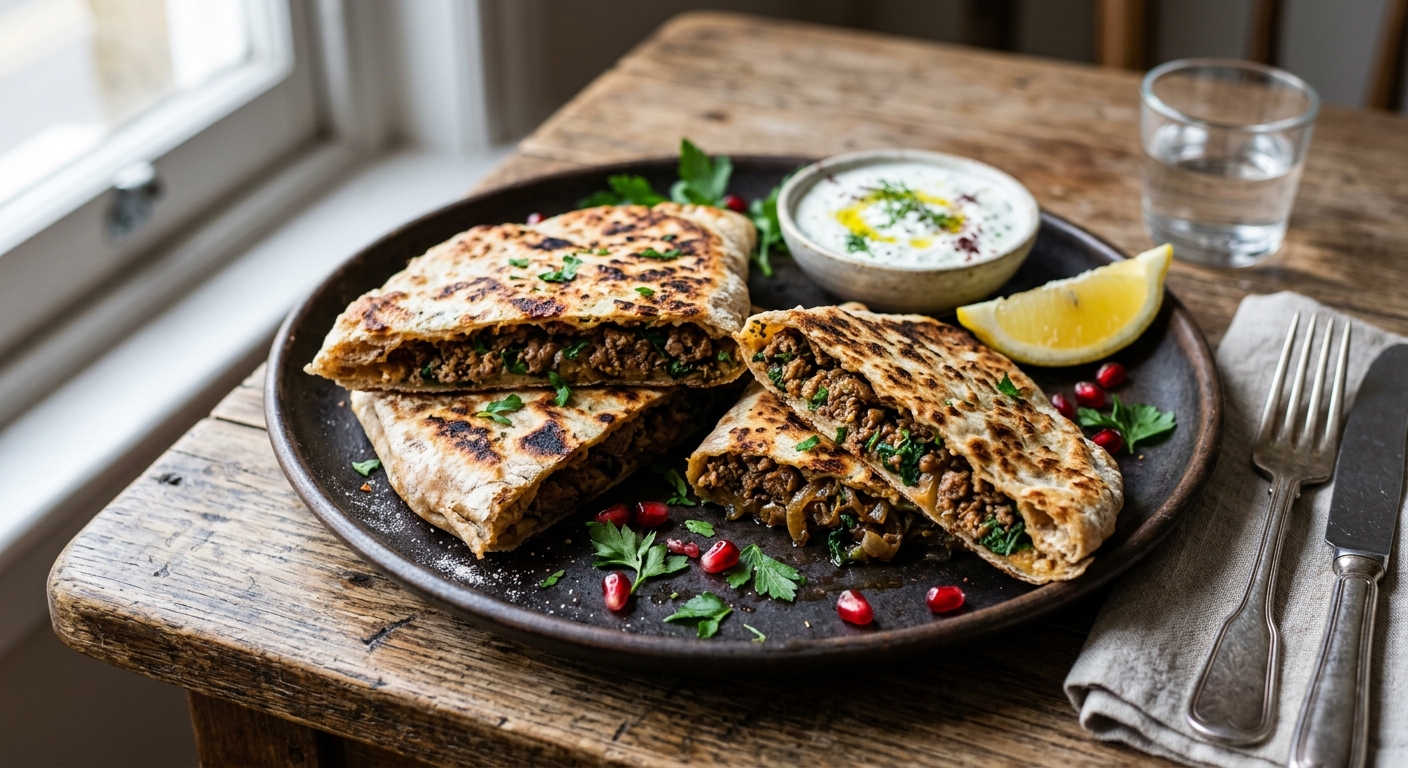
There is a reason spiced lamb flatbreads have anchored the cuisines of the Middle East, North Africa, and Central Asia for thousands of years: the combination of iron-rich ruminant meat with wheat-based bread creates a nutritional pairing that is almost perfectly designed for human needs. This recipe distills that ancient wisdom into a modern, precisely calibrated dish where every component earns its place on both flavour and function grounds. The lamb filling is seasoned with cumin, coriander, cinnamon, and smoked paprika, ingredients that do far more than taste good. Cumin and coriander both contain compounds that measurably enhance non-haem iron absorption, and the vitamin C contributed by fresh tomato in the filling further boosts uptake of the lamb’s substantial haem iron content.
The flatbread dough itself uses a modest amount of whole wheat flour blended with white bread flour, a deliberate choice that adds meaningful fibre and B-vitamins without sacrificing the supple, blistered texture that makes stuffed flatbreads so irresistible. A thin smear of full-fat yogurt inside each bread before sealing adds a slight tang, encourages browning, and contributes calcium and additional protein. Pine nuts folded into the lamb mixture provide heart-healthy monounsaturated fats, a hit of copper (which is required for iron metabolism), and a gentle textural contrast that elevates this well beyond standard fast-food territory.
Whether you are cooking the filling low and slow for a weekend gathering, under pressure on a busy weeknight, or searing it hot in a skillet for maximum caramelisation, each method below has been written as a genuinely distinct process tuned to the equipment’s strengths. The flatbreads themselves are always cooked on a scorching-hot dry skillet or griddle, which produces the characteristic charred bubbles and chewy crumb that no oven alone can replicate. Plan for four generous stuffed flatbreads per batch, each one delivering a calibrated payload of iron, zinc, B12, selenium, and all the essential amino acids your body needs.
4
servings
Ingredients
- 300 gbread flour (or 00 flour), plus extra for dusting
- 100 gwhole wheat flour
- 7 ginstant yeast (1 sachet)
- 5 gColima Sea SaltMicroplastic Free Salt
- 5 gcaster sugar
- 240 mlwarm water (approximately 38 degrees C)
- 2 tbspextra-virgin olive oil, divided
- 500 gground lamb (15 to 20% fat)
- 1 mediumbrown onion, finely diced
- 4 clovesgarlic, minced
- 1 mediumripe tomato, finely diced (about 120g)
- 2 tspground cumin
- 1.5 tspground coriander
- 1 tspsmoked paprika
- 0.5 tspground cinnamon
- 0.25 tspcayenne pepper (adjust to taste)
- 0.5 tspground allspice
- 30 gpine nuts, lightly toasted
- 20 gfresh flat-leaf parsley, roughly chopped
- 4 tbspfull-fat plain yogurt
- 1 tbsppomegranate molasses
- —Colima Sea SaltMicroplastic Free Salt and black pepper to taste
- —Lemon wedges, extra yogurt, and fresh mint to serve
Instructions
Click on an item below to shop for the recommended items for this recipe on Amazon.
As an Amazon Associate, we earn from qualifying purchases.
- Make the dough: Combine both flours, yeast, salt, and sugar in a large bowl. Make a well in the centre and add the warm water and 1 tablespoon of the olive oil. Mix until a shaggy dough forms, then turn out onto a lightly floured surface and knead firmly for 8 to 10 minutes until smooth, elastic, and slightly tacky. Place in a lightly oiled bowl, cover with a damp cloth, and leave to rise at room temperature for 45 to 60 minutes until doubled.
- Cook the lamb filling: Heat the remaining 1 tablespoon of olive oil in a large heavy-bottomed skillet or cast iron pan over medium-high heat until shimmering. Add the diced onion with a pinch of salt and cook, stirring occasionally, for 5 to 6 minutes until softened and golden at the edges. Add the minced garlic and cook for 1 minute until fragrant. Add the ground lamb, breaking it up with a wooden spoon or spatula, and cook undisturbed for 2 to 3 minutes to develop a deep brown sear on the bottom before stirring. Continue cooking and breaking up the meat for a further 5 minutes until no pink remains and some pieces are well caramelised.
- Season and finish the filling: Reduce heat to medium. Add the cumin, coriander, smoked paprika, cinnamon, cayenne, and allspice directly to the lamb and stir constantly for 1 minute to toast the spices in the rendered fat. Add the diced tomato and pomegranate molasses, stir well, and cook for 3 to 4 minutes until the tomato breaks down and the mixture is fragrant and cohesive but not soupy. Taste and adjust salt and pepper. Remove from heat and fold in the toasted pine nuts and chopped parsley. Allow the filling to cool for at least 10 minutes so it does not tear the dough.
- Divide and shape the flatbreads: Punch down the risen dough and divide it into 4 equal portions (approximately 165g each). On a lightly floured surface, roll each portion into a rough oval or circle about 20 to 22 cm across and 3 to 4 mm thick. Spread 1 tablespoon of yogurt over one half of each dough circle, leaving a 1.5 cm border. Spoon one-quarter of the lamb filling (about 130g) evenly over the yogurt layer. Fold the bare half of the dough over the filling, press the edges firmly to seal, and crimp with a fork. Gently press each parcel flat with your palm to an even thickness of about 1.5 cm.
- Cook the flatbreads: Heat a large dry cast iron skillet or heavy skillet over high heat for 2 minutes until very hot. Cook each stuffed flatbread for 3 to 4 minutes per side, pressing gently with a spatula, until deep golden-brown with charred spots and the dough is cooked through. Work in batches, keeping finished flatbreads warm wrapped in a clean towel. Serve immediately with lemon wedges, extra yogurt, and fresh mint.
- Brown the lamb base first: Heat 1 tablespoon of olive oil in a skillet over high heat. Add the onion with a pinch of salt and cook for 4 minutes until softened. Add the garlic and cook 1 minute. Add the ground lamb and break it up, cooking for 6 to 7 minutes until browned and the liquid has largely evaporated. This browning step is essential for the slow cooker, as it creates the Maillard compounds that the low, moist environment cannot replicate. Drain excess rendered fat if more than 2 tablespoons remains.
- Build the slow cooker filling: Transfer the browned lamb and onion mixture to the slow cooker insert. Add the diced tomato, pomegranate molasses, cumin, coriander, smoked paprika, cinnamon, cayenne, and allspice. Stir everything together thoroughly so the spices coat the meat evenly. Add 3 tablespoons of water to help steam circulate. Cover and cook on Low for 4 hours. The low heat gently melds the spices into the fat of the lamb, creating a richer, more rounded flavour than fast stovetop cooking.
- Make the dough during the final hour: About 60 to 70 minutes before the filling finishes, combine both flours, yeast, salt, sugar, warm water, and 1 tablespoon of olive oil in a large bowl. Knead for 8 to 10 minutes until smooth and elastic. Place in a lightly oiled bowl, cover, and let rise for 45 to 60 minutes. This way the dough is proofed and ready exactly when the filling is done.
- Finish the filling: When the 4 hours are up, uncover the slow cooker and stir the filling. If it looks watery, turn the cooker to High and leave uncovered for 15 to 20 minutes to reduce excess liquid until the mixture is thick and cohesive. Remove from heat, fold in the toasted pine nuts and chopped parsley, and allow to cool for 10 minutes.
- Shape and cook flatbreads on the stovetop: Divide the dough into 4 portions and roll each into a 20 to 22 cm oval. Spread 1 tablespoon of yogurt over one half of each piece, top with one-quarter of the slow-cooked filling, fold and crimp the edges firmly. Heat a dry cast iron skillet over high heat until very hot. Cook each stuffed flatbread for 3 to 4 minutes per side, pressing lightly, until deep golden-brown and cooked through. Serve with lemon wedges, fresh mint, and extra yogurt.
- Saute the aromatics and brown the lamb: Set the Instant Pot or electric pressure cooker to Saute on High. Add 1 tablespoon of olive oil and heat for 1 minute. Add the diced onion with a pinch of salt and saute for 4 minutes until softened. Add the garlic and cook 1 minute. Add the ground lamb, breaking it up, and cook for 5 to 6 minutes until well browned. Add the cumin, coriander, smoked paprika, cinnamon, cayenne, and allspice, stirring for 1 minute to bloom the spices in the hot fat. Add the diced tomato and pomegranate molasses and stir to combine. Add 60 ml (1/4 cup) of water to bring the liquid to the minimum required for pressurisation and deglaze any browned bits from the bottom of the insert to prevent a burn warning.
- Start the dough while the pressure cooker comes up to pressure: Secure the lid, set the valve to Sealing, and cook on High Pressure for 8 minutes. While the cooker pressurises and cooks (roughly 15 to 18 minutes total), mix both flours, yeast, salt, sugar, warm water, and 1 tablespoon olive oil in a bowl. Knead for 8 minutes until smooth, then cover and let rest. The dough will begin proofing while the filling cooks.
- Natural release and reduce: When the 8 minutes are complete, allow a natural pressure release for 10 minutes, then carefully switch the valve to Venting to release any remaining pressure. Open the lid. If liquid pooled in the filling, switch back to Saute on Normal and stir for 3 to 5 minutes until the mixture tightens to a thick, scoopable consistency. Cancel Saute, fold in the pine nuts and parsley, and allow to cool for 10 minutes.
- Shape the flatbreads: By now the dough should have risen noticeably, approximately 30 to 40% in volume (a shorter proof than stovetop because the room warmed up). That is sufficient for a pleasantly chewy flatbread. Divide into 4 portions, roll each to a 20 to 22 cm oval about 3 mm thick. Spread 1 tablespoon of yogurt over one half, add one-quarter of the pressure-cooked filling, fold, and crimp edges firmly with a fork.
- Cook the flatbreads: Heat a dry cast iron skillet or heavy pan over high heat for 2 minutes until very hot. Cook each flatbread 3 to 4 minutes per side, pressing gently with a spatula, until deep golden-brown patches form and the interior is fully cooked. Serve immediately with lemon wedges, extra yogurt, and torn fresh mint.
- Preheat the oven aggressively: Place a large baking steel, pizza stone, or heavy-duty rimmed baking sheet on the middle rack and preheat the oven to 230 degrees C (450 degrees F) for at least 45 minutes. Thorough preheating is the single most important step for oven flatbreads. A cold baking surface produces a pale, steamed result; a scorching-hot surface produces the blistered, golden-brown crust you want.
- Make the dough and prepare the stovetop filling: Follow the stovetop filling instructions (steps 2 and 3 from the Stovetop method) to cook the spiced lamb filling on the hob while the oven preheats and the dough rises. This is the most efficient use of time. Make the dough at the same time, kneading for 8 to 10 minutes and resting covered for 45 to 60 minutes.
- Shape the flatbreads for oven cooking: Divide the dough into 4 equal portions. On a piece of lightly floured baking parchment (this is how you will transfer them), roll each piece into a thin oval or round of about 22 to 24 cm across and only 2 to 3 mm thick. Thinner than the skillet version, as the oven provides gentler heat and a slightly thicker flatbread will stay doughy inside. Spread 1 tablespoon of yogurt over one half, add one-quarter of the cooled lamb filling, fold the dough over, and crimp firmly. Brush the tops lightly with olive oil to encourage deep browning.
- Bake in two batches if needed: Using a pizza peel or the back of a flat baking sheet, slide 2 flatbreads (on their parchment) onto the preheated baking surface. Bake for 9 to 11 minutes until the tops are deep golden-brown with some charred patches and the underside is crisp. The parchment will darken but not burn. Remove and bake the remaining 2. If your oven has a broiler (grill), switch it on for the final 2 minutes to intensify colour on top.
- Rest and serve: Transfer the baked flatbreads to a wire rack for 3 minutes before slicing, which allows the steam inside to redistribute and prevents the filling from spilling immediately on cutting. Serve with lemon wedges, cool yogurt, and fresh mint leaves.
Nutrition Breakdown
Per 1 serving (makes 4)
Vitamins & Minerals
% Daily Value based on a 2,000 calorie diet (FDA reference)
🧬 Essential Amino Acids
% of recommended daily intake (RDA) per serving
🛡 Antioxidant Profile
The Nutrition Science
Lamb is one of the most bioavailable iron sources in the human diet. A 125 g cooked portion delivers roughly 2.7 mg of haem iron, the Fe(II) form bound to myoglobin and haemoglobin, which is absorbed at 15 to 35% efficiency regardless of gut conditions. This contrasts sharply with plant-based non-haem iron (Fe(III)), which absorbs at only 2 to 20% and is heavily influenced by competing dietary factors. This recipe provides approximately 8 mg of total iron per serving, the majority as haem iron from the lamb plus a meaningful non-haem contribution from the whole wheat flour. At a conservative 20% average absorption rate, this single meal delivers roughly 1.6 mg of absorbed elemental iron, making a substantial dent in the adult RDA of 8 mg (men) or 18 mg (women).
The spice blend is not merely decorative. Cumin (Cuminum cyminum) contains the phenolic aldehyde cuminaldehyde, which has been demonstrated in several in vitro studies to chelate ferric iron and reduce its precipitation as insoluble ferric hydroxide in the gut, thereby keeping more iron in solution for mucosal uptake. Coriander seed and black pepper both contain piperine-adjacent alkaloids that enhance enterocyte permeability for micronutrients. Meanwhile, the vitamin C from fresh tomato (approximately 15 mg per serving) reduces dietary Fe(III) to the more absorbable Fe(II) form directly in the stomach. Pomegranate molasses adds a small further boost via ellagic acid, which has been shown to stimulate ferroportin expression, the key iron export protein in intestinal epithelium.
The zinc story is equally compelling. Lamb is among the richest dietary zinc sources, providing around 7.4 mg per serving here, exceeding the RDA of 11 mg for men by 67% on its own. Zinc is required as a cofactor for over 300 enzymatic reactions including those governing DNA repair, immune signalling, and testosterone synthesis, yet it is chronically under-consumed in Western diets that have shifted away from red meat. Crucially, the pine nuts contribute copper at a ratio favourable to zinc metabolism: excessive zinc without copper can competitively inhibit copper absorption, so the roughly 0.4 mg of copper from pine nuts here acts as a natural buffer. The high selenium content (primarily from the lamb at approximately 25 mcg per 125 g) supports glutathione peroxidase activity, the body’s primary lipid-peroxide-neutralising enzyme, which is especially relevant when cooking fat-containing red meat at high heat.
Pro Tips
- Toast the pine nuts in a dry skillet over medium heat for 2 to 3 minutes, shaking constantly, until golden. They go from pale to burned in under a minute if left unattended, and toasted pine nuts contribute a buttery, almost caramel depth that raw ones simply cannot.
- The most common cause of burst flatbreads is overfilling or under-crimping. Leave a clear 1.5 cm border of dough around the filling edge and crimp firmly twice with a fork. A damp finger run along the dough border just before folding acts like glue and dramatically reduces blowouts.
- For maximum iron absorption, avoid drinking tea, coffee, or calcium-rich milk with this meal. Polyphenols in tea and tannins in coffee bind non-haem iron in the gut and can reduce absorption by up to 60%. Save your coffee for 1 hour after eating, and squeeze the provided lemon wedge liberally over the flatbread just before eating for a final ascorbic acid boost.
Such a smart question, Laurie! The heme iron from lamb is already in that highly absorbable form (around 15-35% bioavailability), but you’re absolutely right that adding vitamin C is a game changer for maximum retention, especially when you’re in that critical postpartum rebuilding phase. A squeeze of fresh lemon over the finished dish or a side of something bright like pickled onions or a fresh tomato salad could push that iron uptake even higher, and it would complement those warm spices beautifully. I’ve seen so many nursing patients’ iron labs improve dramatically just by pairing their iron-rich meals with citrus or tomatoes rather than focusing only on quantity
Love this insight, Veronika! I’d also add that the spice blend itself matters for postpartum iron absorption, especially if there’s turmeric or cinnamon in there, since cinnamon actually helps with insulin stability while you’re rebuilding. When I was recovering from my own iron dip, I started pairing iron-rich meals with a small glass of orange juice and it made such a visible difference in my energy levels within weeks. The heme iron from lamb is definitely your friend here, but yeah, that vitamin C pairing is absolutely non-negotiable for maximizing what your body actually absorbs, especially when you’re running on nursing hormones and sleep deprivation!
This looks incredible for iron, but I’m immediately wondering about the bioavailability here, especially for those of us postpartum who are nursing and trying to rebuild iron stores! Is there vitamin C in the spice blend or served alongside it? I’ve been experimenting with pairing iron-rich meals with citrus or fermented elements to actually absorb what we’re eating, and the lamb’s heme iron is such a head start. Also, total side note but this would be *amazing* for postpartum recovery, and I’m curious if you have thoughts on whether this stays good for freezing in portions, since new moms rarely have time to cook fresh meals.