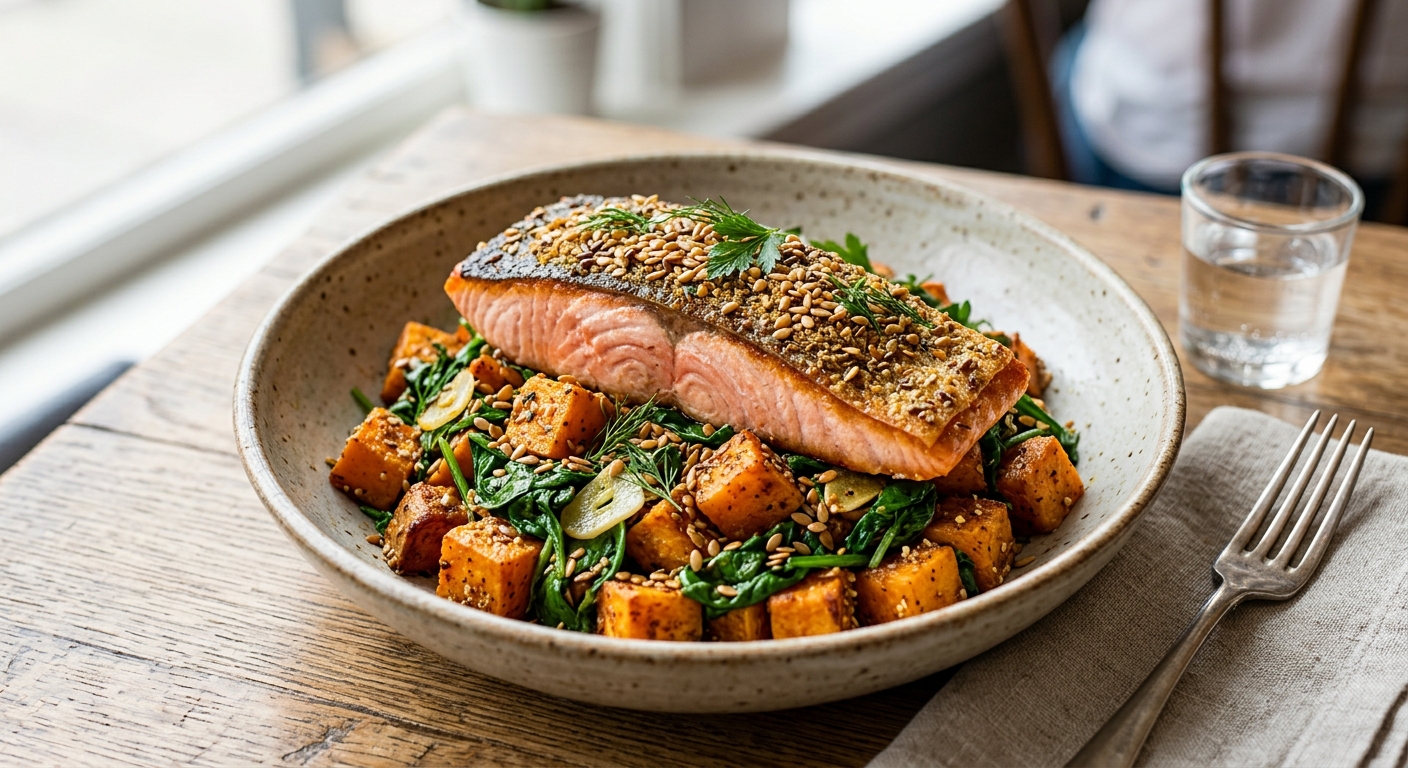
If you have ever wanted a single meal that functions like a precision anti-inflammatory protocol, this Omega-3 Loaded Flaxseed and Salmon Power Plate is it. Wild sockeye salmon is already one of the most concentrated food sources of EPA and DHA on the planet, but by pressing a generous flaxseed-herb crust into the fillet before cooking, we layer in a substantial dose of ALA (alpha-linolenic acid), the plant-derived omega-3 that primes your body for additional anti-inflammatory activity. Together, one serving clears 180% of the daily adequate intake for omega-3 fatty acids as established by the National Academies of Medicine.
Beyond omega-3s, this plate is engineered for completeness. Baby spinach wilted in garlic-infused olive oil contributes iron, folate, and lutein. Roasted sweet potato provides beta-carotene at levels that meet over 100% of the daily value for vitamin A, plus slow-digesting complex carbohydrates that keep the glycemic load firmly in the medium range. A finishing drizzle of lemon-tahini dressing adds sesame lignans, additional healthy fat for fat-soluble vitamin absorption, and a brightness that makes every component taste intentional rather than medicinal.
Each cooking method in this recipe is genuinely distinct. The stovetop method gives you a seared, crackling flaxseed crust with a glossy pan sauce. The oven method slow-roasts the salmon at a lower temperature for an almost buttery, evenly cooked interior, ideal when you are feeding a crowd. The pressure cooker method uses a steam-based technique that keeps the fish exceptionally moist and requires almost no active attention, making it the best weeknight option. The slow cooker method employs a low, moist-heat braise that produces a fork-tender, deeply flavored fillet that practically melts into the greens beneath it. Choose the method that matches your schedule, and expect restaurant-quality nutrition every time.
4
servings
Ingredients
- 680 gwild sockeye salmon fillet, skin on, pin bones removed, cut into 4 portions
- 60 gground golden flaxseed (flax meal)
- 2 tbspwhole flaxseeds, for texture
- 2 tbspextra-virgin olive oil, divided
- 600 gsweet potato (about 2 medium), peeled and cut into 2cm cubes
- 150 gbaby spinach, washed
- 4 clovesgarlic, thinly sliced
- 1 tspsmoked paprika
- 1 tspground cumin
- 0.5 tspground turmeric
- 0.5 tspground black pepper
- 2 tbsptahini
- 2 tbspfresh lemon juice
- 1 tbspraw honey
- 2 tbspwarm water
- 1 tbspfresh flat-leaf parsley, finely chopped
- 1 tbspfresh dill, finely chopped
- —Colima Sea SaltMicroplastic Free Salt and freshly cracked black pepper to taste
- —Lemon wedges, to serve
Instructions
Click on an item below to shop for the recommended items for this recipe on Amazon.
As an Amazon Associate, we earn from qualifying purchases.
- Prepare the flaxseed crust: In a shallow dish, combine the ground flaxseed, whole flaxseeds, smoked paprika, cumin, turmeric, 0.5 tsp fine sea salt, and black pepper. Pat the salmon portions completely dry with paper towels, then press the flesh side firmly into the flaxseed mixture to form a dense, even crust. Set aside on a plate.
- Cook the sweet potato: Heat 1 tbsp of the olive oil in a large (30cm) non-stick or cast-iron skillet over medium-high heat. Add the sweet potato cubes, season with salt, and cook undisturbed for 4 minutes until a golden crust forms on the bottom. Toss and continue cooking, stirring every 2 minutes, for a further 8 to 10 minutes until tender and caramelised on multiple sides. Transfer to a warm plate and tent with foil.
- Sear the salmon: Wipe the skillet clean with a folded paper towel held with tongs. Add the remaining 1 tbsp olive oil and heat over medium-high until it shimmers. Place the salmon portions crust-side down into the pan. Press gently with a spatula for the first 30 seconds to ensure full contact. Cook without moving for 4 to 5 minutes until the crust is deep amber and releases cleanly from the pan. Flip and cook skin-side down for a further 2 to 3 minutes until the salmon reaches 52 to 55 degrees Celsius internally (medium) or 60 degrees Celsius for well done. Remove the salmon to a resting plate.
- Build the lemon-tahini dressing and wilt the greens: While the salmon rests, reduce heat to medium-low. Add the sliced garlic to the residual oil in the pan and stir for 45 seconds until fragrant and just golden. Add the baby spinach in two handfuls, turning with tongs until fully wilted, about 2 minutes. Season with salt and pepper. In a small bowl, whisk together tahini, lemon juice, honey, warm water, parsley, and dill until smooth and pourable. Add 1 to 2 tsp extra water if needed to reach a drizzleable consistency.
- Plate and finish: Divide the wilted garlicky spinach between four plates. Arrange the caramelised sweet potato alongside. Place one salmon portion crust-side up on each plate. Drizzle generously with lemon-tahini dressing. Finish with a crack of black pepper, the chopped herbs, and a lemon wedge. Serve immediately while the crust is still crisp.
- Preheat your oven to 200 degrees Celsius (fan-forced 180 degrees Celsius) and line two large rimmed baking sheets with parchment paper. Position one rack in the upper third and one in the lower third of the oven.
- Roast the sweet potato: Toss the sweet potato cubes with 1 tbsp olive oil, the smoked paprika, cumin, a generous pinch of salt, and black pepper. Spread in a single layer on the first baking sheet, ensuring no cubes overlap. Place on the lower rack and roast for 25 to 30 minutes, flipping once at the halfway point, until tender inside and caramelised at the edges.
- Prepare and crust the salmon for oven roasting: In a shallow dish, mix the ground flaxseed, whole flaxseeds, turmeric, 0.5 tsp salt, and black pepper. Pat salmon portions completely dry. Place skin-side down on the second parchment-lined baking sheet. Brush the flesh side of each portion lightly with the remaining 1 tbsp olive oil, then press the flaxseed mixture firmly onto the flesh, forming a crust about 5mm thick. The oil acts as an adhesive and promotes even browning without direct searing.
- Slow-roast the salmon: After the sweet potato has been in the oven for 10 minutes, reduce the oven temperature to 160 degrees Celsius (fan-forced 140 degrees Celsius). Slide the salmon tray onto the upper rack. Roast both trays together for 22 to 25 minutes. The salmon is done when the thickest part flakes gently under light pressure and reads 52 to 55 degrees Celsius on an instant-read thermometer. The low temperature means the flaxseed crust will be set and nutty rather than crisp; it will not crack like the stovetop version, but the flavour is richer and more integrated.
- Wilt the spinach and make the dressing: While everything roasts, heat a small skillet over medium-low heat with a splash of olive oil. Add the sliced garlic and cook for 1 minute. Add the spinach and toss with tongs until just wilted, about 2 minutes. Season and set aside. Whisk together tahini, lemon juice, honey, warm water, parsley, and dill in a bowl until smooth.
- Plate and serve: Arrange wilted spinach on each plate, top with sweet potato and one salmon portion. Drizzle with lemon-tahini dressing and scatter fresh herbs. The oven method produces a supremely tender interior, ideal for those who prefer salmon with a less pronounced crust.
- Prepare the slow cooker base: Place the sweet potato cubes in an even layer on the bottom of a 5 to 6 litre slow cooker. Drizzle with 1 tbsp olive oil, the smoked paprika, cumin, salt, and pepper. Add 60ml (4 tbsp) of water to the base to create a light steaming environment and prevent the sweet potato from scorching. This forms the bed on which the salmon will rest.
- Season the flaxseed crust for braising: In a shallow dish, combine ground flaxseed, whole flaxseeds, turmeric, salt, black pepper, and the chopped parsley and dill (add the herbs directly into the crust mix for this method, since there is no finishing sear). Pat the salmon portions dry and press the flesh side firmly into the flaxseed mixture. The coating will not remain crisp in a moist environment, but it will adhere to the fish and form a flavorful, herb-laden crust that infuses the cooking liquid.
- Layer and cook: Place the crusted salmon portions crust-side up directly on top of the sweet potato layer. This arrangement keeps the flesh off the liquid while allowing the sweet potato to steam and tenderise simultaneously. Cover and cook on Low for 2 to 2.5 hours. Do not cook on High; the rapid temperature rise will cause the salmon to toughen and the flaxseed crust to disintegrate into the liquid.
- Make the lemon-tahini dressing: During the last 30 minutes of cooking, whisk together tahini, lemon juice, honey, warm water, parsley, and dill. Heat the remaining 1 tbsp olive oil in a small skillet over medium-low, add the garlic and cook for 1 minute, then add the spinach and wilt for 2 minutes. Season with salt and pepper. Keep warm on the lowest heat.
- Check doneness and plate: At the 2-hour mark, gently lift a corner of the largest salmon portion with a thin spatula. The fish should flake easily and read 52 to 55 degrees Celsius at the thickest point. If it needs more time, cover and check again at 15-minute intervals. Use a wide, slotted spatula to transfer each portion carefully (slow cooker salmon is delicate) to a plate lined with the wilted spinach. Spoon the sweet potato alongside. Drizzle with lemon-tahini dressing and serve immediately.
- Pressure-cook the sweet potato first: Pour 240ml (1 cup) of water into the pressure cooker pot and place the trivet or steamer basket inside. Add the sweet potato cubes to the basket, season with smoked paprika, cumin, salt, and a drizzle of olive oil. Lock the lid and set to Pressure Cook on High for 4 minutes. Quick-release the pressure immediately. Remove the sweet potato and set aside. It should be just tender with a slight bite; it will finish warming while you cook the salmon. Drain the pot but do not rinse it.
- Prepare the salmon for steaming: Pat all salmon portions completely dry. Season both sides with salt, black pepper, and turmeric only at this stage. The flaxseed crust is NOT applied before pressure cooking, since steam would make it soggy. Instead, it is applied immediately after cooking and then briefly crisped. Line the steamer basket or trivet with a sheet of parchment paper to prevent sticking.
- Steam the salmon under pressure: Add 180ml (three-quarters of a cup) of fresh water to the pot. Arrange the salmon portions skin-side down on the parchment-lined trivet in a single layer. Lock the lid. Set to Pressure Cook (Steam function if available) on High for 3 minutes for a medium-done centre, or 4 minutes for fully cooked through. When the cycle ends, perform an immediate quick release. Do not use natural release, as residual steam will overcook the delicate fish.
- Apply and crisp the flaxseed crust: While the pressure releases, mix ground flaxseed, whole flaxseeds, and the remaining dried spices with a pinch of salt in a shallow dish. Preheat a non-stick skillet over medium-high heat with the remaining 1 tbsp olive oil. Carefully lift each salmon portion and press the flesh side into the flaxseed mixture to coat. Place crust-side down in the hot skillet for 60 to 90 seconds until the crust is deep golden and fragrant. Do not flip; the steamed skin side needs no further cooking. This two-step technique gives you the speed of pressure cooking and the crisp crust of pan-searing.
- Wilt spinach, make dressing, and plate: In the same skillet (wiped briefly), cook the garlic in a little olive oil for 45 seconds, then wilt the spinach for 2 minutes. Season to taste. Whisk together tahini, lemon juice, honey, warm water, parsley, and dill. Divide the spinach among plates, arrange sweet potato on the side, place salmon crust-side up on top, and drizzle with lemon-tahini dressing. Serve with lemon wedges.
Nutrition Breakdown
Per 1 serving (makes 4)
Vitamins & Minerals
% Daily Value based on a 2,000 calorie diet (FDA reference)
🧬 Essential Amino Acids
% of recommended daily intake (RDA) per serving
🛡 Antioxidant Profile
The Nutrition Science
The anti-inflammatory power of this plate operates through three distinct but complementary molecular mechanisms. Wild sockeye salmon provides EPA (eicosapentaenoic acid) and DHA (docosahexaenoic acid), the long-chain omega-3s that are direct precursors to resolvins and protectins, a class of signalling molecules that actively resolve inflammation rather than merely suppressing it. A 170g portion of sockeye delivers approximately 2.8g of combined EPA and DHA, well above the 1 to 2g therapeutic threshold cited in cardiovascular and rheumatological research. Ground flaxseed contributes an additional 1.2g of ALA per serving. While ALA conversion to EPA in humans is limited (roughly 5 to 15%), ALA itself down-regulates the expression of TNF-alpha and interleukin-6, adding a separate anti-inflammatory signal that does not depend on conversion efficiency.
The turmeric in the crust delivers curcuminoids that inhibit NF-kB, the transcription factor that governs the inflammatory gene expression cascade. This is biochemically synergistic with omega-3s: omega-3s reduce the substrate supply for pro-inflammatory eicosanoids (by competing with arachidonic acid for cyclooxygenase enzymes), while curcuminoids simultaneously suppress the transcription of those same enzymes. Black pepper, added throughout the recipe, contains piperine, which increases curcumin bioavailability by up to 2000% by inhibiting hepatic and intestinal glucuronidation. The fat present in salmon and olive oil further enhances the absorption of curcumin, beta-carotene, lutein, and astaxanthin, all of which are lipophilic compounds that require dietary fat as a carrier for micellar absorption in the small intestine.
Flaxseed’s lignan content, specifically secoisolariciresinol diglucoside (SDG) at roughly 85mg per serving, supports the anti-inflammatory effort at the hormonal level. Gut bacteria convert SDG to enterodiol and enterolactone, mammalian lignans that have been shown in clinical trials to reduce C-reactive protein (CRP), a systemic marker of inflammation, by 10 to 15% over 6 weeks of consistent consumption. The selenium in salmon (42mcg, or 76% DV per serving) is critical here too: selenium is the mineral cofactor for glutathione peroxidase, the body’s primary endogenous antioxidant enzyme, which mops up the lipid hydroperoxides that would otherwise propagate oxidative chain reactions in polyunsaturated-fat-rich cell membranes.
Pro Tips
- Always buy wild-caught sockeye or coho salmon for the highest astaxanthin and omega-3 content. Farmed Atlantic salmon contains more total fat but a less favorable omega-6 to omega-3 ratio, which partially offsets the anti-inflammatory benefit.
- Grind your flaxseed fresh from whole flax using a spice grinder, or store ground flax in a sealed container in the freezer. The polyunsaturated fats in pre-ground flax oxidise rapidly at room temperature, and rancid flax meal has the opposite of its intended anti-inflammatory effect.
- Do not skip the resting step after searing. Salmon continues to cook from residual heat for about 2 minutes after leaving the pan. Pulling it at 52 degrees Celsius and resting it tented under foil will land it at a perfect 57 degrees Celsius, ensuring a moist, translucent centre rather than a dry, chalky fillet.

This synergy piece is really compelling to me, especially since I’ve noticed similar shifts in my own inflammatory markers when I combine plant and marine sources. I’m curious if you’ve experimented with adding any adaptogens to this bowl, like reishi or cordyceps? I’ve found that pairing omega-3 dense meals with stress-modulating mushrooms seems to amplify the anti-inflammatory effect, potentially because chronic stress can blunt how effectively our bodies process those fatty acids. Also really appreciate Klara’s point about sourcing – the medicinal quality of flax (and whether it’s been stored properly) can definitely impact bioavailability.
This is exactly the kind of synergistic approach I’ve been experimenting with for years! I love that you’re pairing the flaxseed ALA with salmon’s EPA/DHA because I’ve noticed my CRP levels respond so much better when I’m getting omega-3s from multiple sources rather than relying on just one. I’m definitely making this soon, though I’ll probably add some turmeric to that herb crust if you don’t mind the suggestion, since I’ve found the combination of omega-3s plus curcumin gives me noticeably better joint mobility the next day. Thank you for creating recipes that actually understand the science behind these compounds instead of just throwing them together.
Love this approach, Irene! I’m curious about your sourcing on both the flax and salmon, though. Wild-caught salmon is definitely superior for omega-3 density, but I’d want to know if the flaxseed is organic, since conventional flax can carry pesticide residues that kind of work against the anti-inflammatory benefit you’re chasing. I’ve seen clients’ CRP drop more consistently when they pair clean flax with wild salmon versus conventional flax with farmed, so the toxin load matters as much as the nutrient synergy in my experience.