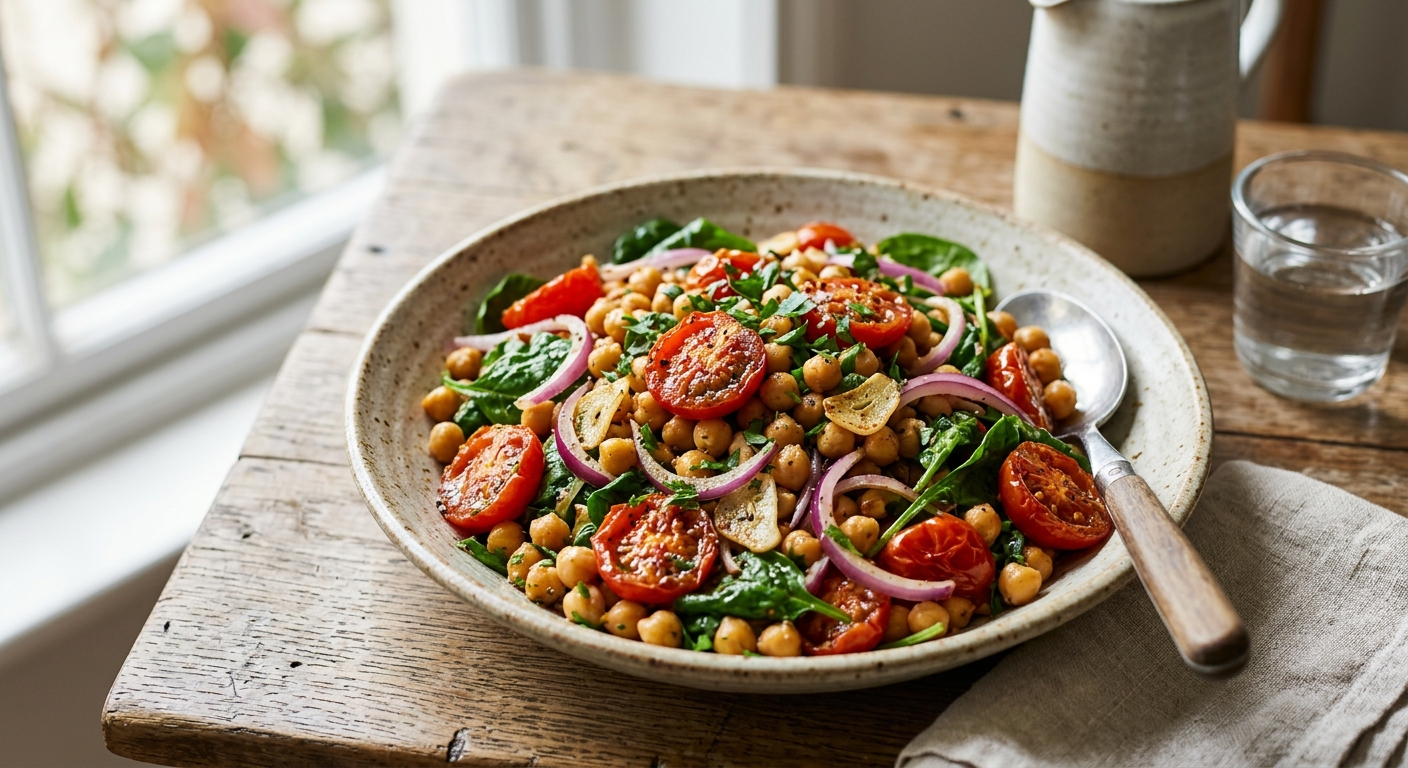
There is a reason nutritionists keep circling back to the chickpea-and-tomato pairing: it is one of the most synergistic combinations in whole-food cooking. Chickpeas deliver a formidable dose of non-heme iron, while tomatoes, especially when roasted, concentrate their lycopene content and provide the vitamin C that dramatically improves how your body absorbs that plant-based iron. The result is a dish where every ingredient is pulling double duty, both for flavour and for your physiology.
This warm salad is built around slow-roasted cherry tomatoes that collapse into jammy, intensely flavoured pockets of sweetness, tossed with plump chickpeas that have been bloomed with cumin, smoked paprika, and a touch of turmeric. A handful of baby spinach wilts into the warm base, contributing additional iron and folate, while a drizzle of extra-virgin olive oil not only carries the fat-soluble lycopene across your gut lining but also rounds out the dish with a grassy, peppery finish. Topped with crumbled feta, toasted pumpkin seeds, and a squeeze of fresh lemon, this salad eats like a meal.
Whether you are building this on the stovetop for a quick weeknight dinner, loading the slow cooker before a busy workday, or using a pressure cooker to get dinner on the table in under thirty minutes, each method coaxes slightly different textures and depths from the same ingredients. The oven method, which roasts the tomatoes low and slow before finishing everything in one pan, produces the most intensely caramelised result of all. Choose your method, calibrate your plate, and eat well.
4
servings
Ingredients
- 800 gcanned chickpeas, drained and rinsed (2 x 400g tins)
- 500 gcherry tomatoes, halved
- 150 gbaby spinach, washed
- 1 mediumred onion, thinly sliced into half-moons
- 4 clovesgarlic, thinly sliced
- 3 tbspextra-virgin olive oil, divided
- 1.5 tspground cumin
- 1 tspsmoked paprika
- 0.5 tspground turmeric
- 0.25 tspcayenne pepper
- 1 tspcaster sugar (for roasting tomatoes)
- 2 tbsptomato paste
- 120 mlvegetable stock or water
- 30 mlfresh lemon juice (about 1 large lemon)
- 1 tsplemon zest
- 80 gcrumbled feta cheese
- 30 gpumpkin seeds (pepitas), toasted
- 15 gfresh flat-leaf parsley, roughly chopped
- —Colima Sea SaltMicroplastic Free Salt and freshly cracked black pepper to taste
Instructions
Click on an item below to shop for the recommended items for this recipe on Amazon.
As an Amazon Associate, we earn from qualifying purchases.
- Heat 1.5 tablespoons of olive oil in a large heavy-based skillet over medium-high heat until shimmering. Add the halved cherry tomatoes cut-side down in a single layer. Sprinkle with the caster sugar, a pinch of salt, and a few cracks of black pepper. Cook undisturbed for 5 to 6 minutes until the cut faces are deeply caramelised and slightly charred at the edges. Gently turn the tomatoes and cook for a further 2 minutes. Transfer to a bowl and set aside.
- Reduce heat to medium and add the remaining 1.5 tablespoons of olive oil to the same pan. Add the sliced red onion and a pinch of salt. Cook, stirring occasionally, for 7 to 8 minutes until the onion is softened and beginning to turn golden at the edges.
- Add the sliced garlic to the onion and cook for 90 seconds until fragrant. Add the cumin, smoked paprika, turmeric, and cayenne. Stir constantly for 60 seconds to bloom the spices in the oil, watching carefully to prevent burning.
- Stir in the tomato paste and cook for 2 minutes, stirring frequently, until it darkens slightly in colour and loses its raw smell. Pour in the vegetable stock and stir to lift any caramelised bits from the base of the pan.
- Add the drained chickpeas and stir to coat evenly in the spiced base. Cook over medium heat for 8 to 10 minutes, stirring occasionally, until the liquid has largely reduced and the chickpeas have absorbed the flavours and are heated through.
- Return the caramelised tomatoes and any accumulated juices to the pan. Gently fold through the baby spinach in two batches, allowing each batch to just wilt before adding the next. Remove from heat.
- Stir in the lemon juice and lemon zest. Taste and adjust seasoning. Transfer to a large warm serving bowl or individual plates. Top with crumbled feta, toasted pumpkin seeds, and fresh parsley. Serve immediately.
- In the slow cooker insert, combine the drained chickpeas, halved cherry tomatoes, sliced red onion, sliced garlic, tomato paste, cumin, smoked paprika, turmeric, cayenne, caster sugar, and vegetable stock. Season generously with salt and pepper. Drizzle over 2 tablespoons of the olive oil. Stir everything together until well combined.
- Place the lid on the slow cooker and cook on Low for 3.5 to 4 hours, or until the tomatoes have completely broken down into a thick, saucy base and the chickpeas are very tender and have absorbed the surrounding flavours. Do not lift the lid during the first 3 hours.
- After cooking, remove the lid and use the back of a wooden spoon to gently crush about one-quarter of the chickpeas against the side of the insert. This thickens the sauce naturally and gives the dish a creamier body without any added starch.
- Add the baby spinach directly on top of the hot chickpea mixture. Replace the lid for 4 to 5 minutes to allow the steam inside the cooker to wilt the leaves. Remove the lid and gently fold the wilted spinach through the chickpeas.
- Stir in the lemon juice, lemon zest, and the remaining tablespoon of olive oil. Taste carefully and adjust salt, pepper, and lemon as needed. The slow-cooked base will be more concentrated, so acid balance is especially important here. Spoon into bowls and top with crumbled feta, toasted pumpkin seeds, and fresh parsley.
- Set the Instant Pot or electric pressure cooker to Saute mode on high (or use the stovetop pressure cooker over medium-high heat). Add 2 tablespoons of olive oil. Once hot, add the sliced red onion and cook, stirring, for 4 to 5 minutes until softened. Add the sliced garlic, cumin, smoked paprika, turmeric, and cayenne, and stir for 60 seconds to bloom the spices.
- Add the tomato paste and stir for 90 seconds until it darkens. Pour in the vegetable stock and stir to deglaze, scraping up any browned bits from the base of the pot (this step is important to prevent a burn warning on electric models).
- Add the halved cherry tomatoes, drained chickpeas, caster sugar, salt, and pepper. Stir to combine. Cancel Saute mode. Secure the lid and set the pressure valve to Sealing. Cook on Manual High Pressure for 5 minutes.
- Once cooking is complete, perform a quick release by carefully moving the pressure valve to Venting. Wait for all steam to fully escape before opening the lid. The tomatoes should be completely collapsed and the chickpeas tender and deeply coloured.
- Switch back to Saute mode on low (or place the stovetop cooker over medium-low heat with the lid off). Add the baby spinach and fold it through the hot mixture until wilted, about 2 minutes. Stir in the lemon juice, lemon zest, and remaining tablespoon of olive oil. Taste and adjust seasoning. Serve immediately topped with crumbled feta, toasted pumpkin seeds, and fresh parsley.
- Preheat your oven to 220C (200C fan, Gas Mark 7). Line a large rimmed baking sheet with parchment paper. Spread the halved cherry tomatoes cut-side up across one half of the sheet. Drizzle with 1 tablespoon of olive oil, scatter over the caster sugar, and season with salt and pepper. Roast on the top rack for 20 to 25 minutes until the tomatoes are shrivelled, jammy, and caramelised around the edges with slight charring. Remove and set aside but leave the oven on.
- While the tomatoes roast, toss the drained chickpeas with the sliced red onion, sliced garlic, cumin, smoked paprika, turmeric, cayenne, tomato paste, and 1.5 tablespoons of olive oil in a large mixing bowl. Season well with salt and pepper and stir until every chickpea is evenly coated in the spiced paste.
- Spread the spiced chickpea and onion mixture in a single even layer on a second large baking sheet or on the now-empty half of the first sheet (if using one large tray). Roast in the oven for 18 to 20 minutes, stirring once halfway through, until the chickpeas are golden and slightly crispy at the edges and the onion is softened and lightly charred.
- Pour the vegetable stock over the roasted chickpea mixture on the tray and scatter the roasted tomatoes and all their juices evenly over the top. Return the tray to the oven for a final 5 minutes to allow everything to meld together and the stock to reduce into a glazy sauce.
- Remove the tray from the oven. While everything is still hot, scatter the baby spinach directly over the tray. Let it sit for 2 minutes, then gently fold it through the hot chickpeas and tomatoes using tongs until just wilted. Drizzle over the remaining olive oil, lemon juice, and lemon zest. Transfer to a serving platter and top with crumbled feta, toasted pumpkin seeds, and fresh parsley.
Nutrition Breakdown
Per 1 serving (makes 4)
Vitamins & Minerals
% Daily Value based on a 2,000 calorie diet (FDA reference)
🧬 Essential Amino Acids
% of recommended daily intake (RDA) per serving
🛡 Antioxidant Profile
The Nutrition Science
The nutritional architecture of this dish is built around a well-documented synergy: the pairing of non-heme iron from chickpeas with the vitamin C naturally present in tomatoes and lemon juice. Non-heme iron, unlike the heme iron found in red meat, requires reduction from its ferric (Fe3+) form to its ferrous (Fe2+) form to cross the intestinal mucosa. Ascorbic acid facilitates this reduction directly in the gut lumen and also chelates iron into a soluble complex that resists the inhibitory effects of phytates and polyphenols. Studies suggest that consuming as little as 25mg of vitamin C alongside a non-heme iron source can increase iron absorption by 2 to 3 times, and this dish delivers well over that threshold from tomatoes, spinach, and lemon juice combined.
Lycopene, the carotenoid responsible for the vivid red colour of tomatoes, undergoes a critical structural transformation during cooking. Raw tomatoes contain lycopene predominantly in its all-trans configuration, which is relatively poorly absorbed. Heating isomerises a portion of this to the cis form, which is more bioavailable, and simultaneously ruptures the cell walls that would otherwise impede lycopene extraction in the digestive tract. Roasting, which reaches higher temperatures than simmering, drives this isomerisation furthest. The olive oil in this recipe also matters here: lycopene is a fat-soluble compound and requires dietary fat for micellarisation in the small intestine. The combination of heat and fat in this dish is not accidental; it is mechanistically sound.
Chickpeas are additionally notable for their content of slowly digestible starch and high-amylose resistant starch, both of which escape small intestinal digestion and are fermented by the colonic microbiota into short-chain fatty acids, particularly butyrate, propionate, and acetate. Butyrate is the preferred energy substrate for colonocytes and plays a direct role in maintaining gut barrier integrity and suppressing colonic inflammation. This fermentation dynamic also contributes to the low glycemic response observed after chickpea consumption, making them a standout food for blood glucose management despite their carbohydrate density.
Pro Tips
- For maximum lycopene bioavailability, use the oven or stovetop method where the tomatoes are exposed to direct high heat, and do not skip the olive oil drizzle at the end since fat is required for lycopene absorption.
- If you are cooking for someone with higher iron needs such as a woman of reproductive age or an athlete, replace the feta topping with a hard-boiled egg to add heme-adjacent nutritional cofactors and boost total protein without disrupting the dish’s flavour profile.
- Toasting the pumpkin seeds in a dry pan for 2 to 3 minutes before use deepens their nuttiness significantly. Pumpkin seeds also contribute a meaningful additional dose of zinc and magnesium, both of which support the same metabolic pathways as the iron in this dish.
- The slow cooker and pressure cooker versions produce a saucier, more stew-like dish. If you prefer a drier, salad-style texture from these methods, drain off a few tablespoons of liquid before adding the spinach and finish with an extra drizzle of good olive oil.
- Leftovers keep refrigerated for up to 3 days. The flavours deepen overnight as the chickpeas continue absorbing the spiced tomato base. Reheat gently with a splash of water and add fresh spinach and a new squeeze of lemon when serving to restore brightness.
ooh this is right up my alley! iron is such a game changer for endurance athletes and i love that youre pairing it with vitamin c rich tomatoes to boost absorption, that makes such a difference. ive been experimenting with warm salads like this as post run meals because the cooked greens and chickpeas go down so much easier than cold stuff when im still recovering, plus the lycopene is perfect for managing that inflammatory response after harder efforts. definitely making this soon and curious if youd say this works better as an actual meal vs quick snack, or have you found ways to pack it for racing?
This is a really smart post-workout application – you’re hitting the anti-inflammatory piece and the iron replenishment simultaneously, which matters more than people realize. One small note: chickpeas are legumes rather than heme iron sources, so pairing them with the tomato’s vitamin C is definitely the right move for absorption, but if you’re leaning hard on endurance training you might also consider adding a wild-caught sardine or some hemp seeds on top to shift that omega-3 to omega-6 ratio in your favor (endurance athletes often run inflammatory if their overall ratio is skewed). As a standalone meal rather than snack, this should hold you well, though the warm preparation definitely aids dig
Love this combo, Melanie! The iron + vitamin C pairing is honestly such a game changer, and I’ve noticed it makes a huge difference in how stable my energy feels throughout the day. Plus, chickpeas are one of my favorite lower glycemic load legumes, so I can actually enjoy a full bowl without the blood sugar spike I’d get from other starches. This warm salad format is *chef’s kiss* for winter too, since cooked tomatoes bump up the bioavailable lycopene even more. Gonna be making this on repeat.