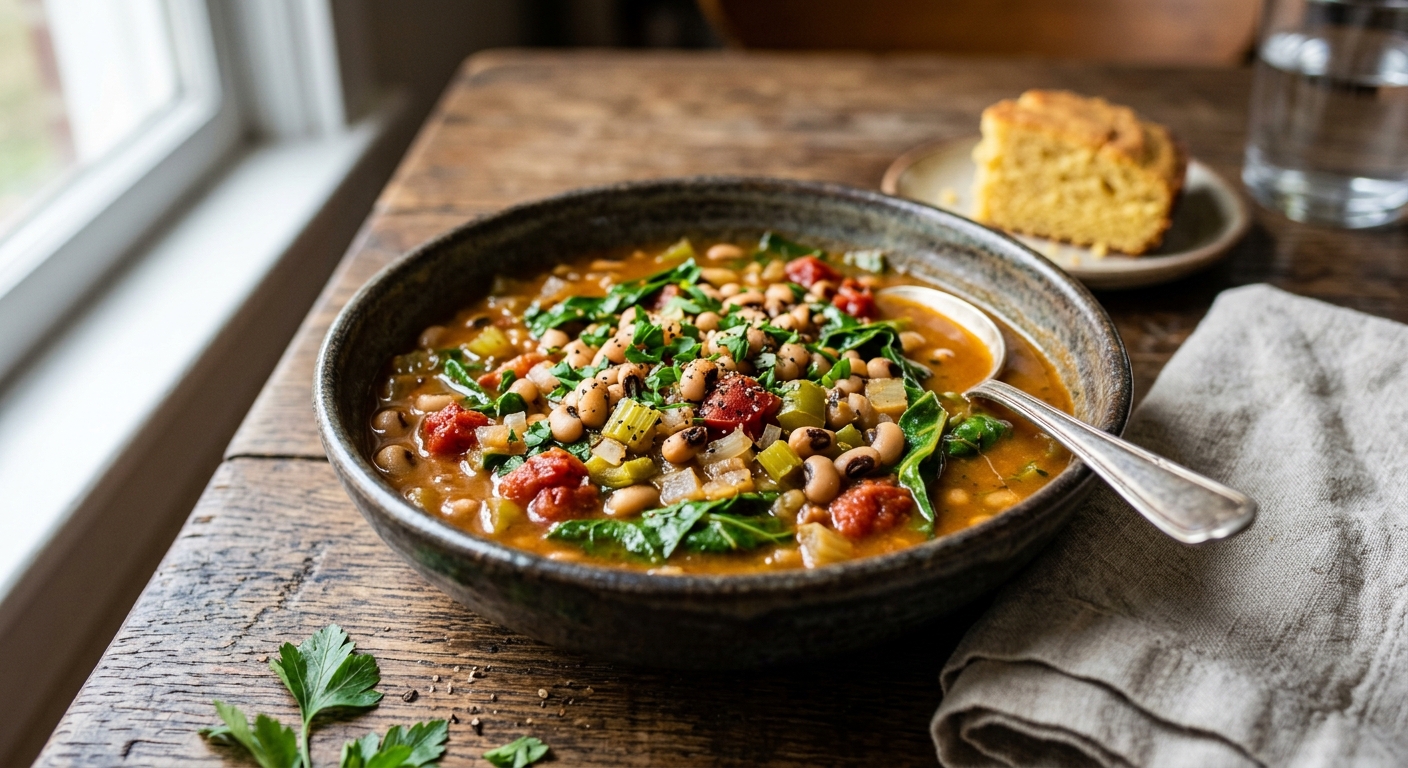
There is a reason black-eyed peas have anchored Southern cooking for centuries. Long before anyone tracked milligrams or daily values, cooks understood intuitively that a pot of these earthy, creamy legumes left you feeling nourished in a way that few other meals could match. Paired with collard greens, one of the most nutrient-dense leafy vegetables on the planet, and layered with smoked paprika, fire-roasted tomatoes, and aromatics, this stew is Southern food at its most purposeful. It is comfort and calibration in the same bowl.
From a nutritional standpoint, this recipe is an iron and folate delivery system disguised as dinner. Black-eyed peas provide roughly 4.3mg of non-heme iron per cooked cup, and collard greens add another meaningful contribution alongside calcium and vitamin K. Crucially, the tomatoes in this dish are not just flavor, they provide vitamin C, which research consistently shows enhances non-heme iron absorption by up to three-fold by converting iron from its ferric to its more absorbable ferrous form. Every ingredient earns its place here both at the table and in your body.
This recipe is designed for flexibility. The stovetop method builds deep flavor through traditional layering and fond development. The slow cooker version uses a cold-start technique that coaxes maximum sweetness from the aromatics over a long, gentle cook. The pressure cooker delivers a weeknight-fast result without sacrificing complexity. And the oven method, a low, slow braise, produces the most luxuriously thick, jammy stew of all four approaches. Choose your method based on your schedule, and expect a genuinely different but equally rewarding result each time.
4
servings
Ingredients
- 400 gdried black-eyed peas, soaked overnight and drained (or 2 x 400g cans, drained and rinsed)
- 180 gcollard greens, stems removed, leaves sliced into 1cm ribbons
- 400 gcanned fire-roasted diced tomatoes
- 1 mediumyellow onion, finely diced
- 4 clovesgarlic, minced
- 1 mediumgreen bell pepper, finely diced
- 2 stalkscelery, finely diced
- 3 tbspextra-virgin olive oil
- 2 tspsmoked paprika
- 1 tspground cumin
- 0.5 tspcayenne pepper
- 1 tspdried thyme
- 1 tspdried oregano
- 950 mllow-sodium vegetable broth
- 2 tspapple cider vinegar
- 1 tspcoconut sugar or light brown sugar
- 2 tsptomato paste
- —Colima Sea SaltMicroplastic Free Salt and freshly ground black pepper to taste
- —Fresh flat-leaf parsley or green onion tops, to serve
Instructions
Click on an item below to shop for the recommended items for this recipe on Amazon.
As an Amazon Associate, we earn from qualifying purchases.
- Heat the olive oil in a large Dutch oven or heavy-bottomed pot over medium heat until shimmering. Add the diced onion, bell pepper, and celery. Cook, stirring occasionally, for 8 to 10 minutes until the vegetables are completely softened and beginning to turn golden at the edges. This patient softening step builds the sweet, savory base the whole stew depends on.
- Push the vegetables to the sides of the pot and add the tomato paste directly to the cleared center. Let it cook undisturbed for 90 seconds until it darkens slightly and smells caramelized, then stir it into the vegetables. Add the minced garlic, smoked paprika, cumin, cayenne, thyme, and oregano. Stir constantly for 60 seconds to bloom the spices in the fat, releasing their fat-soluble compounds.
- Add the drained black-eyed peas and pour in the vegetable broth. Stir well to scrape up any fond from the bottom of the pot. Bring to a boil over high heat, then reduce to a steady, gentle simmer (small bubbles breaking the surface but not a rolling boil). Cook uncovered for 30 to 35 minutes for canned peas, or 45 to 55 minutes for pre-soaked dried peas, until the peas are completely creamy and tender throughout.
- Once the peas are tender, stir in the fire-roasted tomatoes, coconut sugar, and apple cider vinegar. Nestle the collard green ribbons into the stew, pressing them down into the liquid. Cook for a further 12 to 15 minutes, stirring occasionally, until the greens are completely wilted, tender, and have lost their raw bitterness but retain a slight texture.
- Taste and adjust seasoning with salt, black pepper, and an extra splash of vinegar if needed. The stew should taste smoky, slightly tangy, savory, and full-bodied. If it is thinner than you prefer, increase heat and simmer uncovered for 5 more minutes. Ladle into bowls and top with fresh parsley or sliced green onion tops.
- The evening before or the morning of cooking, place the onion, bell pepper, celery, garlic, tomato paste, olive oil, smoked paprika, cumin, cayenne, thyme, oregano, coconut sugar, and drained black-eyed peas directly into the slow cooker insert. Pour over the vegetable broth and stir everything together thoroughly. There is no pre-sauteing here; the cold-start method allows the aromatics to slowly release their sugars into the broth from the very beginning, building a round, integrated sweetness that the stovetop method achieves differently.
- Place the lid on the slow cooker and cook on Low for 6 to 7 hours or on High for 3.5 to 4 hours, until the black-eyed peas are completely tender and the broth has developed a rich, deeply savory color. Resist lifting the lid during this period, as each peek loses approximately 20 to 30 minutes of cooking time.
- Once the peas are tender, stir in the fire-roasted tomatoes and apple cider vinegar. Lay the collard green ribbons over the top of the stew without stirring them in yet. Replace the lid and cook on High for a further 45 to 60 minutes until the greens are fully wilted and silky.
- Stir the greens through the stew. Using the back of a ladle or a potato masher, roughly crush about one-quarter of the peas directly in the pot. This releases their starch into the broth and thickens the stew naturally, compensating for the slower evaporation rate of a sealed slow cooker versus an open stovetop pot.
- Taste carefully and adjust with salt, black pepper, and additional apple cider vinegar. Slow-cooked stews often need a brighter final hit of acid to wake up the flavors. Serve directly from the insert, topped with fresh parsley or green onions.
- Select the Saute function on your Instant Pot or pressure cooker and heat the olive oil until shimmering. Add the onion, bell pepper, and celery and cook, stirring frequently, for 5 to 6 minutes until softened. Add the tomato paste and cook for 60 seconds, then add the garlic, smoked paprika, cumin, cayenne, thyme, and oregano. Stir constantly for 30 seconds. Press Cancel to stop the Saute function.
- Add the drained black-eyed peas, vegetable broth, and coconut sugar. Stir well, scraping any bits from the bottom of the pot with a wooden spoon to prevent the burn notice. Do not add the tomatoes, vinegar, or collard greens at this stage. Acidic ingredients can toughen legume skins under pressure, and leafy greens turn mushy.
- Secure the lid and set the pressure valve to Sealing. Cook on Manual High Pressure for 18 minutes for pre-soaked dried peas or 8 minutes for canned peas. When the cook time ends, allow a natural pressure release for 15 minutes, then carefully switch the valve to Venting to release any remaining steam.
- Open the lid and check that the peas are fully tender. Select the Saute function again on the Normal setting. Stir in the fire-roasted tomatoes, apple cider vinegar, and collard green ribbons. Simmer uncovered, stirring occasionally, for 8 to 10 minutes until the greens are tender and the broth tightens slightly with the tomato liquid. The open saute at the end is critical for flavor concentration after the sealed pressure environment.
- Taste and season generously with salt and black pepper. The stew should have a bold, smoky depth. If it tastes flat, add a few more drops of apple cider vinegar. Serve immediately, topped with fresh parsley or green onion tops.
- Preheat your oven to 160C (320F) with a rack positioned in the lower third. On the stovetop over medium heat, heat the olive oil in a large oven-safe Dutch oven with a tight-fitting lid. Add the onion, bell pepper, and celery and cook for 8 to 10 minutes until deeply softened. Add the tomato paste and cook for 2 minutes until it darkens, then add garlic and all the dried spices and herbs. Stir for 60 seconds to bloom.
- Add the drained black-eyed peas, fire-roasted tomatoes, vegetable broth, apple cider vinegar, and coconut sugar all at once. Stir to combine and bring the mixture to a gentle boil on the stovetop. Unlike the stovetop method, you add the tomatoes at this stage because the lower, more consistent oven temperature will not toughen the pea skins the way a stovetop boil can.
- Lay the collard green ribbons over the surface of the stew. They will look like too much volume at first but will collapse beautifully into the stew as it braises. Press them gently down into the liquid, place the lid firmly on the Dutch oven, and transfer to the preheated oven.
- Braise for 1 hour 45 minutes without opening the oven. At the 1 hour 45 minute mark, remove the lid and carefully stir the stew, folding any caramelized edges inward. Return to the oven uncovered for a final 15 to 20 minutes to reduce and concentrate the surface of the stew into a glossy, thick gravy.
- Remove from the oven and let the stew rest for 10 minutes before serving. The resting period allows the residual heat to finish the greens and gives the starches time to fully set the broth into that signature jammy consistency. Season with salt and black pepper, and finish with fresh parsley or green onion tops.
Nutrition Breakdown
Per 1 serving (makes 4)
Vitamins & Minerals
% Daily Value based on a 2,000 calorie diet (FDA reference)
🧬 Essential Amino Acids
% of recommended daily intake (RDA) per serving
🛡 Antioxidant Profile
The Nutrition Science
The iron story in this stew is a study in synergy. Black-eyed peas provide non-heme iron, the plant-based form that the body absorbs at a baseline rate of around 2 to 5 percent under normal conditions. However, vitamin C fundamentally changes that equation. By reducing ferric iron (Fe3+) to the more soluble ferrous form (Fe2+) in the acidic environment of the stomach, ascorbic acid can increase non-heme iron absorption by 2 to 3 times. The 38mg of vitamin C in this stew, coming from the fire-roasted tomatoes, bell pepper, and collard greens, is specifically why those ingredients are non-negotiable from a nutritional architecture standpoint. The apple cider vinegar provides additional acidity that creates a favorable gastric environment for this conversion.
Folate deserves particular attention here. At 89% DV per serving, this stew is one of the most folate-dense savory dishes in everyday cooking. Black-eyed peas are among the top 10 dietary sources of folate globally, providing the food form (dietary folate equivalents) that research increasingly suggests may be better regulated by the body than synthetic folic acid supplementation. Folate is essential for DNA synthesis, red blood cell formation, and one-carbon metabolism, which governs methylation processes throughout the body. Collard greens add a second significant folate source, making the legume-greens combination particularly powerful for anyone with elevated homocysteine, during pregnancy, or recovering from anemia.
The smoked paprika in this recipe is not merely a flavor tool. Paprika is a concentrated source of carotenoids, particularly capsanthin and beta-carotene, along with vitamin E. Research published in food chemistry literature shows that the fat-soluble carotenoids in paprika have significantly higher bioavailability when consumed with fat, which is exactly why they are bloomed in olive oil early in every version of this recipe. The olive oil also provides oleocanthal, a phenolic compound with ibuprofen-like anti-inflammatory properties, and enhances absorption of the fat-soluble vitamin K abundant in the collard greens.
Pro Tips
- Never add salt to legumes at the start of cooking if using dried peas. Salt and acid (tomatoes) both toughen the skin and slow water absorption. Season generously only once the peas are already tender.
- For maximum iron absorption, eat this stew alongside a vitamin C source rather than with tea, coffee, or calcium-rich dairy on the side. Tannins in tea and phytates in bran bind non-heme iron and can reduce absorption by up to 60 percent.
- Leftover stew thickens considerably overnight as the peas continue to absorb the broth. When reheating, add 60 to 120ml of water or broth and stir over medium-low heat. The reheated version often tastes better than the freshly made one as the flavors continue to develop.
This is such a thoughtful approach to honoring tradition while optimizing nutrition, and I’m really curious about the spice profile here. Black pepper gets overlooked so often, but the piperine in it actually enhances iron absorption significantly, which would amplify that impressive 42% even further. I’ve found that adding medicinal mushrooms like reishi or chaga to long-simmering stews like this one creates an almost imperceptible earthy depth while adding stress-modulating compounds that help with the inflammatory response from burnout, if anyone’s dealing with that. Did you consider any mushrooms for this recipe, or does the collard green and smoked paprika combination give you everything you’re looking for
This looks absolutely beautiful, and I love how you’re honoring the soul food tradition while highlighting the nutritional density! I’m curious though, are you incorporating any black pepper into the stew or perhaps as a finishing touch? I ask because the iron bioavailability from those black-eyed peas would really shine when paired with even a small amount of black pepper, especially if you layered in some turmeric as well, which would complement that smoky paprika beautifully and add anti-inflammatory benefits. The collard greens are already such a powerhouse, so this dish has serious potential for mineral absorption.
Oh Tiara, what a wonderful question about the black pepper! I’ve been making variations of this stew for over forty years, and I’ve noticed that finishing with freshly cracked black pepper really does something special, not just for flavor but because piperine actually enhances iron absorption, which means this dish becomes even more nutritionally dense than the 42% mentioned. I’m planning to make this for my next class and I’m going to experiment with adding the pepper at different stages, just like you’re suggesting, because I suspect a good crack at the end will brighten all those deep smoky notes while boosting what our bodies can actually use from those black-eyed peas. Thank you for thinking about the