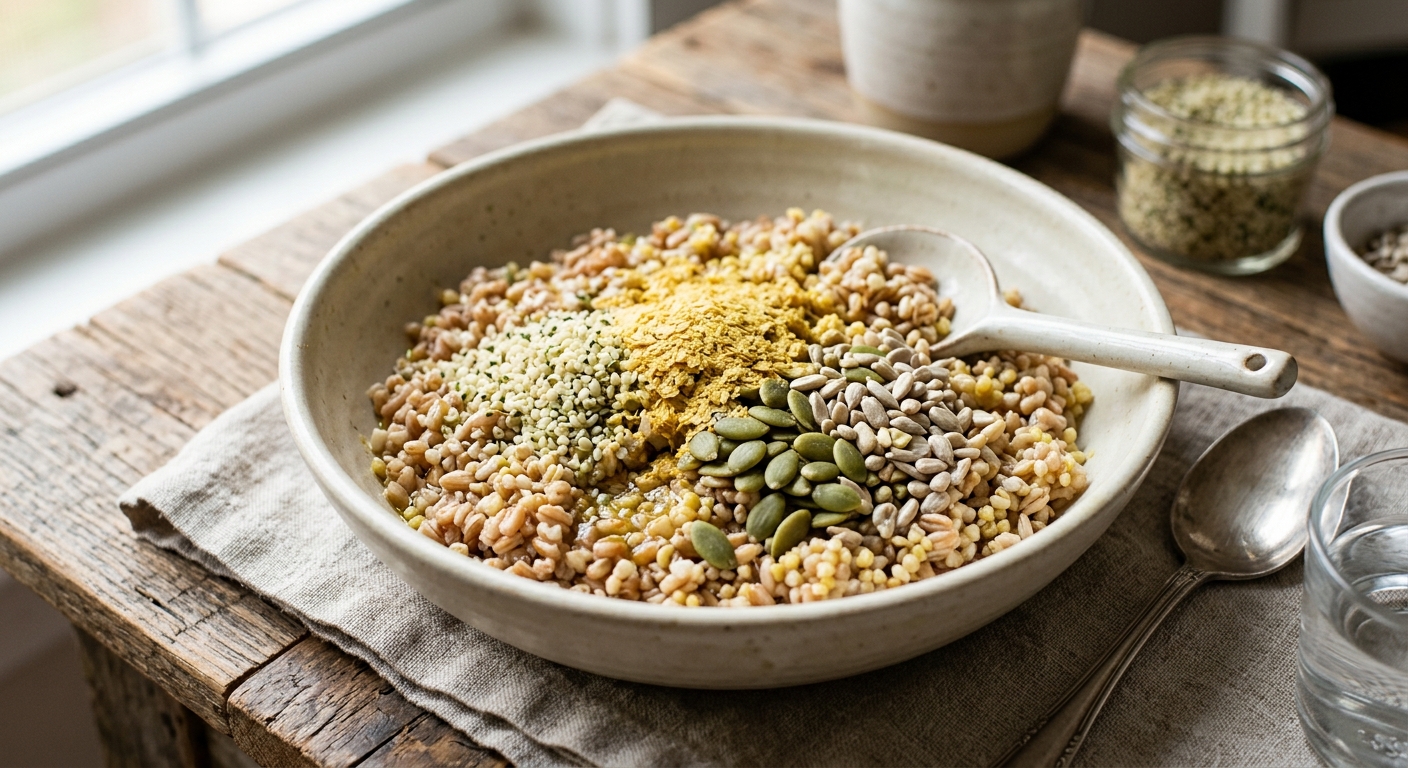
Most breakfast bowls promise a nutritious start but deliver little beyond a spike in blood sugar and a mid-morning crash. This B-Vitamin Complex Whole Grain Breakfast Bowl is engineered differently. By layering three whole grains, each with a distinct B-vitamin profile, alongside hemp seeds, nutritional yeast, sunflower seeds, and a soft-cooked egg, we have built a breakfast that reads almost like a multivitamin in edible form. Farro contributes thiamine and niacin; oat groats bring riboflavin and pantothenic acid; millet adds B6 and folate; and nutritional yeast provides the kind of B-vitamin density that makes every other ingredient look modest by comparison.
The culinary goal here is just as serious as the nutritional one. Each grain has a different ideal texture and cook time, so the recipe is designed to honour that. The farro should be pleasantly chewy with a nutty backbone, the oat groats creamy and yielding, and the millet light and slightly fluffy, binding the bowl together like a savoury porridge. A base of shallot and garlic cooked in olive oil gives the bowl a savoury depth that makes it feel like a proper meal rather than a wellness obligation. Fresh herbs, a drizzle of tahini, and a hit of lemon zest lift the whole thing into something you will genuinely look forward to every morning.
Each serving provides over 500 mcg of folate, more than 2 mg of riboflavin, and meaningful amounts of every B vitamin except B12, which the optional egg begins to address. If you follow a plant-based diet, a tablespoon of nutritional yeast fortified with B12 can close that gap entirely. Whether you cook this on the stovetop in 40 minutes, set it in the slow cooker overnight for a ready breakfast, or pressure-cook it in under 20 minutes on a rushed morning, the nutritional output remains consistent and the result is genuinely delicious.
4
servings
Ingredients
- 120 gpearled farro, rinsed
- 100 goat groats, rinsed
- 80 gmillet, rinsed
- 30 gnutritional yeast flakes
- 40 ghemp seeds (hulled)
- 40 graw pepitas (pumpkin seeds)
- 30 graw sunflower seeds
- 2 tbspextra-virgin olive oil
- 2 mediumshallots, finely diced
- 3 clovesgarlic, minced
- 1 tspground turmeric
- 0.5 tspsmoked paprika
- 1000 mllow-sodium vegetable broth
- 240 mlwater
- 2 tbsptahini
- 1 tbspfresh lemon juice
- 1 tsplemon zest
- 4 largeeggs (optional, for soft-poached topping)
- 15 gfresh flat-leaf parsley, roughly chopped
- 10 gfresh chives, thinly sliced
- —Colima Sea SaltMicroplastic Free Salt and black pepper to taste
Instructions
Click on an item below to shop for the recommended items for this recipe on Amazon.
As an Amazon Associate, we earn from qualifying purchases.
- Toast the pepitas and sunflower seeds in a dry medium skillet over medium heat, stirring frequently, for 3 to 4 minutes until golden and fragrant. Remove from heat, season lightly with salt, and set aside.
- In a large heavy-bottomed pot or Dutch oven, heat the olive oil over medium heat. Add the shallots and cook, stirring occasionally, for 3 to 4 minutes until softened and translucent. Add the garlic, turmeric, and smoked paprika and cook for 1 minute until fragrant.
- Add the rinsed farro and oat groats to the pot and stir to coat them in the oil and aromatics. Toast the grains in the pot for 2 minutes, stirring constantly, until they smell nutty and faintly toasty.
- Pour in the vegetable broth and water. Increase the heat to bring the liquid to a rolling boil, then reduce to a gentle simmer. Cover partially with a lid and cook for 20 minutes.
- After 20 minutes, stir in the rinsed millet. Re-cover partially and continue cooking for another 15 to 18 minutes, stirring every 5 minutes, until the farro is tender-chewy, the oat groats are creamy, and the millet has absorbed most of the liquid. The texture should resemble a thick, risotto-like porridge. If it thickens too much before the grains are done, add 60 ml of water at a time.
- Remove from heat. Stir in the nutritional yeast, hemp seeds, lemon juice, and lemon zest. Taste and season generously with salt and black pepper.
- If using eggs, poach them while the grains finish: bring a separate small saucepan of water to a gentle simmer, add a splash of white vinegar, swirl the water, and slip in the eggs one at a time. Cook for 3 to 3.5 minutes for a runny yolk, then lift out with a slotted spoon.
- Divide the grain mixture among four bowls. Top each with a soft-poached egg if using, a drizzle of tahini, a scatter of toasted pepitas and sunflower seeds, and a generous pinch of parsley and chives. Serve immediately.
- The night before, toast the pepitas and sunflower seeds in a dry skillet over medium heat for 3 to 4 minutes until golden. Let cool completely, then store in a small airtight container at room temperature overnight.
- Lightly grease the insert of a 4- to 6-quart slow cooker with a small amount of olive oil. Add the diced shallots, minced garlic, rinsed farro, oat groats, and millet directly to the insert. No pre-cooking is needed as the long low heat will develop the aromatics sufficiently.
- Stir in the turmeric, smoked paprika, olive oil, vegetable broth, and water. Mix well to distribute everything evenly. Season lightly with salt now, knowing you will adjust at the end. Place the lid on the slow cooker.
- Cook on Low for 7 to 8 hours. Because slow cookers vary in intensity, check at 7 hours: the grains should be very tender and the mixture creamy and thick, like congee. If it looks soupy, remove the lid and cook on High for 15 to 20 minutes to evaporate excess moisture.
- In the morning, stir in the nutritional yeast, hemp seeds, lemon juice, and lemon zest. Taste and adjust salt and pepper. The residual heat will bloom the nutritional yeast into the bowl beautifully.
- Soft-cook the eggs to order using your preferred method: a 6.5-minute boil from cold water for a jammy soft-boiled egg works especially well here as it requires no extra pans. Peel and halve each egg.
- Divide the grain porridge among four bowls. Top with the soft-boiled egg halves, a drizzle of tahini, the toasted seeds, and fresh parsley and chives. Finish with black pepper and serve.
- Select the Saute function on your Instant Pot or electric pressure cooker and set to medium (or Normal). Once hot, add the olive oil. Saute the shallots for 2 to 3 minutes until softened, then add the garlic, turmeric, and smoked paprika and cook for 30 seconds.
- Add the rinsed farro and oat groats and stir to coat in the aromatics for 1 minute. Add the rinsed millet, vegetable broth, and water. Stir well, scraping any browned bits off the bottom of the pot to prevent a burn notice. Press Cancel to end the Saute function.
- Secure the lid and set the pressure valve to Sealing. Cook on High Pressure for 18 minutes. While the cooker builds and holds pressure, toast the pepitas and sunflower seeds in a small dry skillet on the stovetop over medium heat for 3 to 4 minutes. Set aside.
- When the cook time ends, allow the pressure to release naturally for 15 minutes before carefully turning the valve to Venting to release any remaining steam. Open the lid away from you.
- The mixture may look slightly wetter than expected immediately after opening. Stir vigorously: the grains will absorb the liquid within 1 to 2 minutes of stirring and settle into a creamy, thick porridge. If it is still too loose, select Saute on Low and stir for 2 to 3 minutes.
- Stir in the nutritional yeast, hemp seeds, lemon juice, and lemon zest. Season well with salt and black pepper. For the eggs, use the Saute-boiled method: in a small saucepan on the stovetop, lower eggs into boiling water and cook for 6.5 minutes, then transfer to an ice bath for 1 minute before peeling and halving.
- Ladle the grain porridge into four bowls. Top each with egg halves, a generous drizzle of tahini, toasted seeds, fresh parsley and chives, and a final crack of black pepper.
Nutrition Breakdown
Per 1 serving (makes 4)
Vitamins & Minerals
% Daily Value based on a 2,000 calorie diet (FDA reference)
🧬 Essential Amino Acids
% of recommended daily intake (RDA) per serving
🛡 Antioxidant Profile
The Nutrition Science
The B vitamins are a family of eight water-soluble nutrients that function as coenzymes in the metabolic pathways that convert carbohydrates, fats, and proteins into ATP, the chemical currency your cells use for energy. Thiamine (B1) is the gateway coenzyme for pyruvate dehydrogenase, the enzyme that commits glucose to the citric acid cycle. Without adequate thiamine, this conversion stalls, leaving cells energy-deprived even in the presence of sufficient calories. Riboflavin (B2) is the precursor to FAD and FMN, two coenzymes central to the electron transport chain, where the majority of ATP is generated. A single serving of this bowl supplies over 160% of the daily value for riboflavin, largely from the combination of nutritional yeast and oat groats.
Niacin (B3) forms the coenzyme NAD+, which participates in over 400 enzymatic reactions and is arguably the single most important coenzyme in human metabolism. Folate (B9), contributed here by millet, farro, and nutritional yeast, is essential for one-carbon metabolism, the biochemical process underpinning DNA synthesis, methylation, and the conversion of homocysteine to methionine. Elevated homocysteine is an independent risk factor for cardiovascular disease, and regular folate intake is one of the most effective dietary strategies for keeping it in check. Vitamin B6, found in meaningful amounts in millet and sunflower seeds, acts as a coenzyme in over 100 enzymatic reactions, including the synthesis of neurotransmitters such as serotonin and dopamine.
Hemp seeds deserve special attention as a nutritional anchor of this bowl. Unlike most plant proteins, hemp seed protein contains all nine essential amino acids in ratios close to the FAO reference pattern, making it one of the few plant-complete proteins available. It also provides an approximately 3:1 ratio of omega-6 to omega-3 fatty acids, close to the ideal range for reducing systemic inflammation. Combined with the beta-glucan in oat groats, which has robust clinical evidence for lowering LDL cholesterol, and the magnesium from farro and pepitas, which supports over 300 enzyme systems including ATP synthesis itself, this bowl functions as a genuinely integrated metabolic support system rather than a collection of individual superfoods.
Pro Tips
- Do not substitute rolled oats for oat groats. Rolled oats will disintegrate in long cook methods and lack the structural integrity and higher B-vitamin content of the whole groat. If oat groats are unavailable, steel-cut oats are the closest acceptable substitute, though reduce the cook time slightly on the stovetop.
- Nutritional yeast loses some heat-sensitive B vitamins if boiled directly. Always stir it in off the heat or after the pressure has been released to preserve maximum thiamine and folate content.
- The tahini drizzle is not just garnish: the fat in sesame tahini significantly enhances the bioavailability of fat-soluble antioxidants like vitamin E and the carotenoids present in the bowl. Do not skip it or reduce it to a token amount.
This is such a thoughtful breakfast blueprint, and I’m glad you’re spotlighting B vitamins since they’re genuinely the unsung heroes of cellular metabolism. From a pharmacist’s perspective, I’d add that this whole grain approach is particularly valuable for patients on metformin (a common diabetes medication that can deplete B12), since the bioavailable B vitamins here help offset that interaction. The combination of farro, hemp seeds, and egg together is smart too – you’re getting both the B vitamins AND the cofactors like magnesium and choline that actually make energy production work properly.
This looks absolutely wonderful, and I love that you’re highlighting the B vitamins since they’re so crucial for energy without relying on refined carbs. I do have a question though – I’ve noticed that while whole grains are fantastic for their nutrient density, I’m curious if you’ve experimented with adding turmeric or ginger to the cooking liquid for the grains? After eight years of testing what reduces my inflammation markers, I found that incorporating warming spices during grain preparation not only boosts absorption but also gives my joints noticeable relief without changing the flavor profile. I’ll definitely be making this bowl soon, maybe with a drizzle of extra virgin olive oil and some roasted pepitas as you suggest –
What a great observation about spices in the cooking liquid, Irene! I’ve definitely seen this in practice with patients too, especially the ginger route for inflammatory markers. One thing worth knowing from a drug interaction standpoint: if you’re on any anticoagulants like warfarin, high-dose ginger supplements can potentiate effects, but culinary amounts in your grain water are totally fine and actually beneficial for most people. The turmeric angle is fascinating because curcumin absorption genuinely improves with fat and heat, so your instinct to pair it with that olive oil drizzle is spot on from a bioavailability perspective. I’d love to hear if you notice a difference when