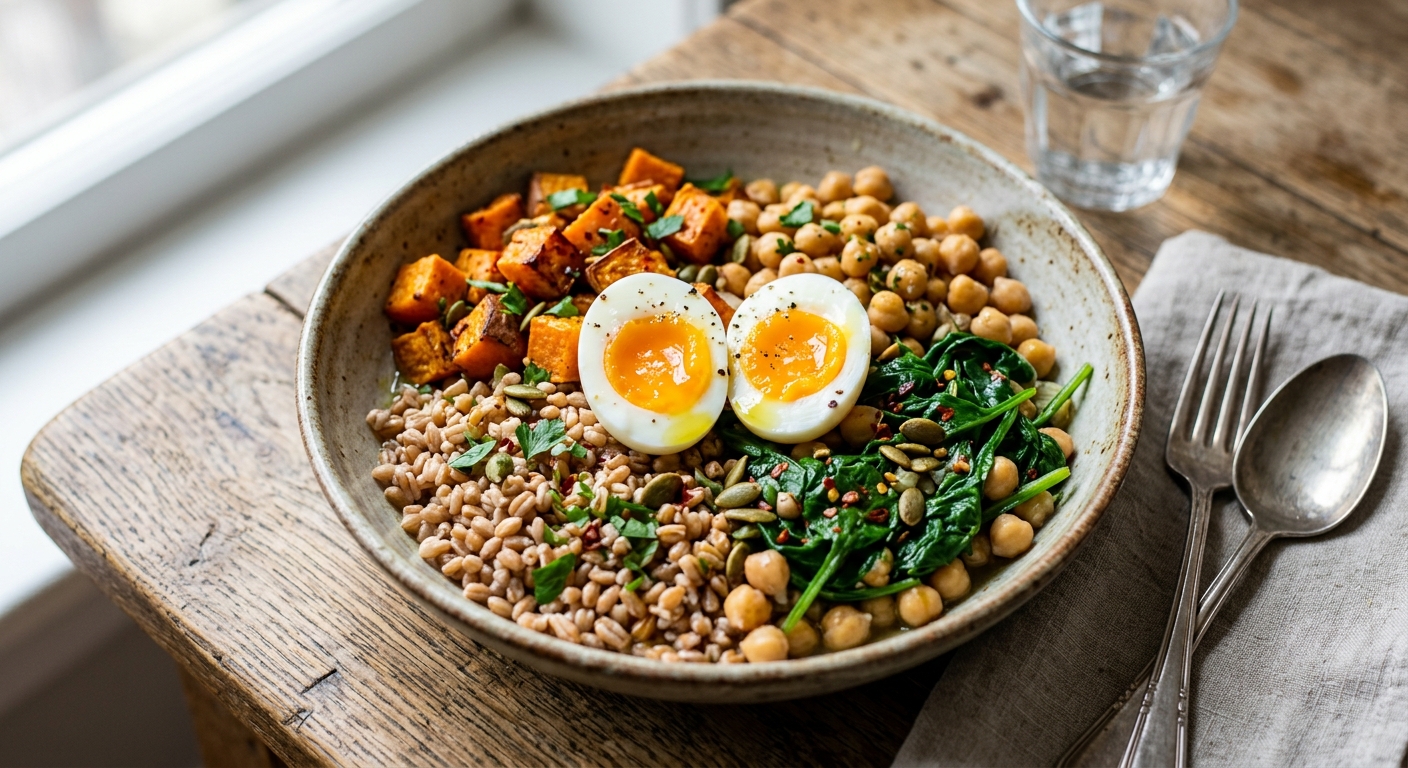
Breaking an intermittent fast is one of the most consequential nutritional moments of your day. After 16 to 24 hours without food, your liver glycogen is partially or fully depleted, circulating insulin is at its lowest, and your cells are primed to absorb glucose, amino acids, and micronutrients with extraordinary efficiency. That window is a gift, and this bowl is designed to use it wisely. Rather than reaching for fast-digesting simple carbohydrates that send blood sugar surging, this refeed bowl pairs slow-releasing farro with protein-rich chickpeas, iron-loaded spinach, and anti-inflammatory turmeric to deliver a controlled, sustained rise in energy that carries you through the entire fed window.
Every component earns its place on nutritional merit. Farro provides a rare combination of complex carbohydrates, plant protein, and B vitamins in a single whole grain. Chickpeas bring resistant starch that feeds gut microbiota while contributing meaningful amounts of folate and manganese. Sweet potato delivers beta-carotene and potassium, two micronutrients commonly depleted after extended fasting periods. The soft-boiled egg adds a complete amino acid profile and choline, a nutrient critical for the liver function that ramps back up the moment you eat. The turmeric-tahini drizzle is not just a flavor bridge: tahini contributes calcium and copper, while turmeric’s curcumin activates the same AMPK pathway that fasting itself stimulates, giving you a smooth metabolic handoff rather than an abrupt stop.
This recipe was calibrated to provide at least 30% of the Daily Value for iron, folate, vitamin A, vitamin C, magnesium, and potassium in a single serving, making it a legitimate nutritional reset whether you practice 16:8, 18:6, or longer extended fasting protocols. The glycemic load sits at a precise medium rating, intentional rather than accidental: enough carbohydrate to restore liver glycogen and signal safety to the hypothalamus, not so much that reactive hypoglycemia becomes a risk two hours later. Cook it on the stovetop in under an hour, set it in a slow cooker before your fast begins so it is ready when you are, or use a pressure cooker to have the entire bowl assembled in 30 minutes flat.
4
servings
Ingredients
- 240 gpearled farro, rinsed
- 400 gcanned chickpeas, drained and rinsed (one 400g tin)
- 500 gsweet potato (about 2 medium), peeled and cut into 2cm cubes
- 200 gbaby spinach, washed
- 4 largeeggs
- 1 mediumyellow onion, finely diced
- 4 clovesgarlic, minced
- 240 mllow-sodium vegetable broth
- 720 mlwater
- 3 tbspextra-virgin olive oil, divided
- 3 tbsptahini (well-stirred)
- 2 tbspfresh lemon juice
- 1.5 tspground turmeric
- 1 tspground cumin
- 0.5 tspsmoked paprika
- 0.25 tspground black pepper (freshly ground)
- 1 tbspraw apple cider vinegar
- 2 tbspwater (to thin tahini drizzle)
- —Colima Sea SaltMicroplastic Free Salt to taste
- —Optional garnish: fresh flat-leaf parsley, sesame seeds, chilli flakes
Instructions
Click on an item below to shop for the recommended items for this recipe on Amazon.
As an Amazon Associate, we earn from qualifying purchases.
- Bring a medium saucepan with 720ml water and a generous pinch of salt to a boil over high heat. Add the rinsed farro, reduce to a steady simmer, and cook uncovered for 25 to 30 minutes until the grains are tender but still have a slight chew. Drain any excess water through a fine mesh strainer and set aside.
- While the farro cooks, heat 2 tablespoons of olive oil in a large Dutch oven or deep skillet over medium heat. Add the diced onion and a pinch of salt. Cook, stirring occasionally, for 7 to 8 minutes until the onion is soft and beginning to turn golden at the edges. Add the minced garlic, turmeric, cumin, smoked paprika, and black pepper. Stir constantly for 60 seconds until the spices bloom and turn fragrant.
- Add the sweet potato cubes to the spiced onion base. Pour in the 240ml vegetable broth, stir to combine, and cover the pan with a lid. Cook over medium-low heat for 12 to 15 minutes, stirring twice, until the sweet potato is completely tender when pierced with a knife. If the pan dries out before the potato is cooked, add 60ml water.
- Add the drained chickpeas to the sweet potato mixture. Stir gently and cook uncovered for 3 to 4 minutes over medium heat to warm the chickpeas through and let them absorb the spiced liquid. Add the baby spinach in two large handfuls, folding it into the mixture. Cover the pan for 90 seconds, then uncover and stir until all spinach is wilted. Remove from heat.
- Soft-boil the eggs while the vegetables finish: bring a small saucepan of water to a rolling boil, gently lower the eggs in with a spoon, and cook for exactly 6 minutes and 30 seconds. Transfer immediately to an ice bath for 2 minutes, then peel carefully. The yolks should be set at the edges but jammy in the centre.
- Make the turmeric-tahini drizzle: whisk together the tahini, fresh lemon juice, apple cider vinegar, 2 tablespoons of water, and remaining 1 tablespoon of olive oil in a small bowl until smooth and pourable. Season with a pinch of salt. If it seizes, add water a teaspoon at a time.
- Assemble the bowls: divide the cooked farro among four wide bowls, creating a base. Spoon the sweet potato and chickpea mixture over the top. Halve each soft-boiled egg and nestle two halves per bowl. Drizzle generously with the turmeric-tahini sauce. Finish with fresh parsley, a pinch of sesame seeds, and chilli flakes if desired.
- Place the rinsed farro directly into the slow cooker insert. Add the sweet potato cubes, drained chickpeas, diced onion, minced garlic, turmeric, cumin, smoked paprika, and black pepper. Stir briefly to distribute the spices.
- Pour the 240ml vegetable broth and 720ml water over the grain and vegetable mixture. Add 1 teaspoon of fine sea salt and 2 tablespoons of olive oil. Stir once more, ensuring the farro is submerged. Do not add the spinach at this stage as it will overcook to a grey mush.
- Place the lid on the slow cooker and cook on Low for 6 to 8 hours or on High for 3 to 4 hours. The farro should be fully tender and have absorbed most of the liquid by the end of the cook time. The texture will be thicker and more stew-like than the stovetop version, which is intentional for a gentle refeed.
- When the cook time is complete, remove the lid and stir in the baby spinach. Replace the lid and let residual heat wilt the spinach for 4 to 5 minutes without turning the cooker back on. This preserves more of the spinach’s vitamin C and folate compared to extended heat exposure.
- While the spinach wilts, soft-boil the eggs on the stovetop: bring a small saucepan of water to a rolling boil, lower the eggs in, cook for 6 minutes and 30 seconds, and transfer to an ice bath. Peel once cool enough to handle.
- Whisk together the tahini, lemon juice, apple cider vinegar, remaining 1 tablespoon of olive oil, and 2 tablespoons of water until the drizzle is smooth and pourable. Taste and adjust salt. Serve the grain and vegetable mixture directly from the slow cooker insert into wide bowls. Top each with a halved soft-boiled egg and the turmeric-tahini drizzle. Garnish as desired.
- Set your Instant Pot or electric pressure cooker to Saute mode on Normal heat. Add 2 tablespoons of olive oil and heat for 1 minute. Add the diced onion and cook, stirring, for 4 to 5 minutes until softened and translucent. Add the minced garlic, turmeric, cumin, smoked paprika, and black pepper. Saute for 60 seconds, stirring constantly, until the spices are fragrant and coating the onion.
- Press Cancel to turn off the Saute function. Add the rinsed farro, sweet potato cubes, and drained chickpeas to the pot. Pour in the 240ml vegetable broth and 600ml water (slightly less than other methods to account for reduced evaporation under pressure). Add 1 teaspoon of fine sea salt and stir to combine. Ensure no farro is stuck to the bottom of the pot, as this can trigger the burn warning.
- Secure the lid and set the pressure valve to Sealing. Select Pressure Cook (Manual) on High Pressure and set the timer to 12 minutes. The pot will take approximately 8 to 10 minutes to come to pressure before the countdown begins.
- When cooking is complete, allow Natural Pressure Release for at least 10 minutes before carefully turning the valve to Venting to release any remaining steam. Open the lid away from you. The farro should be fully cooked and most liquid absorbed. If the mixture looks soupy, press Saute and stir for 2 to 3 minutes to reduce.
- Immediately stir in the baby spinach in two batches. The residual heat inside the sealed pot environment is sufficient to wilt the spinach within 60 to 90 seconds of stirring. Taste and adjust salt.
- Soft-boil the eggs during the natural pressure release phase: bring a separate small saucepan to a boil, cook the eggs for 6 minutes and 30 seconds from boiling, transfer to an ice bath for 2 minutes, and peel. Whisk the tahini, lemon juice, apple cider vinegar, remaining 1 tablespoon of olive oil, and 2 tablespoons of water into the drizzle. Assemble bowls with the grain base, egg halves, and a generous pour of the turmeric-tahini sauce.
- Preheat your oven to 220C (425F) with a large rimmed baking sheet inside on the middle rack for at least 10 minutes. A pre-heated pan creates an immediate sear on the sweet potato rather than steaming it. Toss the sweet potato cubes and drained chickpeas together with 2 tablespoons of olive oil, smoked paprika, cumin, 0.5 teaspoon of turmeric, black pepper, and 0.5 teaspoon of fine sea salt until evenly coated.
- Carefully remove the hot baking sheet from the oven and spread the sweet potato and chickpea mixture in a single layer, ensuring the cubes are not touching. Return the sheet to the oven and roast for 20 minutes, then flip the sweet potato pieces and shake the pan. Roast for a further 10 to 15 minutes until the sweet potato is deeply caramelised on two sides and the chickpeas are crispy at the edges. The chickpeas will provide a satisfying textural crunch that no other method replicates.
- While the sheet pan roasts, cook the farro on the stovetop: bring 720ml water and a pinch of salt to a boil in a medium saucepan. Add the rinsed farro, reduce heat to a simmer, and cook uncovered for 25 to 30 minutes until tender. Drain excess water.
- In a large skillet over medium heat, warm the remaining 1 tablespoon of olive oil. Add the diced onion and cook for 6 to 7 minutes until golden. Add the minced garlic and remaining 1 teaspoon of turmeric and stir for 45 seconds. Add the drained cooked farro to the skillet, pour in the 240ml vegetable broth, and stir to combine over medium heat for 2 minutes until the farro absorbs the seasoned broth. Add the baby spinach and fold through until wilted, about 90 seconds. Remove from heat.
- Soft-boil the eggs: while the oven finishes roasting, bring a small saucepan of water to a rolling boil. Gently lower in the eggs and cook for 6 minutes and 30 seconds. Transfer to an ice bath, then peel.
- Whisk the tahini, lemon juice, apple cider vinegar, and 2 tablespoons of water into a smooth pourable drizzle. Assemble the bowls with the seasoned farro base, then pile the roasted sweet potato and crispy chickpeas on top (do not stir them in, keep them on top to preserve the crunch). Halve the eggs and place them yolk-side up on the bowl. Finish with the turmeric-tahini drizzle, fresh parsley, and sesame seeds.
Nutrition Breakdown
Per 1 serving (makes 4)
Vitamins & Minerals
% Daily Value based on a 2,000 calorie diet (FDA reference)
🧬 Essential Amino Acids
% of recommended daily intake (RDA) per serving
🛡 Antioxidant Profile
The Nutrition Science
The timing of nutrient delivery after a fast is not merely a matter of comfort; it has measurable effects on metabolic outcomes. During fasting, GLUT4 transporter expression rises on muscle cell membranes, creating a state of enhanced insulin sensitivity that can persist for several hours into the refeed. This means the carbohydrates in the farro and sweet potato are preferentially shuttled into muscle glycogen rather than adipose tissue, provided the glycaemic load stays in the moderate range. A glycaemic load of 17 sits precisely in that productive zone. The 14g of dietary fibre slows gastric emptying, the chickpea resistant starch produces a second-meal effect, and the fat from tahini and olive oil further blunts the insulin response, giving you a clean, extended glucose curve rather than a sharp spike and crash.
Iron deserves special attention in the context of intermittent fasting. Hepcidin, the hormone that regulates iron absorption, follows a circadian rhythm and drops during overnight fasting, meaning the intestinal wall is maximally prepared to absorb non-haem iron in the morning refeed window. This bowl provides 6.2mg of non-haem iron from farro, chickpeas, and spinach, and pairs it with 28mg of vitamin C from spinach and lemon juice. Vitamin C reduces ferric iron to the more bioavailable ferrous form, and research suggests this conversion can increase non-haem iron absorption by two to three times compared to eating iron without an ascorbic acid source. Adding a splash of extra lemon juice if you are specifically targeting iron status is a small change with meaningful impact.
Choline is one of the most overlooked micronutrients in post-fast nutrition. During fasting, liver autophagy accelerates, breaking down damaged cellular components and preparing the organ for the metabolic surge of refeeding. Choline is a rate-limiting substrate for the synthesis of phosphatidylcholine, the primary phospholipid used to rebuild those cell membranes. The four eggs in this recipe contribute approximately 100mg of choline each, providing the lion’s share of this bowl’s 148mg per serving. Combined with the manganese from farro and chickpeas, which activates the superoxide dismutase enzyme that neutralises mitochondrial free radicals produced during the metabolic ramp-up after fasting, this bowl is specifically architected for the post-fast physiological state, not just generally healthy eating.
Pro Tips
- Rinse the farro thoroughly and soak it for 30 minutes before cooking to reduce phytic acid content by up to 30%, which increases the bioavailability of the iron and zinc already present in the grain.
- For the crispiest chickpeas in the oven method, dry them completely with a kitchen towel after rinsing and remove any loose skins before tossing with oil; even a small amount of surface moisture creates steam and prevents the crackling texture.
- The turmeric-tahini drizzle stores well in a sealed jar in the refrigerator for up to 5 days, and because curcumin’s absorption increases by up to 20 times in the presence of fat and black pepper (due to piperine), always include both olive oil and a generous grind of black pepper in the drizzle.
- If breaking a fast longer than 20 hours, reduce the initial portion size to approximately 75% and wait 20 minutes before having the remainder; this allows gastrin and digestive enzyme secretion to ramp up gradually and avoids the refeeding discomfort that can occur with a large sudden bolus of fibre.
- Swap pearled farro for semi-pearled or whole farro if you want to increase fibre content further, but extend the cook time by 10 to 15 minutes on the stovetop and add 2 minutes at pressure in the Instant Pot.


What a thoughtful post, and Steve K. makes a really valid point about protein – I’ve definitely had to adjust my thinking there over the years! I used to teach a whole unit on meal composition that was far too carb-heavy, and I’ve learned that breaking a fast with adequate protein actually steadies everything better. I’m planning to make this bowl for my next class but I’m thinking of adding a scoop of Greek yogurt or a sprinkle of hemp seeds to bump up that protein while keeping the glycemic response gentle, since that’s what my students struggle with most. Have you considered a protein-boosting variation in the refeed formula, or do you find the current micronutrient load is doing
omg this is EXACTLY what ive been looking for! i just realized my family has been breaking fasts all wrong and basically undoing all the benefits, so this is such a game changer. quick question though – would this work for my picky eaters? im thinking the eggs and sweet potato would be fine but my youngest refuses wilted greens lol, would finely shredded spinach mixed into the tahini sauce sneak past her? also im so glad youre emphasizing the electrolytes and iron because thats literally what our doctor said we needed more of after our deficiency test came back, and the combo of eggs, spinach AND sweet potato in one bowl hits ALL those boxes at once
This bowl hits all the micronutrient marks, which is great, but I’d push back gently on one thing: that soft-boiled egg is only giving you maybe 6g of protein, and with the grains and legumes you’re probably hitting 15-18g total. After a fast, you want closer to 25-30g to trigger muscle protein synthesis, especially if you’re over 50 like me. I’ve been experimenting with adding Greek yogurt or extra eggs to my refeed meals and it made a real difference in how I felt during fasted training windows. Did you consider bumping the protein target, or is the micronutrient restoration the primary goal here?