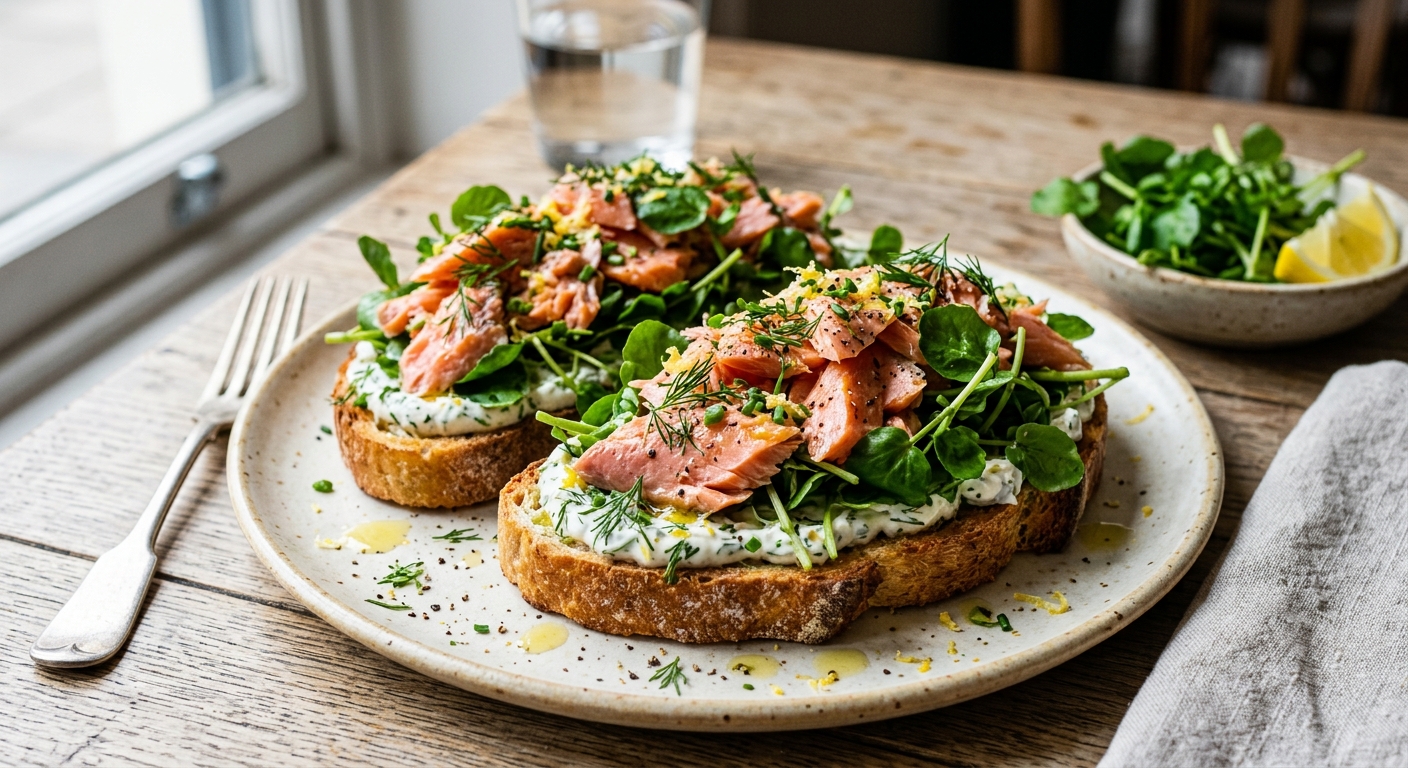
The tartine, that elegant French open-face sandwich, is one of the most underrated vehicles for serious nutrition. This version builds on a foundation of thick-cut sourdough, toasted until golden and structural, then layered with a bright, herb-forward crème fraîche, generous flakes of cold-smoked trout, and a tangle of raw watercress dressed with lemon and good olive oil. It is the kind of lunch that feels indulgent while quietly delivering a remarkable nutritional payload.
Smoked trout is one of the most nutrient-dense proteins available at any fishmonger or well-stocked supermarket. A single 100g portion provides over 1,800mg of combined EPA and DHA omega-3 fatty acids, the long-chain forms that the body can use directly to reduce systemic inflammation, support cardiovascular function, and maintain neurological health. Paired with watercress, one of the most nutrient-dense leafy greens by weight according to the CDC, this tartine also delivers a significant dose of vitamin K1, which is critical for proper blood clotting and emerging research links strongly to bone mineral density and arterial calcification prevention.
What makes this recipe particularly well-designed from a nutritional standpoint is the synergy between its fat-soluble nutrients and the fat sources present. Vitamin K1 from watercress and vitamin D from the trout are both fat-soluble, meaning the olive oil in the dressing and the natural fat in the fish dramatically improve their bioavailability. The lemon juice contributes vitamin C, which simultaneously brightens the flavour and enhances the absorption of the non-heme iron present in both the watercress and the sourdough. Every element earns its place here, both culinarily and scientifically.
4
servings
Ingredients
- 4 thick slicessourdough bread (approx. 90g per slice)
- 300 gcold-smoked trout fillets, skin removed and flaked
- 120 gwatercress, tough stems removed and roughly sorted
- 180 gcrème fraîche
- 2 tbspfresh dill, finely chopped
- 1 tbspfresh chives, finely sliced
- 2 tbspextra-virgin olive oil
- 1 wholelemon, zested and juiced (divided use)
- 1 tspDijon mustard
- 0.5 tspcapers, drained and roughly chopped
- 1 smallshallot, very finely minced
- 0.5 tspfreshly cracked black pepper
- —Colima Sea SaltMicroplastic Free Salt to taste
- —Extra lemon wedges for serving
- —Optional: thinly sliced radishes or cucumber for garnish
Instructions
Click on an item below to shop for the recommended items for this recipe on Amazon.
As an Amazon Associate, we earn from qualifying purchases.
- Make the herbed crème fraîche: In a medium bowl, combine the crème fraîche, chopped dill, sliced chives, Dijon mustard, half the lemon zest, 1 teaspoon of lemon juice, and the minced shallot. Season with a small pinch of sea salt and a few grinds of black pepper. Stir well until fully combined. Taste and adjust seasoning. Cover and refrigerate while you prepare the remaining components.
- Prepare the watercress salad: Place the watercress in a bowl. In a small separate bowl, whisk together the extra-virgin olive oil, 1 tablespoon of lemon juice, the remaining lemon zest, and a pinch of sea salt. Do not dress the watercress yet, as it will wilt quickly once the acid and oil hit it.
- Toast the sourdough on the stovetop: Heat a large, heavy-based skillet or cast-iron griddle pan over medium-high heat until it is genuinely hot, about 2 to 3 minutes. You need no added fat here. Place the sourdough slices flat in the dry pan. Toast for 2 to 3 minutes per side, pressing lightly with a spatula, until each side is deeply golden brown with visible char marks if using a griddle. The interior should remain slightly chewy. Transfer to a board.
- While the bread is still warm, dress the watercress: Pour the prepared lemon-olive oil dressing over the watercress and toss gently with your hands or tongs. The residual warmth from the kitchen and the acid will just barely soften the watercress while keeping it vibrant and peppery.
- Assemble the tartines: Spread a generous, even layer of the herbed crème fraîche over each slice of toasted sourdough, going right to the edges. Top with evenly distributed flakes of smoked trout. Scatter the chopped capers over the trout. Pile a loose mound of dressed watercress on top of each tartine. Finish with an extra grind of black pepper, a light drizzle of olive oil if desired, and serve immediately with lemon wedges alongside.
- Make the slow-cooker confit shallots and aromatics: Slice 3 additional shallots (beyond the minced one in the base recipe) into thin rings. Add them to the slow cooker insert along with the minced shallot, the drained chopped capers, 2 tablespoons of extra-virgin olive oil, 1 teaspoon of lemon juice, a pinch of sea salt, and the black pepper. Stir to combine. Set the slow cooker to Low, cover, and cook for 2 hours. The shallots will become deeply sweet, jammy, and caramelised without any risk of burning. This confit can be made up to 3 days ahead and refrigerated.
- While the shallots are in the final 20 minutes of cooking, prepare the herbed crème fraîche: Combine the crème fraîche, dill, chives, Dijon mustard, the full amount of lemon zest, 1 teaspoon of lemon juice, and seasoning in a bowl. Mix thoroughly. The flavour of this spread will deepen if made 30 minutes ahead and refrigerated.
- Prepare the watercress: Remove the slow cooker lid and allow the confit shallots to cool for 5 minutes. Check seasoning, adding extra lemon juice if the sweetness needs balancing. Toss the watercress with the olive oil and lemon juice dressing in a separate bowl, just before assembly.
- Toast the sourdough using your preferred method: Use a toaster, a grill pan, or a hot oven at 220C for 5 to 6 minutes per side. For this method, a conventional toaster works perfectly since the flavour complexity comes from the slow-cooker confit, not the toast method.
- Assemble with the confit topping: Spread the herbed crème fraîche generously over each slice of toast. Lay flakes of smoked trout across the surface. Spoon the warm or room-temperature confit shallot and caper mixture over the trout, distributing it evenly across all four tartines. Top with a generous pile of dressed watercress, an extra drizzle of the confit oil from the slow cooker insert, and serve with lemon wedges.
- Substitute fresh trout for this method: Replace the 300g smoked trout with 300g fresh skin-on trout fillets. Add to the pressure cooker insert along with 240ml water, 60ml dry white wine, 2 thin slices of lemon, 3 sprigs of fresh dill, 1 bay leaf, 4 black peppercorns, and a pinch of sea salt. These aromatics will infuse the fish as it pressure-cooks, creating a clean, herbal flavour profile.
- Seal the pressure cooker and bring to high pressure over medium-high heat, or select the Steam or Fish function on an electric Instant Pot. Cook at high pressure for 4 minutes. This is sufficient to cook the trout fillets fully through without drying them. Quick-release the pressure immediately after the timer ends to prevent overcooking.
- Remove the trout with a slotted spoon and transfer to a plate. Allow to rest for 2 minutes, then remove the skin and flake the flesh gently with a fork into large, generous pieces. Taste and add a small pinch of sea salt if needed. Reserve 2 tablespoons of the poaching liquid, which will be lightly infused with dill and lemon and can be whisked into the crème fraîche for extra depth.
- Prepare the herbed crème fraîche while the trout rests: Combine the crème fraîche, dill, chives, Dijon mustard, full lemon zest, 1 teaspoon of lemon juice, and the 2 tablespoons of reserved poaching liquid in a bowl. Season to taste. The poaching liquid adds a subtle savoury, herbal note that ties the spread to the fresh-poached fish.
- Toast the sourdough in a grill pan or toaster until golden. Dress the watercress with the olive oil, lemon juice, and a pinch of salt. Spread the enriched crème fraîche over each toast slice, top with the warm poached trout flakes, scatter over the chopped capers, pile on the dressed watercress, and finish with lemon zest, cracked black pepper, and lemon wedges for serving.
- Preheat the oven to 200C (400F) with the rack in the upper-middle position. Line a large baking sheet with parchment paper. Brush both sides of each sourdough slice lightly with a thin film of extra-virgin olive oil. Arrange on the prepared baking sheet in a single layer.
- Initial toast in the oven: Place the baking sheet on the upper-middle rack and bake for 6 minutes. The bread should be lightly golden but not fully crisped, as it will return to the oven. Remove the sheet from the oven.
- Prepare the herbed crème fraîche while the bread does its first toast: Combine the crème fraîche, dill, chives, Dijon mustard, lemon zest, 1 teaspoon of lemon juice, minced shallot, and seasoning in a bowl. Mix until smooth and well combined.
- Build the tartines on the baking sheet: Spread a generous, even layer of the herbed crème fraîche over each partially toasted bread slice. Distribute the flaked smoked trout evenly over the crème fraîche on all four slices. Scatter the chopped capers over the trout. Return the baking sheet to the oven and bake for a further 5 to 6 minutes. The crème fraîche will warm through and very slightly set at the edges, and the trout will become fragrant. Do not overbake, the goal is warm and just-set, not dried out.
- Remove from the oven and allow to cool for 1 to 2 minutes. While the tartines rest, toss the watercress with the olive oil, remaining lemon juice, and a pinch of salt. Pile the dressed watercress onto each warm tartine immediately before serving, so the contrast between the warm toasted base and the cool, peppery greens is preserved. Serve with lemon wedges.
Nutrition Breakdown
Per 1 serving (makes 4)
Vitamins & Minerals
% Daily Value based on a 2,000 calorie diet (FDA reference)
🧬 Essential Amino Acids
% of recommended daily intake (RDA) per serving
🛡 Antioxidant Profile
The Nutrition Science
The anti-inflammatory credentials of this tartine rest primarily on its omega-3 fatty acid content. EPA (eicosapentaenoic acid) and DHA (docosahexaenoic acid) from the smoked trout are the direct substrates from which the body synthesises specialised pro-resolving mediators including resolvins, protectins, and maresins. These lipid signalling molecules do not merely suppress inflammation as pharmaceutical NSAIDs do; they actively resolve it, clearing inflammatory cells and restoring tissue homeostasis. A 2022 meta-analysis in the British Journal of Nutrition found that consistent dietary EPA and DHA intake above 1,500mg per day was associated with significant reductions in circulating IL-6 and CRP, two primary markers of chronic low-grade inflammation.
Watercress provides one of the highest concentrations of vitamin K1 (phylloquinone) of any commonly eaten salad green, at approximately 250mcg per 80g portion. Vitamin K1 serves as a cofactor for gamma-carboxylation of osteocalcin and matrix Gla protein (MGP), two proteins that are fundamental to routing calcium into bone rather than arterial walls. MGP in particular has attracted significant research attention as a vascular calcification inhibitor, with studies showing that adequate vitamin K status is inversely associated with coronary artery calcification scores. The fat in this dish from the trout and olive oil is essential for proper absorption of this fat-soluble vitamin.
The inclusion of sourdough rather than conventional bread is nutritionally deliberate. The long fermentation process carried out by lactic acid bacteria substantially reduces phytic acid content. Phytic acid is the primary anti-nutrient in grains that chelates divalent minerals such as iron, zinc, and calcium, rendering them poorly absorbable. By reducing phytate levels by up to 62% compared to standard bread, sourdough fermentation meaningfully increases the bioavailability of the iron contributed by both the watercress and the grain itself. The lactic acid environment also lowers the glycemic index by interfering with alpha-amylase activity, slowing starch breakdown and producing a more moderate postprandial glucose response.
Pro Tips
- Buy cold-smoked trout rather than hot-smoked for a silkier, more delicate texture that spreads gently over the crème fraîche rather than breaking into dry chunks. Cold-smoked trout is cured at below 30C, preserving a sashimi-like consistency.
- Dress the watercress no more than 2 to 3 minutes before serving. The acid in the lemon juice begins to wilt and discolour the leaves quickly, and the peppery, glucosinolate-rich bite that makes watercress nutritionally powerful is most intact when the greens are barely dressed and served immediately.
- For maximum omega-3 retention, avoid heating the smoked trout. EPA and DHA are sensitive to prolonged high heat. In the stovetop and oven methods, the fish is added after cooking or warmed only very briefly, which preserves the vast majority of its fatty acid profile intact.
This is exactly the kind of micronutrient-dense recipe I’ve been recommending to patients on anticoagulant therapy, though I always make sure they know the vitamin K content (watercress is seriously concentrated here) shouldn’t scare them away if they’re on warfarin, just consistency matters. The omega-3 to vitamin K pairing is genuinely smart from a cardiovascular inflammation standpoint, and I love that you’re hitting it in under 20 minutes because compliance with “healthy eating” tanks when prep time climbs. Have you experimented with different smoked fish, or is trout your go-to for the flavor profile with the dill?
This is such an important point about warfarin and vitamin K, Veronika! I’ve definitely seen clients get nervous about leafy greens when they’re on anticoagulants, so I love that you’re normalizing consistency over avoidance. The omega-3 plus vitamin K combo is genuinely thoughtful for vascular health, and you’re totally right that the sub-20-minute factor changes everything for real-world adherence. I haven’t tried this exact tartine with other smoked fish, but I’m curious if you’ve experimented beyond trout? I’m imagining smoked mackerel could be even richer in omega-3s, though the flavor might compete with the
Love this approach, especially for the watercress angle. Quick technique note from my kitchen: if you’re using smoked trout, the heat from toasting the sourdough can push it into that dry, flaky territory. I’ve had best results letting the toast cool for 30 seconds, then assembling, so the residual warmth just wakes up the fat in the fish without drying it out. Also worth noting that watercress loses maybe 15-20% of its vitamin K in even light blanching, so raw is definitely the move here if micronutrient density is the goal. Been plating something similar for clients doing post-exercise recovery, and the combination of omega-3s
Love this assembly technique, Chris – that cooling window is such a smart detail for preserving the trout’s texture. Quick flag for anyone with histamine sensitivity: smoked trout is unfortunately quite high in histamine (the smoking process concentrates it), and both smoked fish and fermented crème fraîche can be real triggers for mast cell issues. If that’s you, I’ve had good results substituting fresh, never-frozen trout (gently pan-seared) and swapping crème fraîche for fresh cultured butter or a simple lemon-infused Greek yogurt instead. The watercress and sourdough stay great, and you still get that nutrient density without the hist
ok this is going straight into my race recovery rotation because the omega-3s plus that vitamin K for inflammation management is honestly chef’s kiss timing after long runs. ive been experimenting with smoked fish as a post-marathon protein source and this tartine format feels so much more appealing than plain canned stuff, plus the sourdough carbs paired with that fat and protein should nail the refueling window. veronika makes a great point about the warfarin angle too, consistency matters way more than avoiding it entirely!
I love that you’re thinking strategically about your recovery nutrition! That timing of carbs, omega-3s, and protein is genuinely ideal for the post-run window, and honestly smoked trout is such an underrated recovery food since it’s giving you selenium and vitamin D on top of those anti-inflammatory omegas. One thing I’d mention from working with athletes: if you’re doing this regularly, just track your vitamin K intake across the week so you’re staying consistent (like Veronika said), but also keep an eye on how the inflammation markers feel for you personally, since the benefit can be really individual. The sourdough is smart too, the fermentation actually improves mineral bioavail