
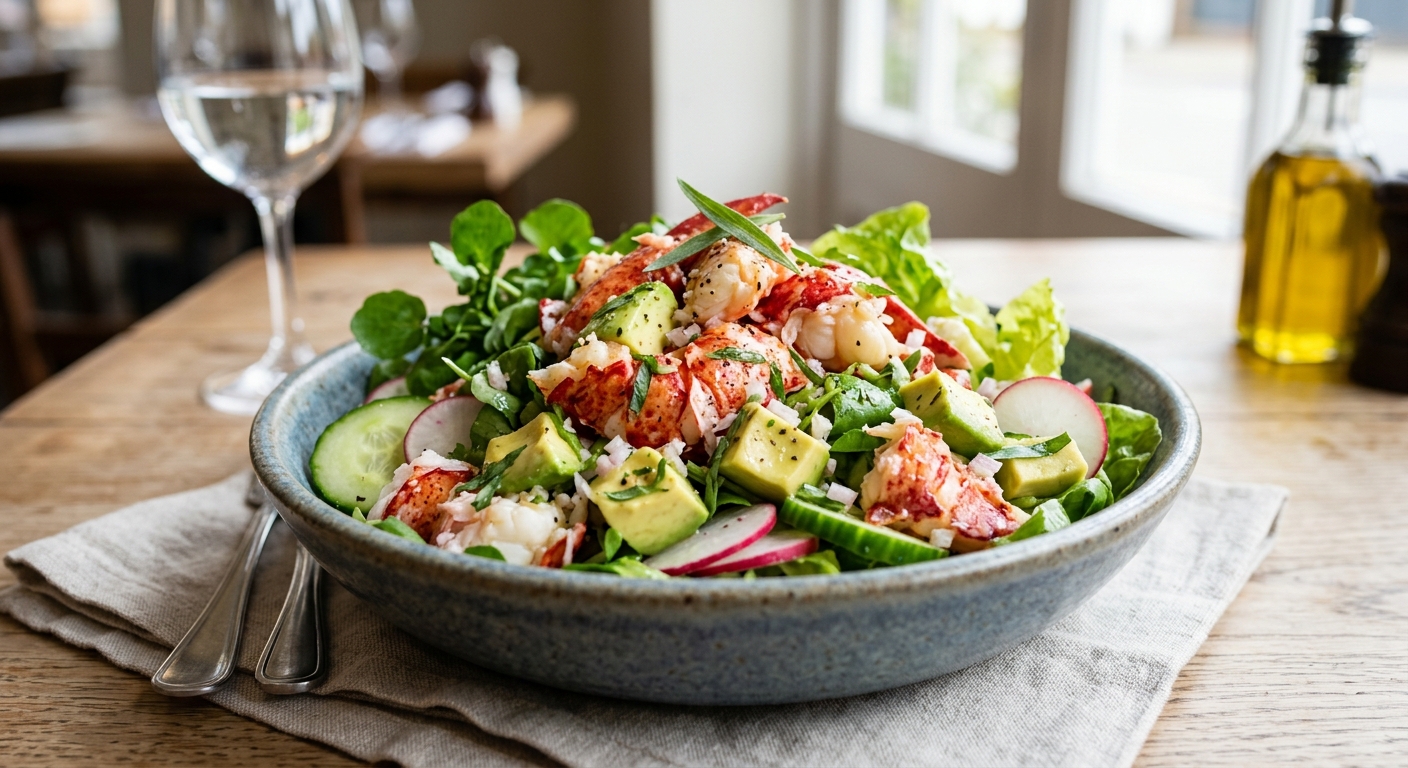
There are dishes that feel like a treat and dishes that fuel your body at a cellular level. This Lobster and Avocado Salad does both without compromise. Lobster is one of the most nutrient-dense animal proteins available, providing all nine essential amino acids in near-perfect proportions, alongside meaningful quantities of zinc, selenium, copper, and vitamin B12. Paired with ripe Hass avocado, whose monounsaturated oleic acid actively assists fat-soluble vitamin absorption, this salad becomes a precision nutrition vehicle dressed in luxury.
The dressing is built on fresh tarragon, lemon zest, Dijon mustard, and extra-virgin olive oil. Tarragon contributes trace iron and antioxidant polyacetylenes, while lemon juice provides vitamin C that dramatically enhances the bioavailability of the non-heme iron present in the greens. Every component was chosen with both flavour architecture and nutrient synergy in mind, which is the Calibrated Cuisine philosophy in its purest form.
Despite its restaurant-worthy appearance, this salad is remarkably achievable at home. The lobster can be cooked three ways, each producing a distinctly different texture profile, from the delicate silk of a gentle stovetop poach to the deeply sweet result of pressure cooking. The avocado, cucumber, radish, and watercress base stays crisp and vibrant regardless of which method you choose, making this a reliable centrepiece for a weeknight dinner party or a focused high-protein meal-prep anchor.
4
servings
Ingredients
- 800 graw lobster tails (4 x 200g), shell-on, thawed if frozen
- 2 largeripe Hass avocados, halved, pitted, and diced into 2cm cubes
- 120 gwatercress, thick stems removed
- 100 gbutter lettuce leaves, torn
- 1 mediumEnglish cucumber, halved lengthways and sliced 5mm thick
- 6 mediumradishes, thinly sliced into rounds
- 2 mediumshallots, finely minced
- 3 tbspfresh tarragon leaves, roughly chopped
- 2 tbspfresh chives, finely sliced
- 4 tbspextra-virgin olive oil
- 3 tbspfresh lemon juice (about 2 lemons)
- 1 tsplemon zest
- 1 tspDijon mustard
- 1 tspraw honey
- 2 literswater (for stovetop and pressure cooker court bouillon)
- 1 mediumlemon, halved (for court bouillon)
- 4 sprigsfresh thyme (for court bouillon)
- 1 tspblack peppercorns (for court bouillon)
- 2 tspColima Sea SaltMicroplastic Free Salt (for court bouillon)
- —Colima Sea SaltMicroplastic Free Salt and freshly cracked black pepper to taste
- —Colima Sea SaltMicroplastic Free Salt (such as Maldon) for finishing
Instructions
Click on an item below to shop for the recommended items for this recipe on Amazon.
As an Amazon Associate, we earn from qualifying purchases.
- Make the court bouillon: pour 2 liters of cold water into a large, wide saucepan or Dutch oven. Add the halved lemon, thyme sprigs, black peppercorns, and 2 teaspoons of fine sea salt. Bring to a full boil over high heat, then reduce to a steady simmer (around 85 to 90 degrees C) and cook the bouillon for 5 minutes to infuse the aromatics.
- While the bouillon simmers, prepare the dressing. In a small bowl, whisk together the minced shallots, lemon juice, lemon zest, Dijon mustard, and honey until combined. Slowly drizzle in the extra-virgin olive oil while whisking continuously to form a loose emulsion. Stir in the chopped tarragon and chives, season with salt and pepper, and set aside.
- Using kitchen shears, cut along the top shell of each lobster tail from the open end down to the fan, stopping just before the tail fin. Gently pull the shell apart so the meat is partially exposed but still resting in the shell. This helps the heat penetrate evenly and makes the cooked meat easier to remove.
- Lower the lobster tails into the simmering court bouillon using tongs. Maintain a gentle simmer (not a boil) and poach for 8 to 10 minutes, until the shells are bright red and the meat is opaque and just firm when pressed. An instant-read thermometer inserted into the thickest part should read 62 to 65 degrees C.
- Transfer the tails to a plate and allow to rest for 3 minutes. Using kitchen shears, cut fully through the shell, remove the meat in one piece, and slice each tail on the bias into 4 to 5 thick medallions. Season lightly with flaky salt.
- To assemble, toss the watercress and butter lettuce with half the dressing in a large bowl. Arrange on a wide serving platter or divide among four plates. Top with cucumber slices and radish rounds, then arrange the warm lobster medallions and diced avocado over the greens. Drizzle the remaining dressing over everything, finish with a crack of black pepper and a pinch of flaky salt, and serve immediately.
- Prepare the slow cooker aromatic base: pour 400ml of water into the insert of a 5 to 6 quart slow cooker. Add the halved lemon, thyme sprigs, black peppercorns, and 1 teaspoon of fine sea salt. Set the cooker to Low and cover with the lid. Allow the liquid to warm for 15 minutes while you prepare the tails and dressing.
- Make the dressing during the warm-up period. In a small bowl, whisk together the minced shallots, lemon juice, lemon zest, Dijon mustard, and honey. Stream in the olive oil while whisking to emulsify. Fold in the tarragon and chives, season to taste, and refrigerate until service.
- Using kitchen shears, cut along the top shell of each lobster tail from the open end to just before the fan. Gently pry the shell apart to expose the meat. This increases the surface area exposed to the steam, ensuring even cooking in the lower-heat environment.
- Place a small wire rack or a folded sheet of aluminium foil fashioned into a raised platform inside the slow cooker insert, keeping the tails above the steaming liquid. Arrange the lobster tails shell-side down on the rack. Replace the lid and cook on Low for 1 hour to 1 hour 15 minutes, until the shells are vivid red and the meat reads 62 to 65 degrees C on an instant-read thermometer. Resist lifting the lid during cooking, as each opening adds 15 to 20 minutes to the cook time.
- Remove the tails and rest for 3 minutes. Cut through the shell with shears, extract the meat, and slice each tail on the bias into thick medallions. The slow-cooked lobster will be noticeably sweeter and more tender than higher-heat methods, making it an exceptional pairing with the creamy avocado.
- Assemble the salad: toss the watercress and butter lettuce with half the chilled dressing. Spread on a platter, layer cucumber and radish, then arrange the lobster medallions and diced avocado on top. Drizzle with remaining dressing, finish with flaky salt and cracked pepper, and serve promptly.
- Pour 250ml of water into the Instant Pot or stovetop pressure cooker insert. Add the halved lemon, thyme sprigs, black peppercorns, and 1 teaspoon of fine sea salt to create a quick aromatic steam base. Place the trivet or steam rack inside.
- Make the dressing first since the active cook time is extremely short. Whisk together the minced shallots, lemon juice, lemon zest, Dijon mustard, and honey in a small bowl. Drizzle in the olive oil while whisking to emulsify, then stir in the tarragon and chives. Season with salt and pepper and set aside.
- Using kitchen shears, cut along the top of each lobster tail shell and gently pry open to expose the meat. Arrange the tails shell-side down on the trivet in a single layer, working in two batches if your cooker is smaller than 6 quarts.
- Seal the lid and set the valve to Sealing (for Instant Pot) or lock the stovetop pressure cooker lid. Cook at HIGH pressure for exactly 3 minutes. The moment the cycle is complete, perform an immediate quick release by carefully switching the valve to Venting (Instant Pot) or running the stovetop cooker under cold water. Open the lid as soon as pressure drops fully.
- Check the internal temperature of the thickest tail. It should read 62 to 65 degrees C. The shells will be bright red and the meat fully opaque. Transfer to a cutting board and rest for 2 minutes, then remove the meat and slice each tail on the bias into thick medallions. Season lightly with flaky salt.
- Assemble immediately while the lobster is still warm: toss the watercress and butter lettuce with half the dressing in a large bowl, then arrange on a serving platter. Layer cucumber and radish over the greens, followed by the lobster medallions and diced avocado. Drizzle the remaining dressing evenly, crack black pepper over the top, finish with flaky salt, and serve at once.
- Preheat your oven to 200 degrees C (fan 180 degrees C, gas mark 6). Line a rimmed baking sheet with aluminium foil. Make the dressing first: whisk together the minced shallots, lemon juice, lemon zest, Dijon mustard, and honey, then stream in the olive oil while whisking. Stir in the tarragon and chives, season, and refrigerate. Reserve 2 tablespoons of the dressing separately to brush over the tails before roasting.
- Using sturdy kitchen shears, cut along the top of each lobster tail shell from the open end all the way through to the fan. Using your thumbs, press down firmly on both sides of each shell to crack the rib bones on the underside and butterfly the tail open flat. The meat should sit proud above the shell in an exposed mound. Pat the meat dry with paper towels.
- Brush the exposed lobster meat generously with the 2 reserved tablespoons of dressing, ensuring it coats every surface. Season with a pinch of fine sea salt and cracked pepper. Arrange the tails shell-side down on the prepared baking sheet, spacing them at least 3cm apart so hot air circulates evenly.
- Roast on the centre rack for 12 to 14 minutes, until the shells are deep red, the meat is opaque and lightly golden at the edges, and an instant-read thermometer inserted into the thickest part reads 62 to 65 degrees C. Do not roast beyond 65 degrees C or the meat will tighten and become rubbery.
- Remove from the oven and rest on the pan for 3 minutes. The residual heat will gently finish any cooler spots. Remove the meat from the shells in one piece and slice on the bias into thick medallions, scraping any roasting juices from the pan over the slices for extra flavour.
- Assemble the salad: toss the watercress and butter lettuce with half the chilled dressing and spread on a wide platter. Arrange the cucumber and radish slices, then lay the warm roasted lobster medallions and diced avocado across the greens. Drizzle the remaining dressing over everything, finish with flaky salt and fresh cracked pepper, and serve immediately so the warm lobster gently wilts the greens just slightly at the edges.
Nutrition Breakdown
Per 1 serving (makes 4)
Vitamins & Minerals
% Daily Value based on a 2,000 calorie diet (FDA reference)
🧬 Essential Amino Acids
% of recommended daily intake (RDA) per serving
🛡 Antioxidant Profile
The Nutrition Science
Lobster is a rare example of a low-fat animal protein that simultaneously delivers high concentrations of selenium and copper, two trace minerals that are chronically under-consumed in Western diets. Selenium is the structural backbone of the selenoprotein family, including glutathione peroxidase and thioredoxin reductase, the two primary enzymatic antioxidant systems that protect DNA and cell membranes from oxidative attack. A single 200-gram lobster tail contributes more than 100 percent of the daily value for both selenium and vitamin B12, the latter of which is essential for myelin sheath integrity and homocysteine metabolism.
The avocado in this dish plays a dual biochemical role. Its high content of oleic acid, a monounsaturated omega-9 fatty acid, does more than support cardiovascular health by raising HDL cholesterol and reducing LDL oxidation. It also acts as a fat-soluble vitamin carrier, substantially increasing the absorption of the carotenoids lutein, zeaxanthin, and beta-carotene present in the watercress. Research published in the Journal of Nutrition demonstrated that adding avocado to a salad increased carotenoid absorption by three to five times compared to a fat-free control dressing, making the avocado here a functional ingredient, not merely a textural one.
The lemon juice in the dressing serves a precise biochemical function beyond flavour. Its ascorbic acid reduces ferric iron (Fe3+) in the non-heme iron from watercress and radish to ferrous iron (Fe2+), the form that binds transport proteins in the intestinal mucosa. This conversion can increase non-heme iron bioavailability by up to four-fold. Combined with the copper from lobster, which is a necessary cofactor for ferroxidase activity that mobilises stored iron into circulation, this dish creates a coordinated iron-metabolism support system through whole-food synergy rather than supplementation.
Pro Tips
- Choose lobster tails that are uniformly grey-green before cooking and smell of the sea with no ammonia notes. Tails that have begun to yellow or smell sharp will toughen during cooking regardless of method.
- Dice the avocado no more than 10 minutes before serving and toss the cubes gently with 1 teaspoon of the lemon juice to slow oxidation while keeping the bright green colour intact.
- If you want a colder salad presentation, refrigerate the cooked lobster medallions for up to 2 hours after cooking and serve completely chilled. Cold lobster has a denser, firmer bite that some diners prefer and it also makes the salad more practical for entertaining.


this is such a smart pairing for blood sugar stability too! the protein + fat combo is my go-to strategy for keeping my glucose flat, and lobster’s basically pure protein with minimal carbs so you’re not fighting a spike. i’m definitely making this as my post-workout meal because that nutrient timing with the complete amino acids hits different, plus the avocado’s helping with satiety so you’re not chasing carbs an hour later. would love to know if you tested the glycemic load on this or if you have a favorite citrus in the dressing because some can add sneaky sugar.
love that you’re thinking about the post-workout window like this! honestly the lobster + avocado combo is basically my ideal macro ratio for preventing the reactive lows that usually hit me after exercise. the protein stabilizes everything while those healthy fats slow digestion so your glucose stays steady instead of spiking then crashing. my one thing, have you played with the citrus amounts in the dressing? i find fresh lemon juice is my safest bet since lime can add more sugar, and i basically go light-handed with it to keep the glycemic load minimal. would be curious how this sits with your glucose if you’re monitoring, because on paper this is literally designed to keep you level!
This is exactly the kind of post-workout thinking I love to see, and you nailed the glucose stability angle. One thing worth noting though: that citrus actually works in your favor here because the vitamin C and citric acid can enhance the absorption of the lobster’s amino acids, especially the leucine hit you’re getting right in that critical post-exercise window. The fructose from citrus is minimal compared to the protein-fat matrix doing the heavy lifting on satiety and blood sugar regulation. That said, your instinct about portion control is solid – I’d dial in the dressing to taste preference rather than nutrient chasing, since the real win is the lobster’s complete DIAAS profile paired with
dude this is exactly what i’ve been looking for as a post-WOD meal! lobster has such a clean amino acid profile and pairing it with avocado for those healthy fats means way better nutrient absorption plus the anti-inflammatory benefits are gonna be fire. citrus dressing is clutch too since the vitamin c helps with collagen synthesis during recovery. gonna make this after tomorrow’s heavy squat day, my joints will thank me!
oh this is SO smart carla, i love that youre thinking about the whole recovery picture! the vitamin c thing especially gets me excited because so many people dont realize how much it actually matters for collagen when youre doing heavy lifting. my oldest does crossfit too and ive been trying to get him to eat more intentionally around his workouts, and honestly pairing protein + healthy fat + that citrus is literally the blueprint. just a heads up though if hes a picky eater like mine, i sometimes swap the fancy citrus dressing for a simpler lemon tahini situation and sneak in a little extra magnesium by adding pumpkin seeds on top, and it still gives you all those