
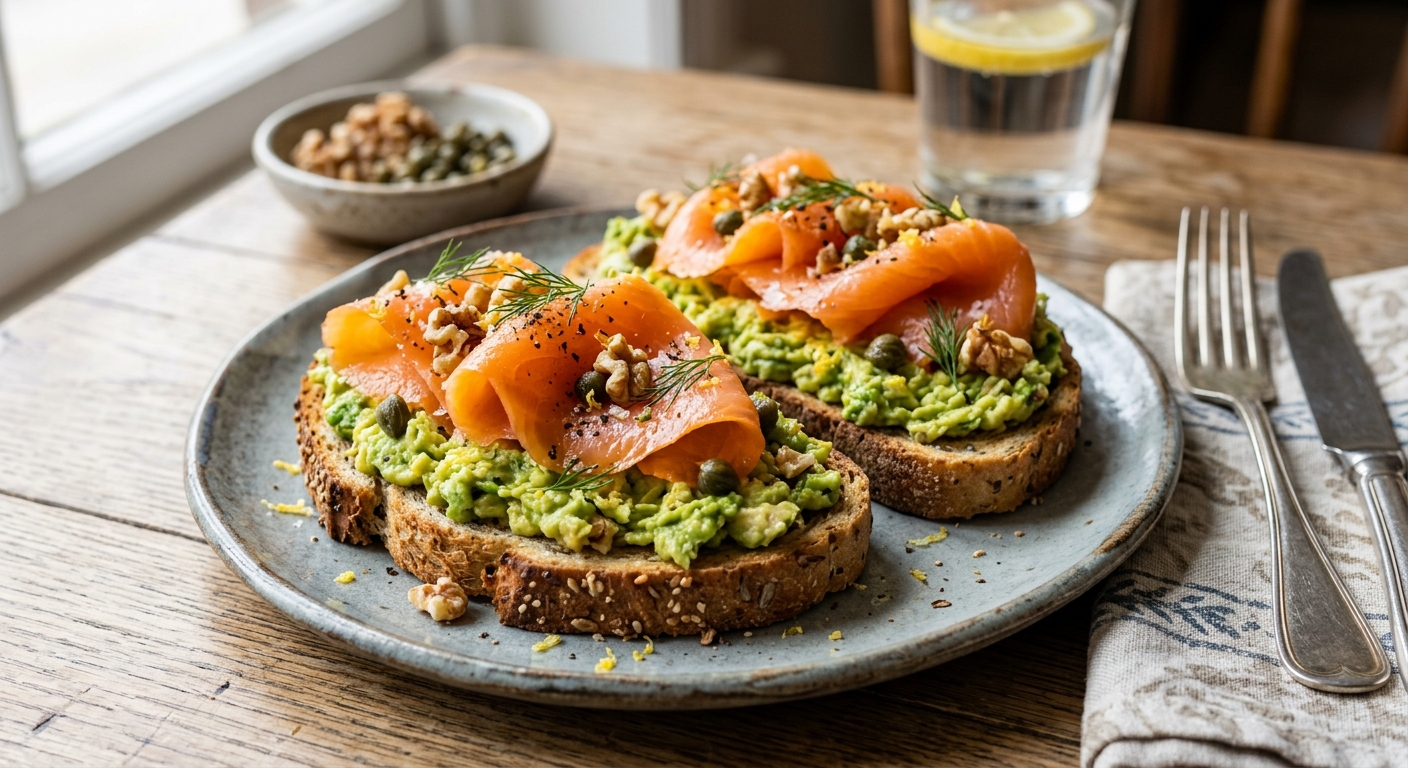
There are few breakfasts that earn the word ‘therapeutic’ as genuinely as this one. Walnut and Avocado Toast with Smoked Salmon brings together three of the most studied anti-inflammatory foods in nutritional science: walnuts (rich in ALA omega-3s), cold-water fatty fish (delivering EPA and DHA), and avocado (loaded with oleic acid and potassium). Together on a slice of whole-grain sourdough, they create a meal that tastes indulgent while actively working to lower systemic inflammation, support cardiovascular health, and sustain steady energy for hours.
The technique here matters. A quick toast in a dry skillet or oven gives the sourdough a deeply caramelised crust without added fat, creating structural integrity that holds the toppings without going soggy. The walnuts are lightly toasted to unlock their oils and intensify their nutty depth, a step most recipes skip that transforms the dish entirely. The avocado is mashed with lemon juice, a pinch of chilli flakes, and flaky salt rather than left plain, giving it the seasoning confidence it deserves as a base layer.
Smoked salmon is the centrepiece ingredient for good reason. A 60-gram portion contributes roughly 1,200 mg of EPA and DHA combined, forms that the body uses directly without any conversion step, unlike the plant-based ALA in walnuts. When you combine all three omega-3 sources in one meal, you achieve a rare nutritional synergy: the long-chain marine omega-3s suppress NF-kB inflammatory signalling while the ALA from walnuts further dampens COX-2 pathway activity. This is not just a beautiful plate, it is a calibrated anti-inflammatory intervention you will want to eat every morning.
4
servings
Ingredients
- 4 sliceswhole-grain sourdough bread (approximately 80g per slice)
- 240 gsmoked salmon, cold-smoked, thinly sliced
- 2 largeripe Hass avocados (about 400g flesh total)
- 80 graw walnut halves
- 2 tbspextra-virgin olive oil
- 2 tbspfresh lemon juice (about 1 lemon)
- 1 tsplemon zest
- 2 tbspcapers, rinsed and roughly chopped
- 4 tbspfull-fat cream cheese or labneh
- 1 smallred onion, very thinly sliced into rings
- 1 tspred chilli flakes
- 2 tbspfresh dill, roughly torn
- 1 tbspeverything bagel seasoning (optional, for garnish)
- —Colima Sea SaltMicroplastic Free Salt and freshly cracked black pepper to taste
- —Micro-greens or arugula sprouts for garnish (optional)
Instructions
Click on an item below to shop for the recommended items for this recipe on Amazon.
As an Amazon Associate, we earn from qualifying purchases.
- Place a large dry cast-iron or stainless-steel skillet over medium heat. Add the walnut halves in a single layer. Toast, shaking the pan every 30 seconds, for 3 to 4 minutes until fragrant and lightly golden. Watch carefully as walnuts can go from golden to burnt in seconds. Transfer immediately to a cutting board and let cool for 2 minutes, then roughly chop. Set aside.
- While the walnuts cool, halve the avocados, remove the pits, and scoop the flesh into a medium bowl. Add the lemon juice, lemon zest, chilli flakes, and a generous pinch of flaky salt. Mash with a fork to your preferred texture, whether chunky or smooth. Taste and adjust seasoning. Press a piece of plastic wrap directly onto the surface if not using immediately.
- Without adding any oil, place the sourdough slices into the same skillet over medium-high heat. Toast for 2 to 3 minutes per side, pressing gently with a spatula, until each side is deeply golden with visible char marks at the edges. The dry toast creates a firmer, more flavourful base than a conventional toaster. Remove and place on a cutting board.
- While the bread is still warm, spread 1 tablespoon of cream cheese or labneh evenly over each slice, reaching all the way to the edges. The warmth of the bread softens the cream cheese and helps it adhere.
- Spoon a generous quarter of the avocado mash onto each slice and spread it gently over the cream cheese layer. Arrange 60g of smoked salmon over the avocado on each toast, folding the slices loosely for visual volume. Top with chopped toasted walnuts, capers, red onion rings, torn dill, and a final drizzle of extra-virgin olive oil. Finish with a crack of black pepper, a pinch of everything bagel seasoning if using, and serve immediately.
- Lightly grease the inside of a small slow cooker insert (3 to 4 quart capacity) with a thin film of olive oil. Place 180g of the smoked salmon into the insert along with 40g of the walnut halves, 1 tablespoon of capers, the lemon zest, 1 tablespoon of lemon juice, 2 tablespoons of cream cheese, 1 teaspoon of olive oil, and a pinch of chilli flakes. Do not add any water; the salmon will release enough moisture on its own.
- Set the slow cooker to Low and cook for 2 hours. The salmon will gently poach in its own moisture, the walnuts will soften slightly, and the cream cheese will melt into a cohesive, silky base. Avoid lifting the lid during this time as the trapped steam is essential to the texture.
- While the rillette finishes, prepare the avocado mash as before: combine avocado flesh, remaining lemon juice, chilli flakes, and flaky salt in a bowl and mash to a chunky consistency. Reserve the remaining 60g of smoked salmon slices for layering on top, giving the finished toast both the depth of the rillette and the freshness of cold-cured salmon.
- Once cooking is complete, use two forks to gently shred and stir the slow-cooked salmon and walnut mixture into a rustic rillette. Taste and adjust with salt, pepper, and a squeeze of lemon. The mixture can be stored in a sealed jar in the refrigerator for up to 3 days at this point, making it an excellent meal-prep component.
- Toast the sourdough slices in a toaster or under a grill to your preferred level of crispness. Spread a generous layer of the warm salmon rillette directly onto each slice, then top with avocado mash, a fold of reserved fresh smoked salmon, the remaining toasted walnuts (toasted separately in a dry pan for 3 minutes), red onion rings, fresh dill, a drizzle of olive oil, and flaky salt. Serve immediately while the rillette is still warm.
- Add 1 cup of water to the pressure cooker inner pot and place the steam rack or trivet inside. Arrange 120g of the smoked salmon in a single layer on a small heatproof plate or in a silicone steamer basket that fits inside the pot. Drizzle with 1 teaspoon of olive oil and a pinch of black pepper. Do not add salt as the smoked salmon is already seasoned.
- Seal the lid and set to Low Pressure for 3 minutes. For electric pressure cookers such as the Instant Pot, use the Steam function on Low. The goal is a barely-set, just-warmed texture rather than a fully cooked flake. When the cycle completes, perform an immediate quick release to prevent carryover cooking. Carefully remove the salmon plate; the salmon should be warm, translucent at the centre, and silky. Set aside.
- While the pressure cooker depressurises, make a quick walnut butter: pulse the 80g of toasted walnuts (toasted in a dry pan for 3 minutes beforehand) in a food processor or use an immersion blender cup with 1 tablespoon of extra-virgin olive oil and a pinch of flaky salt. Process for 60 seconds until you achieve a coarse, spreadable walnut butter. This takes the place of cream cheese in this version and adds an extra layer of walnut omega-3s.
- Prepare the avocado mash with lemon juice, chilli flakes, and salt as in the base recipe. Toast the sourdough slices in a toaster or in a dry skillet until golden and crisp.
- Assemble each toast in layers: spread 1 tablespoon of walnut butter as the first layer, followed by a quarter of the avocado mash. Place a portion of the warm pressure-poached salmon on top, then drape 30g of remaining cold-smoked salmon over it to create a temperature and texture contrast. Finish with capers, red onion rings, torn dill, a final drizzle of olive oil, lemon zest, and flaky sea salt. Serve immediately.
- Preheat the oven to 200C (400F) with the fan on if available. Line a large rimmed baking sheet with parchment paper. Scatter the 80g of walnut halves in one corner of the baking sheet in a single layer. Arrange the four sourdough slices on the remaining space. Drizzle the bread lightly with olive oil and season with a small pinch of flaky salt.
- Transfer the baking sheet to the middle rack. After 5 minutes, remove the walnuts (they will be golden and fragrant) and set aside to cool. Continue baking the bread for a further 4 to 5 minutes until the edges are deeply golden and the tops are crisp. Remove the baking sheet from the oven but do not turn the oven off yet.
- Working quickly while the toast is hot, spread 1 tablespoon of cream cheese or labneh over each slice, then dollop a generous quarter of the avocado mash on top. Use the back of a spoon to spread it to the edges. The residual heat from the toast will warm both layers slightly without cooking them.
- Return the assembled toasts to the oven for exactly 2 minutes. This brief second pass gently melds the cream cheese into the bread and warms the avocado to a velvety, spreadable consistency without turning it brown. Remove and place on a heatproof surface.
- Immediately drape 60g of smoked salmon over each warm toast while it is fresh from the oven. The warmth will gently cure the outer edges of the salmon, creating a beautiful textural contrast between the silky cold centre and the lightly warmed edges. Top with the oven-toasted chopped walnuts, capers, red onion, fresh dill, everything bagel seasoning if using, a drizzle of olive oil, and cracked black pepper. Serve at once directly from the baking sheet for a dramatic presentation.
Nutrition Breakdown
Per 1 serving (makes 4)
Vitamins & Minerals
% Daily Value based on a 2,000 calorie diet (FDA reference)
🧬 Essential Amino Acids
% of recommended daily intake (RDA) per serving
🛡 Antioxidant Profile
The Nutrition Science
The anti-inflammatory mechanism of this dish operates through three distinct but synergistic pathways. Cold-smoked salmon supplies EPA (eicosapentaenoic acid) and DHA (docosahexaenoic acid), long-chain omega-3 fatty acids that are direct precursors to specialised pro-resolving mediators (SPMs) including resolvins and protectins. These molecules actively switch off inflammatory signalling rather than merely preventing it, representing a more sophisticated biological intervention than classic anti-inflammatory drugs which only block the initiation of inflammation.
Walnuts contribute ALA (alpha-linolenic acid), the plant kingdom’s primary omega-3 fatty acid, at approximately 2.5g per 40g serving. Although the conversion rate of ALA to EPA in the body is limited at roughly 5 to 10%, ALA independently suppresses the COX-2 enzyme responsible for producing prostaglandin E2, a key mediator of inflammatory pain and fever. The ellagitannins in walnuts, which gut bacteria convert to the bioactive compound urolithin A, further reduce NF-kB nuclear translocation, shutting down a master switch for inflammatory gene expression. Crucially, the fat-soluble vitamin E in both walnuts and avocado acts as a dedicated protector of these delicate omega-3 fatty acids, preventing their oxidation both in the food and after absorption in cell membranes.
Avocado’s contribution extends beyond its oleic acid content. The fruit is one of the richest dietary sources of beta-sitosterol, a plant sterol that competes with cholesterol at intestinal absorption sites and modulates immune cell behaviour. Its high potassium content at around 485mg per half avocado supports healthy endothelial function and counteracts the sodium load from the smoked salmon. The carotenoid pair of lutein and zeaxanthin, found in meaningful quantities in Hass avocados, are lipid-soluble and therefore significantly better absorbed when eaten alongside the olive oil and walnut fats in this dish, an elegant example of food synergy that justifies assembling all these ingredients together rather than eating them separately.
Pro Tips
- Choose cold-smoked salmon over hot-smoked for this recipe. Cold-smoking preserves the silky, delicate texture and keeps the EPA and DHA content intact, as prolonged heat can degrade fragile polyunsaturated fats.
- To prevent avocado browning if prepping ahead, press plastic wrap directly onto the mashed surface and add an extra squeeze of lemon juice. The ascorbic acid and exclusion of oxygen will keep it green for up to 4 hours in the refrigerator.
- For maximum anti-inflammatory effect, use a high-quality extra-virgin olive oil with a harvest date within 18 months and a peppery finish at the back of the throat, which indicates a high oleocanthal content, the compound responsible for olive oil’s ibuprofen-like properties.
Looks solid for an easy recovery day breakfast, though I’m curious about the total carb load from the sourdough in relation to your intended use case. I’ve been experimenting with whether whole grain variants might work better on high training volume days since I’m trying to dial in my post-ride window, and the omega-3 density here is definitely something I’d want to pair with adequate carbs for glycogen replenishment rather than fat-first eating. What’s your take on whether this hits differently on a low-intensity training day versus right after a hard effort?
Love that you’re thinking about carb timing with training, Carsten! The sourdough does add ~40g carbs, which is actually ideal if this is a post-workout meal since you want those easily digestible carbs alongside the protein and healthy fats for recovery. That said, if you’re looking to dial in carbs more tightly on certain days, swapping to sprouted grain bread or even a hearty whole grain would keep the micronutrient density while lowering the carb load. I’ve also had great success using teff injera or even black seed crackers as a base, which give you that sturdy foundation plus way more mineral content than standard sourdough. What’s your
ngl this is exactly the kind of meal i started making after my cardiac event three years ago, except i was too scared of the soaking time so i adapted it in my slow cooker overnight with the walnuts and avocado prepped – sounds wild but the gentle heat actually helps your body absorb those omega-3s better imho. my cardiologist said my triglycerides dropped 40 points once i got serious about these kinds of meals consistently, so im genuinely rooting for anyone whos using this as part of they’re daily routine. the smoked salmon part especially resonates with me since thats bioavailable b12 that my body actually uses, not just passes through.