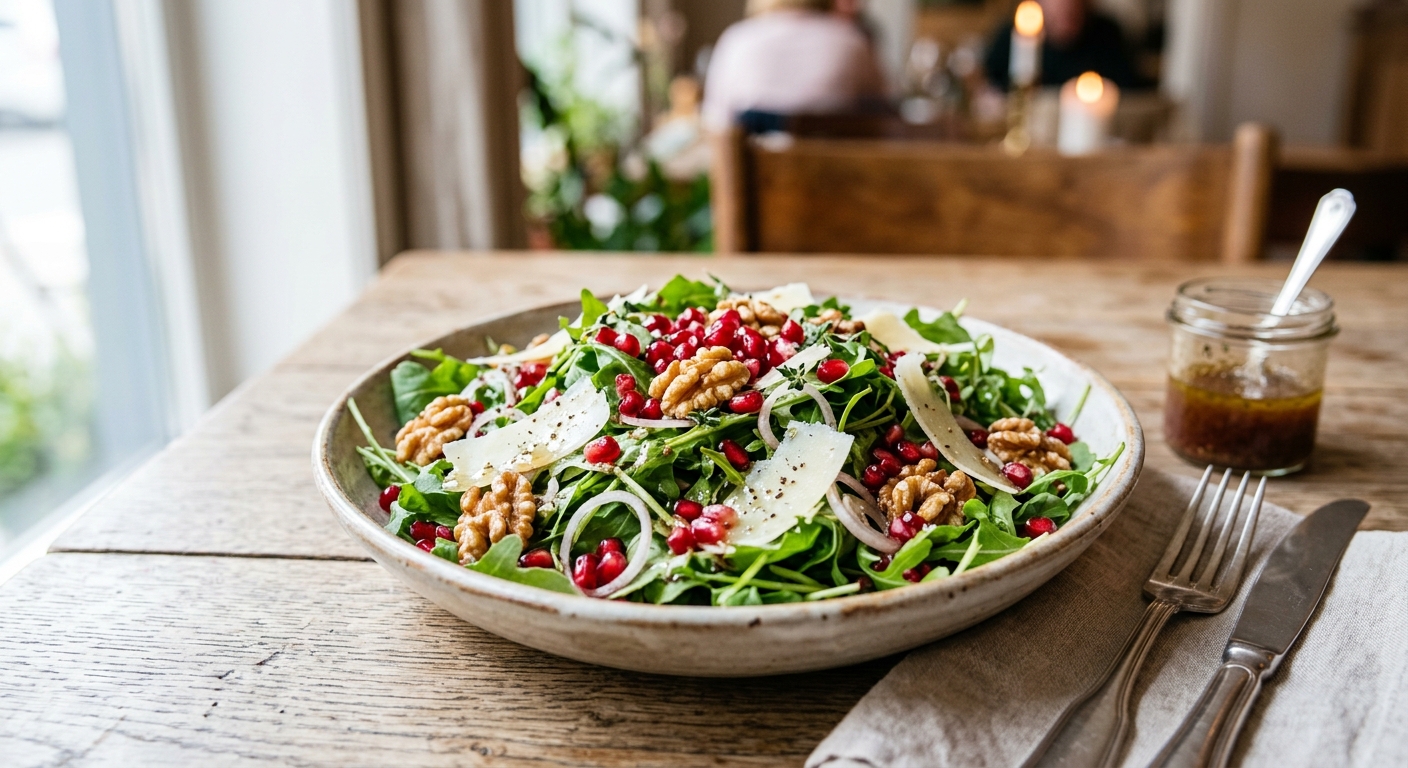
Some salads are side dishes. This one is a nutritional event. The combination of baby arugula, fresh pomegranate arils, and raw walnuts creates one of the most antioxidant-dense plates you can assemble in under 20 minutes, with each ingredient pulling serious scientific weight. Arugula contributes glucosinolates and nitrates that support cardiovascular health; pomegranate seeds deliver punicalagins, among the most potent antioxidants measured in any food; and walnuts are the only common nut with a meaningful ratio of alpha-linolenic acid, the plant-based omega-3 that helps suppress inflammatory cytokines.
At Calibrated Cuisine, we have engineered the dressing to amplify the dish’s anti-inflammatory profile rather than dilute it. Cold-pressed extra-virgin olive oil provides oleocanthal, a compound with ibuprofen-like COX-inhibiting activity, while a touch of raw honey and Dijon mustard emulsify the vinaigrette and add trace minerals. Shaved Parmesan lends umami depth and a meaningful hit of calcium without overwhelming the delicate balance of flavors. The result is a salad that is simultaneously bright, bitter, sweet, and savory – the kind of dish you crave again the next day.
We offer four distinct preparation methods to suit every kitchen and occasion. The classic stovetop method uses a skillet to toast walnuts and bloom the dressing aromatics for maximum flavor development. The oven method caramelizes shallots and creates maple-glazed walnuts with a deeper, nuttier profile. The slow cooker method produces a rich warm pomegranate reduction that transforms into a glossy, complex dressing perfect for cooler months. The pressure cooker method delivers quick-candied spiced walnuts and a bloomed-spice dressing in a fraction of the time. Choose your method, and you choose a different but equally calibrated experience.
4
servings
Ingredients
- 150 gbaby arugula, washed and dried
- 160 gfresh pomegranate arils (from approximately 1 large pomegranate)
- 100 graw walnut halves
- 60 gParmesan cheese, shaved with a vegetable peeler
- 2 mediumshallots, thinly sliced
- 60 mlextra-virgin olive oil
- 45 mlpure pomegranate juice (unsweetened)
- 30 mlred wine vinegar
- 15 mlraw honey
- 10 gDijon mustard
- 1 clovegarlic, minced
- 15 mlmaple syrup (for glazed walnut methods)
- 0.5 tspground cinnamon
- 0.25 tspcayenne pepper
- —Colima Sea SaltMicroplastic Free Salt and freshly cracked black pepper to taste
Instructions
Click on an item below to shop for the recommended items for this recipe on Amazon.
As an Amazon Associate, we earn from qualifying purchases.
- Set a dry medium skillet over medium heat. Add the walnut halves in a single layer and toast, tossing every 60 seconds, for 4 to 5 minutes until golden-brown and fragrant. Transfer immediately to a cutting board and let cool for 3 minutes, then roughly chop.
- Return the same skillet to medium-low heat and add 1 tablespoon of the olive oil. Add the sliced shallots with a pinch of salt and cook, stirring frequently, for 5 to 6 minutes until softened and lightly golden. Add the minced garlic and cook for 30 seconds until fragrant. Remove the pan from the heat.
- Whisk together the pomegranate juice, red wine vinegar, honey, and Dijon mustard in a small bowl until the honey dissolves. Pour the mixture into the warm skillet with the shallots and garlic. Return the pan to low heat, stir to deglaze any fond, and cook for 1 minute. Remove from heat and slowly whisk in the remaining olive oil in a thin stream to emulsify. Season generously with salt and black pepper.
- Place the arugula in a large, wide serving bowl. Drizzle two-thirds of the warm dressing over the greens and toss gently with tongs, coating every leaf. The warmth will very slightly wilt the arugula, which is intentional and desirable.
- Scatter the chopped toasted walnuts and pomegranate arils evenly over the dressed arugula. Arrange the shaved Parmesan on top. Drizzle the remaining dressing around the edges of the bowl. Finish with a few extra cracks of black pepper and serve immediately.
- Preheat the oven to 190C (375F). Line a rimmed baking sheet with parchment paper, keeping the two halves separated by folding a small pleat down the center to create two zones.
- On one half of the baking sheet, toss the walnut halves with the maple syrup, cinnamon, cayenne, and a pinch of salt until evenly coated. Spread in a single layer. On the other half, toss the sliced shallots with 1 tablespoon of the olive oil and a pinch of salt. Spread in a single layer.
- Roast for 10 minutes, then use a spatula to flip the walnuts and stir the shallots. Return to the oven for 8 to 12 more minutes, watching closely after the 8-minute mark. The walnuts should be lacquered and deep golden brown; the shallots should be soft, caramelized, and beginning to crisp at the edges. Transfer the walnuts to a sheet of parchment to cool and harden (they will crisp as they cool). Let the shallots cool slightly.
- While the walnuts and shallots cool, prepare the dressing. In a small jar with a tight-fitting lid, combine the pomegranate juice, red wine vinegar, honey, Dijon mustard, minced garlic, and the remaining olive oil. Seal and shake vigorously for 30 seconds to emulsify. Stir in the roasted shallots directly into the dressing so their caramelized fond enriches the vinaigrette. Season with salt and pepper.
- Place the arugula in a large serving bowl. Pour about two-thirds of the dressing over the greens and toss gently. Break the glazed walnuts into irregular pieces over the salad. Scatter the pomegranate arils and arrange the Parmesan shavings across the top. Drizzle with the remaining dressing and serve immediately while the walnuts are still slightly warm and crisp.
- In the insert of a 4-quart or larger slow cooker, combine the pomegranate juice, red wine vinegar, honey, Dijon mustard, minced garlic, sliced shallots, cinnamon, and cayenne. Stir well. Set the slow cooker to Low, prop the lid very slightly ajar using a folded dish towel or a wooden spoon handle to allow steam to escape, and cook for 2 hours. The liquid will reduce by roughly half into a glossy, syrupy concentrate.
- About 15 minutes before the dressing is done, toast the walnut halves in a dry skillet over medium heat, tossing frequently for 4 to 5 minutes until golden and fragrant. Transfer to a cutting board, cool for 3 minutes, and roughly chop.
- Carefully ladle the hot pomegranate reduction from the slow cooker into a heatproof bowl or measuring jug. Using an immersion blender or a regular blender, blend the reduction for 20 seconds to puree the shallots into the dressing. With the blender running on low, slowly drizzle in the remaining olive oil in a thin stream to create a fully emulsified, glossy pomegranate vinaigrette. Season generously with salt and black pepper. Allow to cool to just above room temperature (approximately 40 to 45C), about 5 to 8 minutes.
- Place the arugula in a large serving bowl. The dressing will be thicker than a standard vinaigrette, so start with a smaller amount: drizzle approximately half the dressing over the greens and toss gently, adding more to taste. The concentrated pomegranate flavor means a little goes a long way.
- Scatter the chopped toasted walnuts and pomegranate arils over the dressed arugula. Top with shaved Parmesan. Finish with cracked black pepper and serve immediately. Any remaining dressing can be stored in a sealed jar in the refrigerator for up to 5 days and works beautifully as a dip or drizzle for roasted vegetables.
- Set the Instant Pot or electric pressure cooker to Saute mode on Normal heat. Once the display reads Hot, add 1 tablespoon of the olive oil. Add the sliced shallots and cook, stirring frequently, for 3 minutes until softened. Add the minced garlic, cinnamon, and cayenne and stir for 30 seconds until fragrant. Add the walnut halves, maple syrup, and a pinch of salt and toss to coat. Continue sauteing and stirring for 2 to 3 minutes until the walnuts are glossy and the sugar begins to caramelize. Use a slotted spoon to transfer the candied walnuts to a sheet of parchment to cool. Press Cancel.
- To the pot, add the pomegranate juice, red wine vinegar, honey, and Dijon mustard. Stir to combine and deglaze any caramelized bits from the bottom of the pot (this is essential to avoid the burn warning). Secure the lid, set the valve to Sealing, and cook on Manual High Pressure for 3 minutes.
- When the cook time ends, perform a Quick Release by carefully switching the valve to Venting. Once the pin drops, open the lid. The liquid should be deeply fragrant and slightly reduced.
- Transfer the hot dressing liquid to a heatproof measuring jug or bowl. Using an immersion blender, blend briefly to integrate the shallots. Slowly whisk or blend in the remaining olive oil in a thin stream to emulsify. Season with salt and black pepper. Allow the dressing to cool for 5 minutes to just above room temperature.
- Place the arugula in a large serving bowl. Drizzle about two-thirds of the dressing over the greens and toss gently with tongs. Break the candied walnuts into pieces and scatter them over the salad along with the pomegranate arils. Arrange the Parmesan shavings on top, drizzle with the remaining dressing, finish with cracked black pepper, and serve immediately.
Nutrition Breakdown
Per 1 serving (makes 4)
Vitamins & Minerals
% Daily Value based on a 2,000 calorie diet (FDA reference)
🧬 Essential Amino Acids
% of recommended daily intake (RDA) per serving
🛡 Antioxidant Profile
The Nutrition Science
The anti-inflammatory synergy in this salad is driven by three distinct biochemical mechanisms operating simultaneously. Walnuts are unique among tree nuts in their high alpha-linolenic acid content (approximately 2.5g per 28g serving), which the body partially converts to EPA and DHA. These long-chain omega-3s are direct precursors to resolvins and protectins, lipid mediators that actively resolve inflammatory cascades. A 2019 meta-analysis in Nutrients found that regular walnut consumption significantly reduced CRP and IL-6 levels, two key inflammatory biomarkers, over 8-week intervention periods.
Pomegranate arils contain punicalagins, hydrolyzable tannins that are metabolized by gut microbiota into urolithin A, a compound that has shown remarkable ability to inhibit NF-kB signaling in macrophages. Urolithin A production is highly individual and depends on microbiome composition, but the ellagic acid present in pomegranate juice exerts direct anti-inflammatory effects regardless of microbiome status. The combination of oleocanthal from extra-virgin olive oil (which suppresses prostaglandin synthesis via COX inhibition) and the glucosinolate-derived isothiocyanates from arugula adds a third layer of inflammation modulation through entirely separate enzymatic pathways, making this a genuinely multi-target anti-inflammatory dish.
From a micronutrient standpoint, the vitamin K content here (approximately 60% DV per serving) deserves attention beyond its bone-health role. Vitamin K2, which the body partially synthesizes from dietary K1, activates matrix Gla protein (MGP), the most potent inhibitor of arterial calcification known. Manganese, provided at 57% DV largely by the walnuts, is a required cofactor for manganese superoxide dismutase (MnSOD), the primary mitochondrial antioxidant enzyme. This means every bite is not just delivering antioxidants, but actively supporting your body’s own antioxidant enzyme systems.
Pro Tips
- Seed a pomegranate without mess by scoring it into quarters, submerging it in a bowl of cold water, and breaking the sections apart underwater. The arils sink and the white pith floats, making separation effortless.
- For the crispest arugula, dry the leaves thoroughly in a salad spinner and refrigerate them between two clean kitchen towels for 20 minutes before dressing. Even slight moisture on the leaves will prevent the vinaigrette from adhering properly.
- The pomegranate dressing (all methods) benefits from a small pinch of fine sea salt added directly to the emulsification step. Salt is an emulsification stabilizer and will keep the oil and juice from separating quickly.
- If Parmesan is unavailable, aged Pecorino Romano works equally well and adds slightly more intensity. For a fully dairy-free version, substitute 30g of toasted pumpkin seeds plus an extra pinch of nutritional yeast for savory depth.


Love this combo, Sue. The key thing I’ve noticed in my kitchen is timing the pomegranate arils separate from the greens and dressing until service, otherwise the juice oxidizes and you lose a good chunk of those anthocyanins you’re after. I usually dress the arugula alone first (lighter hand with the vinaigrette since the arils add their own liquid), then fold in the pomegranate and walnuts last. Game changer for both texture and micronutrient retention.
Oh, what a beautiful way to showcase pomegranate! I’ve been making arugula salads for years, but I never paid much attention to the polyphenol content until I started studying functional nutrition in my retirement, and this recipe really captures why those deep reds and peppery greens matter so much for reducing inflammation. I’m absolutely making this for my next cooking class because it’s the perfect example of how simple swaps and ingredient knowledge can transform a basic salad into medicine, and the walnut omega-3s combined with those pomegranate antioxidants is just inspired. Do you have any thoughts on timing the pomegranate vinaigrette, or does it hold up well
Love this combo, and Chris N. has such a solid point about the timing – I do the exact same thing! I’m always thinking about glycemic load too, so I appreciate that pomegranate arils plus walnuts plus that vinaigrette means you’ve got fiber, fat, and acid working together to flatten any blood sugar spike. For my T1D folks watching, this is the kind of salad where you can actually eat a generous portion without anxiety because the macros are so well balanced. The polyphenol angle is the cherry on top!