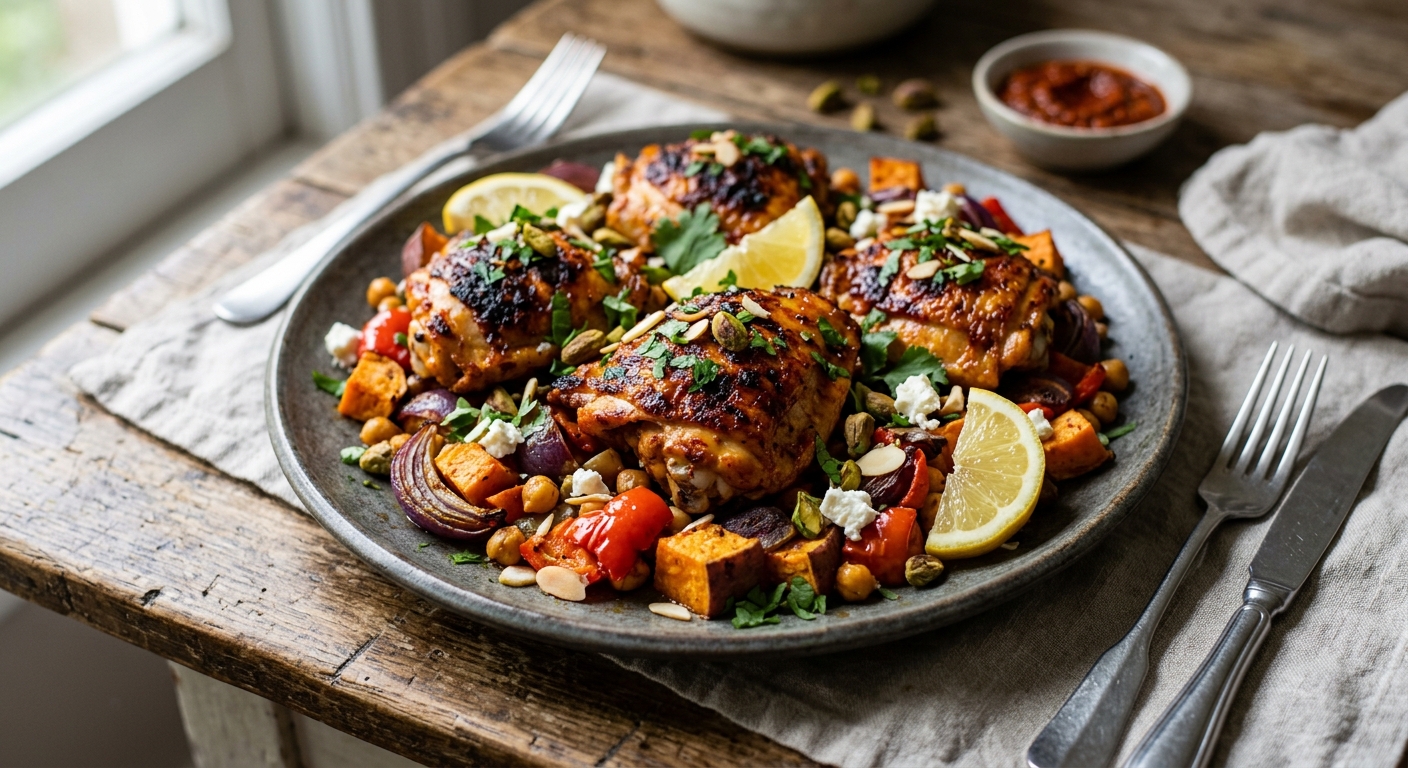
Sheet pan cooking is the weeknight hero that professional kitchens have quietly relied on for decades, and this harissa chicken recipe is the dish that proves why. Bone-in, skin-on chicken thighs are marinated in a punchy harissa paste, brightened with lemon zest, and roasted alongside a colorful tangle of bell peppers, red onion, zucchini, and protein-loaded chickpeas. The result is caramelized edges, juicy meat, and vegetables that have absorbed every drop of spiced, rendered fat. It is the kind of meal that tastes like it took hours, yet lands on the table in under an hour.
From a nutritional standpoint, this dish is a carefully constructed powerhouse. Chicken thighs provide heme iron (the most bioavailable form) while the chickpeas add non-heme iron, pushing total iron content to an impressive 36% of your daily value per serving. The harissa paste, built on red chili peppers and roasted red peppers, contributes substantial beta-carotene, vitamin C, and capsaicin. Vitamin C from the peppers is not incidental: it actively enhances non-heme iron absorption from the chickpeas by up to 67%, making this a meal where the ingredients are nutritionally intelligent as well as delicious.
Harissa is a North African chili paste with roots in Tunisian and Moroccan cooking, traditionally made by grinding dried chilies with caraway, coriander, and garlic. Store-bought harissa varies widely in heat and quality, so tasting before you coat the chicken is essential. Rose harissa offers a floral, milder profile, while traditional harissa brings serious heat. Either works beautifully here. The marinade needs only 30 minutes but rewards overnight resting with deeper penetration into the meat, making this an ideal recipe to prep the evening before a busy day.
4
servings
Ingredients
- 900 gbone-in, skin-on chicken thighs (about 4 large thighs)
- 3 tbspharissa paste (rose or traditional)
- 3 tbspextra-virgin olive oil, divided
- 1 tbspfresh lemon juice
- 1 tsplemon zest
- 4 clovesgarlic, minced
- 1 tspground cumin
- 1 tspsmoked paprika
- 0.5 tspground coriander
- 2 mediumred bell peppers, cut into 3cm strips
- 1 mediumyellow bell pepper, cut into 3cm strips
- 2 mediumzucchini, sliced into 1.5cm half-moons
- 1 largered onion, cut into wedges
- 400 gcanned chickpeas, drained and rinsed
- 200 gcherry tomatoes
- 2 tbsptomato paste
- 120 mlchicken stock (low sodium)
- 30 gflat-leaf parsley, roughly chopped
- 60 gfull-fat Greek yogurt (for serving)
- —Colima Sea SaltMicroplastic Free Salt and black pepper to taste
- —Lemon wedges for serving
Instructions
Click on an item below to shop for the recommended items for this recipe on Amazon.
As an Amazon Associate, we earn from qualifying purchases.
- Make the marinade: In a large bowl, whisk together the harissa paste, 2 tablespoons olive oil, lemon juice, lemon zest, minced garlic, cumin, smoked paprika, coriander, 1 teaspoon salt, and a generous grind of black pepper until fully combined.
- Add the chicken thighs to the bowl and coat every surface thoroughly with the marinade, pressing it under the skin where possible. Cover and refrigerate for at least 30 minutes, or overnight for best results. Remove from the refrigerator 20 minutes before cooking to temper.
- Preheat your oven to 220C (425F) with a large rimmed sheet pan (half-sheet size, approximately 46 x 33 cm) inside. Heating the pan ensures immediate contact heat and prevents vegetables from steaming.
- In a separate bowl, toss the bell peppers, zucchini, red onion wedges, and drained chickpeas with the remaining 1 tablespoon olive oil, a pinch of salt, and pepper. Spread the vegetables in a single layer on the preheated sheet pan, leaving four gaps for the chicken.
- Nestle the marinated chicken thighs skin-side up among the vegetables. Scatter the cherry tomatoes across the pan. Roast on the middle-upper rack for 40 to 45 minutes, until the chicken skin is deeply charred at the edges, the internal temperature reads 74C (165F) on an instant-read thermometer, and the vegetables are tender with caramelized, slightly blistered edges.
- If the skin needs more color in the final 5 minutes, switch to the broiler on high for 3 to 4 minutes, watching closely to prevent burning. Rest the chicken for 5 minutes on the pan before garnishing with flat-leaf parsley and serving with Greek yogurt and lemon wedges alongside.
- Prepare the marinade and marinate the chicken thighs as described in the oven method (steps 1 and 2), refrigerating for at least 30 minutes. In a small bowl, stir the tomato paste into the chicken stock and set aside.
- Heat a large, heavy-bottomed skillet or cast-iron pan (30cm diameter) over medium-high heat until very hot. Add 1 tablespoon olive oil and swirl to coat. Lift the chicken thighs from the marinade, shaking off excess, and place them skin-side down in the pan. Do not move them. Sear for 6 to 7 minutes until the skin is deep golden and releases cleanly from the pan. Flip and sear the flesh side for 3 minutes. Transfer chicken to a plate.
- Reduce heat to medium. In the same pan with the rendered chicken fat, add the red onion wedges and cook for 3 minutes, stirring occasionally. Add the bell pepper strips and cook for a further 4 minutes until softened at the edges. Add any remaining marinade from the bowl and stir for 1 minute until fragrant and slightly darkened.
- Push the vegetables to the edges of the pan. Pour the tomato paste and stock mixture into the center, scraping up any browned bits from the base with a wooden spoon. Add the chickpeas and cherry tomatoes and stir everything together. Nestle the seared chicken thighs skin-side up on top of the vegetable mixture, ensuring the skin sits above the liquid to stay as crisp as possible.
- Add the zucchini half-moons around the chicken, cover with a tight-fitting lid, and reduce heat to medium-low. Braise for 18 to 20 minutes until the chicken is fully cooked through (74C internal temperature) and the vegetables are tender. Remove the lid for the final 3 minutes to reduce the sauce slightly. Garnish with parsley and serve directly from the pan with Greek yogurt and lemon wedges.
- Make the marinade: whisk together harissa, 1 tablespoon olive oil (not 2, as you need less fat with slow cooking), lemon juice, lemon zest, garlic, cumin, smoked paprika, coriander, 1 teaspoon salt, and black pepper. Coat the chicken thighs thoroughly. Marinating is optional for this method since the long cook time develops flavor, but even 30 minutes helps.
- Stir the tomato paste into the chicken stock. Layer the red onion wedges and chickpeas on the base of the slow cooker insert. Add the bell pepper strips and scatter the cherry tomatoes over. Pour the tomato-stock mixture evenly over the vegetables.
- Nestle the marinated chicken thighs on top of the vegetable layer, skin-side up if keeping skin on. Do not add the zucchini yet as it will become mushy over the long cook. Spoon any remaining marinade over the chicken. Place the lid on and cook on Low for 5 to 6 hours or on High for 2.5 to 3 hours, until the chicken is completely tender and reads at least 74C.
- In the last 30 minutes of cooking, add the zucchini half-moons by pressing them into the liquid around the chicken. Replace the lid and continue cooking until just tender but not falling apart.
- For optional crisping: transfer the cooked chicken thighs to a foil-lined baking sheet. Brush lightly with olive oil and place under the broiler on high for 3 to 4 minutes until the skin or surface is browned and slightly charred. Meanwhile, if the sauce in the slow cooker is too thin, ladle it into a small saucepan and reduce over medium-high heat for 5 minutes. Serve chicken over the vegetable and chickpea mixture, topped with parsley, Greek yogurt, and lemon wedges.
- Prepare the marinade and coat the chicken thighs as described in the oven method. For the pressure cooker, even a 15-minute marinade is effective since the high-pressure environment drives flavors into the meat rapidly. Stir the tomato paste into the chicken stock and set aside.
- Set the Instant Pot or electric pressure cooker to Saute on High (or use the stovetop pressure cooker over medium-high heat). Add 1 tablespoon olive oil. Once shimmering, place the chicken thighs skin-side down and sear without moving for 4 to 5 minutes until a deep golden crust forms. Flip and sear 2 minutes on the flesh side. Remove and set aside. This step builds the fond that forms the flavor base of the sauce.
- Without rinsing the pot, add the red onion and bell peppers. Saute for 3 minutes, scraping up the browned fond from the searing step as the vegetables release moisture. This is critical for both flavor and to prevent a burn warning on electric models. Add the remaining marinade from the bowl and cook for 1 minute until darkened and fragrant.
- Pour in the tomato-stock mixture and stir well, ensuring nothing is stuck to the bottom of the pot. Add the chickpeas and cherry tomatoes. Nestle the seared chicken thighs on top, skin-side up. Do not add the zucchini yet. Secure the lid and set the pressure valve to Sealing. Cook at High Pressure for 12 minutes.
- Allow a natural pressure release for 5 minutes, then carefully quick-release any remaining pressure. Open the lid away from you. Check that the chicken reads 74C internally. Remove the chicken thighs and set aside. Switch back to Saute mode and add the zucchini directly to the hot liquid. Simmer for 4 to 5 minutes until just tender. The sauce will reduce slightly during this time. Return the chicken to the pot, garnish with parsley, and serve with Greek yogurt and lemon wedges.
Nutrition Breakdown
Per 1 serving (makes 4)
Vitamins & Minerals
% Daily Value based on a 2,000 calorie diet (FDA reference)
🧬 Essential Amino Acids
% of recommended daily intake (RDA) per serving
🛡 Antioxidant Profile
The Nutrition Science
The central nutritional story of this dish is the iron synergy between its two primary protein sources. Chicken thighs provide heme iron, a form bound to hemoglobin and myoglobin that is absorbed at a rate of 15 to 35 percent regardless of other dietary factors. The chickpeas contribute non-heme iron, which is normally absorbed at only 2 to 10 percent, but is dramatically upregulated in the presence of ascorbic acid. The 112mg of vitamin C per serving (primarily from the bell peppers) converts ferric iron (Fe3+) to ferrous iron (Fe2+) in the gut lumen, making it far more soluble and available for uptake through the divalent metal transporter 1 (DMT1) in the intestinal brush border. This means the chickpeas’ iron contribution in this dish is effectively two to three times more bioavailable than it would be eaten alone.
Chicken thighs are often overlooked in favor of breast meat, but they offer a superior micronutrient profile for many applications. They are substantially richer in iron, zinc, selenium, and B vitamins, particularly niacin and B6. Niacin (B3) at 9.8mg per serving covers 61% of the daily value and is essential for the NAD and NADP coenzymes that drive over 400 enzymatic reactions in human metabolism, including energy production from carbohydrates, fats, and proteins. Selenium at 51% DV supports the selenoprotein family, including glutathione peroxidase, the body’s primary enzymatic defense against lipid peroxidation.
The harissa paste and spice blend contribute more than flavor. Cumin contains thymoquinone, a bioactive compound with documented anti-inflammatory and hepatoprotective properties. Smoked paprika and dried red chilies are dense sources of capsaicinoids and carotenoids, particularly beta-carotene and capsanthin, a xanthophyll unique to peppers. Coriander seeds provide linalool, a monoterpenoid with anxiolytic and antioxidant activity in preclinical models. While the quantities of these compounds per serving are modest, regular consumption of diverse spice matrices has been consistently associated with reduced markers of systemic inflammation in large observational studies.
Pro Tips
- Score the chicken thighs two to three times through the skin down to the bone before marinating. This dramatically increases the surface area for marinade penetration and helps the skin render more fat during cooking, producing crispier results in the oven method.
- Drying the chickpeas thoroughly with paper towels before tossing with oil is the single most important step for achieving roasted, slightly crispy chickpeas in the oven. Any residual moisture from the can will steam them soft instead.
- Harissa pastes vary enormously in heat between brands. Taste your harissa before using and adjust the quantity up or down. If you want heat without extra paste volume, add a pinch of cayenne to the marinade separately and reduce harissa to 2 tablespoons.
- The Greek yogurt is not just a garnish. Its cool dairy fat tempers capsaicin heat and the lactic acid brightens the richness of the spiced chicken fat, making it a functional component of the dish’s flavor balance.

OMG Miranda, YES – I’ve been tracking the same thing with my IBS! I noticed that chicken thighs specifically don’t trigger my usual inflammation flares like leaner cuts do, plus the iron absorption is SO much better when it’s paired with vitamin C from those bell peppers – this recipe is basically designed for optimal bioavailability. The chickpeas are genius too, adding both soluble fiber for my gut and plant-based iron, which I’ve found settles better in my system than red meat. I’m definitely making this tonight and comparing it to my food diary – the spice from harissa might actually help with digestion if it’s the right heat level for my sensitivities, so
This is exactly the kind of quantified approach I love seeing, Miranda and Greta. I’ve been tracking the same heme vs non-heme iron absorption patterns on my CGM and blood work, and the data backs you both up / chicken thighs with vitamin C sources (those peppers are clutch here) can push non-heme iron bioavailability up to around 3-4x compared to thighs alone. Have you both noticed measurable shifts in your ferritin or serum iron levels since prioritizing the thigh cuts, or mainly just the subjective energy difference? I’m curious whether the anti-inflammatory lipid profile in darker meat is doing additional work here beyond just the
The heme iron + vitamin C synergy you’re mentioning is huge, Ben – I’ve actually seen my ferritin climb from 38 to 62 ng/mL over three months since I made the switch to thighs, which correlates pretty directly with when I started being more intentional about pairing them with high-ascorbic acid sides like these peppers. What’s interesting is that my CGM stability also improved noticeably, which makes me wonder if the oleic acid content in thighs is dampening postprandial glucose spikes compared to leaner cuts, though I haven’t found much literature specifically isolating that effect. Have you noticed any glycemic pattern differences between th
This is such a thoughtful observation, Greta! The heme iron plus vitamin C pairing is something I’ve been intentional about for years now, and your ferritin improvement really validates that synergy, especially since I saw similar jumps when I switched my cooking methods to preserve those heat-sensitive vitamins in the peppers. I haven’t tracked glucose responses as granularly as you with a CGM, but I’ve definitely noticed my joint inflammation markers (CRP specifically) respond better to the thighs with all that oleic acid compared to leaner poultry, so I wonder if there’s some broader anti-inflammatory mechanism at play that’s also steadying your blood sugar, not just the fat content
This thread is so validating, Irene – I’m really curious whether you’ve noticed nightshade sensitivity with the peppers in this recipe? I ask because I’m on a modified AIP protocol for my Hashimoto’s and I’ve found that even roasted bell peppers can trigger inflammation for me, which potentially masks that iron absorption benefit you’re describing. Have you experimented with swapping them out for other vitamin C sources (like a squeeze of lemon or some cruciferous veggies), or do you find the peppers themselves are worth it for your inflammation markers?
Oh this is exactly the kind of dinner I’ve been craving, especially since I started tracking how iron affects my energy levels during this perimenopausal transition. The combo of chicken thighs (which have way more iron than breast) plus chickpeas is *chef’s kiss* for someone like me trying to keep my ferritin up while managing hot flashes. Definitely making this tonight and honestly the harissa spice might even help with circulation, which I’ve found matters more than I expected. Thanks for breaking down the actual amino acid profile, because I’m learning that complete proteins help stabilize my mood way better than I’d realized.