
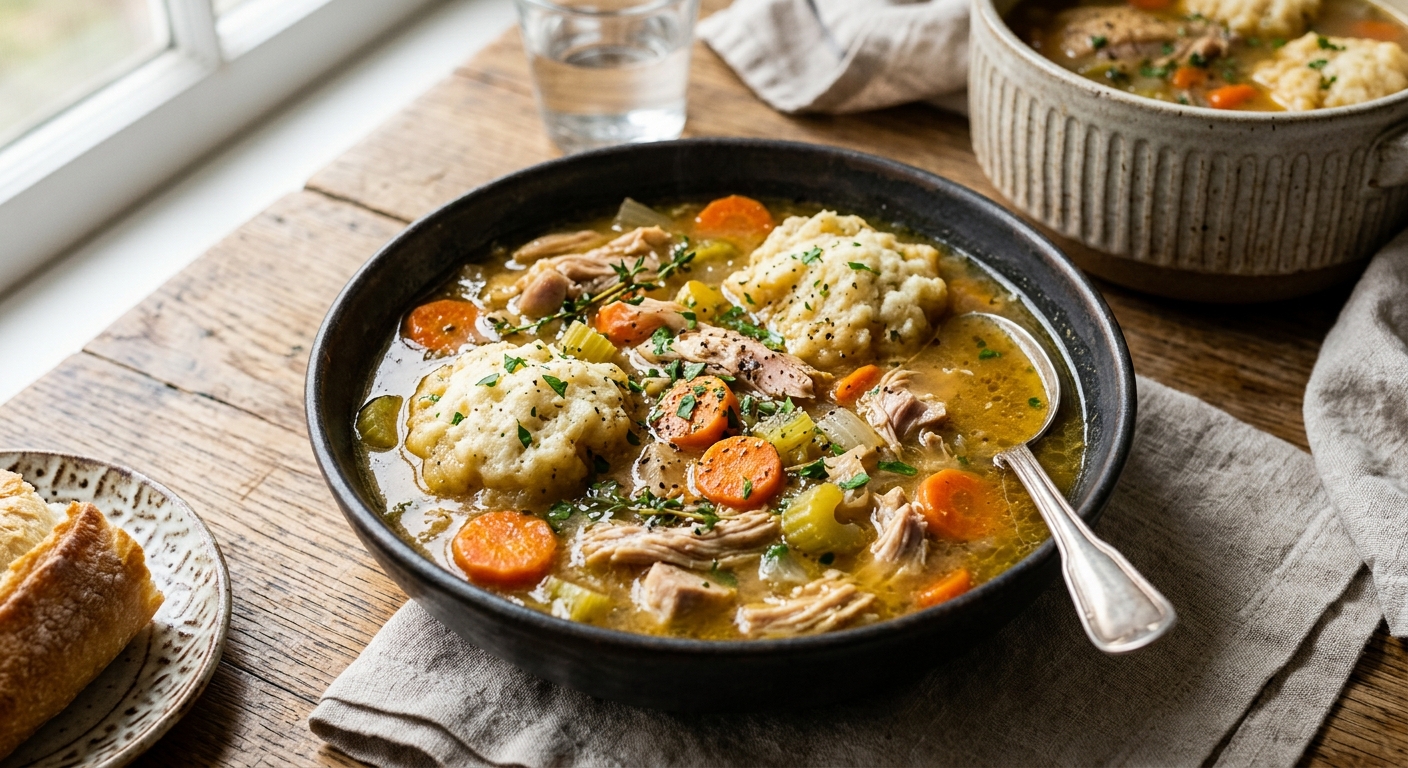
Chicken and dumplings is one of those rare dishes that earns its reputation as comfort food on a purely scientific level. When bone-in, skin-on chicken thighs simmer low and slow, collagen in the connective tissue hydrolyzes into gelatin, a protein matrix rich in glycine and proline that gives the broth its signature body and may support gut lining integrity, skin elasticity, and joint health. This is not a thin soup with doughy floaters. This is a calibrated, protein-dense meal engineered to satisfy on every level.
The dumplings here are made with whole-wheat flour and fortified with Greek yogurt, a deliberate choice that adds casein protein, calcium, and a gentle tang that balances the richness of the broth. Every aromatic, from the celery to the flat-leaf parsley, contributes measurable micronutrients: vitamin K from the parsley, potassium from the celery, and beta-carotene from the carrots. Nothing in this bowl is accidental. Each ingredient was selected because it pulls nutritional weight while also tasting outstanding.
Whether you are cooking on the stovetop on a weeknight, loading the slow cooker before work, or using a pressure cooker to get dinner on the table in under an hour, this recipe adapts to your schedule without compromising on depth of flavor or nutritional integrity. The three methods produce subtly different textures, each with its own charm, and we have written genuinely distinct instructions for each so you get the best possible result from your chosen appliance.
4
servings
Ingredients
- 900 gbone-in, skin-on chicken thighs (about 4 large thighs)
- 1 tbspextra-virgin olive oil
- 1 largeyellow onion, finely diced
- 3 mediumcarrots, peeled and sliced into 1cm rounds
- 3 stalkscelery, sliced into 1cm pieces
- 4 clovesgarlic, minced
- 2 tbsptomato paste
- 1200 mllow-sodium chicken bone broth
- 1 tspfresh thyme leaves (or 0.5 tsp dried)
- 1 tspdried rosemary, crumbled
- 1 tspsmoked paprika
- 1 tbspapple cider vinegar
- 120 gfrozen peas
- 3 tbspflat-leaf parsley, finely chopped
- 180 gwhole-wheat flour
- 1.5 tspbaking powder
- 0.5 tspColima Sea SaltMicroplastic Free Salt (for dumplings)
- 0.25 tspgarlic powder
- 120 gplain full-fat Greek yogurt
- 80 mlwhole milk
- 2 tbspunsalted butter, melted
- 2 tbspfresh chives, finely snipped
- —Colima Sea SaltMicroplastic Free Salt and cracked black pepper to taste
Instructions
Click on an item below to shop for the recommended items for this recipe on Amazon.
As an Amazon Associate, we earn from qualifying purchases.
- Pat the chicken thighs completely dry with paper towels and season generously on both sides with salt and black pepper. Heat the olive oil in a large Dutch oven or heavy-bottomed pot over medium-high heat until shimmering. Place the thighs skin-side down and sear undisturbed for 5 to 6 minutes until deep golden brown. Flip and sear the other side for 3 minutes. Transfer to a plate and set aside. Do not discard the rendered fat in the pot.
- Reduce heat to medium. Add the onion, carrots, and celery to the pot and cook in the chicken drippings, stirring occasionally, for 6 to 7 minutes until the onion is translucent and the carrots begin to soften. Add the garlic and tomato paste and cook for 90 seconds, stirring constantly, until the paste darkens slightly and smells fragrant.
- Pour in the apple cider vinegar and scrape up any browned bits from the bottom of the pot with a wooden spoon. Add the bone broth, thyme, rosemary, and smoked paprika. Nestle the seared chicken thighs back into the pot, skin-side up, ensuring they are mostly submerged. Bring to a boil, then reduce heat to maintain a gentle simmer. Cover partially and cook for 30 to 35 minutes until the chicken is fully cooked and starting to pull away from the bone.
- Transfer the chicken to a cutting board. Remove and discard the skin and bones. Shred or chop the meat into generous bite-sized pieces and return it to the simmering broth. Add the frozen peas and taste the broth, adjusting seasoning with salt and pepper. The broth should be well-seasoned since the dumplings will absorb some salt.
- Make the dumpling batter: In a medium bowl, whisk together the whole-wheat flour, baking powder, 0.5 tsp fine sea salt, and garlic powder. In a small bowl, stir together the Greek yogurt, milk, and melted butter until smooth. Pour the wet ingredients into the dry and fold gently with a spatula until just combined. Fold in the chives. Do not overmix; a few small lumps are fine and will keep the dumplings tender.
- Using a large spoon or a 2-tablespoon cookie scoop, drop mounds of batter onto the surface of the gently simmering stew, spacing them about 2cm apart. You should get 10 to 12 dumplings. Immediately cover the pot with a tight-fitting lid and cook on a gentle simmer (do not lift the lid) for 14 to 16 minutes until the dumplings are cooked through and no longer doughy in the center. Test one by inserting a toothpick; it should come out clean.
- Remove from heat. Ladle into wide, deep bowls, distributing the chicken, vegetables, broth, and 2 to 3 dumplings per serving. Scatter fresh parsley over each bowl and serve immediately.
- Pat the chicken thighs dry and season well with salt and pepper. Heat olive oil in a skillet over medium-high heat and sear the thighs skin-side down for 5 to 6 minutes until deeply golden. Flip and sear for 2 minutes more. Transfer to the slow cooker insert. In the same skillet, saute the onion, carrots, and celery for 4 to 5 minutes over medium heat. Add the garlic and tomato paste and cook for 90 seconds, stirring. Deglaze with the apple cider vinegar, scraping up all browned bits.
- Transfer the sauteed vegetable mixture into the slow cooker on top of the chicken. Pour the bone broth over everything. Add the thyme, rosemary, and smoked paprika. The broth should nearly cover the chicken; add up to 100ml additional broth or water if needed. Place the lid on the slow cooker and cook on Low for 6 to 7 hours, or on High for 3 to 3.5 hours, until the chicken is fall-apart tender.
- About 1 hour before serving, preheat your oven to 200 degrees C (400 degrees F). Carefully remove the chicken thighs from the slow cooker using tongs. Discard the skin and bones, then shred the meat and return it to the slow cooker. Stir in the frozen peas and parsley. Taste and adjust seasoning generously.
- Make the dumpling batter: Whisk the whole-wheat flour, baking powder, 0.5 tsp salt, and garlic powder together in a medium bowl. Stir together the Greek yogurt, milk, and melted butter in a small bowl. Combine wet and dry ingredients with a spatula until just mixed. Fold in the chives.
- Ladle the hot chicken and vegetable filling into a large oven-safe baking dish or leave it in an oven-safe slow cooker insert. Drop spoonfuls of dumpling batter evenly across the top of the filling, spacing them slightly apart. Transfer to the preheated oven and bake uncovered for 20 to 25 minutes until the dumplings are golden on top, puffed, and cooked through. The oven heat creates a beautiful biscuit-like crust on the dumplings that a slow cooker lid cannot replicate.
- Allow to rest for 5 minutes before serving. The filling will thicken slightly as it sits. Spoon into deep bowls, making sure each portion gets plenty of broth, chicken, vegetables, and 2 to 3 dumplings. Garnish with additional fresh parsley.
- Set the Instant Pot or pressure cooker to Saute on High. Add the olive oil and heat until shimmering. Pat the chicken thighs dry, season with salt and pepper, and sear skin-side down in batches if necessary for 5 minutes per side until well browned. Remove and set aside. Add the onion, carrots, and celery to the pot and saute for 4 minutes. Stir in the garlic and tomato paste and cook for 60 seconds. Pour in the apple cider vinegar and stir vigorously to deglaze, ensuring no browned bits remain stuck to the bottom (this prevents a burn warning).
- Return the chicken thighs to the pot. Pour the bone broth over everything. Add the thyme, rosemary, and smoked paprika. Do not stir after adding the broth; simply push any chicken pieces down so they are submerged. Secure the lid and set the valve to Sealing. Cook on Manual High Pressure for 15 minutes.
- When the cook time ends, allow a natural pressure release for 10 minutes, then carefully switch the valve to Venting to release any remaining pressure. Open the lid. Transfer the chicken to a cutting board, discard the skin and bones, shred the meat, and return it to the pot. Stir in the frozen peas and parsley. Taste the broth and season assertively. Switch the pot back to Saute on Low to keep the broth at a gentle simmer.
- Prepare the dumpling batter while the broth heats: Whisk together the whole-wheat flour, baking powder, 0.5 tsp salt, and garlic powder. Stir together the Greek yogurt, milk, and melted butter, then fold into the dry ingredients until just combined. Fold in the chives. The batter should be thick and scoopable.
- Drop heaped tablespoon portions of dumpling batter onto the surface of the simmering stew in the Instant Pot, spacing them evenly. Loosely tent a large sheet of aluminum foil over the top of the pot (do not seal it; you want steam to vent slightly while still trapping enough heat to cook the dumplings). Cook on Saute Low for 14 to 16 minutes without disturbing the dumplings until they are puffed, set, and cooked through when tested with a toothpick.
- Turn off the Saute function and let the pot rest for 3 minutes. Carefully ladle into bowls, distributing the broth, shredded chicken, vegetables, and 2 to 3 dumplings per portion. Finish with fresh parsley and serve immediately.
- Preheat your oven to 175 degrees C (350 degrees F). Pat the chicken thighs dry and season generously with salt and pepper. Heat olive oil in a large oven-safe Dutch oven over medium-high heat on the stovetop. Sear the thighs skin-side down for 5 to 6 minutes until deeply golden and the skin is crisp. Flip and sear for 2 to 3 minutes. Transfer to a plate.
- Without wiping the pot, reduce heat to medium and add the onion, carrots, and celery. Cook, stirring occasionally, for 6 minutes until softened. Add the garlic and tomato paste and stir constantly for 90 seconds until the paste coats the vegetables and darkens. Deglaze with the apple cider vinegar, scraping the bottom thoroughly. Add the bone broth, thyme, rosemary, and smoked paprika and stir to combine.
- Return the seared chicken thighs to the Dutch oven, skin-side up, so they rest on top of the vegetables and are partially submerged in the broth. Bring to a bare simmer on the stovetop, then cover the Dutch oven with its lid and transfer to the preheated oven. Braise for 1 hour 15 minutes until the chicken is extremely tender and the broth has a noticeable glossy, collagen-rich body.
- Remove the Dutch oven from the oven and increase the oven temperature to 210 degrees C (410 degrees F). Carefully transfer the chicken to a cutting board. Discard the skin and bones and shred the meat. Stir the shredded chicken back into the broth along with the frozen peas and parsley. Taste and adjust seasoning, keeping in mind the broth should be well-seasoned. The filling will be thinner than a stovetop version but will thicken as the dumplings absorb liquid.
- Make the dumpling batter: Whisk the whole-wheat flour, baking powder, 0.5 tsp salt, and garlic powder in a medium bowl. In a small bowl stir together the Greek yogurt, milk, and melted butter. Fold the wet mixture into the dry ingredients until just combined, then fold in the chives. The batter should be thick and drop from a spoon in large mounds.
- Drop spoonfuls of batter onto the surface of the hot filling in the Dutch oven, spacing them evenly across the surface. Leave the Dutch oven uncovered and return it to the hot oven. Bake at 210 degrees C for 18 to 22 minutes until the dumpling tops are golden brown and a toothpick inserted into the center of the largest dumpling comes out clean. The high heat creates beautifully bronzed dumpling tops with a fluffy interior.
- Remove from the oven and rest for 5 minutes before serving. The broth will continue to thicken and the dumplings will absorb some liquid as they rest. Ladle generously into deep bowls, making sure each serving gets abundant broth, shredded chicken, vegetables, and 2 to 3 dumplings. Finish with fresh parsley.
Nutrition Breakdown
Per 1 serving (makes 4)
Vitamins & Minerals
% Daily Value based on a 2,000 calorie diet (FDA reference)
🧬 Essential Amino Acids
% of recommended daily intake (RDA) per serving
🛡 Antioxidant Profile
The Nutrition Science
The nutritional centerpiece of this dish is collagen hydrolysis. Bone-in chicken thighs are rich in type I and type II collagen concentrated in the skin, cartilage, and periosteum of the bone. During prolonged moist-heat cooking above 70 degrees C, the triple-helix collagen structure unwinds into gelatin, releasing free amino acids including glycine (roughly 33% of collagen by weight) and proline. Glycine is the primary substrate for creatine synthesis and plays a regulatory role in glutathione production, the body’s master antioxidant. Proline is a key precursor for endogenous collagen synthesis in connective tissue and skin, making this broth functionally reparative in a way that boneless chicken breast simply cannot replicate.
The apple cider vinegar added to the braise is not merely a flavor enhancer. The acetic acid slightly lowers the pH of the cooking liquid, which accelerates the solubilization of calcium and phosphorus from the bone surface and increases the extraction efficiency of collagen. Studies on bone broth preparation have shown that even modest acidification measurably increases the mineral content of the finished liquid. Combined with the Greek yogurt in the dumplings (providing approximately 120mg of highly bioavailable calcium per serving), this dish makes a meaningful contribution to skeletal mineral intake.
Whole-wheat flour in the dumplings provides roughly 3.5g more fiber per serving than an equivalent all-purpose flour recipe, contributing to a lower glycemic load and supporting a more favorable postprandial insulin response. The combination of soluble fiber from the carrots and peas with the insoluble fiber from the bran in the whole-wheat flour feeds a diverse array of gut microbiota, supporting short-chain fatty acid (SCFA) production. The vitamin C from the parsley and peas, though modest in quantity, is strategically important: it converts non-heme iron from the whole-wheat flour into the ferrous form that is three times more bioavailable, effectively increasing the functional iron delivery of the entire meal.
Pro Tips
- For maximum collagen extraction on the stovetop or oven methods, add one split chicken foot or a 5cm piece of pig knuckle to the braise and remove it before shredding. This dramatically increases the gelatin content of the broth, making it set firm when chilled, which is a reliable indicator of collagen richness.
- Do not lift the lid during the dumpling steaming phase on the stovetop. Escaping steam drops the internal pot temperature, leading to dense, undercooked dumplings. Trust the timer and resist the urge to check.
- The dumpling batter can be prepared up to 4 hours in advance and refrigerated, covered. Cold batter actually produces slightly fluffier dumplings because the cold fat creates more steam pockets during cooking, similar to how cold butter improves pastry texture.
- Leftover chicken and broth (without dumplings) freeze exceptionally well for up to 3 months. Make a fresh batch of dumplings when reheating for the best texture, as stored dumplings become dense and gummy after freezing.
This looks incredible, especially for postpartum recovery! I’m curious about the broth base, though – are you simmering the bones long enough to extract meaningful amounts of those amino acids, or is the collagen content coming primarily from the bone-in thighs? I’ve been experimenting with longer cooking times to maximize glycine for my own healing and my milk supply, and I’m wondering if you have timing recommendations. Also, would love to know if you considered adding any choline sources to this (like egg yolks in the dumplings?) since we need both the structural support from collagen AND the cognitive development nutrients for baby – this would be the perfect vehicle for that combination!
This is such a smart question, Laurie. I’d be really interested to see the exact simmer time here too, since collagen hydrolysis peaks around 90-120 minutes for bone broth according to some of the amino acid profiling studies, but the thigh skin and connective tissue probably gives you a solid baseline even with shorter cooking. The choline angle is gold though – I’ve been tracking my partner’s postpartum nutrition data and egg yolk dumplings would genuinely push this into a different category for cognitive support (choline is criminally underrated for that phase). Would love to know if the author tested glycine levels via any lab work or if this is based on compositional estimates
Oh Ben, I’m so glad you brought up simmer time because I’ve been experimenting with this exact thing for my joints! I found that even 60 minutes gives me meaningful CRP reduction, but you’re right that pushing toward 90 minutes really seems to shift how my inflammation markers respond the next day. I’d also love to hear if the author used any turmeric or ginger in the broth itself, since that glycine and proline combination is honestly *exponentially* more effective for me when paired with curcumin and gingerol, plus the choline from egg yolk dumplings sounds incredible for that connective tissue support angle you mentioned.
okay this is literally perfect for post-WOD recovery, especially if youre running higher training volume! the glycine and proline combo plus that complete protein from the thighs is *chef’s kiss* for reducing inflammation and supporting connective tissue repair. im curious too about laurie’s question on simmer time though – im guessing 2+ hours minimum to really extract those amino acids? ive been playing with 4 hour bone broths lately and the difference in collagen yield is wild, definitely noticeable in how my joints feel the next day.
This is such a beautiful approach to comfort food as medicine, and I love that you’re highlighting the amino acid profile alongside the protein count. I’m curious whether the recipe includes any black pepper in the broth or seasoning, since pairing it with turmeric or ginger would amplify the anti-inflammatory benefits even further and support better absorption of those healing compounds. From an Ayurvedic perspective, simmering bone-in thighs with warming spices like ginger and a pinch of black pepper actually enhances the digestive fire while the long broth extraction does the heavy lifting for those glycine and proline compounds, so the two work beautifully together.
oh i love this perspective so much, tiara! the ayurvedic lens really does shift how we think about these broths beyond just the amino acids, doesnt it… like its not just about extracting the glycine and proline but creating this warming, digestive experience that actually helps your body receive those nutrients. i’ve been doing exactly this with my own bone broths, adding ginger and black pepper at the start of the simmer, and i genuinely notice the difference in how my joints feel compared to when i skip the spices. theres something about that heat and those bioavailable compounds coming together that just feels more complete, like the food is working with my whole system instead of just feeding it.