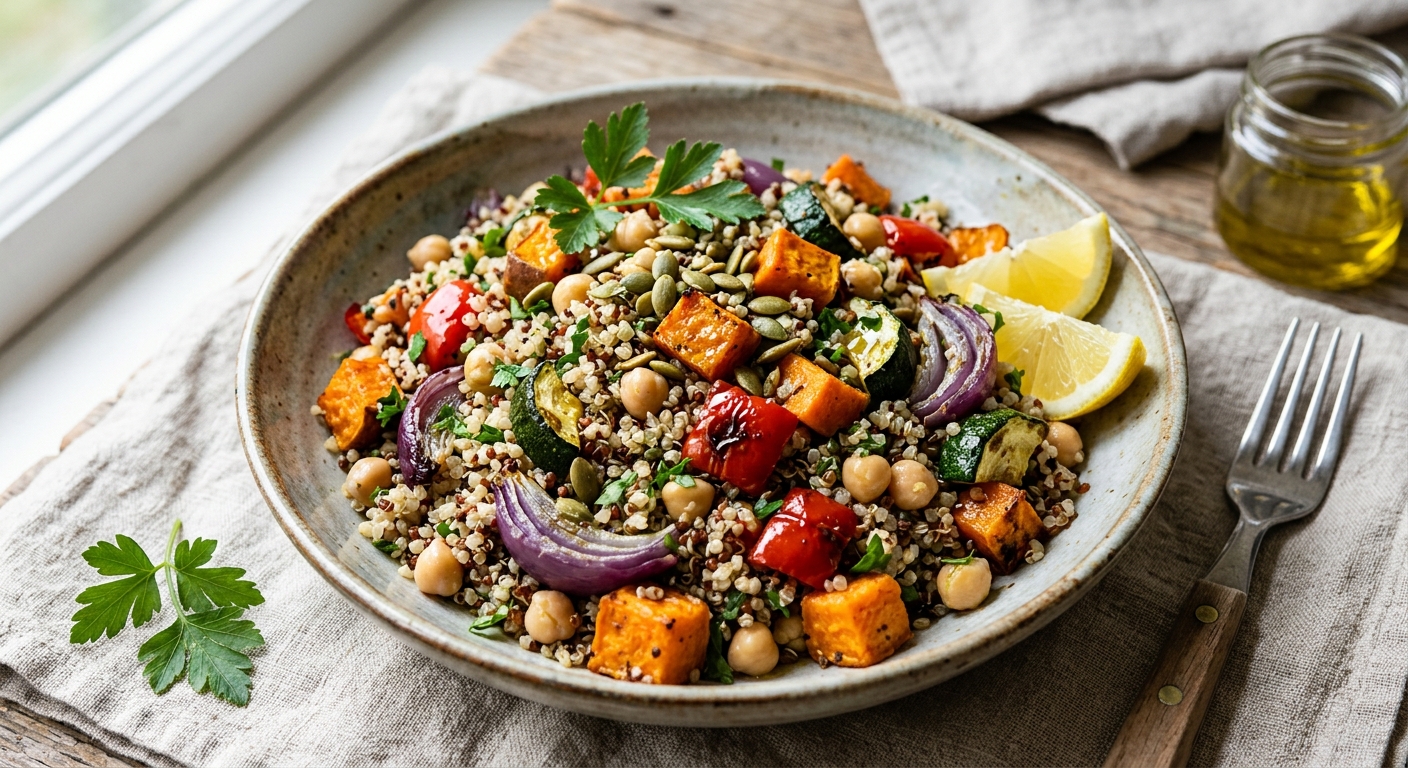
Most plant-based salads fall short on protein, leaving you hungry an hour after eating. This quinoa and roasted vegetable salad breaks that pattern decisively. Quinoa brings 8 grams of complete protein per cooked cup, a distinction shared by almost no other grain or seed in the plant kingdom. Paired with sweet potato, red bell pepper, red onion, zucchini, and chickpeas, each bowl delivers a mineral profile that would make a multivitamin blush: meaningful percentages of your daily iron, magnesium, zinc, potassium, and folate all in one deeply satisfying dish.
The flavor story is just as compelling as the nutritional one. Roasting the vegetables at high heat transforms their natural sugars into rich, caramelized edges that plain steamed vegetables simply cannot match. Sweet potato becomes jammy and sweet, red onion softens into silky strands, zucchini picks up golden, slightly crisp surfaces, and chickpeas turn nutty and almost crunchy. The warm vegetables are folded into freshly cooked quinoa so they absorb the lemon-cumin vinaigrette while everything is still fragrant and steaming, then finished with fresh parsley, toasted pepitas, and crumbled feta for layers of texture and brightness.
At Calibrated Cuisine we engineered this salad to exceed 20% of the Daily Value for five distinct minerals in a single serving, making it a true flagship in our Mineral Matrix category. Whether you roast the vegetables in the oven and cook the quinoa on the stovetop, prepare the whole dish in a pressure cooker on a busy weeknight, or let a slow cooker do the heavy lifting, every method is calibrated to the same nutrient targets and the same crowd-pleasing result.
4
servings
Ingredients
- 200 gwhite or tri-color quinoa, rinsed thoroughly under cold water
- 480 mllow-sodium vegetable broth
- 350 gsweet potato (about 1 medium), peeled and cut into 2cm cubes
- 250 gzucchini (about 1 large), halved lengthwise and cut into 1.5cm half-moons
- 200 gred bell pepper (about 1 large), seeded and cut into 2cm pieces
- 180 gred onion (about 1 medium), cut into 2cm wedges
- 240 gcanned chickpeas, drained and rinsed (about one 400g can)
- 4 tbspextra-virgin olive oil, divided
- 3 tbspfresh lemon juice (about 1 large lemon)
- 1 tspground cumin
- 1 tspsmoked paprika
- 0.5 tspgarlic powder
- 0.5 tspground turmeric
- 30 gpepitas (pumpkin seeds), toasted
- 20 gfresh flat-leaf parsley, roughly chopped
- 80 gfeta cheese, crumbled (optional, omit for vegan)
- —Colima Sea SaltMicroplastic Free Salt and freshly cracked black pepper to taste
Instructions
Click on an item below to shop for the recommended items for this recipe on Amazon.
As an Amazon Associate, we earn from qualifying purchases.
- Toast the rinsed quinoa in a medium dry saucepan over medium heat, stirring constantly for 2 to 3 minutes until the grains smell nutty and turn lightly golden. This step drives off residual moisture and deepens flavor. Pour in the vegetable broth, add a pinch of salt, and bring to a boil.
- Once boiling, reduce heat to the lowest setting, cover tightly, and cook for 15 minutes without lifting the lid. Remove from heat and let the quinoa steam, still covered, for a further 5 minutes. Uncover and fluff gently with a fork. Spread onto a large baking tray or wide bowl to cool slightly so it does not turn soggy when the vegetables are added.
- While the quinoa cooks, prepare the vinaigrette in a small bowl: whisk together 2 tablespoons of olive oil, the lemon juice, cumin, smoked paprika, garlic powder, turmeric, a generous pinch of salt, and several grinds of black pepper. Set aside.
- Heat the remaining 2 tablespoons of olive oil in a large (30cm) heavy-bottomed or cast-iron skillet over medium-high heat until shimmering. Add the sweet potato cubes in a single layer and cook undisturbed for 4 minutes until a deep golden crust forms on the bottom. Toss and cook for another 3 to 4 minutes. Push the sweet potato to the edges of the pan.
- Add the red onion wedges to the center of the pan and cook for 2 minutes, then add the bell pepper and zucchini. Cook everything together, tossing occasionally, for 5 to 6 minutes until the vegetables are tender with charred edges. Add the drained chickpeas to the pan, stir to combine, and cook for 2 more minutes until the chickpeas are heated through and starting to crisp.
- Transfer the warm vegetables and chickpeas to the bowl with the quinoa. Pour over the vinaigrette and toss well to coat. Fold in the parsley and half the pepitas. Taste and adjust seasoning with salt and pepper. Divide among bowls, then top each portion with crumbled feta (if using) and the remaining pepitas. Serve warm or at room temperature.
- Whisk together 2 tablespoons of olive oil, the lemon juice, cumin, smoked paprika, garlic powder, turmeric, 1 teaspoon of salt, and black pepper directly in the insert of the slow cooker. This becomes both the cooking liquid flavor base and the finishing vinaigrette.
- Add the rinsed quinoa to the slow cooker and stir to coat in the seasoned oil mixture. Add the vegetable broth and stir again. Layer the sweet potato cubes, red onion wedges, red bell pepper pieces, and drained chickpeas on top of the quinoa. Do not stir: the quinoa needs to stay submerged at the bottom to absorb liquid properly while the vegetables steam above.
- Cover and cook on High for 2 hours 45 minutes. Do not open the lid during this time, as slow cookers lose significant heat each time they are uncovered and require up to 30 minutes to recover temperature.
- After 2 hours 45 minutes, scatter the zucchini over the top of the vegetables, replace the lid quickly, and continue cooking on High for a further 45 minutes. The zucchini will cook through while still holding its shape, and the quinoa at the bottom should have absorbed all the broth and show the characteristic white spiral tails that indicate doneness.
- Turn off the slow cooker and remove the lid. Using a wide spatula or large spoon, gently fold everything together from the bottom up, breaking up any quinoa that has clumped. The residual heat and steam will finish any remaining moisture. Add the remaining 2 tablespoons of olive oil, fold in the parsley and half the pepitas, and taste for seasoning. Serve directly from the insert, topped with crumbled feta and the remaining pepitas.
- Select the Saute function on your Instant Pot (or use a stovetop pressure cooker over medium-high heat). Add 1 tablespoon of olive oil and, once shimmering, add the sweet potato, red onion, and chickpeas. Saute for 4 minutes, stirring occasionally, until the onion softens and the sweet potato picks up a little color on the edges. This saute step builds fond that enriches the final dish. Turn off Saute.
- Add the rinsed quinoa directly over the sauteed vegetables. Pour in the vegetable broth and stir once to distribute evenly. Add the cumin, smoked paprika, garlic powder, turmeric, and 0.5 teaspoon of salt. Stir briefly. Lay the bell pepper and zucchini pieces on top without stirring them in: placing delicate vegetables on top rather than submerged prevents them from turning to mush under pressure.
- Secure the lid and set the pressure release valve to Sealing. Cook on Manual High Pressure for 1 minute. When the cycle ends, allow a natural pressure release for 10 full minutes, then carefully switch the valve to Venting to release any remaining steam.
- Open the lid away from your face. The quinoa should have absorbed all the broth and the vegetables should be tender throughout. If any liquid remains in the bottom, select Saute and stir for 1 to 2 minutes to evaporate it. Gently fold everything together with a wide spatula.
- Drizzle over the remaining 3 tablespoons of olive oil and the lemon juice, then fold in the parsley and half the pepitas. Taste and adjust salt and pepper. Spoon into bowls and finish with crumbled feta and the remaining pepitas. For caramelized edges without roasting time, transfer the finished salad to a foil-lined baking sheet and place under a broiler on High for 3 to 4 minutes before plating.
- Preheat your oven to 220 degrees Celsius (425 degrees Fahrenheit) with two racks positioned in the upper and lower thirds of the oven. Line two large rimmed baking sheets with parchment paper. While the oven heats, cook the quinoa on the stovetop: combine the rinsed quinoa, vegetable broth, and a pinch of salt in a medium saucepan. Bring to a boil, reduce to a simmer, cover, and cook for 15 minutes. Remove from heat and steam for 5 minutes covered, then fluff and set aside.
- Divide the sweet potato, red onion, bell pepper, and zucchini between the two lined baking sheets, keeping them in a single layer with space between pieces. Drizzle 1.5 tablespoons of olive oil over each sheet, then sprinkle the cumin, smoked paprika, garlic powder, turmeric, 0.75 teaspoon of salt, and a generous amount of black pepper over both sheets. Toss each sheet directly to coat every piece, then spread back into a single layer.
- Place both sheets in the oven and roast for 20 minutes. Remove both sheets, add the drained chickpeas to one of the sheets among the partially roasted vegetables, and use a spatula to flip the vegetables. Rotate the sheets between racks. Return to the oven and roast for a further 15 to 20 minutes until the sweet potato is tender and caramelized at the edges, the zucchini is golden, and the chickpeas are lightly crisped.
- While the vegetables finish roasting, prepare the vinaigrette: whisk together the remaining 1 tablespoon of olive oil, the lemon juice, and a pinch of salt in a large serving bowl.
- Transfer the hot roasted vegetables and chickpeas directly into the serving bowl with the vinaigrette. Add the fluffed quinoa and toss well so the residual heat from the vegetables helps the quinoa absorb the dressing. Fold in the parsley and half the pepitas. Taste for seasoning and adjust as needed. Scatter the crumbled feta and remaining pepitas over the top. This salad is exceptional served warm immediately from the oven or at room temperature after 20 minutes of resting, during which the flavors deepen considerably.
Nutrition Breakdown
Per 1 serving (makes 4)
Vitamins & Minerals
% Daily Value based on a 2,000 calorie diet (FDA reference)
🧬 Essential Amino Acids
% of recommended daily intake (RDA) per serving
🛡 Antioxidant Profile
The Nutrition Science
Quinoa’s status as a complete protein source is well-documented in peer-reviewed literature. Unlike most plant proteins, which are deficient in one or more essential amino acids, quinoa contains all nine in proportions that meet or approach FAO/WHO reference patterns. This is largely due to its classification as a pseudocereal: botanically a seed rather than a true grain, quinoa’s protein is stored in the embryo rather than the endosperm, giving it a superior amino acid distribution to wheat or rice. The lysine content is particularly notable at around 630mg per 100g cooked, an amino acid notoriously scarce in conventional grains and critical for collagen synthesis, calcium absorption, and immune function.
The combination of vitamin C-rich red bell pepper with the non-heme iron present in quinoa, chickpeas, and pepitas is a deliberate and evidence-backed strategy. Non-heme iron, the form found exclusively in plants, has a bioavailability of roughly 2 to 20% depending on dietary context. Vitamin C (ascorbic acid) converts ferric iron (Fe3+) to ferrous iron (Fe2+) in the gut lumen, the only form that intestinal enterocytes can efficiently absorb via the DMT-1 transporter. Studies suggest that consuming as little as 63mg of vitamin C alongside a non-heme iron source can increase iron absorption by up to 300%. A single serving of this salad provides 72mg of vitamin C alongside 5.2mg of iron, making it a genuinely optimized meal for addressing iron insufficiency on a plant-forward diet.
Magnesium, often the most under-consumed major mineral in Western diets, is supplied here through three synergistic sources: quinoa (approximately 64mg per cooked cup), pepitas (74mg per 28g serving), and chickpeas (48mg per 100g cooked). Magnesium acts as a cofactor in over 300 enzymatic reactions including ATP synthesis, DNA repair, and protein folding. Research consistently links low magnesium status with increased risk of type 2 diabetes, hypertension, and osteoporosis, yet national dietary surveys indicate that over 50% of adults in the United States and United Kingdom fail to meet the RDA. At 128mg per serving, or 30% of the Daily Value, this salad is one of the most efficient single-dish magnesium deliveries in our entire recipe catalog.
Pro Tips
- Rinse the quinoa in a fine-mesh strainer under cold running water for at least 60 seconds to remove saponins, the naturally occurring bitter coating. Even pre-rinsed quinoa benefits from a second rinse for the cleanest, nuttiest flavor.
- Do not skip toasting the pepitas if using raw seeds: spread them in a dry skillet over medium heat for 3 to 4 minutes, stirring constantly, until they start to pop and turn golden. Toasting activates Maillard compounds that add significant nuttiness and improves the palatability of the zinc and magnesium within them.
- This salad stores exceptionally well. Keep the feta and remaining pepitas separate and add them only at serving. The dressed quinoa and vegetable base will keep refrigerated for up to 4 days and actually improves in flavor after an overnight rest as the quinoa fully absorbs the vinaigrette.
ooh love that steve brought up leucine! honestly quinoa alone probably wouldnt be my go-to post-wod protein, but pairing it with those pepitas is smart because youre bumping up the amino acid profile significantly. have you tested this as a recovery meal? im curious if adding a scoop of protein powder or maybe some greek yogurt on the side would get you closer to that 2.5g leucine sweet spot for optimal muscle protein synthesis. the micronutrient density is killer though, especially the mag and zinc for inflammation management, so its definitely a solid complete meal regardless!
Great post, though I’d be curious about the leucine content here. Quinoa’s got all nine amino acids, sure, but at about 0.3g leucine per cooked cup, you’re looking at maybe 0.5-0.7g per serving depending on portion size. For us older folks trying to trigger muscle protein synthesis, most research suggests we need closer to 2.5-3g per meal. I’ve found pairing these plant-based complete proteins with Greek yogurt, cottage cheese, or an egg on the side really gets you over that leucine threshold without much fuss. The minerals you highlighted are spot on though, and I definitely appreciate the micronutrient angle here.
Love that you’re digging into the leucine numbers, Steve – that’s the detail that actually matters for real results! You’re totally right that quinoa alone won’t cut it for muscle synthesis, and I appreciate you naming the gap instead of just accepting the “complete protein” marketing. The pepitas help bump it up but you’d still need strategic pairing like you mentioned. From a T1D perspective, I’m also eyeing how adding that Greek yogurt or egg actually flattens my glucose response to the carbs in this salad, so it’s a win/win for blood sugar stability plus hitting that leucine threshold. Have you found a particular ratio that works best for you, or does it depend on what