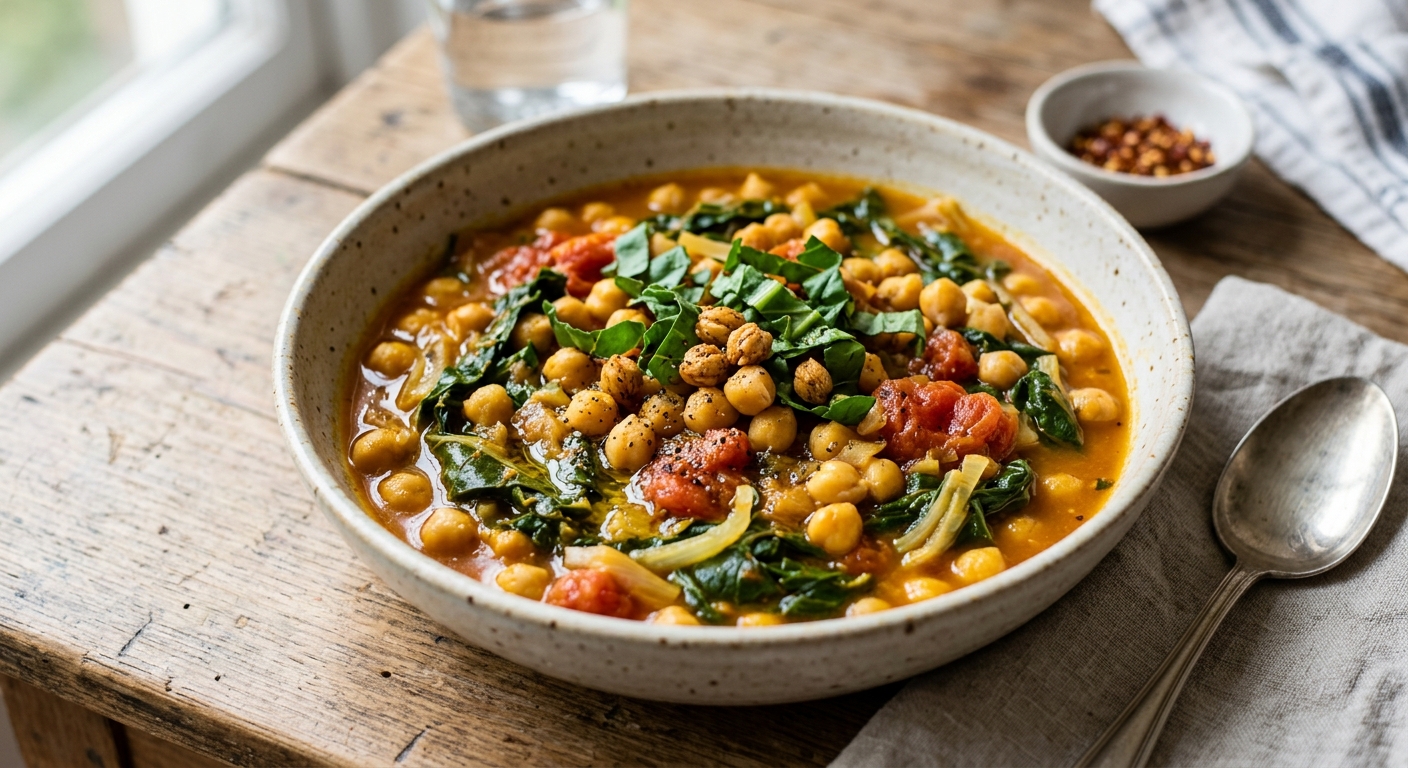
Some dishes earn their place on a weekly rotation purely on flavor. Others earn it on nutrition. This Chickpea and Swiss Chard Stew with Turmeric earns it on both counts simultaneously. Swiss chard is one of the most mineral-dense leafy greens available, packing iron, magnesium, potassium, and calcium into every dark, glossy leaf. Paired with chickpeas, which contribute their own substantial iron and folate load, this stew becomes a genuinely powerful tool for meeting your daily mineral targets without resorting to supplementation.
The turmeric here is not decorative. Curcumin, the active polyphenol in turmeric, has well-documented anti-inflammatory properties, and the addition of black pepper in this recipe increases curcumin bioavailability by up to 2000% by inhibiting its rapid hepatic metabolism. The tomato base provides lycopene and vitamin C, and that vitamin C is strategically important: it converts non-heme iron (the type found in plants) into its more absorbable ferrous form, meaningfully improving the iron uptake from both the chard and the chickpeas.
This is a stew built on culinary logic as much as nutritional science. The aromatics are bloomed in olive oil to release fat-soluble compounds. The chard stems are cooked separately from the leaves so nothing turns to mush. The chickpeas are added at a stage that lets them absorb flavor without losing their satisfying bite. Every step has a reason, and the result is a bowl that tastes like it took all day even when made in under an hour.
4
servings
Ingredients
- 2 x 400g canschickpeas, drained and rinsed (approximately 480g drained weight)
- 450 gSwiss chard, stems and leaves separated, both thinly sliced
- 400 gcanned crushed tomatoes
- 1 mediumyellow onion, finely diced
- 5 clovesgarlic, minced
- 2 tbspextra-virgin olive oil
- 2 tspground turmeric
- 1 tspground cumin
- 1 tspsmoked paprika
- 0.5 tspground coriander
- 0.5 tspfreshly ground black pepper
- 0.25 tspcayenne pepper
- 700 mllow-sodium vegetable broth
- 1 tbsptomato paste
- 1 tbspfresh lemon juice
- 1 tsplemon zest
- 2 tbspflat-leaf parsley, roughly chopped, for serving
- —Colima Sea SaltMicroplastic Free Salt to taste
Instructions
Click on an item below to shop for the recommended items for this recipe on Amazon.
As an Amazon Associate, we earn from qualifying purchases.
- Heat the olive oil in a large Dutch oven or heavy-bottomed pot over medium heat. Once the oil shimmers, add the diced onion and the sliced chard stems together. Cook, stirring occasionally, for 7 to 8 minutes until the onion is soft and translucent and the chard stems have lost their crunch. Season with a pinch of salt to help draw out moisture.
- Push the onion and stems to the outer edges of the pot. Add the minced garlic to the centre and cook for 60 seconds until fragrant. Add the tomato paste directly onto the garlic and stir it into the oil, pressing and spreading it across the base of the pot. Cook for 90 seconds, stirring constantly, until the paste darkens slightly from bright red to a brick-red colour. This step caramelises the sugars in the paste and builds deep umami foundation for the broth.
- Add the turmeric, cumin, smoked paprika, coriander, black pepper, and cayenne. Stir everything together and cook the spices for 60 seconds, stirring continuously so they do not scorch. You will smell them bloom and become intensely fragrant. Pour in approximately 50ml of the vegetable broth to deglaze, scraping up any browned bits from the base of the pot.
- Add the crushed tomatoes and the remaining vegetable broth. Stir to combine and bring the stew to a gentle boil over medium-high heat. Once boiling, add the drained chickpeas, reduce the heat to medium-low, and simmer uncovered for 15 minutes, stirring occasionally. The broth should reduce slightly and begin to coat the chickpeas.
- Add the sliced chard leaves in two or three batches, stirring each addition into the hot broth and waiting for it to wilt before adding the next. Once all the chard is incorporated, continue simmering for a further 5 minutes until the leaves are tender but still have a deep green colour. Remove from heat, stir in the lemon juice and lemon zest, and taste for salt. Serve in warmed bowls topped with fresh parsley.
- There is no need to saute anything before loading the slow cooker, but one important preparatory step improves the final flavour significantly: toast the dry spices (turmeric, cumin, smoked paprika, coriander, black pepper, cayenne) in a small dry skillet over medium heat for 60 to 90 seconds, stirring constantly, until fragrant. This wakes up the fat-soluble aromatic compounds that a slow, low-heat cook would otherwise leave muted. Set aside.
- Place the diced onion, sliced chard stems, minced garlic, tomato paste, crushed tomatoes, drained chickpeas, and toasted spices into the slow cooker insert. Pour the vegetable broth over everything and stir well to distribute the tomato paste and spices evenly throughout the liquid. Season with salt.
- Place the lid on the slow cooker and cook on Low for 7 hours or on High for 3.5 hours. The chickpeas will become very soft and creamy, and the broth will thicken and deepen in colour. Do not lift the lid during cooking, as each peek adds 20 to 30 minutes of recovery time.
- Approximately 25 minutes before serving, switch the slow cooker to High if it was on Low. Add the sliced chard leaves, pressing them down into the hot broth. Replace the lid and cook for 20 to 25 minutes until the leaves are fully wilted and tender.
- Stir in the olive oil, lemon juice, and lemon zest. Taste and adjust salt. The olive oil is added at the end here rather than at the start, which preserves its fruity, peppery flavour notes that would otherwise cook off over seven hours. Serve in warmed bowls topped with fresh parsley.
- Select the Saute function on your Instant Pot (or heat your stovetop pressure cooker over medium heat). Add the olive oil and allow it to heat for about 60 seconds. Add the diced onion and sliced chard stems and saute for 5 minutes, stirring regularly, until softened. Add the garlic and cook for 30 seconds. Add the tomato paste and stir it into the base, cooking for 60 seconds until it darkens.
- Add all the dry spices (turmeric, cumin, smoked paprika, coriander, black pepper, cayenne) and stir constantly for 45 seconds to bloom them in the oil. Pour in 100ml of the vegetable broth immediately and deglaze the pot thoroughly, using a wooden spoon to scrape every bit of the fond from the bottom. This step is critical: any residue stuck to the pot base will trigger a Burn warning on electric pressure cookers.
- Add the crushed tomatoes, remaining vegetable broth, drained chickpeas, and a pinch of salt. Stir to combine. Cancel the Saute function. Secure the lid and set the pressure valve to Sealing. Select High Pressure and set the cook time for 12 minutes. The pot will take approximately 8 minutes to come to pressure.
- When the cook cycle is complete, allow the pressure to release naturally for 10 minutes. Then carefully move the valve to Venting to release any remaining steam. Remove the lid. The stew should be thick and richly coloured.
- Select Saute mode again (or return to medium heat). Add the sliced chard leaves in batches, pressing them into the hot stew. Cook for 3 to 4 minutes, stirring, just until the leaves are wilted and bright. Cancel Saute. Stir in the lemon juice, lemon zest, and taste for salt. Serve immediately topped with fresh parsley, as the chard colour is at its best right now.
- Preheat your oven to 175C (350F) with a rack positioned in the lower-middle position. Place a large oven-safe Dutch oven over medium-high heat on the stovetop. Add the olive oil, then add the diced onion and chard stems. Cook for 6 to 7 minutes until softened and beginning to take on a light golden colour at the edges. Add the garlic and cook for 60 seconds.
- Add the tomato paste and stir it across the base of the pot, cooking for 90 seconds until it deepens in colour. Add all the spices and stir continuously for 60 seconds to bloom them. Deglaze with 100ml of vegetable broth, scraping up the fond. Add the crushed tomatoes and remaining broth, then stir in the drained chickpeas. Season with salt and bring the mixture to a gentle simmer.
- Cover the Dutch oven tightly with its lid and carefully transfer it to the preheated oven. Braise for 45 minutes. Unlike stovetop simmering, the oven heat surrounds the pot uniformly, causing the stew to bubble gently from all sides and infuse the chickpeas with the spiced tomato broth without scorching the base.
- Remove the Dutch oven from the oven. Using oven mitts, carefully remove the lid (tilt it away from you to allow steam to escape safely). The stew should be thick and aromatic. Add the sliced chard leaves in batches, folding them into the hot stew using tongs. Return the pot to the oven, uncovered, for a final 10 minutes. The uncovered time wilts the chard, reduces the broth slightly, and develops a faint, pleasant caramelisation on the surface.
- Remove from the oven and allow to rest for 3 to 4 minutes. Stir in the lemon juice and lemon zest. Taste and adjust salt. The rest period allows the residual heat to finish the chard without overcooking it and lets the flavours settle and meld. Serve in warmed bowls topped with fresh parsley.
Nutrition Breakdown
Per 1 serving (makes 4)
Vitamins & Minerals
% Daily Value based on a 2,000 calorie diet (FDA reference)
🧬 Essential Amino Acids
% of recommended daily intake (RDA) per serving
🛡 Antioxidant Profile
The Nutrition Science
The iron in this stew comes entirely from non-heme sources, the form of iron found in plants, which has an absorption rate of roughly 2 to 20% compared to 15 to 35% for heme iron from animal sources. This sounds like a disadvantage, but the recipe is engineered to close that gap. Swiss chard and tomatoes both provide ascorbic acid (vitamin C), which reduces ferric iron (Fe3+) to the more absorbable ferrous form (Fe2+) directly in the gut lumen. Research published in the American Journal of Clinical Nutrition demonstrates that consuming 50mg of vitamin C alongside a plant-based meal can increase non-heme iron absorption by three to six times. This dish provides approximately 38mg of vitamin C per serving, and pairing it with a vitamin C-rich accompaniment pushes absorption higher still.
Turmeric’s curcumin content deserves more than a passing mention. Curcumin is lipophilic, meaning it requires fat for absorption, and cooking the spices in olive oil at the start of this recipe satisfies that requirement. Piperine, the active alkaloid in black pepper, inhibits the glucuronidation enzymes in the liver and intestinal wall that would otherwise rapidly inactivate curcumin. The half-teaspoon of black pepper in this recipe is not seasoning, it is a pharmaceutical-grade bioavailability intervention backed by a 1998 study in Planta Medica showing a 2000% increase in curcumin serum concentration when co-administered with piperine. The 90mg of curcumin estimated per serving from 2 teaspoons of ground turmeric is a meaningful dose for anti-inflammatory purposes.
Swiss chard’s extraordinarily high vitamin K content (approximately 480mcg per serving, or 400% of the daily value) is worth a clinical note. Vitamin K1 (phylloquinone), found in leafy greens, is essential for the gamma-carboxylation of clotting factors and osteocalcin, a protein that binds calcium into bone matrix. The magnesium contribution (28% DV per serving) matters here too: magnesium activates the enzyme that converts vitamin D into its active form, and active vitamin D is required for calcium absorption. The chickpeas and chard together create an unusually complete mineral synergy, where the nutrients present actively facilitate each other’s metabolism rather than simply sitting alongside each other passively.
Pro Tips
- Buy Swiss chard with firm, glossy stems and deeply coloured leaves. Rainbow chard works beautifully and adds visual contrast, but any variety performs identically in terms of nutrition and flavour.
- If you are cooking dried chickpeas from scratch rather than canned, use 200g dried (which yields approximately 480g cooked). Soak them overnight, drain, then proceed. Dried-and-cooked chickpeas hold their texture better under long braises like the slow cooker and oven methods.
- The stew thickens considerably as it cools. If reheating leftovers, add a splash of vegetable broth or water and warm gently over medium-low heat, stirring occasionally. Flavour actually deepens on day two as the spices continue to infuse the chickpeas.
Just tested this recipe against my CGM data and I’m impressed, the turmeric + tomato broth combination kept my glucose response remarkably stable compared to chickpea dishes without that curcumin element. A quick question though, are you accounting for the bioavailability hit from the oxalates in Swiss chard when you cite that 42% iron DV? I know some studies suggest pairing with vitamin C helps (which the tomato handles), but I’m curious if you’ve run the numbers on actual absorbed iron versus total iron content.
That’s a fascinating observation about the glucose stability, Ben – I’ve noticed something similar in my own practice, where the curcumin and other polyphenols in turmeric seem to modulate the glycemic response pretty noticeably. I’m curious whether you’re also considering that Swiss chard’s oxalates might slightly reduce bioavailability of that iron, though the vitamin C from the tomato broth should help offset it? The real magic here might be pairing this with some reishi or chaga tea alongside the meal, since adaptogens can help support your HPA axis while you’re getting solid mineral nutrition – just wondering if that’s something you’ve experimented with too.
Love that you’re tracking the glucose response here, Ben – the turmeric angle is really interesting! I’d just add that the Swiss chard is doing some heavy lifting too, since the fiber and magnesium combo actually helps with both iron absorption *and* glycemic stability, which people don’t always realize. Plus the vitamin C from the tomatoes is crucial for non-heme iron bioavailability, so this recipe is basically a masterclass in how whole foods work synergistically. I’m definitely saving this one to recommend to clients who are nervous about getting enough iron on a plant-based diet.