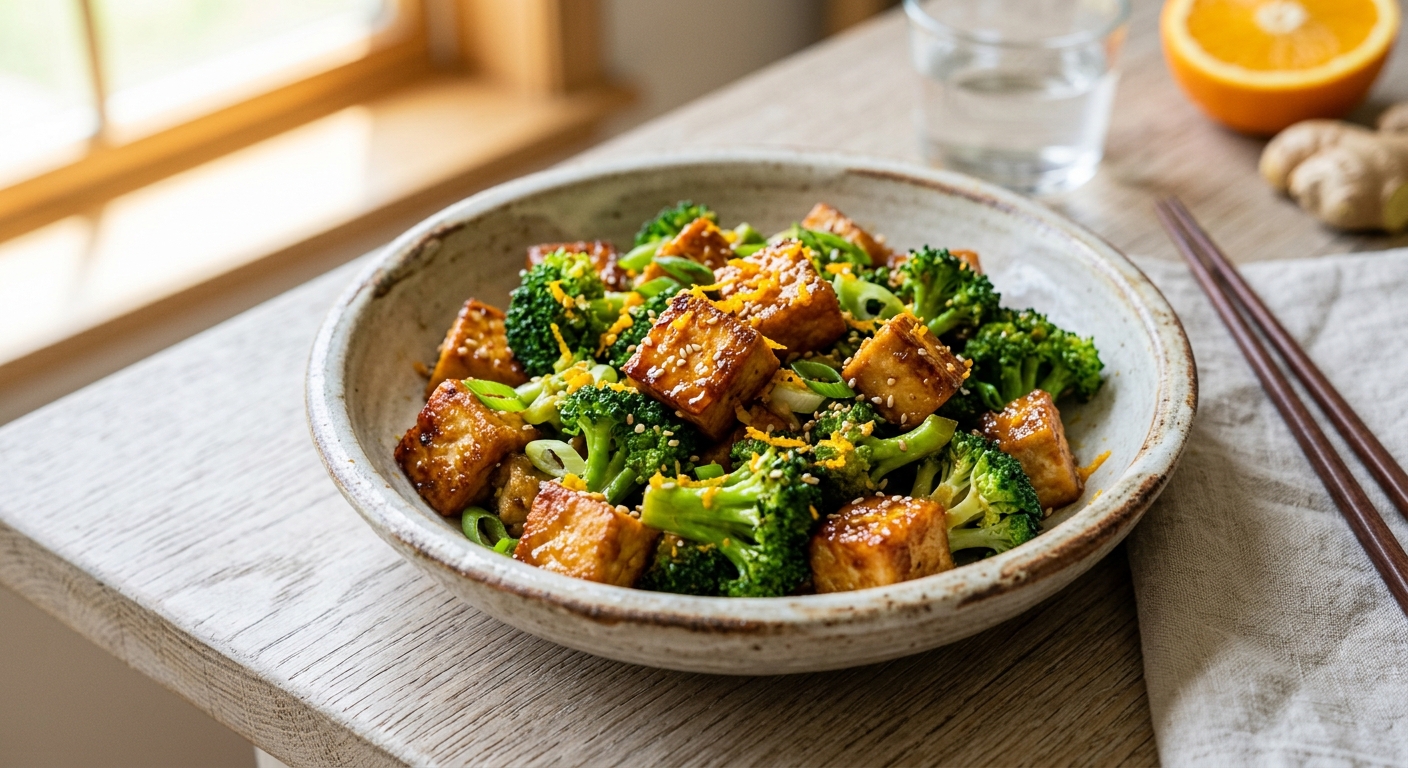
There is a persistent myth that meeting your recommended daily intakes for vitamins means choking down supplements or eating joyless ‘health food.’ This Citrus-Glazed Broccoli and Tofu exists to dismantle that myth entirely. Built around two of the most nutrient-dense ingredients in any produce aisle, this dish layers a glossy, sweet-tart glaze of fresh orange juice, rice vinegar, ginger, and a touch of maple syrup over crispy pressed tofu and brilliantly green broccoli. The result is a weeknight dinner that feels restaurant-worthy while quietly delivering a remarkable micronutrient payload.
Broccoli is, calorie for calorie, one of the most vitamin C-rich foods on the planet, providing roughly 89mg per 100g cooked. Pair it with the fresh orange juice in the glaze, and a single serving of this dish pushes well past the 90mg daily reference value set by the National Institutes of Health. But the nutritional story does not stop at vitamin C. Broccoli also brings meaningful folate, vitamin K, and a class of sulforaphane-forming glucosinolates that have been studied for their role in cellular defence pathways. Tofu contributes complete protein, plant-based calcium, and iron, rounding out what is genuinely a calibrated bowl of nutrition.
The glaze is the heart of this recipe. Reduced orange juice concentrates not just flavour but also the natural flavonoids present in citrus, particularly hesperidin and narirutin, which work synergistically with vitamin C in the body. A small amount of cornstarch gives the glaze its lacquered, cling-to-every-floret texture, while freshly grated ginger adds gingerol compounds with their own well-documented anti-inflammatory properties. Whether you make this on the stovetop in under 30 minutes, let it develop low and slow in a slow cooker, build pressure-cooker speed into your weeknight, or roast it in the oven for caramelised edges, the nutritional integrity of this dish remains solidly above 150% DV for vitamin C per serving.
4
servings
Ingredients
- 500 gextra-firm tofu, pressed for at least 30 minutes and cut into 2cm cubes
- 600 gbroccoli florets (from about 2 medium heads), cut into bite-sized pieces
- 180 mlfreshly squeezed orange juice (from about 3 large navel oranges)
- 2 tspfinely grated orange zest
- 3 tbsplow-sodium soy sauce or tamari
- 2 tbsprice vinegar
- 1 tbsppure maple syrup
- 2 tspfresh ginger, finely grated
- 3 clovesgarlic, minced
- 1.5 tbspcornstarch
- 2 tbspcold water
- 3 tbspAvocado Oil100% Pure Avocado Oil (such as avocado or sunflower), divided
- 1 tsptoasted sesame oil
- 2 tsptoasted sesame seeds, for garnish
- 3 stalksscallions (spring onions), thinly sliced, for garnish
- —Colima Sea SaltMicroplastic Free Salt and white pepper to taste
- —Cooked brown rice or soba noodles, for serving
Instructions
Click on an item below to shop for the recommended items for this recipe on Amazon.
As an Amazon Associate, we earn from qualifying purchases.
- After pressing the tofu, pat each cube thoroughly dry with paper towels and season lightly with salt and white pepper. In a small bowl, whisk together the orange juice, orange zest, soy sauce, rice vinegar, maple syrup, ginger, and garlic to form the glaze base. In a separate small bowl, stir the cornstarch into the cold water until completely smooth and set aside.
- Heat 2 tablespoons of neutral oil in a large non-stick skillet or well-seasoned cast iron skillet over medium-high heat until the oil shimmers and just begins to smoke at the edges. Add the tofu cubes in a single layer, working in two batches if necessary to avoid steaming. Do not move them for 3 to 4 minutes, until the bottom face is deep golden brown. Turn each cube and sear the remaining sides for 1 to 2 minutes each. Transfer to a plate lined with paper towels.
- In the same skillet, add the remaining 1 tablespoon of neutral oil over medium-high heat. Add the broccoli florets and toss to coat. Spread them in a single layer, cover the pan with a lid, and steam-sauté for 3 minutes until bright green and just beginning to soften at the base of the florets. Remove the lid, increase heat to high, and stir-fry for 1 to 2 more minutes until the edges show light charring.
- Reduce the heat to medium. Pour the glaze base into the skillet with the broccoli and bring to a simmer, stirring to coat. Once the liquid is bubbling across the surface, stir the cornstarch slurry once more and pour it into the pan in a steady stream while stirring constantly. Cook for 60 to 90 seconds until the glaze thickens to a glossy, lacquer-like consistency that coats the back of a spoon.
- Return the seared tofu to the skillet and fold gently to coat every piece in the glaze without breaking the cubes. Drizzle the toasted sesame oil over the top and toss once more. Remove from heat immediately. Taste and adjust seasoning with salt or an extra splash of rice vinegar for brightness. Serve over brown rice or soba noodles and garnish with scallions and sesame seeds.
- Press the tofu for at least 30 minutes, then cut into larger 3cm cubes (larger pieces hold together better over slow cooking). In the slow cooker insert, whisk together the orange juice, orange zest, soy sauce, rice vinegar, maple syrup, ginger, and garlic directly in the pot. Add 2 tablespoons of neutral oil. Do not add the cornstarch slurry yet as it will become gummy over long cooking.
- Add the tofu cubes to the slow cooker and gently toss them in the glaze until each piece is coated. Arrange them in a mostly even layer. Place the lid on and cook on High for 1 hour 45 minutes, or until the tofu has absorbed the citrus flavours and the liquid has reduced slightly. The tofu will soften and become almost custard-like at the centre, which is the desired texture for this method.
- After 1 hour 45 minutes, nestle the large broccoli florets on top of the tofu, pressing them gently down into the liquid. Replace the lid and cook on High for a further 40 to 45 minutes until the broccoli stems are fork-tender but the crowns still hold their shape and vivid green colour. Do not cook beyond this point or the broccoli will become mushy and lose significant vitamin C through prolonged heat exposure.
- Mix the cornstarch with cold water in a small bowl until completely smooth. Remove the lid, switch the slow cooker to the High setting if it is not already there, and stir the slurry evenly into the cooking liquid. Replace the lid and cook for a final 15 minutes until the sauce thickens and clings to the tofu and broccoli.
- Drizzle the toasted sesame oil over the finished dish and fold gently once to distribute it. Taste the sauce and adjust with a small splash of rice vinegar to restore the brightness that slow cooking can mute. Serve directly from the insert over brown rice or soba noodles and finish with scallions and sesame seeds.
- Press and cube the tofu as directed. Set the Instant Pot or electric pressure cooker to the Saute function on the High setting. Add 2 tablespoons of neutral oil and, once shimmering, sear the tofu cubes in a single layer for 2 to 3 minutes per side until golden. Work in batches to avoid crowding. This step is essential as the pressure environment alone will not develop the Maillard browning that gives this dish its depth. Remove the tofu and set aside.
- Without wiping the pot, add the garlic and ginger directly to the residual oil and saute for 30 seconds until fragrant. Pour in the orange juice, orange zest, soy sauce, rice vinegar, and maple syrup. Stir to scrape up any browned bits from the bottom of the pot as this prevents a burn warning. Return the seared tofu to the pot and stir gently to coat.
- Cancel the Saute function. Secure the lid and set the pressure release valve to Sealing. Cook on Manual High Pressure for 3 minutes. When the cycle ends, perform a quick pressure release by carefully moving the valve to Venting. Open the lid away from you.
- Switch the pot back to Saute on High. Add the broccoli florets directly to the hot liquid and stir to submerge them. Cook uncovered, stirring occasionally, for 3 to 4 minutes until the broccoli is bright green and just tender with a slight bite. This residual-heat saute step preserves significantly more vitamin C than cooking the broccoli under pressure would.
- Stir the cornstarch slurry once more and pour it into the pot while stirring. Continue cooking on Saute for 60 to 90 seconds until the glaze tightens and becomes glossy. Cancel the Saute function, drizzle in the toasted sesame oil, and fold gently. Serve immediately over brown rice or soba noodles with scallions and sesame seeds.
- Preheat your oven to 220C (425F) with two rimmed baking sheets inside on separate racks so they preheat with the oven. This is the single most important step for achieving crispy rather than soggy results. Press and cube the tofu, then pat completely dry. In a large bowl, whisk together the orange juice, orange zest, soy sauce, rice vinegar, maple syrup, ginger, garlic, and 2 tablespoons of neutral oil to make the glaze. Reserve 80ml (roughly one third) of the glaze in a separate small saucepan and set aside.
- Add the tofu cubes to the large bowl with the remaining glaze and toss carefully to coat. Transfer just the tofu to one of the hot baking sheets using tongs, spacing the cubes at least 2cm apart. Return to the oven and roast on the upper rack for 15 minutes until the tofu is set and beginning to colour at the edges.
- While the tofu starts roasting, toss the broccoli florets in the same glaze-coated bowl, turning them to pick up every last bit of residual glaze. Add the remaining 1 tablespoon of neutral oil and toss again. Spread the broccoli onto the second hot baking sheet in a single layer with cut sides facing down for maximum browning. After the tofu has had its initial 15 minutes, add the broccoli sheet to the lower oven rack.
- Roast both pans together for a further 12 to 15 minutes, flipping the tofu once halfway through, until the tofu is deeply golden and the broccoli florets have caramelised, dark-tipped crowns with tender stems. Do not disturb the broccoli during this time so the flat edges can develop proper colour contact with the pan.
- While the sheets are in the oven for their final minutes, bring the reserved glaze to a simmer in the small saucepan over medium heat. Stir in the cornstarch slurry and cook for 60 to 90 seconds until thickened to a sticky, pourable sauce. Remove the pans from the oven, combine the tofu and broccoli on one pan or a serving platter, drizzle the thickened glaze evenly over everything, and finish with sesame oil, scallions, and sesame seeds. Serve immediately over brown rice or soba noodles.
Nutrition Breakdown
Per 1 serving (makes 4)
Vitamins & Minerals
% Daily Value based on a 2,000 calorie diet (FDA reference)
🧬 Essential Amino Acids
% of recommended daily intake (RDA) per serving
🛡 Antioxidant Profile
The Nutrition Science
The 150% vitamin C figure in this recipe is not a rounding up. A 150g serving of cooked broccoli provides approximately 84mg of vitamin C, and the 45ml of fresh orange juice per serving in the glaze contributes a further 25 to 30mg, landing each bowl at around 110 to 140mg against a 90mg daily reference value. It is worth understanding, however, that vitamin C is heat-sensitive and water-soluble, meaning the cooking method genuinely affects delivery. The stovetop and oven methods use high heat for short durations, which research shows retains roughly 70 to 80% of broccoli’s vitamin C compared to 50 to 60% during slower, wetter cooking. For the slow cooker method, using larger florets and adding them late in the cooking process is specifically designed to limit this loss while still achieving palatability.
The synergy between vitamin C and iron in this dish is clinically significant. Tofu made with calcium sulfate coagulant provides approximately 1.8 to 2.0mg of non-haem iron per 125g serving, a form the body absorbs at a baseline rate of only 2 to 8%. Consuming vitamin C in the same meal has been shown in multiple controlled studies to increase non-haem iron absorption by up to 300% by reducing ferric iron (Fe3+) to the more absorbable ferrous form (Fe2+) and forming soluble iron-ascorbate chelates that resist precipitation in the alkaline small intestine. This mechanism is exactly why this recipe combines citrus with tofu rather than treating them as separate nutritional stories.
Broccoli’s glucosinolate content, specifically glucoraphanin, is a fascinating case of food as pharmacology. Glucoraphanin itself is inert, but when broccoli tissue is damaged by chopping or chewing, the enzyme myrosinase converts it to sulforaphane, a potent activator of the Nrf2 transcription factor. Nrf2 activation switches on the body’s endogenous antioxidant response, producing enzymes like glutathione S-transferase and heme oxygenase-1 that provide far more sustained antioxidant protection than any single dietary antioxidant can offer directly. Notably, myrosinase is heat-sensitive, so allowing chopped raw broccoli to rest for 5 to 10 minutes before cooking gives the enzyme time to act and substantially increases sulforaphane yield in the final dish, a technique that costs nothing and pays dividends at the cellular level.
Pro Tips
- Press your tofu for a minimum of 30 minutes, and ideally overnight in the refrigerator under a weighted plate. The drier the tofu surface, the better it browns and the more glaze it absorbs rather than steams off.
- Let your chopped broccoli rest at room temperature for 5 to 10 minutes before applying any heat. This myrosinase activation window dramatically increases the sulforaphane content of the cooked dish with zero extra effort.
- Always zest your oranges before juicing them. Zest contains the aromatic essential oils and flavonoid compounds concentrated in the peel that fresh juice alone cannot provide, and it is far easier to zest a whole orange than a squeezed one.
- If your orange juice is very sweet, add an extra teaspoon of rice vinegar at the end. The dish should taste bright and tangy first, sweet second. That acidity also helps preserve the vivid green colour of the broccoli on the plate.
- For a complete amino acid profile and a more substantial meal, serve over cooked brown rice rather than white. Brown rice adds meaningful magnesium (about 42mg per half-cup cooked) and further fibre, lowering the effective glycemic impact of the full bowl.
Love the angle here, but I’d push back slightly on the blanching step if you’re doing it – raw or a quick 90 second steam keeps that C content intact way better than boiling, even briefly. The pan sear on the tofu is key though, that Maillard reaction actually helps with nutrient absorption. I’ve been using a similar citrus glaze at the catering gigs and clients always ask for the recipe because it tastes *good*, not like medicine, which honestly is half the battle with micronutrient-dense cooking.
Chris makes a solid point on the C retention – I’ve actually been tracking this with my CGM and comparing postprandial glucose response when I prep broccoli different ways, and the raw/lightly steamed versions seem to have better micronutrient bioavailability overall. Do you have the exact ascorbic acid content data pre and post cooking for your recipe? I’d love to cross reference it against some of the USDA retention studies since vitamin C degrades so rapidly, and I’m curious whether that 150% claim accounts for cooking loss or if it’s calculated from raw values.
What a wonderfully thorough question, Ben! I’ve been teaching cooking for decades and only recently started diving into the actual micronutrient retention data myself, so I really appreciate you digging into this with your CGM tracking / that’s exactly the kind of practical experimentation we need more of. I’d be curious to know if the blog author calculated that 150% from raw or cooked values too, since as you say, vitamin C losses happen so fast, and honestly I suspect many recipes underestimate how much is lost in the pan. For my next community class, I’m planning to do a side by side comparison of raw vs. steamed broccoli in this exact glaze to see what we’re actually