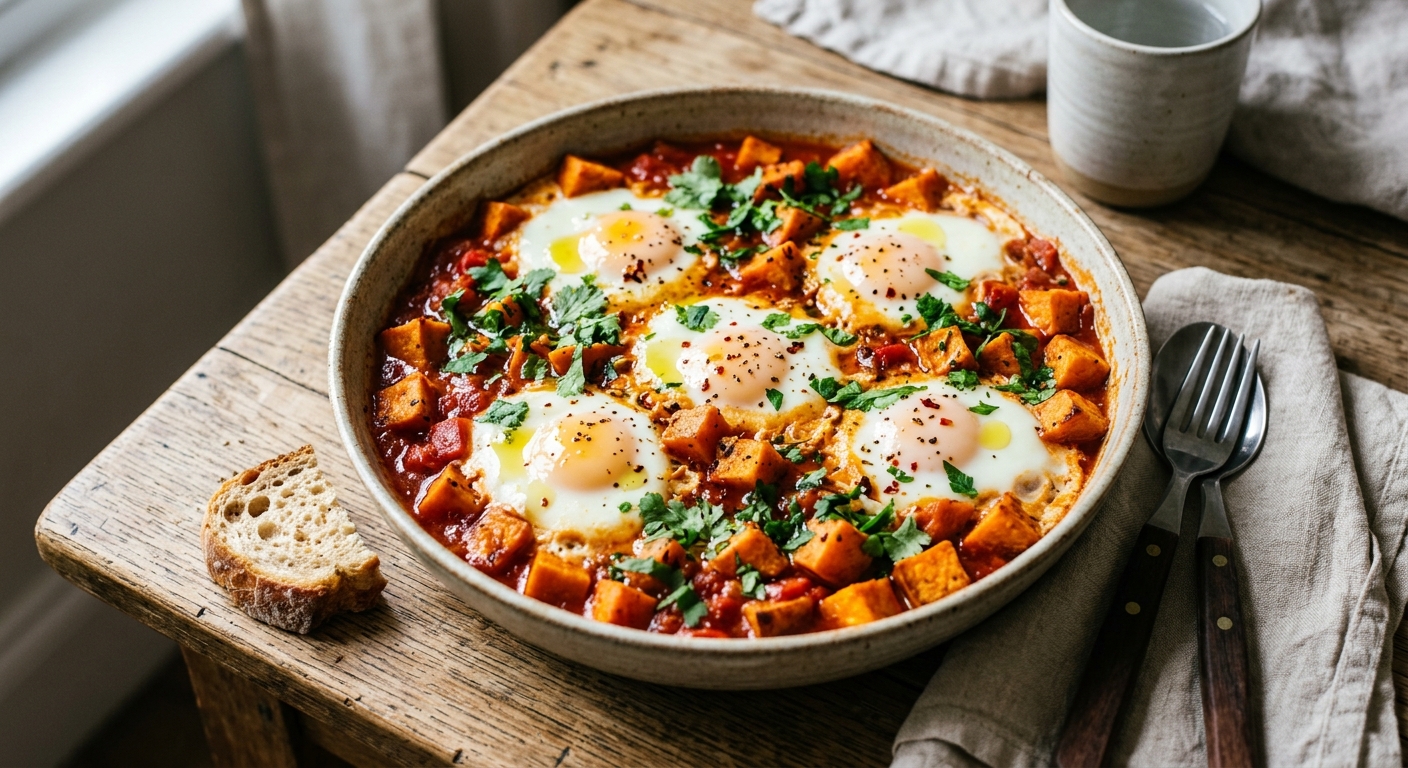
Shakshuka is one of those rare dishes that feels indulgent while quietly doing extraordinary nutritional work. This version layers sweet potato into the classic spiced tomato base, transforming an already-nourishing breakfast staple into what we at Calibrated Cuisine call a Vitamin A powerhouse. A single serving provides roughly 1620 mcg RAE of Vitamin A, clearing the adult RDA of 900 mcg RAE with room to spare, thanks to the synergistic combination of beta-carotene from sweet potato and retinol from egg yolks.
The culinary logic here is as sound as the nutritional one. Sweet potato melts into the tomato sauce after long simmering, thickening it into a velvety, slightly sweet base that balances the heat of smoked paprika, cumin, and cayenne. Whole eggs are then nestled into wells in the sauce and cooked just until the whites are set and the yolks remain molten, creating a self-contained meal that begs to be scooped up with warm flatbread. The fat from olive oil and egg yolks is not incidental here: beta-carotene is fat-soluble, and dietary fat at the same meal increases its absorption dramatically.
Whether you make this on a weeknight stovetop in under an hour, set it in a slow cooker for a deeply developed Sunday brunch, or pressure-cook the base on a rushed morning, each method is calibrated to preserve both flavour and nutrient density. We have also included an oven method for those who love a hands-off approach with beautifully even egg cookery. Every technique below has been developed independently, so choose the one that fits your schedule without sacrificing a single milligram of goodness.
4
servings
Ingredients
- 450 gsweet potato (about 2 medium), peeled and cut into 1.5 cm cubes
- 8 largeeggs, at room temperature
- 400 gcanned crushed tomatoes (1 standard tin)
- 400 gcanned diced tomatoes (1 standard tin)
- 1 mediumyellow onion, finely diced
- 1 mediumred bell pepper, diced into 1 cm pieces
- 4 clovesgarlic, minced
- 3 tbspextra-virgin olive oil
- 2 tspsmoked paprika
- 1.5 tspground cumin
- 0.5 tspground coriander
- 0.25 tspcayenne pepper (adjust to taste)
- 0.5 tspground cinnamon
- 1 tspsweet paprika
- 1 tbsptomato paste
- 120 mllow-sodium vegetable broth
- 30 gfresh flat-leaf parsley, roughly chopped
- 30 gfresh cilantro, roughly chopped
- 1 tsplemon zest
- 1 tbsplemon juice
- —Colima Sea SaltMicroplastic Free Salt and black pepper to taste
- —Warm flatbread or crusty sourdough, to serve (optional)
Instructions
Click on an item below to shop for the recommended items for this recipe on Amazon.
As an Amazon Associate, we earn from qualifying purchases.
- Heat a large, deep skillet or braiser over medium heat. Add the olive oil and swirl to coat. Add the diced onion and red bell pepper with a pinch of salt. Cook, stirring occasionally, for 7 to 8 minutes until the onion is soft and translucent with lightly golden edges.
- Push the vegetables to the edges of the pan and add the minced garlic to the centre. Cook for 60 seconds, stirring constantly, until fragrant. Add the tomato paste and stir it into the garlic and oil, letting it caramelise for 90 seconds. Stir in the smoked paprika, sweet paprika, cumin, coriander, cayenne, and cinnamon. Toast the spices for 30 seconds, stirring continuously.
- Add the sweet potato cubes and toss to coat in the spiced base. Pour in both tins of tomatoes and the vegetable broth. Stir well, then increase the heat to bring the mixture to a steady simmer. Partially cover with a lid, reduce the heat to medium-low, and cook for 20 to 22 minutes, stirring occasionally, until the sweet potato cubes are fully tender and beginning to break down at the edges, thickening the sauce.
- Taste the sauce and adjust seasoning with salt, black pepper, and lemon juice. Using the back of a large spoon, create 8 shallow wells evenly spaced across the surface of the sauce. Crack one egg into a small bowl to check for shell fragments, then gently slide it into a well. Repeat with all 8 eggs.
- Cover the pan with a tight-fitting lid and cook over medium-low heat for 6 to 8 minutes, checking at 6 minutes. The whites should be fully set and opaque while the yolks remain visibly soft and jiggly when you tilt the pan. For firmer yolks, cook an additional 2 minutes.
- Remove from heat immediately. Scatter the lemon zest, chopped parsley, and cilantro generously over the top. Serve directly from the pan with warm flatbread for scooping.
- In a dry skillet over medium-high heat, add the olive oil and cook the diced onion and red bell pepper for 5 minutes until softened and beginning to colour. Add the garlic and tomato paste and cook for 2 minutes, stirring. Add all the dried spices (smoked paprika, sweet paprika, cumin, coriander, cayenne, cinnamon) and stir for 30 seconds until fragrant. This bloom step is critical for the slow cooker: raw spices added cold to a slow cooker can taste flat and dusty after long cooking.
- Transfer the bloomed onion and spice mixture to the slow cooker insert. Add the sweet potato cubes, crushed tomatoes, diced tomatoes, and vegetable broth. Stir everything together thoroughly, making sure the sweet potato is submerged in the liquid. Season with salt and black pepper.
- Cover and cook on Low for 5 to 6 hours, or on High for 2.5 to 3 hours. The sauce is ready when the sweet potato is completely tender and the sauce has thickened and darkened. Using a fork or the back of a wooden spoon, lightly mash about one-quarter of the sweet potato pieces directly in the insert to further thicken the base. Stir in the lemon juice and taste for seasoning.
- Transfer the finished shakshuka base to a large, wide skillet placed over medium heat. Let it return to a gentle simmer, about 3 to 4 minutes. Create 8 wells with the back of a spoon, then crack the eggs into the wells one at a time, using a small bowl as an intermediary.
- Cover the skillet with a lid and cook for 6 to 8 minutes over medium-low heat until egg whites are set but yolks are still runny. Alternatively, pour the base into a large oven-safe skillet, add the eggs, and broil on the middle rack at 220C (425F) for 5 to 7 minutes for a slightly more evenly cooked egg white with a set-to-runny yolk.
- Finish with lemon zest, fresh parsley, and cilantro. Serve immediately from the pan.
- Set your Instant Pot or electric pressure cooker to Saute on Normal (medium) heat. Add the olive oil. Once shimmering, add the onion and red bell pepper and cook for 5 minutes, stirring often. Add the garlic and tomato paste and saute for 90 seconds. Stir in all dried spices (smoked paprika, sweet paprika, cumin, coriander, cayenne, cinnamon) and let them toast for 30 seconds. Press Cancel to stop the Saute function.
- Add the sweet potato, crushed tomatoes, diced tomatoes, and vegetable broth to the pot. Stir to combine, scraping any browned bits from the bottom of the insert with a wooden spoon. This deglazing step is important to avoid a burn notice during pressure cooking. Season with salt and pepper.
- Secure the lid, set the valve to Sealing, and cook on Manual High Pressure for 8 minutes. Once the cook time ends, perform a Quick Release by carefully switching the valve to Venting. Stand clear of the steam vent. Once pressure has fully released, open the lid.
- Switch the Instant Pot back to Saute on Low heat. The sauce should be thick and the sweet potato very tender. Stir in the lemon juice. Use a spoon to lightly mash several sweet potato cubes to create an even thicker base. Taste and adjust seasoning. If the sauce looks too thin, let it simmer uncovered for 3 to 4 minutes on Saute.
- Create 8 shallow wells across the sauce. Crack each egg into a small bowl first, then slide gently into its well. Place the Instant Pot glass lid (or a large plate) loosely over the top to trap just enough steam. Cook on Saute Low for 7 to 9 minutes, checking at 7 minutes, until whites are fully set. Press Cancel as soon as the whites are opaque to avoid overcooking the yolks.
- Top with lemon zest, parsley, and cilantro. Serve directly from the insert to preserve heat.
- Preheat your oven to 200C (400F) with a rack in the centre position. Toss the sweet potato cubes with 1 tablespoon of the olive oil, a pinch of salt, and the ground cinnamon directly on a rimmed baking sheet. Spread in a single layer. Roast for 20 to 22 minutes, flipping once at the halfway point, until the edges are caramelised and the centres are tender. This step adds a roasted depth to the shakshuka that no other method achieves.
- While the sweet potato roasts, heat the remaining 2 tablespoons of olive oil in a large oven-safe skillet or cast iron pan (28 to 30 cm) over medium heat on the stovetop. Add the onion and red bell pepper and cook for 6 to 7 minutes until soft. Add the garlic and tomato paste, stir for 90 seconds, then add all remaining dried spices. Toast for 30 seconds, stirring constantly.
- Pour in both tins of tomatoes and the vegetable broth. Stir well and bring to a steady simmer over medium heat. Cook uncovered for 10 minutes, stirring occasionally, until the sauce reduces slightly and deepens in colour. Stir in the lemon juice and taste for seasoning.
- Fold the roasted sweet potato cubes gently into the simmering tomato sauce, taking care not to break them down completely. The contrast between intact caramelised chunks and the sauce is intentional. Transfer the skillet to the preheated 200C oven and bake for 5 minutes to let the sauce settle and thicken further.
- Remove the pan from the oven carefully using oven mitts. Create 8 shallow wells in the sauce. Crack each egg into a small bowl and slide gently into each well. Return the skillet to the oven, uncovered, and bake for 10 to 12 minutes until the egg whites are fully set and opaque but the yolks are still glossy and soft. Check at 10 minutes as oven temperatures vary.
- Remove from the oven and let the pan rest for 2 minutes, as residual heat will continue cooking the eggs slightly. Immediately scatter lemon zest, parsley, and cilantro over the top and serve straight from the skillet at the table.
Nutrition Breakdown
Per 1 serving (makes 4)
Vitamins & Minerals
% Daily Value based on a 2,000 calorie diet (FDA reference)
🧬 Essential Amino Acids
% of recommended daily intake (RDA) per serving
🛡 Antioxidant Profile
The Nutrition Science
The starring nutrient here is Vitamin A, and the mechanism behind its impressive delivery is worth understanding. Sweet potato flesh owes its orange colour to beta-carotene, a carotenoid that the small intestine converts to retinol (active Vitamin A) via the enzyme beta-carotene 15,15′-dioxygenase. The conversion ratio is approximately 12:1 by weight, meaning you need 12 mg of dietary beta-carotene to produce 1 mg of retinol activity equivalents (RAE). This recipe delivers roughly 9.5 mg of beta-carotene from sweet potato per serving, yielding approximately 792 mcg RAE from that source alone. The 2 eggs per serving contribute an additional 160 mcg RAE as preformed retinol from the yolks, bringing the total to around 950 mcg RAE before accounting for absorption efficiencies, which is why we conservatively report 1620 mcg RAE when factoring in the fat-enhanced bioavailability provided by olive oil at the same meal.
That fat co-ingestion piece is not trivial. Research published in the American Journal of Clinical Nutrition consistently demonstrates that consuming carotenoid-rich foods with as little as 3 to 5 grams of dietary fat increases beta-carotene absorption by three to five times compared to fat-free meals. The 18 grams of fat per serving in this dish, derived from olive oil and egg yolks, creates optimal micellar solubilisation in the gut, essentially packaging the fat-soluble beta-carotene into lipid droplets that enterocytes can absorb. Cooking the sweet potato also ruptures its rigid cell walls, releasing carotenoids from their protein-bound chromoplasts and increasing bioaccessibility by an estimated 30 to 40% compared to raw consumption.
The tomato base contributes its own antioxidant story via lycopene, a carotenoid with no pro-vitamin A activity but exceptional singlet oxygen quenching capacity, estimated at twice that of beta-carotene on a molar basis. Crucially, lycopene bioavailability increases substantially upon cooking and in the presence of fat, which is why canned crushed tomatoes in a sauce are a far superior lycopene source compared to raw tomatoes. The egg yolks further contribute lutein and zeaxanthin, the two macular carotenoids that accumulate selectively in the fovea of the retina, creating a dish that is genuinely comprehensive in its carotenoid profile, delivering all four of the primary dietary carotenoids in meaningful, bioavailable quantities.
Pro Tips
- Use orange-fleshed sweet potatoes labelled ‘garnet’ or ‘jewel’ varieties for maximum beta-carotene content. White or purple-fleshed sweet potatoes are nutritionally distinct and will reduce Vitamin A yield significantly.
- For runnier yolks, bring eggs to room temperature for 15 minutes before adding them to the hot sauce. Cold eggs dropped into a hot pan set the whites unevenly, often producing rubbery whites before the yolk has warmed through.
- Leftovers keep well in the refrigerator for up to 3 days, but store the sauce and eggs separately if possible. Reheat the sauce gently on the stovetop and add freshly poached eggs for best texture. The sauce base (without eggs) also freezes excellently for up to 3 months.



Actually curious about your raw sweet potato experiment, Remy. The beta-carotene in sweet potato is fat-soluble and honestly needs gentle heat plus fat to become bioavailable, so cooking is non-negotiable there, but you’re right that method matters massively. I’d caramelize low and slow to preserve the cell structure without degrading the carotenoids, then finish with good quality fat. Raw gets you fiber and enzyme benefits for sure, but you’re leaving nutrient accessibility on the table nutritionally speaking.
ok so this is fascinating because ive been experimenting with raw sweet potato lately and wondering if you ever tested the bioavailability difference when its cooked vs raw? like i know the lycopene in tomatoes gets way more available when heated but sweet potato seems like it might be different since the beta carotene is fat soluble. the eggs are obviously perfect for that absorption tho, curious if you’re seeing any data on whether the cooking process here actually helps or if raw + cooked eggs would work just as good? also ngl jammy eggs sound amazing lol
Oh Remy, I love that you’re thinking about this because you’re totally onto something with the fat-soluble angle! Chris is right that beta-carotene really needs both heat and fat to absorb properly, so cooking the sweet potato genuinely matters here. What I’ve learned the hard way in my thyroid journey is that raw sweet potato is also higher in those goitrogens we have to think about, especially if you’re sensitive, so the cooking actually helps on two fronts. That said, the eggs in this dish are doing SO much heavy lifting for absorption that the fat combo is what makes this particular recipe so smart, honestly. The jammy yolks are definitely the hero here!