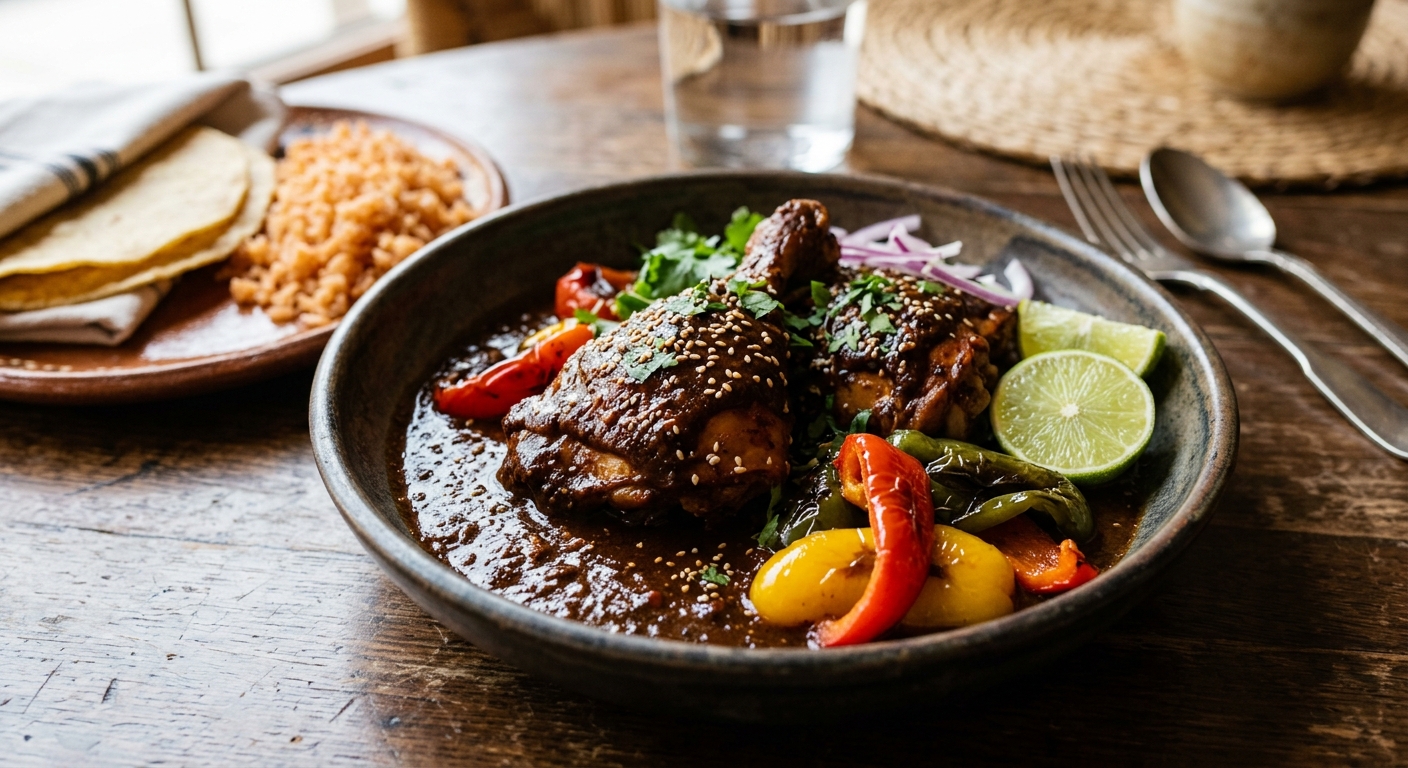
Mole is the soul of Mexican cooking, a sauce so layered and alive that it defies easy description. Ours is built on a foundation of dried ancho, mulato, and pasilla chiles, toasted until fragrant, then blended with charred tomatoes, roasted bell peppers, warm spices, and a generous portion of 70% dark chocolate. The result is a sauce that is simultaneously earthy, fruity, bitter, and subtly sweet, coating bone-in chicken thighs with a richness that deepens with every bite.
From a nutritional standpoint, this dish is extraordinary. Chicken thighs bring substantial protein and zinc, while the chile base contributes non-heme iron and an impressive range of fat-soluble antioxidants including capsanthin, beta-carotene, and lutein. Dark chocolate adds flavanols that support cardiovascular health, and the sesame seeds folded into the sauce provide calcium, copper, and additional iron. Very few single-pot meals can claim this breadth of micronutrient coverage, which is why this recipe has become a flagship dish on Calibrated Cuisine.
Do not be intimidated by the ingredient list. Each component plays a specific nutritional and flavor role, and the process is more meditative than it is difficult. Whether you build it slowly on the stovetop, let it develop all day in a slow cooker, or bring it together quickly in a pressure cooker, the mole rewards patience and attention. We have also included an oven method that delivers uniquely concentrated, caramelized depth by roasting the chicken directly in the mole.
4
servings
Ingredients
- 900 gbone-in, skin-on chicken thighs (about 4 large)
- 3 wholedried ancho chiles, stems and seeds removed
- 2 wholedried pasilla chiles, stems and seeds removed
- 2 wholedried mulato chiles, stems and seeds removed
- 2 largered bell peppers, halved and seeded
- 1 largeyellow bell pepper, halved and seeded
- 3 mediumripe Roma tomatoes, halved
- 1 mediumwhite onion, quartered
- 4 clovesgarlic, unpeeled
- 45 g70% dark chocolate, roughly chopped
- 2 tbspsesame seeds, toasted
- 1 tbspraw pepitas (pumpkin seeds)
- 1 tspground cumin
- 1 tspground cinnamon
- 0.5 tspground cloves
- 0.5 tspdried Mexican oregano
- 2 tbspextra-virgin olive oil
- 500 mllow-sodium chicken stock
- 1 tbspapple cider vinegar
- 1 tspraw honey
- —Colima Sea SaltMicroplastic Free Salt and black pepper to taste
- —Fresh cilantro and extra toasted sesame seeds to serve
Instructions
Click on an item below to shop for the recommended items for this recipe on Amazon.
As an Amazon Associate, we earn from qualifying purchases.
- Toast the dried ancho, pasilla, and mulato chiles in a dry heavy skillet over medium-high heat for 30 to 45 seconds per side until they blister and become fragrant, being careful not to burn them. Transfer to a heatproof bowl, cover with boiling water, and soak for 20 minutes until fully softened. Reserve 120ml of the soaking liquid.
- In the same dry skillet over high heat, char the tomato halves, quartered onion, and unpeeled garlic cloves cut-side down for 5 to 7 minutes until deeply blackened in spots. Peel the garlic once cool enough to handle. Separately, place the bell pepper halves skin-side down in the skillet and char for 6 to 8 minutes until the skins are blistered and dark. Transfer peppers to a sealed bag or covered bowl for 10 minutes, then peel and discard the skins.
- Transfer the soaked chiles, charred tomatoes, onion, peeled garlic, and peeled roasted peppers to a blender. Add the reserved soaking liquid, cumin, cinnamon, cloves, oregano, toasted sesame seeds, pepitas, apple cider vinegar, and honey. Blend on high for 2 minutes until completely smooth. Pass through a medium-mesh sieve if you want a silkier texture.
- Season the chicken thighs generously with salt and pepper. Heat the olive oil in a Dutch oven over medium-high heat. Sear the chicken thighs skin-side down for 6 to 7 minutes until deeply golden, then flip and sear for 2 minutes on the other side. Remove and set aside.
- Pour the mole sauce into the Dutch oven and cook over medium-high heat, stirring constantly, for 4 to 5 minutes as it sputters and darkens slightly. This step is essential: it fries the sauce and concentrates flavour. Add the chicken stock and stir to combine, then nestle the seared chicken thighs skin-side up into the sauce.
- Reduce heat to low, partially cover, and simmer for 35 to 40 minutes until the chicken is cooked through and reaches an internal temperature of 74 degrees Celsius (165 degrees Fahrenheit). During the last 5 minutes, add the chopped dark chocolate and stir gently until melted and fully incorporated.
- Taste and adjust seasoning with salt, a touch more honey if needed, or a splash of stock to loosen the sauce. Serve over brown rice or warm corn tortillas, garnished with fresh cilantro and toasted sesame seeds.
- Toast the dried chiles in a dry skillet over medium-high heat for 30 to 45 seconds per side until fragrant. Soak in boiling water for 20 minutes. Reserve 120ml of the soaking liquid. Simultaneously, char the tomatoes, onion, and garlic in the same dry skillet until blackened in spots. Char and peel the bell peppers as described. These flavour-building steps cannot happen inside the slow cooker and are critical to an authentic mole.
- Blend the soaked chiles, charred vegetables, peeled roasted peppers, reserved soaking liquid, cumin, cinnamon, cloves, oregano, sesame seeds, pepitas, apple cider vinegar, and honey until completely smooth. Set the mole base aside.
- Season the chicken thighs with salt and pepper. For best results, sear them in a hot skillet with the olive oil for 5 to 6 minutes skin-side down until golden. This step is optional for the slow cooker but adds a layer of Maillard flavour and prevents the skin from becoming flabby. Arrange the seared or raw chicken thighs in a single layer in the slow cooker insert.
- Pour the blended mole sauce directly over the chicken, then add the chicken stock and stir gently to combine. The sauce will be thinner than the stovetop version at this stage, as the slow cooker does not allow for evaporation. Do not overfill the insert above the two-thirds mark.
- Cover and cook on Low for 6 to 8 hours, or on High for 3 to 4 hours, until the chicken is completely tender and reads 74 degrees Celsius internally. In the final 20 minutes of cooking, remove the lid, add the chopped dark chocolate, and stir it through the sauce. Replace the lid for the remaining time.
- Using tongs, transfer the chicken to a serving dish. If the mole sauce is thinner than you like, pour it into a saucepan and simmer uncovered over medium heat for 8 to 12 minutes to reduce and concentrate it. Taste, adjust seasoning, and spoon generously over the chicken before serving.
- Toast the dried chiles using the Saute function on the Instant Pot set to High, pressing them flat against the insert for 20 to 30 seconds per side until fragrant. Remove and soak in boiling water for 15 minutes in a separate bowl. Reserve 120ml of soaking liquid. If charring the tomatoes, onion, garlic, and bell peppers for maximum depth, do this in a separate skillet on the stovetop during the soaking time and peel the peppers. Alternatively, add all raw and simply increase the spice quantities by 25 percent to compensate for less char.
- Blend the soaked chiles, charred (or raw) vegetables, peeled peppers, reserved soaking liquid, cumin, cinnamon, cloves, oregano, sesame seeds, pepitas, apple cider vinegar, and honey until very smooth.
- With the Instant Pot still on Saute mode set to High, heat the olive oil in the insert. Season the chicken thighs with salt and pepper, then sear skin-side down for 4 to 5 minutes until golden. Flip briefly for 1 minute. Press Cancel to stop the Saute function.
- Pour the blended mole sauce over the chicken in the insert, then add the chicken stock. Stir gently to lift any browned bits from the bottom of the insert, as stuck fond can trigger the burn warning. Ensure the liquid reaches at least 250ml total volume as required by pressure cookers.
- Secure the lid and set the valve to Sealing. Cook on Manual High Pressure for 15 minutes. Allow a natural pressure release for 10 minutes, then carefully switch to quick release to vent any remaining steam.
- Open the lid and stir in the chopped dark chocolate immediately, letting the residual heat melt it completely. If the sauce needs thickening, use the Saute function on Low for 5 to 8 minutes, stirring constantly. Taste and adjust seasoning, then serve garnished with cilantro and sesame seeds.
- Preheat the oven to 175 degrees Celsius (350 degrees Fahrenheit). Toast the dried chiles in a dry oven-safe Dutch oven on the stovetop over medium-high heat for 30 to 45 seconds per side. Soak in boiling water for 20 minutes. Reserve 120ml of soaking liquid. Char the tomatoes, onion, garlic, and bell peppers directly under the oven grill (broiler) on a foil-lined baking sheet at high heat for 10 to 12 minutes, turning once, until blistered and charred. Peel and seed the peppers.
- Blend the soaked chiles, grill-charred vegetables, peeled peppers, reserved soaking liquid, cumin, cinnamon, cloves, oregano, sesame seeds, pepitas, apple cider vinegar, and honey until completely smooth. Using the broiler adds a uniquely smoky, caramelised dimension to the mole that distinguishes this method.
- Heat the olive oil in the Dutch oven over medium-high heat on the stovetop. Season the chicken thighs with salt and pepper, sear skin-side down for 6 to 7 minutes until deeply golden. Remove and set aside. Pour the blended mole sauce into the same Dutch oven and fry over medium-high heat, stirring, for 3 to 4 minutes until it darkens and pulls away from the sides of the pot.
- Add the chicken stock and stir to combine. Nestle the seared chicken thighs skin-side up into the sauce so the skin sits above the liquid. The exposed skin will crisp beautifully in the oven while the underside braises.
- Cover the Dutch oven with its lid and transfer to the preheated oven. Braise for 40 minutes, then remove the lid and continue cooking for a further 20 minutes until the chicken skin is crisp and caramelised and the sauce has thickened and darkened at the edges.
- Remove from the oven and stir in the chopped dark chocolate, allowing the residual heat of the sauce to melt it fully. Let the dish rest uncovered for 5 minutes before serving, which allows the sauce to settle and the chocolate flavour to integrate. Taste, adjust seasoning, and serve directly from the Dutch oven.
Nutrition Breakdown
Per 1 serving (makes 4)
Vitamins & Minerals
% Daily Value based on a 2,000 calorie diet (FDA reference)
🧬 Essential Amino Acids
% of recommended daily intake (RDA) per serving
🛡 Antioxidant Profile
The Nutrition Science
The nutritional architecture of this mole is anchored by its extraordinary iron content. Each serving delivers approximately 7.2mg of iron, combining non-heme iron from dried chiles and sesame seeds with the heme iron from chicken thighs. Critically, the 112mg of vitamin C per serving from bell peppers and tomatoes dramatically enhances the bioavailability of non-heme iron: research published in the American Journal of Clinical Nutrition demonstrates that ascorbic acid can increase non-heme iron absorption by up to 300 percent by reducing ferric iron to the more soluble ferrous form in the gut. This synergy is built into the recipe structurally, not added as an afterthought.
The cacao component deserves particular attention. The 45g of 70% dark chocolate contributes not only iron and magnesium but a clinically significant dose of cocoa flavanols, primarily epicatechin and catechin. Meta-analyses in the European Journal of Nutrition link regular flavanol intake with measurable reductions in systolic blood pressure (averaging 2 to 3 mmHg) and improved flow-mediated dilation, an indicator of arterial flexibility. In the context of a protein-rich meal, these flavanols also help blunt the oxidative stress associated with intensive protein metabolism, acting as molecular chaperones for the amino acids being processed by the liver.
The dried chile base is one of the most antioxidant-dense ingredients in any cuisine. Ancho, pasilla, and mulato chiles all belong to the Capsicum annuum species, and the drying process actually concentrates their fat-soluble carotenoids, including capsanthin, capsorubin, and beta-carotene, by reducing water weight. A 2018 study in Food Chemistry found that dried ancho chiles contain up to 12 times more total carotenoids per gram than their fresh counterparts. Combined with the quercetin from charred onion skins and the lignans from sesame, this mole delivers a genuinely diverse antioxidant profile that targets multiple oxidative pathways simultaneously.
Pro Tips
- Do not rush the chile soaking step: a full 20 minutes in just-boiled water ensures the dried skins fully rehydrate, which prevents grainy texture in the finished sauce even without sieving.
- The frying step where blended mole sauce is cooked dry in oil before adding stock is called ‘frying the sauce’ in Mexican cooking tradition and is non-negotiable for authentic depth. Skipping it produces a flat, raw-tasting mole.
- Mole improves significantly after 24 hours in the refrigerator as the chocolate, chiles, and spices meld together. Make this a day ahead when possible and gently reheat over low heat with a splash of stock to loosen.
- For a deeper nutritional boost, substitute one cup of the chicken stock with an equal volume of homemade bone broth, which adds collagen peptides, glycine, and additional minerals without altering the mole’s flavour profile.

The iron bioavailability angle here is clutch, especially since you’re pairing those dried chiles with vitamin C from the peppers and the acidic components of the mole base. I’ve found that simmering at a gentle temp (never boiling hard) preserves those heat-sensitive anthocyanins in the darker chiles while the chocolate’s polyphenols stay intact. Did you test the final dish for actual iron content, or are you working from USDA database estimates? I’m curious if the traditional stone grinding method affects nutrient availability differently than a blender approach.
This is such a great question about processing methods, Chris! I’m curious about the bioavailability angle too, though I’d flag one thing for folks like me with histamine sensitivities: dried chiles are actually pretty high in histamine, and the longer simmering time (even gentle) can concentrate it further. I’ve found that fresh chiles work better for my system, though I lose some of that depth. Have you noticed whether the traditional stone grinding vs blender actually impacts the final histamine levels, or is that not something you’ve measured? Either way, the iron pairing with vitamin C here is smart, and I love that you’re thinking about temperature and nutrient preservation.
Great question on the processing angle, Lorraine! I haven’t specifically measured histamine levels post-grinding, but I’d imagine the traditional stone method’s slower friction generates less heat than a blender, which could theoretically help (heat can increase histamine formation). Your fresh chile swap is smart – you might also try adding a squeeze of fresh lime juice at the end to boost that vitamin C for iron absorption without the histamine load from the dried chiles. Curious if you’ve noticed any difference in how you tolerate the recipe when you use fresh vs dried, since the iron bioavailability piece is still there either way?
This is such a thoughtful breakdown of iron bioavailability, Chris! I’m totally saving this recipe for my clients who eat poultry, because you’re hitting on something I emphasize constantly: plant and animal sources of iron both benefit hugely from that vitamin C pairing. The dried chiles here are doing SO much heavy lifting nutritionally, and I love how the chocolate and peppers create this naturally synergistic micronutrient profile. That gentle simmering tip is gold too, since heat can degrade some of those polyphenols you want to preserve.
oh this is exactly what ive been learning through my own ferritin journey, priya! the heme iron from the chicken is already ahead of the game, but pairing it with that vitamin c from fresh peppers plus the acidity in the mole base? that’s genuinely smart strategy for absorption. ive noticed my labs improve so much more when i’m intentional about those combos rather than just eating iron-rich foods randomly. my one thing tho – do you know if the dried chiles retain most of their vitamin c through the drying process, or should someone add extra fresh lime or tomato to the sauce to really maximize that bioavailability boost?
oh i love this question so much! from what ive read, dried chiles lose a decent amount of their vitamin c in the drying process, so yeah adding fresh lime juice or tomato paste at the end (or even fresh cilantro and lime at serving) is genuinely smart if youre trying to maximize that absorption window. ive started doing this with all my iron dishes and my most recent ferritin panel actually showed improvement, so i’m pretty convinced the timing and pairing really does matter!