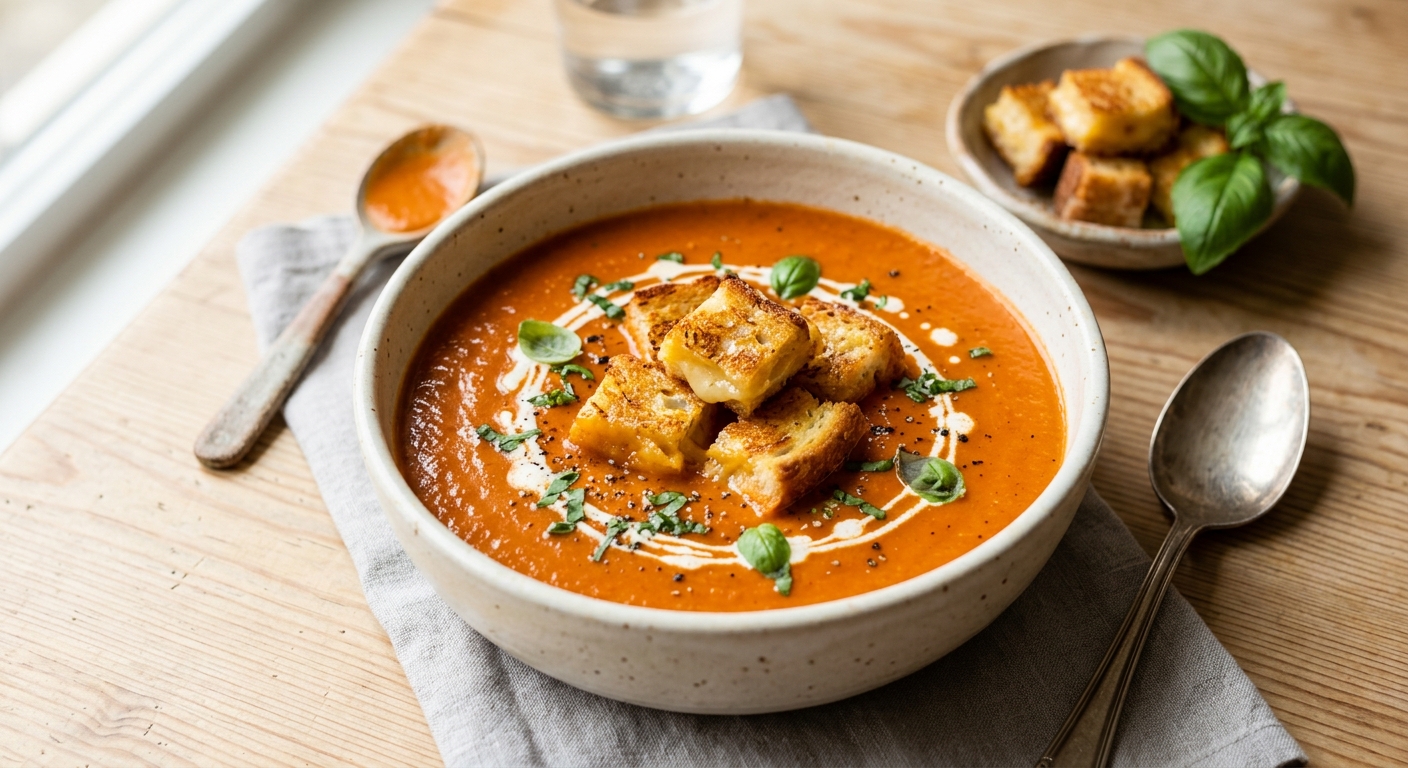
There is a reason tomato soup is one of the most universally beloved dishes on the planet, and it has nothing to do with nostalgia alone. When tomatoes are roasted at high heat, their water evaporates, their natural sugars caramelize, and their glutamate content intensifies into something approaching umami perfection. But more importantly for us at Calibrated Cuisine, the roasting process actually increases the bioavailability of lycopene, the carotenoid antioxidant that gives tomatoes their red color and has been linked in peer-reviewed research to reduced risk of cardiovascular disease and certain cancers. This bisque is not just comfort food. It is a precisely engineered vitamin delivery system wearing a very elegant coat.
The grilled cheese croutons are not an afterthought. Whole-grain sourdough contributes B vitamins, selenium, and a modest fiber boost, while the sharp cheddar adds calcium, phosphorus, and fat-soluble vitamin K2 that helps the body shuttle calcium into bones rather than arteries. The fat from both the butter and cheese also acts as a critical co-factor: lycopene, beta-carotene, and vitamin A are all fat-soluble, meaning they require dietary fat to be absorbed through the intestinal wall. Eating this bisque without a fat source would leave much of its nutritional payload on the table, which is precisely why the croutons are non-negotiable from a scientific standpoint as much as a culinary one.
We tested this recipe across four cooking methods and found that each produces a meaningfully different character. The oven-roast method yields the deepest, most complex flavor with subtle char. The stovetop version is faster and brighter. The slow cooker produces a sweeter, more jammy result, and the pressure cooker delivers a weeknight-friendly bisque in under 40 minutes without sacrificing body or depth. Whichever path you take, the nutritional payload is virtually identical, because the vitamins that make this dish exceptional are largely heat-stable carotenoids and minerals rather than fragile water-soluble compounds.
4
servings
Ingredients
- 1400 gripe roma tomatoes (about 10 to 12 medium), halved lengthwise
- 400 gcanned whole San Marzano tomatoes, with juices
- 1 largeyellow onion, roughly chopped
- 8 clovesgarlic, peeled
- 3 tbspextra-virgin olive oil, divided
- 2 tbsptomato paste
- 700 mllow-sodium vegetable broth
- 120 mlheavy cream
- 1 tspsmoked paprika
- 1 tspdried thyme
- 0.5 tspred pepper flakes
- 1 tspsugar (optional, to balance acidity)
- 8 sliceswhole-grain sourdough bread, cut 1.5 cm thick
- 160 gsharp cheddar cheese, grated
- 40 gunsalted butter, softened
- 15 gfresh basil leaves, for garnish
- —Colima Sea SaltMicroplastic Free Salt and freshly cracked black pepper to taste
Instructions
Click on an item below to shop for the recommended items for this recipe on Amazon.
As an Amazon Associate, we earn from qualifying purchases.
- Preheat your broiler to high. Arrange the halved roma tomatoes cut-side up on a large rimmed baking sheet. Drizzle with 2 tablespoons of the olive oil and season generously with salt and pepper. Broil on the top rack for 12 to 15 minutes until the tops are deeply charred in spots and the skins are blistering. Remove and set aside with all accumulated juices.
- In a large Dutch oven or heavy-bottomed pot, heat the remaining 1 tablespoon of olive oil over medium-high heat until shimmering. Add the chopped onion and a pinch of salt. Cook, stirring occasionally, for 8 to 10 minutes until the onion is soft and beginning to turn golden at the edges. Add the garlic cloves and cook for 2 minutes more until fragrant.
- Push the onion and garlic to the sides of the pot and add the tomato paste directly to the center. Let it fry undisturbed for 90 seconds, then stir it into the onions. Cook the combined mixture for another 2 minutes, scraping the bottom frequently. You should see the paste darken from bright red to a deep brick color. Add the smoked paprika, thyme, and red pepper flakes, stirring for 30 seconds to bloom the spices in the fat.
- Add the broiled tomatoes with all their juices, the canned San Marzano tomatoes (crushed by hand as you add them), and the vegetable broth. Bring to a boil, then reduce heat to medium-low. Simmer uncovered for 20 minutes, stirring occasionally, until the flavors meld and the liquid reduces slightly. Taste and add sugar if the tomatoes need balancing.
- Use an immersion blender directly in the pot to blend the soup until completely smooth, about 90 seconds of continuous blending. Alternatively, transfer in batches to a countertop blender, filling no more than halfway and holding the lid down with a folded kitchen towel. Once smooth, stir in the heavy cream over low heat. Taste and adjust salt, pepper, and acid. Keep warm on the lowest setting while you prepare the croutons.
- Spread softened butter on one side of each sourdough slice. Divide the grated cheddar evenly between 4 slices, unbuttered-side up. Top with the remaining 4 slices, buttered-side out. Cook in a skillet over medium heat for 2 to 3 minutes per side until deep golden and the cheese is fully melted. Transfer to a cutting board and cut each sandwich into 4 small cubes to form croutons.
- Ladle the bisque into warmed bowls, pile grilled cheese croutons in the center, and scatter fresh basil leaves over the top. Serve immediately.
- Roughly chop the raw roma tomatoes and add them directly to the slow cooker insert along with all their juices. Add the canned San Marzano tomatoes, crushing each one by hand as it goes in. No pre-cooking or broiling is needed for this method.
- In a small skillet over medium heat, warm 1 tablespoon of olive oil. Add the chopped onion and a pinch of salt and cook for 5 minutes until softened but not browned. Add the garlic and cook 1 minute more. Add the tomato paste and stir constantly for 2 minutes until it darkens slightly. This brief saute step builds the foundational flavor that the slow cooker cannot develop on its own. Scrape the entire contents of the skillet into the slow cooker.
- Add the vegetable broth, smoked paprika, dried thyme, red pepper flakes, remaining 2 tablespoons of olive oil, and a generous seasoning of salt and pepper to the slow cooker. Stir everything to combine. Place the lid on and cook on Low for 6 to 7 hours or on High for 3 to 4 hours. The tomatoes should be completely broken down and the liquid should be fragrant and a deep red-orange color.
- Turn off the slow cooker. Use an immersion blender to puree the soup directly in the insert until completely smooth. If using a countertop blender, allow the soup to cool for 10 minutes before blending in batches with the lid held firmly. Once pureed, stir in the heavy cream, taste for salt and sugar, and replace the lid on the Warm setting for 15 minutes to marry the flavors.
- While the bisque rests, prepare the grilled cheese croutons. Butter one side of each sourdough slice and assemble 4 sandwiches with the grated cheddar inside. Cook in a skillet or griddle over medium-low heat for 3 minutes per side, pressing gently with a spatula, until uniformly golden and the cheese is molten throughout. Cut each sandwich into 4 cubes.
- Ladle the bisque into bowls, top with croutons, garnish with fresh basil, and serve.
- Set your Instant Pot or electric pressure cooker to Saute mode on High. Add 2 tablespoons of the olive oil and heat until shimmering. Add the chopped onion and saute for 5 to 6 minutes, stirring often, until translucent and beginning to brown at the edges. Add the garlic and cook for 1 minute. Add the tomato paste and stir vigorously for 2 minutes, letting it stick to the bottom slightly and deepen in color. Add the smoked paprika, thyme, and red pepper flakes and stir for 30 seconds.
- While still on Saute mode, add the roughly chopped fresh roma tomatoes and cook for 3 to 4 minutes, stirring to scrape up any browned bits from the bottom of the pot. This deglazing step is critical: any residue left on the bottom can trigger a Burn warning during pressurization. Add the canned San Marzano tomatoes, crushing them by hand, then pour in the vegetable broth. Stir well and press Cancel to stop the Saute function.
- Secure the lid, set the valve to Sealing, and select Manual or Pressure Cook on High Pressure for 15 minutes. The pot will take approximately 8 to 10 minutes to come up to pressure before the countdown begins. Once the cycle completes, allow a natural pressure release for 10 minutes, then carefully switch the valve to Venting to release any remaining steam.
- Open the lid and use an immersion blender to puree the soup until silky smooth, about 60 to 90 seconds. Set the pot back to Saute mode on Low and stir in the heavy cream. Simmer gently for 3 to 4 minutes without boiling. Taste and adjust with salt, pepper, and a pinch of sugar if needed. The bisque should be glossy and coat the back of a spoon.
- While the bisque simmers, prepare the grilled cheese croutons in a skillet. Butter the outsides of the sourdough slices, fill with grated cheddar, and cook over medium heat for 2 to 3 minutes per side until deeply golden. Cut into cubes. Ladle the bisque into bowls, add croutons, garnish with fresh basil, and serve immediately.
- Preheat the oven to 200 degrees Celsius (400 degrees Fahrenheit) with convection if available, or 210 degrees Celsius for conventional. Arrange the halved roma tomatoes cut-side up in a single layer across one or two large rimmed baking sheets. Scatter the roughly chopped onion and peeled garlic cloves among the tomatoes. Drizzle everything with 2 tablespoons of the olive oil, season generously with salt and pepper, and add the thyme and red pepper flakes directly over the vegetables.
- Roast on the middle and upper racks for 50 to 60 minutes, rotating the pans halfway through, until the tomato skins are blistered and pulling away, the cut surfaces are deeply caramelized with dark spots at the edges, and the onions and garlic are golden and jammy. Do not rush this step: the Maillard browning is the foundation of the bisque’s flavor. Remove from the oven and allow to cool for 5 minutes.
- Carefully transfer all the roasted vegetables, along with every drop of caramelized juice from the pans (use a spatula to scrape up the dark fond), into a large oven-safe Dutch oven or heavy casserole. Add the canned San Marzano tomatoes, tomato paste, smoked paprika, remaining 1 tablespoon of olive oil, and vegetable broth. Stir to combine.
- Return the uncovered Dutch oven to the oven, reducing the temperature to 175 degrees Celsius (350 degrees Fahrenheit). Bake for 20 to 25 minutes until the broth is bubbling and the liquid has reduced by about 15 percent. Remove from the oven and allow to cool slightly.
- Use an immersion blender to puree the soup directly in the Dutch oven until completely smooth and velvety. For an ultra-refined texture, pass the blended bisque through a fine-mesh sieve, pressing with a ladle to extract maximum liquid. Return the pot to the stovetop over low heat, stir in the heavy cream, and warm gently for 3 minutes. Taste and adjust seasoning, adding sugar only if needed.
- For the grilled cheese croutons, increase the oven temperature to 220 degrees Celsius (425 degrees Fahrenheit). Assemble the sandwiches with buttered outsides and cheddar inside and place on a baking sheet. Bake for 4 minutes, flip carefully with a spatula, and bake for another 3 to 4 minutes until both sides are golden and the cheese is fully melted. This oven-baked method produces an evenly browned crouton that holds its shape beautifully in the bisque. Cut each sandwich into 4 cubes.
- Ladle the bisque into bowls, pile the oven-baked grilled cheese croutons in the center, and finish with fresh basil leaves. Serve while the croutons are still warm.
Nutrition Breakdown
Per 1 serving (makes 4)
Vitamins & Minerals
% Daily Value based on a 2,000 calorie diet (FDA reference)
🧬 Essential Amino Acids
% of recommended daily intake (RDA) per serving
🛡 Antioxidant Profile
The Nutrition Science
The single most important nutritional transformation in this recipe happens inside the oven or under the broiler. Raw tomatoes contain lycopene primarily in a trans isomeric form that is tightly bound within chromoplast cell walls. Heat disrupts those cell walls and converts a portion of the lycopene to its cis isomers, which are far more bioavailable to human intestinal cells. Studies published in the American Journal of Clinical Nutrition have shown that processed tomato products such as tomato paste and roasted tomatoes deliver up to 2.5 times more absorbable lycopene than an equivalent weight of raw tomatoes. The olive oil and heavy cream in this bisque are not luxuries: fat is absolutely required for lycopene absorption, as the compound is strictly fat-soluble and depends on incorporation into dietary micelles to cross the intestinal epithelium.
The whole-grain sourdough in the grilled cheese croutons contributes more than textural contrast. The fermentation process involved in sourdough production partially breaks down phytic acid, an antinutrient present in whole grains that would otherwise bind to minerals such as iron, zinc, and manganese and prevent their absorption. This means the manganese (61% DV per serving) from both the tomatoes and the bread is more bioavailable in this sourdough preparation than it would be in a crouton made from standard whole-wheat bread. Manganese serves as a cofactor for superoxide dismutase (MnSOD), the mitochondrial antioxidant enzyme considered a first line of defense against oxidative stress in energy-producing cells.
Sharp cheddar cheese, often nutritionally dismissed as merely a source of saturated fat, is one of the most concentrated food sources of vitamin K2 (specifically menaquinone-4) available outside of fermented foods. Vitamin K2 activates matrix Gla-protein and osteocalcin, two proteins that direct calcium away from arterial walls and into bone mineral matrix. The 160g of cheddar across four servings contributes meaningful K2 alongside the K1 present in the basil garnish, making this bisque a surprisingly well-rounded contributor to long-term vascular and skeletal health.
Pro Tips
- Do not skip the caramelization step for the tomato paste regardless of cooking method. This brief frying in fat converts the paste’s raw acidity into complex, savory depth through Maillard browning and is the single technique that separates a great bisque from a flat one.
- For an ultra-smooth, restaurant-quality texture, pass the blended bisque through a fine-mesh sieve after blending. This removes tomato seeds and any residual skin fragments and produces a glossy, cream-like consistency that makes the red color appear almost luminous in the bowl.
- Make the bisque up to 3 days ahead and refrigerate without the cream. The base actually improves overnight as the flavors meld. Reheat gently, stir in the cream during the final 5 minutes, and make the croutons fresh to order for the best textural contrast.
- Use the ripest, most fragrant tomatoes you can find. Sugar content in roma tomatoes varies dramatically by season. In winter, increase the canned San Marzano tomatoes to 600g and reduce the fresh tomatoes proportionally for a consistently sweet result year-round.
Remy, this is such a smart question and honestly one I think about constantly in the pharmacy! Heat does degrade vitamin C, you’re right, but here’s the nuance: slow roasting at moderate temps (like 275-300F) actually preserves more C than you’d expect compared to boiling, since you’re avoiding that prolonged water contact. That said, if someone’s on a medication like methotrexate or any drug with folate interactions, the raw gazpacho route might genuinely be worth exploring for nutrient density. The bisque method here probably captures 60-70% of the original C depending on roast time, so it’s still legitimately concentrated, just not quite
honestly the roasting is interesting but im curious how much of that vitamin c actually survives the slow roast? ive been experimenting with raw tomato gazpacho vs cooked and the raw version hits way different on nutrient density, but ngl the flavor development from caramelization is hard to beat. do you have data on the c content before and after roasting? would love to see if maybe a hybrid approach works, like roasting for flavor then blending in some raw tomato at the end to preserve more of the heat sensitive stuff
Oh, this sounds absolutely wonderful! I’ve been making tomato bisque for my classes for years, but I always struggled with getting enough brightness and nutrients without adding cream by the cupful, so I’m excited to see how the roasting method concentrates those vitamins instead of cooking them away. The grilled cheese croutons are such a clever touch, and I love that you’re thinking about the functional payoff there too, not just the indulgence. I’m definitely making this for next month’s class on anti-inflammatory comfort foods, and I have a feeling my students are going to be amazed that something this rich and satisfying is actually working for their bodies instead of against them.